


A Practical Guide to Key Agriculture Standards: Connectivity, Irrigation, and Sustainable Aquaculture
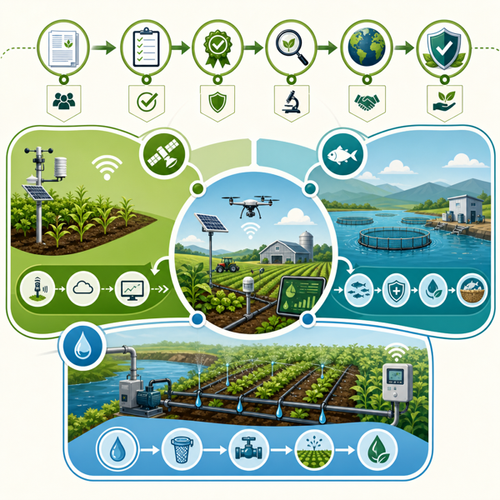
Modern agriculture faces unprecedented challenges and opportunities—from rapid technological advances and the realities of climate change to the need for feeding a growing global population sustainably. Internationally recognized standards offer a path forward, delivering a foundation for interoperability, efficient resource use, and improved productivity. This article explores three essential agriculture standards—ISO 11783-3:2026, ISO 24120-3:2025, and ISO 25247:2026—highlighting how they empower businesses to enhance efficiency, security, and scalability across farming operations and aquaculture.
Overview / Introduction
Agriculture today is more connected, complex, and technology-driven than ever before. From precision-guided tractors in vast crop fields to automated irrigation in greenhouses and advanced waste management in aquaculture, seamless data exchange, efficient water use, and environmental responsibility are key. Against this backdrop, international standards in agriculture are not just regulatory requirements—they are business multipliers that:
- Enable robust, data-driven operations
- Ensure interoperability and safety
- Drive productivity and resource savings
- Foster sustainable and scalable practices
In this guide, you will learn what each featured standard covers, why it matters for your work, and how following these guidelines positions your business for success in a competitive and evolving sector.
Detailed Standards Coverage
ISO 11783-3:2026 – Data Network Layers for Agricultural Machinery
Tractors and machinery for agriculture and forestry — Serial control and communications data network — Part 3: Application layer, transport layer and network layer
The ISO 11783-3:2026 standard is foundational to the digital transformation of modern farms. It specifies how tractors, implements, and other agricultural or forestry machinery communicate via a standard serial data network using the widely adopted Controller Area Network (CAN) protocol. This enables the safe, efficient, and real-time exchange of operational data between electronic control units (ECUs) from different vendors, accelerating the rise of precision agriculture.
Scope and Key Requirements:
- Defines the OSI model’s application, transport, and network layers for machine communications.
- Maps standardized messages to CAN data frames, ensuring compatibility between multiple manufacturers.
- Supports robust message routing, prioritization, multi-packet transfers, and error detection/correction.
- Specifies parameter group numbers (PGNs), protocol data units (PDUs), message formats, and network arbitration rules.
- Aligns with SAE J1939-21 for larger transport layer needs and extended messaging.
Who Should Comply:
- Manufacturers of tractors and agricultural machinery.
- Embedded systems engineers designing ECUs and CAN communications.
- Integrators of smart farming and connected equipment.
Practical Implications: By adhering to ISO 11783-3, manufacturers ensure their products will "speak the same digital language," allowing seamless integration of implements (e.g., mowers, balers, sprayers) with tractors, regardless of brand. This not only increases operational efficiency but also reduces downtime, improves diagnostics, and enables true plug-and-play interoperability in the field.
Notable Features:
- Assigned message priority for low latency and safety-critical data
- Support for multi-vendor, mixed-equipment environments
- Strong error detection and arbitration mechanisms for reliable communication
Key highlights:
- Standardized digital communications for agriculture and forestry machinery
- Enhanced operational security and performance through robust error handling
- Streamlined equipment management and maintenance via interoperable protocols
Access the full standard:View ISO 11783-3:2026 on iTeh Standards
ISO 24120-3:2025 – Guidelines for Pressurized Sprinkler Irrigation Systems
Agricultural irrigation equipment — Guidelines on the implementation of pressurized irrigation systems — Part 3: Sprinkler irrigation
Water scarcity and land management are among the most critical issues for global agriculture. ISO 24120-3:2025 offers comprehensive guidelines for the selection, design, installation, and maintenance of pressurized sprinkler, micro-sprinkler, and sprayer systems—whether for family farms, large commercial operations, or protected environments like greenhouses.
Scope and Application:
- Guidance on all aspects of pressurized irrigation except for center pivot, linear, and side roll systems.
- Applicability for both open-field and covered (e.g., greenhouse) agriculture, covering farms of all sizes.
Key Requirements and Specifications:
- Principles for choosing and sizing micro-sprinklers and sprayers tailored to crop, soil, and site-specific needs.
- Comprehensive design criteria for control heads, valves (manual, check, relief), and water meters to ensure precise flow and pressure management.
- Detailed instructions for selecting, installing, and maintaining pumps, filtration systems, and dosing units (for fertigation/chemigation).
- Emphasizes best practices in water management, including calculating application rates, distribution uniformity, pressure losses, and soil infiltration.
- Step-by-step installation and operational guidance to maximize system performance and minimize resource wastage.
Who Should Use It:
- Agriculture ministries and regulatory agencies
- Irrigation planners, engineers, consultants, and contractors
- Farmers and farm operators (small- to large-scale)
- Agronomists and extension professionals
Practical Implications: Implementing ISO 24120-3 enables farms to drastically reduce water usage while optimizing application rates and uniformity. It supports sustainable agriculture by maximizing yields, reducing fertilizer and chemical loan-off, lowering labor and maintenance costs, and ultimately helping farms to remain productive amid increasing water stress.
Notable Features:
- Stepwise methodology for system evaluation and troubleshooting
- Guidance on safe and efficient chemical/fertilizer delivery (fertigation and chemigation)
- Applicability to both emerging and established markets
Key highlights:
- Detailed best practices for modern sprinkler and micro-sprinkler irrigation
- Increased yield and water savings for sustainable agriculture
- Clear, stepwise guidance suitable for all farm sizes and structures
Access the full standard:View ISO 24120-3:2025 on iTeh Standards
ISO 25247:2026 – Sustainable Aquaculture Effluent Management
Treatment of aquaculture effluent in closed and semi-closed aquaculture systems — Principles, methods and guidance
As aquaculture production scales up globally, managing effluent is essential to protect water resources and surrounding ecosystems. ISO 25247:2026 establishes the framework for the reduction, treatment, and responsible discharge of effluent from closed and semi-closed aquaculture systems—covering both freshwater and seawater operations. The goal: support sustainable food production with minimal environmental impact.
Scope and Intended Users:
- Applicable to all closed and semi-closed aquaculture setups (ponds, tanks, recirculating systems)
- Relevant for fish, molluscs, crustaceans, and aquatic plant farming
- Not applicable to open aquaculture systems
Key Requirements and Guidance:
- Principles of ecological prioritization, source reduction, and stringent discharge control
- Best practices for minimizing effluent pollution and valorizing waste—supporting circular economy models within aquaculture
- Guidance for effluent treatment technologies (mechanical, biological, chemical) and discharge-specific monitoring requirements
- Control mechanisms and thresholds for nitrogen, phosphorus, and organic load
- Procedures for effluent sampling, water quality analysis, and documentation
Who Needs to Comply:
- Owners/operators of recirculating aquaculture facilities
- Aquaculture engineers, environmental managers, and site planners
- Regulatory bodies and policymakers overseeing greenhouse gas and pollution standards
Practical Implications: By following ISO 25247, aquaculture producers can significantly reduce the risk of water pollution, comply with local/international regulations, and demonstrate their commitment to sustainability. The standard helps protect biodiversity, optimize resource use, and ensure compliance with evolving environmental legislation.
Notable Features:
- Ecologically prioritized effluent reduction and discharge guidelines
- Flexible for both seawater and freshwater applications
- Strong focus on monitoring and continuous improvement
Key highlights:
- Enhanced environmental stewardship for rapidly growing aquaculture sector
- Reduced operating risks and enhanced compliance profile
- Standardized procedures for effluent assay and management
Access the full standard:View ISO 25247:2026 on iTeh Standards
Industry Impact & Compliance
The adoption of these standards drives measurable change across the agriculture and food production supply chain:
How Standards Affect Agriculture Businesses
- Productivity Gains: ISO 11783-3 connects machines for seamless operations and data-driven farming, while ISO 24120-3 and ISO 25247 help optimize use of water and nutrients.
- Risk Reduction: By following proven guidelines, businesses mitigate risks—from mechanical failures to water misuse and environmental fines.
- Consumer Trust: Demonstrating compliance with international standards signals quality and responsibility to buyers, regulators, and the broader public.
- Global Scalability: Standardization enables interoperability and replication across regions, supporting business expansion and market access.
Risks of Non-Compliance
- Potential loss of access to international markets
- Increased costs due to inefficiencies and regulatory penalties
- Negative impacts on brand reputation (e.g., from pollution incidents)
- Disrupted operational continuity due to system interoperability issues
Implementation Guidance
Common Implementation Approaches
- Assessment & Planning:
- Evaluate current equipment, processes, and compliance status
- Identify gaps relative to each standard’s requirements
- Training & Capacity Building:
- Educate operators, engineers, and maintenance staff on new procedures and monitoring needs
- System Upgrades & Integration:
- Deploy or retrofit equipment for networked operations (for ISO 11783-3)
- Redesign irrigation/injection systems or install advanced effluent treatment as required (for ISO 24120-3 and ISO 25247)
- Documentation & Ongoing Monitoring:
- Implement standardized recordkeeping and regular audits
- Monitor water, nutrient, and effluent metrics to ensure performance
Best Practices
- Engage with standard-setting organizations and stay updated on revisions
- Use pilot projects to test new approaches before widescale rollout
- Invest in digital solutions for monitoring, diagnostics, and reporting
- Foster a culture of continuous improvement for operational, environmental, and safety results
Resources for Organizations
- Technical manuals and implementation toolkits from standards bodies
- Training and consultancy support from approved iTeh Standards partners
- Online platforms for ongoing compliance management
Conclusion / Next Steps
In today’s dynamic agriculture sector, implementing international standards is more than a regulatory checkbox—it’s a core strategy for enhancing productivity, resource efficiency, and sustainable growth.
Key takeaways:
- ISO 11783-3 ensures data interoperability and secure digital communication between machines, essential for precision agriculture.
- ISO 24120-3 unlocks water savings and productivity through well-designed pressurized sprinkler systems and practical, universal guidelines.
- ISO 25247 empowers aquaculture operations to scale responsibly by reducing environmental impact and meeting rising regulatory demands.
Recommendations:
- Assess your operations in light of these standards, identify compliance gaps, and take concrete steps to implement best practices.
- Stay up to date with standard revisions and leverage professional guidance.
- Explore the iTeh Standards platform for additional support, guidance, and the latest updates on agriculture compliance and innovation.
By aligning your business with these internationally recognized standards, you’ll be well-positioned to thrive in a future where sustainability, productivity, and security are interconnected priorities.
https://standards.iteh.ai/catalog/standards/iso/226c6aaf-d32d-4406-abcd-74907700f2b8/iso-25247-2026
Categories
- Latest News
- New Arrivals
- Generalities
- Services and Management
- Natural Sciences
- Health Care
- Environment
- Metrology and Measurement
- Testing
- Mechanical Systems
- Fluid Systems
- Manufacturing
- Energy and Heat
- Electrical Engineering
- Electronics
- Telecommunications
- Information Technology
- Image Technology
- Precision Mechanics
- Road Vehicles
- Railway Engineering
- Shipbuilding
- Aircraft and Space
- Materials Handling
- Packaging
- Textile and Leather
- Clothing
- Agriculture
- Food technology
- Chemical Technology
- Mining and Minerals
- Petroleum
- Metallurgy
- Wood technology
- Glass and Ceramics
- Rubber and Plastics
- Paper Technology
- Paint Industries
- Construction
- Civil Engineering
- Military Engineering
- Entertainment