


Space Systems and Operations: Key International Standards for Safety, Cleanliness, Multipactor, and Procedure Languages
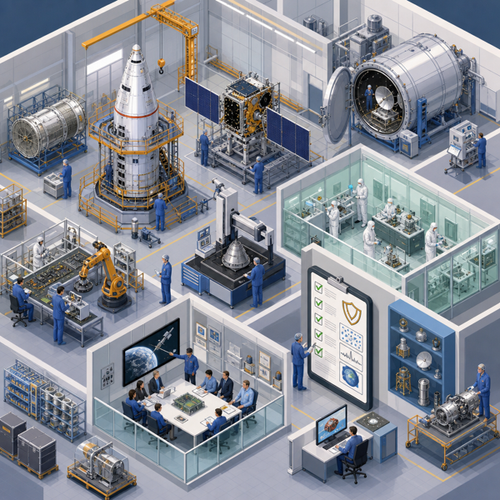
Space exploration and satellite technology are no longer exclusive to major space agencies. Today’s rapid advancements and the growth of the commercial space industry have made space systems and operations a dynamic sector open to both established companies and ambitious startups. Ensuring safe, reliable, and efficient space missions requires a solid framework—one built on internationally recognized standards. In this article, we delve into four critical standards that underpin modern space systems and operations, exploring how they shape missions, enhance productivity, enable scaling, and safeguard both people and assets.
Overview / Introduction
Space systems and operations encompass a broad set of activities, from the design and testing of spacecraft hardware to mission control and safety assurance. As the complexity of missions grows—driven by mega-constellations, deep-space probes, and commercial satellite launches—compliance with international standards has become essential. These standards foster interoperability, safety, and quality, helping companies deliver effective solutions while minimizing risks to personnel, assets, and the environment.
In this guide, we explore:
- The importance of formalized safety frameworks
- How preventing electrical breakdowns (multipactor) increases equipment reliability
- Why propulsion hardware cleanliness matters for mission longevity
- The power of unified languages for test and operational procedures
Implementing these standards enables organizations to:
- Streamline development cycles and facilitate supply chain interactions
- Reduce operational hazards and enhance mission assurance
- Scale more easily by leveraging proven practices
- Improve compliance with European and international regulations
Let’s unpack how each standard transforms aspects of space operations.
Detailed Standards Coverage
EN 16602-40:2018 – Space Product Assurance: Safety
Space product assurance - Safety
EN 16602-40:2018 sets the foundational framework for safety across all European space projects—spanning spacecraft, launch vehicles, ground support equipment, payloads, and even public spaces impacted by space operations. Its robust requirements address the entire project lifecycle, from initial risk assessments and program planning to safety audits, incident reporting, and the formal documentation of critical items.
What This Standard Covers
This standard’s primary objective is to protect:
- Flight and ground personnel
- Launch vehicles and payloads
- Ground support equipment
- The general public and private property
- The broader environment
It mandates a systematic safety program, including:
- Hazard identification and risk reduction
- Safety organization and management structure
- Safety-critical items tracking
- Incident investigation and lessons learned
- Regular safety reviews and audits
Key Requirements and Specifications
Key requirements include:
- Establishing a comprehensive, phase-driven safety program plan
- Ensuring safety managers have authority and access for audits
- Systematic risk assessments and documentation for all project stages
- Safety verification through analysis, inspection, and testing (see section 8)
- Special attention to human spaceflight, re-entry, and space debris mitigation
Who Should Comply
- All European space missions and projects
- Satellite manufacturers, component suppliers, launch service providers
- Ground facility operators and integration teams
- Subcontractors participating in the space supply chain
Practical Implications for Implementation
- Mandatory safety risk management as an embedded part of project planning
- Integration of safety considerations in design selection and manufacturing
- Conformity with European safety legislation and CE marking
- Enhanced assurance for both government and commercial missions
Notable Features/Requirements
- Harmonized with ECSS family of standards (including ECSS-M-ST-80 on risk management)
- Covers specialized domains: atmospheric re-entry, debris mitigation, human spaceflight
- Emphasis on continuous safety improvement and knowledge transfer
Key highlights:
- Protection across space and ground operations
- Risk-based approach, aligned with ECSS and EU regulations
- Mandatory for all phases of mission development and execution
Access the full standard:View EN 16602-40:2018 on iTeh Standards
EN 16603-20-01:2020 – Space Engineering: Multipactor, Design and Test
Space engineering - Multipactor, design and test
EN 16603-20-01:2020 addresses a highly technical—yet mission-critical—phenomenon: multipactor discharge within RF (radio frequency) satellite components. Multipactor is an avalanche effect that can rapidly damage RF hardware when electrons multiply uncontrollably under high vacuum and strong electric fields (common in satellite payloads).
What This Standard Covers
- Requirements to design and verify RF components to avoid multipactor breakdowns
- Applicable to all RF satellite components across frequency bands in space environments
- Includes both analysis- and test-based verification strategies
Key Requirements and Specifications
- Extensive verification planning (including custom verification plans for each program)
- Definition of qualification and acceptance margins for power thresholds to avoid breakdown
- Detailed guidelines on component classification (by material, geometry, and prior heritage)
- Describes test methods for single-carrier, pulse-modulated, and multi-carrier RF systems
- Requirements for secondary electron emission yield (SEY) testing and documentation
Who Should Comply
- Satellite/spacecraft system designers, especially those developing communication or radar subsystems
- RF component developers and equipment suppliers
- Payload integrators and satellite operators
Practical Implications for Implementation
- Extends equipment life and reliability by preventing sudden, catastrophic failures
- Requires integration of multipactor analysis early during RF component design
- Mandates use of up-to-date modeling and simulation tools for complex geometries/materials
- Ensures comprehensive validation—by both theoretical and practical (test) means
Notable Features/Requirements
- Supports verification under both cleanroom and operational environments
- Detailed documentation of multipactor test sequences, acceptance steps, and anomaly reporting
- Provides analysis margins and design/test requirements tailored for batch or individual units
Key highlights:
- Ensures multipactor-free operation in RF and microwave space equipment
- Supports both modeling-based and test-based hardware validation
- Improves mission robustness by targeting a mission-critical failure mode
Access the full standard:View EN 16603-20-01:2020 on iTeh Standards
EN 16603-35-06:2022 – Space Engineering: Cleanliness Requirements for Spacecraft Propulsion Hardware
Space engineering - Cleanliness requirements for spacecraft propulsion hardware
EN 16603-35-06:2022 is the reference for keeping spacecraft propulsion systems free from contamination. Even minute particles or residues can jeopardize propulsion system integrity, threatening both mission success and spacecraft safety. Maintaining specified cleanliness levels for propellant systems is essential—this standard formally defines how to design, clean, test, and verify propulsion hardware cleanliness.
What This Standard Covers
- Design requirements to facilitate cleaning of propulsion hardware (components, sub-systems, systems)
- Cleanliness level specifications (for allowable particulate, impurities, wetness)
- Cleaning process requirements and corresponding verification procedures
- Covers all commonly used propellant types (hydrazine, MMH, MON, nitrogen, helium, propane, butane, xenon)
- Guidance for both spacecraft and associated ground support equipment
Key Requirements and Specifications
- Cleanliness class definitions (particulate, non-volatile residue, dryness)
- Acceptance and verification test methods, including specific procedures for surface and internal fluid path cleaning
- Explicit packaging, handling, and environmental control criteria
- Deliverables: cleanliness analysis report, certificate of cleaning, verification data
- Compatibility checks for cleaning agents/processes relative to materials
Who Should Comply
- Spacecraft manufacturers and propulsion system integrators
- Subsystem suppliers, including tank, valve, and line manufacturers
- Test facility operators and contracted cleaning vendors
Practical Implications for Implementation
- Reduces risk of propulsion system malfunctions and improves mission success rates
- Streamlines assembly, integration, and test cycles by making cleanliness a managed, trackable attribute
- Facilitates sharing of clean, certified components across supply chain partners
- Aligns with ECSS and ISO standards for fluid system cleanliness
Notable Features/Requirements
- Applies specifically to spacecraft propulsion; complements broader material/process standards
- Includes procedures for field cleaning and handling out-of-facility (non-cleanroom) components
- Requires ongoing verification and documentation across manufacturing and integration
Key highlights:
- Reduces mission risks associated with propulsion system contamination
- Establishes strict, actionable cleanliness procedures and verification steps
- Supports industry-wide compatibility and traceability for critical hardware
Access the full standard:View EN 16603-35-06:2022 on iTeh Standards
EN 16603-70-32:2014 – Space Engineering: Test and Operations Procedure Language
Space engineering - Test and operations procedure language
EN 16603-70-32:2014 is all about process—specifically, how automated and manual procedures are defined, standardized, and communicated during satellite assembly, integration, testing, and on-orbit operation. Central to this standard is the “PLUTO” procedure language, a dedicated system designed to support robust mission control and system integration.
What This Standard Covers
- Capabilities, requirements, and syntax for procedure languages used across the space project lifecycle
- Definition of PLUTO (Procedure Language for Users in Test and Operations), the reference implementation
- Requirements for the language structure (procedures, steps, activities, watchdogs, confirmations)
- Contextualizes procedures for all main space system segments (space, ground, launch)
Key Requirements and Specifications
- Building blocks for procedure definition: preconditions, main/confirmation/watchdog bodies, step/activity organization
- Dynamic behavior definition (execution logic, contingencies, error handling)
- Explicit requirements for supporting engineering units, mathematical/time/string functions
- Formalized, machine- and human-readable syntax (based on extended Backus-Naur form)
- Procedure reusability for both test and operational scenarios, supporting automation and reduction of manual effort
Who Should Comply
- Space agencies, mission control centers, and spacecraft operators
- Contractors and suppliers developing test environments/logging systems
- Software teams responsible for ground support, AIV (Assembly, Integration, Verification), and mission automation
Practical Implications for Implementation
- Introduces consistency across test and operations, enabling greater automation
- Allows for rapid adaptation and re-use of procedures, streamlining repeat missions or satellite platforms
- Enhances safety and traceability through standardized execution and documentation
- Bridges the gap between engineering teams and operations, easing technology transfer
Notable Features/Requirements
- Rich, extensible language specification tailored for complex space system scenarios
- Features built-in support for contingency management and failure recovery
- Enables smooth transition from ground test to flight operation procedures
Key highlights:
- Standardizes development and automation of test and operation procedures
- Enables re-use and adaptation, accelerating project cycles
- Reduces errors by harmonizing process language across mission stages
Access the full standard:View EN 16603-70-32:2014 on iTeh Standards
Industry Impact & Compliance
The space sector is defined by its exceptionally high safety, reliability, and quality demands. Adopting these international standards delivers:
- Regulatory alignment: Meets European and global regulatory expectations, including CE marking and ECSS harmonization.
- Risk reduction: Systematic hazard analysis, multipactor prevention, and contamination control protect investments, lives, and property.
- Productivity and scaling: Standardized procedures and documentation streamline collaboration across teams, nations, and supply chains.
- Security and knowledge transfer: Documentation requirements and procedural languages enable rapid onboarding, incident learning, and long-term operational security.
- Competitive advantage: Demonstrated compliance opens business opportunities, particularly with government agencies and commercial launch partners.
Risks of non-compliance:
- Increased potential for mission failure or catastrophic breakdown
- Regulatory fines or loss of market access
- Reduced customer trust and reputational damage
Implementation Guidance
Common implementation approaches:
- Gap analysis: Compare current company processes against standards requirements.
- Integration planning: Embed standard requirements in engineering, testing, and operations plans.
- Staff training: Ensure all relevant teams understand requirements—especially safety practices, cleanliness protocols, and procedure language specifics.
- Documentation & traceability: Leverage the documentation templates (program plans, hazard logs, cleanliness certificates) recommended by each standard.
- Verification/validation: Adopt both analytical and test-based methods to confirm compliance (supported by EN 16603-20-01:2020 and EN 16603-35-06:2022).
- Continuous improvement: Record incidents, lessons learned, and process updates as required by EN 16602-40:2018.
Best Practices for Adoption:
- Start implementation early—in concept and design phases—not as an afterthought
- Select qualified suppliers and partners familiar with EN/ECSS standards
- Use automated tools for procedural language generation and test reporting
- Establish a culture of proactive safety and contamination control
- Participate in standards working groups to stay updated
Resources for Organizations:
- iTeh Standards platform: Authoritative source for latest documents
- Industry working groups and trade associations (ESA, ECSS user communities)
- Professional training and certification programs in safety, contamination control, and mission planning
Conclusion / Next Steps
International standards form the backbone of the new space economy. Standards like EN 16602-40:2018, EN 16603-20-01:2020, EN 16603-35-06:2022, and EN 16603-70-32:2014 transform risk management, efficiency, and innovation by turning lessons learned into actionable requirements. Today, more than ever, they are vital for companies aiming for productivity, security, and long-term growth in the competitive space sector.
Key takeaways:
- Adopting space engineering and operations standards boosts compliance, safety, and competitiveness.
- Standards make scaling and collaboration possible—across teams, nations, and supply chains.
- Proactive implementation reduces risk, prevents common failure modes, and aligns with industry best practices.
Next steps for organizations:
- Review your current practices against these four standards
- Explore the full suite of EN/ECSS/ISO standards via standards.iteh.ai
- Invest in staff training for standard-specific competencies
- Stay connected with standards organizations and industry groups
For detailed requirements, guidance, and official documentation, browse and purchase the latest space systems and operations standards at iTeh Standards. Stay current—stay compliant—lead the future of space with confidence.
Categories
- Latest News
- New Arrivals
- Generalities
- Services and Management
- Natural Sciences
- Health Care
- Environment
- Metrology and Measurement
- Testing
- Mechanical Systems
- Fluid Systems
- Manufacturing
- Energy and Heat
- Electrical Engineering
- Electronics
- Telecommunications
- Information Technology
- Image Technology
- Precision Mechanics
- Road Vehicles
- Railway Engineering
- Shipbuilding
- Aircraft and Space
- Materials Handling
- Packaging
- Textile and Leather
- Clothing
- Agriculture
- Food technology
- Chemical Technology
- Mining and Minerals
- Petroleum
- Metallurgy
- Wood technology
- Glass and Ceramics
- Rubber and Plastics
- Paper Technology
- Paint Industries
- Construction
- Civil Engineering
- Military Engineering
- Entertainment