


Space Systems and Operations Standards: Boosting Innovation, Safety, and Sustainability in Aerospace
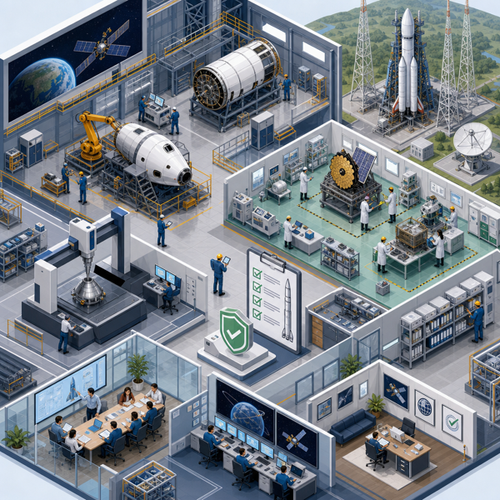
Space Systems and Operations Standards: Boosting Innovation, Safety, and Sustainability in Aerospace
As humanity’s ambitions in space grow rapidly, the need for robust, universally accepted space engineering standards has never been greater. From designing the microelectronics powering spacecraft to ensuring orbital sustainability and managing complex, safety-critical projects, these international standards shape every stage of the space mission lifecycle. This article reviews four foundational standards—spanning ASIC, FPGA and IP Core engineering, space debris mitigation, and program management for dependability and reliability—demonstrating how strategic compliance not only increases productivity, security, and scaling but is growing indispensable as new technologies become mainstream for businesses entering the space sector.
Overview of Space Systems and Operations Standards
Space exploration and satellite infrastructure have evolved from specialist ambitions to high-impact commercial and scientific ventures. As more governments and private companies deploy satellites, launch spacecraft, or enter space-related industries, consistent technical guidelines—space systems and operations standards—are pivotal.
These standards:
- Define technical requirements, engineering processes, and best practices for hardware and software used in space.
- Provide frameworks for sustainability, safety, and dependability, particularly in sensitive domains like microelectronics or orbital debris management.
- Help organizations scale operations, improve interoperability, and manage risk effectively.
Why are these standards essential today?
- The complexity of modern aerospace projects requires harmonized approaches across technologies and borders.
- Implementing and adhering to international standards supports innovation by enabling companies to integrate new technologies with proven reliability and safety.
- For businesses, standards compliance is key to access global supply chains, satisfy regulatory expectations, and reduce operational risks—making them a competitive must, not just an option.
In the following sections, we break down each standard, its core requirements, and how it impacts today’s aerospace sector.
Detailed Standards Coverage
EN 16603-20-40:2023 – Engineering Excellence for ASIC, FPGA and IP Cores in Space
Space engineering – ASIC, FPGA and IP Core engineering
EN 16603-20-40:2023 establishes comprehensive requirements for engineering application-specific integrated circuits (ASICs), field programmable gate arrays (FPGAs), and Intellectual Property (IP) cores—collectively called “DEVICEs”—destined for use in space missions. This standard supersedes previous guidance by integrating end-to-end requirements, from initial concept through design, verification, production, validation, and qualification.
Scope and Applicability
- Sets the baseline for engineering digital, analogue, and mixed-signal custom integrated circuits used in spacecraft, satellites, and launch vehicles.
- Distinguishes workflows for ASICs, FPGAs (across SRAM, FLASH, anti-fuse technology types), and system-on-chip devices with embedded processor cores requiring software-hardware co-design.
- Describes a staged development process: Definition → Architectural Design → Detailed Design → Physical Implementation → Validation and Qualification.
Key Requirements
- DEVICE Development Plan: Mandates creation of a tailored development plan assessing criticality, defining project-phased reviews, risk assessments, and documentation requirements (such as DEVICE Requirements Specification, Verification and Validation Plans).
- Verification and Validation: Requires thorough testing, including pre-tailing for device type, risk-based verification processes, and detailed phase reviews to ensure mission-critical reliability.
- Lifecycle Support: Details expectations for support, maintenance plans, and experience documentation for reproducibility and lessons learned.
Who Should Use This Standard?
- Satellite designers, spacecraft manufacturers, and suppliers of space-grade microelectronics.
- Organizations developing or procuring high-reliability ASICs, FPGAs, or IP cores for space applications.
Practical Implementation
- Supports parallel or modular hardware and software co-design—critical for modern SoC devices operating with complex software dependencies.
- Encourages reuse of qualified IP blocks to accelerate new developments while retaining validation rigor.
- Provides industry-recognized outputs: DEVICE development plans, validation and verification reports, data sheets, and test documentation.
Key highlights:
- Tailored device criticality and workflow management
- Emphasizes traceability, risk-based engineering, and documentation
- Aligns with ESCC qualification pathways for European space components
Access the full standard:View EN 16603-20-40:2023 on iTeh Standards
EN 16604-10:2023 – Ensuring Sustainable Orbits: Space Debris Mitigation Requirements
Space sustainability – Space debris mitigation requirements (ISO 24113:2023, modified)
The proliferation of non-functional satellites and fragments—space debris—poses increasing hazards to both manned and unmanned space assets. EN 16604-10:2023 adapts and modifies the latest ISO 24113 guidelines to address this by setting high-level, globally harmonized requirements for space debris mitigation.
Scope and Applicability
- Applicable to all unmanned systems (satellites, launch vehicle stages, mission-related debris) that are launched into, or transit, near-Earth space.
- Focuses on the protected regions of Low Earth Orbit (LEO) and Geostationary Orbit (GEO)—the zones most critical to the sustainability of space activities and international safety.
Key Requirements
- Prohibits intentional debris release: Bans routine, avoidable release of debris during normal activities (such as separation, deployment, or stage jettison).
- Requires energy passivation: Mandates safe depletion of stored energy in spacecraft or upper stages at end-of-life to prevent accidental explosions.
- Post-mission Disposal: Dictates active removal or controlled re-entry of non-operational spacecraft and stages—either de-orbiting objects from LEO within 25 years, or maneuvering beyond GEO protected region—minimizing long-term orbital clutter.
- Debris Mitigation Planning: Calls for comprehensive mission-specific debris mitigation plans to be submitted to regulatory bodies or licensing authorities prior to launch.
- Break-up Avoidance: Outlines measures to monitor and control accidental break-up risks (collisions, failures, structural degradations).
Who Should Use This Standard?
- All satellite operators, launch service providers, and organizations involved in unmanned spacecraft missions.
- Regulatory, licensing, and governmental organizations tasked with authorizing, monitoring, or guiding spaceflight activities.
Practical Implementation
- Drives the adoption of mission lifecycle checks, design-for-demise approaches, and de-orbit technologies.
- Ensures new launches comply with international sustainability norms and so avoid future legal or insurance complications.
- Increasingly mandated by national and international licensing authorities for any new space mission.
Key highlights:
- Transform UN treaties and IADC guidelines into enforceable engineering requirements
- Reduces collision and casualty risk, protecting mission assets and public safety
- Provides sustainability benchmarking for corporate and national space programs
Access the full standard:View EN 16604-10:2023 on iTeh Standards
EN 9227-1:2025 – Aerospace Programme Management: Dependability and Safety Control
Aerospace series – Programme management – Part 1: Guide to dependability and safety control
EN 9227-1:2025 provides structured guidance for integrating Reliability, Availability, Maintainability, and Safety (RAMS) principles into aerospace project management. Focusing on both product construction and organizational processes, this standard ensures dependable and safe outcomes across the entire lifecycle of aircraft and space systems.
Scope and Applicability
- Establishes a systematic approach for RAMS definition, monitoring, and improvement throughout a program’s lifecycle—from concept, through design, manufacturing, operation, and disposal.
- Addresses both hardware and software, and is applicable for all projects with customer/supplier relationships.
- Acts as a foundation for developing RAMS plans, including objectives, resource allocation, risk control, and reporting.
Key Requirements
- RAMS Planning: Defines roles for both customers and suppliers, requiring each to contribute and escalate RAMS information throughout program execution.
- Risk Identification and Control: Mandates processes for technical risk analysis, prioritization, mitigation, and acceptance—ensuring that unacceptable risks are addressed through robust engineering and management action.
- Lifecycle Integration: Requires RAMS to be embedded from feasibility phase through operational and disposal phases, enabling consistent safety and reliability assurance.
- Documentation and Digital Continuity: Prescribes thorough documentation and integration with digital tools for RAMS traceability and growth tracking.
Who Should Use This Standard?
- Programme managers, systems engineers, and quality assurance professionals in the aerospace sector.
- Project teams seeking to mature their approach to dependability and risk management, or required by contracts to demonstrate safety control.
Practical Implementation
- Promotes negotiation and collaboration between all levels of supply chain, with tasks clearly allocated and escalated as projects evolve.
- Recommends interfaces with other critical processes such as quality assurance, security (including cybersecurity), system engineering, and logistics.
- Offers example RAMS plan templates and typical task breakdowns for immediate adoption and customization.
Key highlights:
- Lifecycle-wide risk and dependability management
- Real-world guidance for both customers and suppliers
- Digital tools and process integration for traceable, scalable safety assurance
Access the full standard:View EN 9227-1:2025 on iTeh Standards
EN 9227-2:2025 – Aerospace Programme Management: Reliability Control Guide
Aerospace series – Programme management – Part 2: Guide for reliability control
EN 9227-2:2025 complements EN 9227-1 by providing targeted methods for reliability construction and management in aerospace and space projects. This standard outlines technical, analytical, and management tasks required to guarantee products perform reliably in even the harshest environments and under mission-specific constraints.
Scope and Applicability
- Applies to all space, aeronautical, and defense programs—at every phase of the product lifecycle.
- Spans all product elements: hardware, software, components, sub-systems, manufacturing, and support processes.
Key Requirements
- Reliability Goals and Allocations: Requires organizations to define, allocate, and budget for reliability objectives, using operational goals, environmental profiles, and risk assessments.
- Reliability Prediction and Analysis: Advocates the use of predictive modeling, failure mode and effect criticality analysis (FMECA), risk analysis, use of historical data, and reliability growth tracking.
- Testing and Demonstration: Outlines phased testing strategies (characterization, reliability growth, demonstration in series production) with clear metrics and corrective action loops (FRACAS).
- Integrated Reliability Plan: Mandates a reliability program plan covering management, analysis, modeling, testing, assurance, and continual improvement.
Who Should Use This Standard?
- Program directors, reliability engineers, design and manufacturing teams across the aerospace and defense supply chain.
- Organizations required to meet stringent reliability metrics for mission success and contractual compliance.
Practical Implementation
- Encourages early integration of reliability into all stages of design, with feedback from operational experience driving continual improvement.
- Supports digital and data-driven reliability processes for modern, interconnected aerospace supply chains.
- Enables transparent communication of reliability performance up and down the value chain, essential for risk sharing and mitigation.
Key highlights:
- Comprehensive reliability engineering framework
- Predictive, data-driven analysis and feedback
- Applies to system, subsystem, and organizational processes
Access the full standard:View EN 9227-2:2025 on iTeh Standards
Industry Impact & Compliance
Transforming Business with Space Systems Standards
In the era of “NewSpace” and globalized satellite communications, adherence to internationally recognized standards in space systems and operations is more than compliance—it’s a business enabler.
Compliance Considerations
- Contractual: Major agencies (e.g., ESA, NASA) require standards compliance for supplier qualification or project participation.
- Regulatory: Increasingly, national laws reference space debris, reliability, and safety standards for licensing launches or satellite operations.
- Insurance & Liability: Non-compliance can render projects uninsurable, or drastically increase premiums due to heightened risks.
Benefits of Adopting These Standards
- Increased Productivity & Scalability: Structured processes and clear requirements drive efficient, repeatable development and allow business scaling across multiple projects with confidence.
- Enhanced Security & Safety: Robust engineering and RAMS management mitigate mission-critical failures, preventing loss of assets, data, or human life.
- Cost Control: Early risk identification and standardized verification processes reduce costly late-stage design corrections or mission failures.
- Sustainability & Reputation: Organizations demonstrating commitment to debris mitigation, safety, and reliability enhance their standing with regulators and partners.
- Market Access: Globally accepted standards provide the technical passport for suppliers, enabling participation in multi-national programs and value chains.
Risks of Non-Compliance
- Regulatory rejection (license denial, mission delays)
- Increased operational, reputational, and financial risk
- Legal liability for damages caused by debris or safety lapses
- Isolation from collaborative projects and supply chains
Implementation Guidance
Common Approaches for Space Standard Adoption
- Gap Analysis: Assess current processes against standard requirements; identify and prioritize gaps.
- Integrated Management Systems: Embed standards-based requirements into existing quality, safety, and engineering management systems.
- Phased Training & Capability Building: Train cross-functional teams in both the technical and process aspects of relevant standards.
- Supplier and Partner Engagement: Ensure sub-suppliers and partners also adhere to standards, using traceable documentation and digital tools.
- Continuous Feedback & Improvement: Use operational data, lessons learned, and incident reports to refine processes and improve compliance continually.
Best Practices for Successful Standards Implementation
- Early Adoption: Start standards integration during project planning—not retroactively after design freezes or launch contracts.
- Cross-functional Collaboration: Involve all stakeholders, from engineering to risk management, in standards interpretation and process design.
- Documentation, Digitalization, and Traceability: Maintain comprehensive digital records for design, testing, reviews, and RAMS activities, ensuring organizational learning and knowledge inheritance.
- Customization (Tailoring): Use the tailoring options provided by the standards to balance rigor, program-specific needs, and cost—while protecting mission safety and reliability.
- Stay Updated: Monitor standards updates and amendments—requirements evolve as technology and space sector best practices change.
Resources for Organizations
- Official standards bodies (e.g., CEN, ISO, ECSS, ASD-STAN)
- iTeh Standards Platform (https://standards.iteh.ai) for document access, comparison, and updates
- Training and consulting services specializing in aerospace compliance
Conclusion and Next Steps
Space is no longer the domain of a select few nations or agencies—it is a dynamic, expanding frontier fueling communications, science, and commerce. For businesses and governmental organizations looking to innovate, scale, and safeguard their missions, the four international standards profiled here are indispensable guides:
- EN 16603-20-40: advanced engineering for the microelectronics powering modern spacecraft
- EN 16604-10: sustainable space operations through debris mitigation
- EN 9227-1: program-wide dependability and safety control
- EN 9227-2: rigorous reliability construction and management
Their adoption streamlines technology integrations, secures operational risks, and meets escalating demands for collaboration, sustainability, and efficiency.
Key takeaways:
- Implementing these standards is a business necessity for aerospace sector competitiveness, resilience, and compliance.
- Strategic standards adoption drives productivity, security, and capability to scale operations in the face of rapid technological change.
- iTeh Standards is your resource for timely, official documents and up-to-date best practices for the aerospace industry.
Recommendation:
- Review your products, programs, and partners for compliance readiness.
- Explore each standard more deeply and access their full content for tailored guidance.
- Stay ahead: revisit your compliance status regularly and invest in standards-based training for your team.
Explore the standards, gain a competitive edge, and future-proof your operations with trusted information from iTeh Standards!
Categories
- Latest News
- New Arrivals
- Generalities
- Services and Management
- Natural Sciences
- Health Care
- Environment
- Metrology and Measurement
- Testing
- Mechanical Systems
- Fluid Systems
- Manufacturing
- Energy and Heat
- Electrical Engineering
- Electronics
- Telecommunications
- Information Technology
- Image Technology
- Precision Mechanics
- Road Vehicles
- Railway Engineering
- Shipbuilding
- Aircraft and Space
- Materials Handling
- Packaging
- Textile and Leather
- Clothing
- Agriculture
- Food technology
- Chemical Technology
- Mining and Minerals
- Petroleum
- Metallurgy
- Wood technology
- Glass and Ceramics
- Rubber and Plastics
- Paper Technology
- Paint Industries
- Construction
- Civil Engineering
- Military Engineering
- Entertainment