


August 2026: Essential Updates to Electrical Engineering Standards (Part 2)
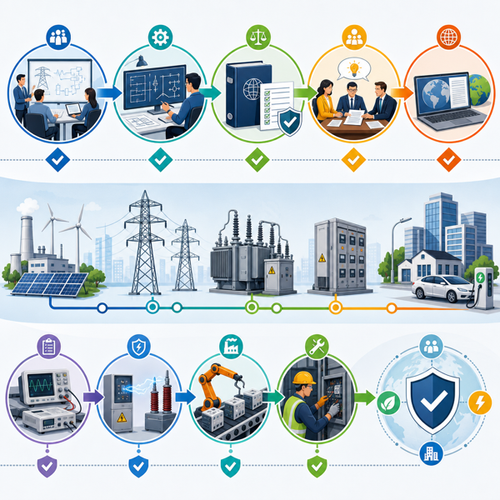
Electrical engineering professionals face a rapidly evolving landscape of safety, reliability, and performance requirements. In August 2026, five key international standards have been published, addressing internal arc-fault protection, advanced battery technologies, vital lightning protection system components, and precise diagnostic methods for winding wires. These standards, issued by IEC and CLC, reflect the industry's ongoing commitment to personnel safety, operational efficiency, and reliable system performance. As regulatory environments and technology benchmarks change, staying informed on these updates is essential for compliance and competitive advantage.
Overview / Introduction
The electrical engineering sector underpins critical infrastructure, manufacturing, transport, and emerging technologies worldwide. Adhering to up-to-date standards is vital for ensuring product safety, efficient system integration, and robust risk management. This comprehensive article explores five recently published standards, released in August 2026, providing insight into their scope, requirements, and industry impact. This is the second part of a three-part series, aiming to deliver essential information for industry professionals, quality managers, compliance officers, engineers, and researchers.
By reading this article, you will:
- Learn about new and revised requirements for key electrical assemblies and components
- Gain practical guidance for compliance and risk mitigation
- Discover best practices for implementation, testing, and certification
Detailed Standards Coverage
IEC TS 61641:2026 - Internal Arc-Fault Protection for Low-Voltage Switchgear Assemblies
Low-voltage switchgear and controlgear assemblies – Internal arc-fault protection of low-voltage switchgear and controlgear assemblies in accordance with the IEC 61439 series
IEC TS 61641:2026 defines comprehensive methods for verifying the ability of low-voltage switchgear and controlgear assemblies to limit injury risk to personnel and prevent excessive damage during internal arc-faults. The specification also aims to maximize power availability post-incident. The scope covers assessment of overpressure effects, thermal hazards, ejection of hot particles, and functional performance of integrated arc protection systems (IAMS).
The standard introduces classifications for arcing class zones and differentiates between macro (installation area) and micro-environment (internal zones). Assemblies are now required to offer clear documentation, designation marking, and structured maintenance guidelines. Significant technical advantages are gained from both passive (mechanical) and active (integrated detection and suppression) protection measures. Changes from previous editions include refined terminology, reorganization around protection zones, and bifurcated classification levels for assembly protection.
Key highlights:
- Two-tier protection classification for assemblies (zones and areas)
- Updated requirements for passive vs. active arc-fault mitigation
- Detailed verification methods (testing, documentation, comparison)
Access the full standard:View IEC TS 61641:2026 on iTeh Standards
FprEN IEC 60622:2026 - Sealed Nickel-Cadmium Prismatic Rechargeable Cells and Batteries
Secondary cells and batteries containing alkaline or other non-acid electrolytes – Sealed nickel-cadmium prismatic rechargeable cells and batteries for use in industrial applications
FprEN IEC 60622:2026 provides rigorous requirements for sealed nickel-cadmium (NiCd) prismatic cells and batteries, targeting high-demand industrial environments such as backup power systems, UPS, telecommunications, and automation control. The standard outlines designation, marking, charging procedures, and battery structure definitions. Test protocols cover electrical performance—like discharge characteristics at various temperatures, endurance in cycles, overcharge, and safety device operation. Mechanical tests, environmental durability, and shelf-life assessments ensure suitability for harsh operational contexts.
Manufacturers and system integrators must comply with detailed documentation requirements, mandatory marking, and acceptance conditions for type and batch approval. Improved specifications around cell structure, safety recommendations, and battery management facilitate longer service life and enhanced reliability under diverse conditions.
Key highlights:
- Standardized testing for charge/discharge, endurance, and safety features
- Battery structure, operating range, and durability enhancements
- Mandatory marking and robust performance verification
Access the full standard:View FprEN IEC 60622:2026 on iTeh Standards
FprEN IEC 62259:2026 - Nickel-Cadmium Prismatic Cells with Partial Gas Recombination
Secondary cells and batteries containing alkaline or other non-acid electrolytes – Nickel-cadmium prismatic rechargeable cells with partial gas recombination and batteries for use in industrial applications
This standard focuses on nickel-cadmium (NiCd) prismatic cells featuring partial gas recombination — a design that minimizes maintenance and gas emissions during charging and cycling. Industrial users benefit from increased environmental compatibility and enhanced operational safety. FprEN IEC 62259:2026 establishes precise electrical test requirements (discharge at multiple temperatures, high-rate current, pulse power, DC resistance, and constant power), mechanical durability, venting procedures, electrolyte retention, and lifecycle endurance.
The document also clarifies performance assessment for battery systems, including energy and power determination, capacity sizing, deep discharge protection, and end-of-life criteria. Specialized test methods for partial gas recombination efficiency support regulatory and safety compliance in critical industrial backup and utility applications.
Key highlights:
- In-depth procedures for testing gas recombination efficiency
- Enhanced discharge, endurance, and lifetime evaluation methods
- Safety measures for minimized venting and controlled battery aging
Access the full standard:View FprEN IEC 62259:2026 on iTeh Standards
EN IEC 62561-8:2026 - Electrically Insulated Lightning Protection System Components
Lightning protection system components (LPSC) – Part 8: Requirements for components for electrically insulated LPS
EN IEC 62561-8:2026 delivers the definitive requirements and validation tests for components used in electrically insulated lightning protection systems (LPS). Covered components—such as insulating stand-offs and down-conductors—help maintain mandated separation distances, avoid flashovers, and boost protection for sensitive structures such as data centers, petrochemical plants, and hospitals.
Major revisions for 2026 include updated test methodologies for salt mist (conforming to IEC 60068-2-52:2017), humid sulfurous atmospheres (ISO 22479:2019), pull-out resistance, electrical impulse testing (with both positive and negative polarity), and tolerance for environmental pollution. Type testing, marking, mechanical robustness, and EMC are mandated. New annexes provide alternative test arrangements and guidance on assessing the influence of different installation arrangements on performance.
Key highlights:
- Expanded corrosion, UV, and high voltage impulse testing schemes
- Refined pass criteria for high-voltage impulse and pollution resistance
- Installation arrangement testing and comprehensive EMC requirements
Access the full standard:View EN IEC 62561-8:2026 on iTeh Standards
IEC 60851-5:2026 - Test Methods for Winding Wires: Electrical Properties
Winding wires – Test methods – Part 5: Electrical properties
IEC 60851-5:2026 lays out rigorous test methods for evaluating the electrical properties of winding wires essential in transformers, motors, and generators. The fifth edition updates procedures for electrical resistance, dielectric breakdown voltage (with expanded conductor size ranges), insulation continuity (including in-line testing for rectangular wires), dielectric dissipation factor, and pinhole detection.
Critical advances in this edition address new requirements for testing fully insulated and rectangular-section wires. The framework ensures wire manufacturers, test labs, and OEMs have benchmark methods to validate quality, safety, and compliance. Accurate and reliable electrical measurement underpins the safe, efficient operation of electrical machinery in demanding industrial and utility settings.
Key highlights:
- Expanded dielectric breakdown testing for large and small wires
- New in-line continuity test methods for rectangular sections
- Comprehensive assessment of resistance, insulation, and quality metrics
Access the full standard:View IEC 60851-5:2026 on iTeh Standards
Industry Impact & Compliance
These 2026 standards introduce updated requirements that impact the design, manufacturing, installation, and maintenance of key electrical components and systems. Organizations supplying low-voltage assemblies, batteries, lightning protection systems, and winding wires must revisit their design verification processes and product testing regimes. The changes support:
- Enhanced safety for personnel, property, and critical infrastructure
- Improved equipment reliability, energy efficiency, and risk mitigation
- Streamlined compliance with international and regional regulations
Timely compliance is vital. Many standards require immediate integration for new product design, while existing equipment may require retroactive verification and documentation. Professional training and revision of quality assurance protocols are recommended to ensure ongoing adherence and optimal market access.
Benefits include:
- Lower liability exposure and operational risk
- Demonstrable commitment to global quality benchmarks
- Increased customer confidence and market competitiveness
Risks of non-compliance include failing external audits, product recalls, regulatory penalties, and diminished reputation.
Technical Insights
Several core themes unite these standards:
Rigorous Verification and Documentation: Comprehensive type, batch, and routine verification methods, including specified marking and operational documentation, support transparent compliance.
Advanced Test Techniques: Enhanced electrical measurement (e.g., breakdown voltage, dissipation factor), complex endurance cycling, and environmental testing represent the new baseline.
Integration of Passive and Active Protection: Both mechanical (passive) and system-integrated (active) protection methods are promoted in arc-fault and lightning protection assemblies.
Long-term Performance and Safety: End-of-life performance, recombination efficiency, and controlled venting are essential for batteries, ensuring safe operation over extended service periods.
Implementation best practices:
- Early incorporation of updated requirements in product development cycles
- Proactive staff training on new compliance, test, and documentation mandates
- Engaging accredited third-party labs for independent type and batch testing
- Maintaining a robust evidence trail for market and regulatory audits
- Regular review of product markings, labels, and user documentation per latest standards
Testing and certification:
- Utilize accredited laboratories and state-of-the-art instrumentation for measurement, endurance, and environmental tests
- Adopt periodic re-evaluation and recertification cycles for critical products to maintain compliance
- Stay abreast of emerging testing methods and digital reporting tools recommended within new standards
Conclusion / Next Steps
Electrical engineering organizations must act swiftly to leverage the benefits and ensure compliance with these pivotal standards released in August 2026. Key takeaways include:
- Proactive compliance supports safety, operational excellence, and access to international markets
- Enhanced documentation and verification are central to modern quality assurance
- Technical upgrades—ranging from improved arc-fault prevention to advanced battery testing—offer competitive advantages
Recommendations:
- Assess current products and processes against the new standards
- Introduce staff training and process updates reflecting the latest requirements
- Utilize the provided iTeh Standards links to access, purchase, and integrate these standards into your QMS
Stay informed and ready for future updates by subscribing to standards notifications and participating in industry forums. Explore the full collection of August 2026 releases at iTeh Standards and ensure your organization is ahead in the evolving landscape of electrical engineering.
Categories
- Latest News
- New Arrivals
- Generalities
- Services and Management
- Natural Sciences
- Health Care
- Environment
- Metrology and Measurement
- Testing
- Mechanical Systems
- Fluid Systems
- Manufacturing
- Energy and Heat
- Electrical Engineering
- Electronics
- Telecommunications
- Information Technology
- Image Technology
- Precision Mechanics
- Road Vehicles
- Railway Engineering
- Shipbuilding
- Aircraft and Space
- Materials Handling
- Packaging
- Textile and Leather
- Clothing
- Agriculture
- Food technology
- Chemical Technology
- Mining and Minerals
- Petroleum
- Metallurgy
- Wood technology
- Glass and Ceramics
- Rubber and Plastics
- Paper Technology
- Paint Industries
- Construction
- Civil Engineering
- Military Engineering
- Entertainment