

Understanding High Voltage Switchgear and Controlgear Standards: A Practical Guide for Modern Electrical Systems
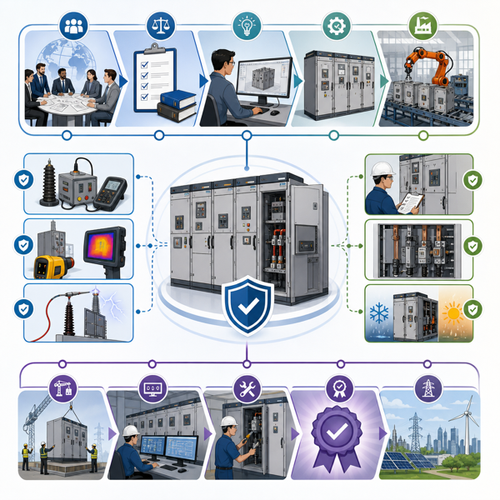
High-voltage switchgear and controlgear form the backbone of safe, reliable, and efficient electrical power systems across industries worldwide. As electrical grids and distribution networks modernize—embracing digital transformation, distributed energy, smart grids, and the challenges of electrification—adherence to the latest international standards becomes critical for every stakeholder. This article provides an accessible yet detailed look at four pivotal IEC standards shaping the future of high voltage switchgear and controlgear. These standards guide electromagnetic field evaluation, catalog data interoperability, digital technology adoption, and DC circuit-breaker deployment, empowering organizations to enhance safety, streamline operations, and unlock scalability in an increasingly complex energy environment.
Overview / Introduction
High voltage switchgear and controlgear are essential for the protection and management of electrical power systems—whether it’s in utilities, industrial sites, or infrastructure projects. Standards from the International Electrotechnical Commission (IEC) provide the definitive requirements and methodologies for product performance, safety, interoperability, and digital integration. In this guide, we demystify four leading IEC standards for high voltage applications:
- IEC 62271-208:2025 covers methods for measuring and quantifying electromagnetic fields around HV assemblies and substations.
- IEC TR 62271-321:2026 provides a reference for consistent product data and information exchange (catalogue data) across manufacturers and operators.
- IEC TR 62271-322:2026 focuses on integrating digital technologies—from IoT to AI—within the life cycle of switchgear and controlgear.
- IEC TS 62271-313:2025 specializes in requirements and testing for direct current (DC) circuit-breakers operating at 100 kV and above.
For businesses implementing new energy technologies or upgrading legacy assets, these standards are now a must-have. Adopting them not only heightens safety and compliance but also supports productivity, seamless scaling, cybersecurity, digitalization, and effective asset management. If you’re a manufacturer, utility operator, engineer, or anyone responsible for electrical infrastructure, this article will help you understand both the letter and the spirit of these critical requirements.
Detailed Standards Coverage
IEC 62271-208:2025 – Evaluating Electromagnetic Fields in HV Assembly and Substations
High-voltage switchgear and controlgear – Part 208: Methods to quantify the steady state, power-frequency electromagnetic fields generated by HV switchgear assemblies and HV/LV prefabricated substations, both for rated voltages above 1 kV and up to and including 52 kV
Modern substations and HV assemblies generate electromagnetic fields (EMF) as a natural byproduct of power transmission. Proper measurement and documentation of these fields are crucial for compliance with regulations, equipment safety, and public acceptance. IEC 62271-208:2025 offers a structured approach to evaluating the external, steady-state power-frequency electromagnetic fields (electric and magnetic) generated by high voltage switchgear, controlgear, and prefabricated substations. While focused on rated voltages from above 1 kV up to and including 52 kV, the methods can also be adapted for various installation scenarios.
Scope and Application
This standard provides practical guidance for both measurement and calculation of EMF emisssions under factory or laboratory conditions (pre-installation), with possible application to on-site evaluations. It references assemblies and substations covered by IEC 62271-200, -201, and -202.
Key Requirements and Specifications
- Summarizes instruments, setups, and procedures for measuring electric and magnetic fields
- Introduces two main assessment methods: hot spot measurement and isoline measurement
- Allows for evaluation by direct measurement or validated calculation methods, including analytical and software-based solutions
- Details documentation requirements for assessment results, making data traceable and comparable
- Emphasizes that it does not set field exposure limits or human health risk assessment protocols
Target Audience
Primarily for high voltage equipment manufacturers, substation designers, utility operators, and health & safety managers needing to demonstrate EMF compliance, especially in new builds or major upgrades.
Practical Implications
Implementing IEC 62271-208:2025 means greater predictability of electromagnetic environment, easier stakeholder communication, and more robust evidence for regulatory bodies. It increases transparency and can also be integrated into digital twin modeling of substations for advanced asset management.
Key highlights:
- Hot spot and isoline field measurement methodologies
- Support for both three-phase and single/multi-phase equipment
- Clear, standard documentation for EMF reporting
Access the full standard:View IEC 62271-208:2025 on iTeh Standards
IEC TR 62271-321:2026 – Product Data and Properties for Information Exchange
High voltage switchgear and controlgear – Part 321: Product data and properties for information exchange – Catalogue data
As energy projects grow in technical and regulatory complexity, the need for seamless data exchange across the design, procurement, installation, and operation lifecycle is greater than ever. IEC TR 62271-321:2026 defines a structured, harmonized framework for high-voltage switchgear and controlgear product data—solving interoperability pain points and minimizing data reformatting in digital exchanges between manufacturers, suppliers, engineering platforms, and asset managers.
Scope and Application
This Technical Report addresses switchgear and controlgear for all rated voltage levels above 1 kV AC or 1.5 kV DC. It serves as a reference dictionary for standard data properties, attributes, and device classes (blocks of properties) consistent across the IEC 62271 series. This foundation is critical for digital twins, BIM (Building Information Modeling), e-catalogues, and automated procurement systems.
Key Requirements and Specifications
- Defines unambiguously named and formatted properties for all device classes covered by IEC TC 17
- Supports data exchange through standardized digital formats, minimizing manual migration
- Addresses block-based structuring of properties for various device functionalities and service conditions
- Provides systematic classification of switchgear device classes and relevant properties for tendering, ordering, and operation
- Does not include manufacturer-specific features but focuses on general, interoperable properties
Target Audience
Ideal for manufacturers, specifiers, supply chain professionals, digital engineers, and developers of electrical asset management software. Key for any organization seeking to mature toward Industry 4.0 paradigms.
Practical Implications
Using this standard allows organizations to streamline product comparison, prevent misinterpretation or loss of critical data, simplify inventories, and easily feed data into regulatory, operational, or commercial systems. It is a cornerstone for digitalization, enabling predictive maintenance, effective recycling, and environmental compliance management.
Key highlights:
- Comprehensive property dictionary for interoperability
- Supports digital twin and lifecycle management solutions
- Reduces redundancy and errors in product data exchange
Access the full standard:View IEC TR 62271-321:2026 on iTeh Standards
IEC TR 62271-322:2026 – The Use of Digital Technologies in Switchgear and Controlgear
High-voltage switchgear and controlgear – Part 322: The use of digital technologies
Digital technology is transforming the way grid assets are designed, deployed, and managed. From the Internet of Things (IoT) to digital twins and AI-driven analytics, the integration of digitalization enables smarter, safer, and more sustainable energy systems. IEC TR 62271-322:2026 delivers a comprehensive exploration of the latest trends, guidance, and practical use cases for embedding digital technologies across the life cycle of high-voltage switchgear and controlgear.
Scope and Application
This Technical Report targets network operators, manufacturers, asset managers, and system integrators driving the digital grid transformation. It covers fundamental architectural changes, specification and qualification of digital components, integration and maintenance strategies, and cyber-resilience requirements.
Key Requirements and Specifications
- Maps the evolution from traditional analog systems to fully digital, intelligent switchgear and substations
- Explores applications of IoT/IIoT, edge and cloud computing, digital twins, AI, and enhanced cybersecurity
- Provides real-world architectures and interfacing models, from add-on monitoring to integrated digital substations
- Details specification, qualification, and installation tasks for digital devices (including sensors, actuators, controllers)
- Offers direction on maintenance in a digital context (asset lifecycle management, reliability-centered maintenance, data-driven diagnostics)
Target Audience
Network/grid operators, digital transformation leaders, systems engineers, OEMs, utility IT professionals, and consultants seeking to future-proof their investments while maintaining operational resilience and safety.
Practical Implications
Adopting this standard helps organizations plan and implement digital upgrades with confidence—balancing innovation with safety, interoperability, and regulatory compliance. By recognizing technology maturity and specifying cybersecurity/electromagnetic compatibility (EMC) from the outset, utilities and asset owners can achieve higher availability, reduced risk, and scalable performance.
Key highlights:
- Guidance for integrating digitalization: sensors, AI, digital twins, and more
- Strategies for maintaining safety and reliability alongside increased automation
- Focus on cybersecurity and lifecycle asset management
Access the full standard:View IEC TR 62271-322:2026 on iTeh Standards
IEC TS 62271-313:2025 – Direct Current Circuit-Breakers for High Voltage
High-voltage switchgear and controlgear – Part 313: Direct current circuit-breakers
Increasing electrification and the push for long-distance HVDC transmission call for specialized technology. IEC TS 62271-313:2025 sets the technical specification for direct current (DC) circuit-breakers designed for voltages of 100 kV and above. These breakers are critical in DC grid and transmission applications—both for indoor and outdoor installations—where robust switching and protection functions are needed to manage bidirectional or unidirectional current flows.
Scope and Application
Applies to DC circuit-breakers including all their mechanical, power electronic, control, and auxiliary components. Covers requirements for operations, protection, energy dissipation, and fault management found in DC transmission/distribution systems.
Key Requirements and Specifications
- Details ratings: direct voltage, insulation levels, continuous current, short-time withstands, and short-circuit breaking/making
- Defines auxiliary/control circuits, device construction, protection features (IP/IK coding), and nameplate requirements
- Specifies stringent performance and safety requirements, including dielectric, mechanical, and EMC tests
- Includes routine and type testing protocols for both main and auxiliary circuits
Target Audience
Utility companies involved in HVDC grids, manufacturers of DC switchgear, project engineers, and system designers in large-scale renewable integration and transmission investment.
Practical Implications
Correct implementation ensures reliable operation of high-stakes DC transmission corridors, supports integration of renewables, and mitigates risks of catastrophic failures. Meeting this specification streamlines global procurement and confidence in safe system operation.
Key highlights:
- Comprehensive electrical, mechanical, and EMC testing
- Applicability to both indoor and outdoor HVDC installations
- Defines both unidirectional and bidirectional operation requirements
Access the full standard:View IEC TS 62271-313:2025 on iTeh Standards
Industry Impact & Compliance
High voltage switchgear and controlgear standards are not just technicalities—they are critical enablers for:
- Ensuring product safety and operational reliability
- Minimizing risk to personnel, assets, and the environment
- Addressing regulatory and public concerns over electromagnetic emissions
- Achieving digital readiness, seamless data integration, and future-proof asset management
- Driving cost-effective procurement and reducing vendor lock-in through data standardization
For businesses, compliance means:
- Streamlining commissioning and maintenance operations
- Easier integration of new technologies (renewables, storage, advanced grid management)
- Boosting transparency for stakeholders, including regulators, shareholders, and the public
- Enabling digital services (performance monitoring, predictive analytics)
- Avoiding penalties and operational delays due to non-compliance
Risk of non-compliance includes fines, project delays, increased long-term costs, and exposure to safety incidents that can impact reputation and regulatory standing.
Implementation Guidance
To successfully implement these IEC standards for high voltage switchgear and controlgear:
- Assess Current Status: Conduct a gap analysis against the relevant standard(s) and your existing equipment, processes, and data readiness.
- Plan and Specify: Integrate standard requirements into project specifications, procurement documentation, and tender processes.
- Engage Qualified Resources: Involve professionals knowledgeable in testing, measurement, digital integration, and compliance documentation.
- Leverage Digital Tools: Use digital asset management tools that harmonize with reference dictionaries and catalogue data structures for efficient operations.
- Ensure Testing and Validation:
- Use appropriate EMF measurement procedures (hot spot, isoline) as per IEC 62271-208
- Conform product data exchange to the definitions in IEC TR 62271-321
- Plan digital upgrades following the roadmap and lifecycle guidance in IEC TR 62271-322
- For DC systems, follow robust test protocols per IEC TS 62271-313
- Continuous Training: Educate operations teams on updated procedures, data handling, safety, and cyber-protection practices.
- Documentation and Audit Readiness: Maintain comprehensive, clear records of measurements, calculations, data formats, and compliance checks.
Best Practices:
- Start implementation at the design stage, not just during construction or commissioning
- Collaborate with suppliers who demonstrate compliance and digital maturity
- Monitor for updates and periodic revisions to the standards via iTeh Standards or industry news
- Use digital twins and modern monitoring to automate ongoing compliance
Conclusion / Next Steps
Adoption of the latest IEC standards for high voltage switchgear and controlgear is no longer optional for organizations aiming for high performance, regulatory compliance, and seamless integration of next-generation energy technologies. Through standardized methods for EMF evaluation, harmonized product data, digital integration, and robust DC switchgear requirements, these standards drive progress in operational safety, productivity, and scalability.
Key takeaways:
- Businesses investing in new technologies or grid upgrades must align with these standards for safety, security, and operational excellence
- The shift to digital, data-driven switchgear and substations requires robust data models, tested integration methods, and stringent cybersecurity
- Access to up-to-date standards enables better planning, procurement, and deployment—reducing costs and risk
Recommendation: For those responsible for electrical infrastructure, now is the time to review your current assets, processes, and procurement against these IEC standards. Stay current, ensure compliance, and unlock the benefits of digitalized, scalable, and secure power systems.
Explore the referenced standards and support your compliance journey with iTeh Standards:
Stay updated at standards.iteh.ai and bring your electrical engineering projects to the next level of compliance, efficiency, and digital innovation.
Categories
- Latest News
- New Arrivals
- Generalities
- Services and Management
- Natural Sciences
- Health Care
- Environment
- Metrology and Measurement
- Testing
- Mechanical Systems
- Fluid Systems
- Manufacturing
- Energy and Heat
- Electrical Engineering
- Electronics
- Telecommunications
- Information Technology
- Image Technology
- Precision Mechanics
- Road Vehicles
- Railway Engineering
- Shipbuilding
- Aircraft and Space
- Materials Handling
- Packaging
- Textile and Leather
- Clothing
- Agriculture
- Food technology
- Chemical Technology
- Mining and Minerals
- Petroleum
- Metallurgy
- Wood technology
- Glass and Ceramics
- Rubber and Plastics
- Paper Technology
- Paint Industries
- Construction
- Civil Engineering
- Military Engineering
- Entertainment