

IEC TR 62271-322:2026
(Main)High-voltage switchgear and controlgear - Part 322: The use of digital technologies
- Abstract
IEC TR 62271-322: 2026 describes trends and the state-of-the-art of digital technologies enabling their use in switchgear and controlgear along their life cycle. The report is a guidance for the IEC TC17 and supported by use cases or by emerging technologies, able to be implemented in power grids. The report can be used by designers, asset managers and any stakeholder dealing with interoperable and digital technologies for a switchgear and controlgear over their whole life cycle. The document consists of three main parts.
Clause 4 describes the trends in user exploitation of digital technologies within the switchgear and controlgear. Clause 5 focuses on trends regarding technology and consequences for system architectures. Clause 6 gives guidance for use of new technologies in substations.
This edition includes the following significant technical changes with respect to the previous edition:
a) IEC numbering has been modified;
b) title has been modified;
c) updates in the field of digital technologies, like Internet of Things, cloud and edge computing, digital twins, artificial intelligence and cybersecurity have been added; in accordance with the IEC strategy themes and goals;
d) synchronization and updates in the context of the latest standards of TC 17: IEC 62271-1 and IEC 62271-3;
e) Bibliography has been added.
- Status
- Published
- Publication Date
- 09-Jul-2026
- Technical Committee
- TC 17 - High-voltage switchgear and controlgear
- Drafting Committee
- MT 9 - TC 17/MT 9
- Current Stage
- PPUB - Publication issued
- Start Date
- 10-Jul-2026
- Completion Date
- 26-Jun-2026
IEC TR 62271-322:2026 is an IEC technical report on the use of digital technologies in high-voltage switchgear and controlgear. It gives guidance for network operators, manufacturers, designers, asset managers, and other stakeholders on how technologies such as IoT, cloud and edge computing, digital twins, AI, and cybersecurity fit into the life cycle of switchgear and controlgear.
What does IEC TR 62271-322:2026 specify?
IEC TR 62271-322:2026 describes trends, current practice, and state-of-the-art guidance for applying digital technologies to switchgear and controlgear across their life cycle. It is structured in three main technical parts: how digital technologies are used, how the technology is evolving, and how new technologies are specified, qualified, and used in substations.
Clause 1 sets the scope around electrical grids, switchgear and controlgear, and life-cycle use. Clause 2 gives normative references, Clause 3 defines the terms and abbreviated terms, Clause 4 covers trends in use, Clause 5 covers technology trends and system architecture, and Clause 6 covers substations, testing, installation, safety, and maintenance.
What are the key requirements of IEC TR 62271-322:2026?
IEC TR 62271-322:2026 is guidance rather than a prescriptive product standard, but it makes several clear technical points that shape design and procurement choices. The document repeatedly ties digitalization to dependability, interoperability, and maintainability, because those are the practical issues that determine whether a digital retrofit or a new digital design works in service.
How should digitalization be approached in switchgear and controlgear?
Clause 4 frames the grid of the future as requiring reliability, flexibility, and resilience. The report links digital technologies to operation, maintenance, and asset management, so the reader is expected to look at the whole life cycle rather than only at equipment delivery.
This matters in practice because a digital solution is not just a sensor or a communication link. It changes how faults are detected, how maintenance is planned, and how responsibility is split between equipment, substation, and remote systems.
What dependability concepts does the report use?
Clause 4 treats dependability as the frame concept for grid performance. The report breaks it into reliability, availability, maintainability, and safety, and it adds performance acceptance criteria as the practical basis for judging whether a system is good enough.
The report also explains that self-supervision can improve instantaneous availability by reducing the chance of a major failure going unnoticed. For a buyer or engineer, that means the value of digital monitoring is not only in collecting data, but in shortening diagnosis and improving the response to failures.
How is maintenance expected to change?
Clause 4 gives reliability centred maintenance (RCM) a central role. RCM is presented as a systematic way to choose maintenance actions and their frequency from the probability and consequences of failure, and the report links it to corrective maintenance, preventive maintenance, condition-based maintenance, predictive maintenance, and run-to-failure decisions.
In practice, this means the maintenance plan should be matched to the failure mode and the business consequence. Simple or redundant items may suit corrective or preventive actions, while complex or multi-mode items may need predictive methods or online monitoring.
What does the report say about retrofitting existing equipment?
Clause 4 says retrofitting is a major route for adding digital functions, including monitoring units, updated components, and digital nameplate concepts. It also notes that retrofitting is generally easier for distribution and transmission AIS substations than for GIS substations, and that increasing digital integration reduces wiring complexity.
This is important for asset managers because the report explicitly supports mixed-manufacturer solutions and life-extension projects. In other words, the equipment can be upgraded step by step, but integration, documentation, and interoperability become key tasks.
What technologies and architectures are covered?
Clause 5 moves from digitization to digitalization and highlights IoT, digital twins, AI, cyberspace security, cloud computing, and edge computing. It also covers the evolution of system architecture, interfacing techniques, transducers, sensors, actuators, control, monitoring, and interoperability.
For readers, the practical point is that digital functions may sit locally, in a control cubicle, in the substation control room, at the device edge, or even off site in the cloud. That affects network design, cybersecurity planning, and responsibility between equipment suppliers and system integrators.
How does the report treat control and monitoring?
Clause 5 says control and monitoring are moving from discrete parallel arrangements toward more integrated and process bus-based solutions. It also stresses that control integrity must be preserved, including the use of select-check-actuate and two-up detect mechanisms where serial technology is used.
This matters because adding digital features must not weaken the ability to operate the switchgear safely and at any time. The report also distinguishes integrated systems from add-on monitoring systems and diagnostic connectors, which is useful when comparing new builds with retrofit projects.
What guidance does the report give for substations?
Clause 6 focuses on identifying suitable digital technologies, then qualifying and installing them in substations. It covers specification, insulation tests, EMC tests, vibration and shock tests, climate tests, installation, dielectric aspects, safety and security, degree of protection, and maintenance.
The practical message is that digital equipment must be selected and installed with EMC, earthing and bonding, cabling, shielding, and filtering in mind. The report also highlights protection of temporary connections, access control, and the need for manufacturer installation procedures when different suppliers provide different parts of the solution.
What terms does IEC TR 62271-322:2026 define?
- Switchgear and controlgear - the general term for switching devices together with associated control, measuring, protective, and regulating equipment, plus their assemblies and supporting parts.
- Dependability - the ability of an item to perform as and when required; the report uses it as the umbrella concept for time-related quality.
- Reliability centred maintenance (RCM) - a systematic method for choosing maintenance actions and their frequency based on failure probability and consequence.
- Digital technology - technology that uses a digital representation of information.
- Internet of Things (IoT) - an infrastructure of interconnected entities, people, systems, and information resources that processes and reacts to information from the physical and virtual worlds.
- Digital twin - a digital representation of a target entity with data connections that keep physical and digital states aligned over time.
- Interoperability - the ability of two or more systems or applications to exchange information and use that information mutually.
Who uses IEC TR 62271-322:2026?
IEC TR 62271-322:2026 is aimed at network operators, manufacturers, designers, asset managers, and other stakeholders involved in the electrical grid transition. It is also a guidance document for IEC TC17 work on high-voltage switchgear and controlgear.
In practice, transmission system operators, distribution system operators, substation engineers, maintenance planners, and procurement teams use it when they need to choose digital monitoring, control, communication, or retrofit options. It is especially relevant when equipment from different manufacturers must work together over the full life cycle.
What changed in IEC TR 62271-322:2026 from the previous edition?
IEC TR 62271-322:2026 states these technical changes from the previous edition:
- IEC numbering has been modified.
- The title has been modified.
- Content has been updated for digital technologies, including IoT, cloud and edge computing, digital twins, artificial intelligence, and cybersecurity.
- The report has been synchronized with the latest TC 17 standards, IEC 62271-1 and IEC 62271-3.
- A bibliography has been added.
Which standards are used with IEC TR 62271-322:2026?
IEC TR 62271-322:2026 says there are no normative references, but it cites several related standards for terms, test methods, and implementation guidance:
- IEC 62271-1 - used for dielectric aspects and for aligning the report with current high-voltage switchgear and controlgear practice.
- IEC 62271-3 - referenced in the update list as part of synchronization with TC 17 documents.
- IEC 60300 series - provides dependability management guidance used to link functional needs with performance specifications.
- IEC 61000-4-18 - supports EMC testing for fast damped oscillatory waves.
- IEC 61000-5-1, IEC TR 61000-5-2, IEC TR 61000-5-6 - give installation guidance focused on EMC, including earthing, cabling, shielding, and filtering.
- IEC 60529 - provides the degree of protection framework used for connectors, sensors, and transducers.
- IEC 60255-21-2 - cited for impact resistance of electronic components.
- IEC 63365 - supplies the digital nameplate definition used in the retrofitting discussion.
- ISO/IEC 30173 - provides the digital twin definitions used in the terminology section.
- ISO/IEC 20924 - provides IoT terminology and concepts, including IoT system, IoT gateway, interoperability, and trustworthiness.
- ISO/IEC TR 30164 - provides the edge computing definition used in the technology discussion.
What does the IEC TR 62271-322:2026 document contain?
IEC TR 62271-322:2026 contains descriptive guidance, terminology, architecture discussion, and state-of-the-art practice examples rather than product ratings or mandatory pass-fail limits. It includes clause 4 material on trends in use and dependability, clause 5 material on digital technologies, system architecture, transducers, control, monitoring, and interfaces, and clause 6 material on substation specification, qualification, and installation.
The document also includes figures and tables that support practical choices, such as the RCM process, maintenance task selection, detection of failures, architecture comparisons, transducer interfacing, and installation guidance for transducers and actuators. It uses these to explain how digital systems are integrated, tested, and maintained in real substations.
Relations
- Effective Date
- 05-Sep-2023
Get Certified
Connect with accredited certification bodies for this standard

IMQ S.p.A. (Certification)
Italian electrical product certification.

SLG Prüf- und Zertifizierungs GmbH
German testing and certification body.

UL Solutions
Global safety science company with testing, inspection and certification.
Sponsored listings
Frequently Asked Questions
IEC TR 62271-322:2026 is a technical report published by the International Electrotechnical Commission (IEC). Its full title is "High-voltage switchgear and controlgear - Part 322: The use of digital technologies". This standard covers: IEC TR 62271-322: 2026 describes trends and the state-of-the-art of digital technologies enabling their use in switchgear and controlgear along their life cycle. The report is a guidance for the IEC TC17 and supported by use cases or by emerging technologies, able to be implemented in power grids. The report can be used by designers, asset managers and any stakeholder dealing with interoperable and digital technologies for a switchgear and controlgear over their whole life cycle. The document consists of three main parts. Clause 4 describes the trends in user exploitation of digital technologies within the switchgear and controlgear. Clause 5 focuses on trends regarding technology and consequences for system architectures. Clause 6 gives guidance for use of new technologies in substations. This edition includes the following significant technical changes with respect to the previous edition: a) IEC numbering has been modified; b) title has been modified; c) updates in the field of digital technologies, like Internet of Things, cloud and edge computing, digital twins, artificial intelligence and cybersecurity have been added; in accordance with the IEC strategy themes and goals; d) synchronization and updates in the context of the latest standards of TC 17: IEC 62271-1 and IEC 62271-3; e) Bibliography has been added.
IEC TR 62271-322: 2026 describes trends and the state-of-the-art of digital technologies enabling their use in switchgear and controlgear along their life cycle. The report is a guidance for the IEC TC17 and supported by use cases or by emerging technologies, able to be implemented in power grids. The report can be used by designers, asset managers and any stakeholder dealing with interoperable and digital technologies for a switchgear and controlgear over their whole life cycle. The document consists of three main parts. Clause 4 describes the trends in user exploitation of digital technologies within the switchgear and controlgear. Clause 5 focuses on trends regarding technology and consequences for system architectures. Clause 6 gives guidance for use of new technologies in substations. This edition includes the following significant technical changes with respect to the previous edition: a) IEC numbering has been modified; b) title has been modified; c) updates in the field of digital technologies, like Internet of Things, cloud and edge computing, digital twins, artificial intelligence and cybersecurity have been added; in accordance with the IEC strategy themes and goals; d) synchronization and updates in the context of the latest standards of TC 17: IEC 62271-1 and IEC 62271-3; e) Bibliography has been added.
IEC TR 62271-322:2026 is classified under the following ICS (International Classification for Standards) categories: 29.130.10 - High voltage switchgear and controlgear; 31.020 - Electronic components in general. The ICS classification helps identify the subject area and facilitates finding related standards.
IEC TR 62271-322:2026 has the following relationships with other standards: It is inter standard links to IEC TR 62063:1999. Understanding these relationships helps ensure you are using the most current and applicable version of the standard.
IEC TR 62271-322:2026 is available in PDF format for immediate download after purchase. The document can be added to your cart and obtained through the secure checkout process. Digital delivery ensures instant access to the complete standard document.
Standards Content (Sample)
IEC TR 62271-322 ®
Edition 1.0 2026-07
TECHNICAL
REPORT
High-voltage switchgear and controlgear -
Part 322: The use of digital technologies
ICS 29.130.10; 31.020 ISBN 978-2-8327-1370-9
All rights reserved. Unless otherwise specified, no part of this publication may be reproduced or utilized in any form or
by any means, electronic or mechanical, including photocopying and microfilm, without permission in writing from either
IEC or IEC's member National Committee in the country of the requester. If you have any questions about IEC copyright
or have an enquiry about obtaining additional rights to this publication, please contact the address below or your local
IEC member National Committee for further information.
IEC Secretariat Tel.: +41 22 919 02 11
3, rue de Varembé info@iec.ch
CH-1211 Geneva 20 www.iec.ch
Switzerland
About the IEC
The International Electrotechnical Commission (IEC) is the leading global organization that prepares and publishes
International Standards for all electrical, electronic and related technologies.
About IEC publications
The technical content of IEC publications is kept under constant review by the IEC. Please make sure that you have the
latest edition, a corrigendum or an amendment might have been published.
IEC publications search - IEC Products & Services Portal - products.iec.ch
webstore.iec.ch/advsearchform Discover our powerful search engine and read freely all the
The advanced search enables to find IEC publications by a
publications previews, graphical symbols and the glossary.
variety of criteria (reference number, text, technical With a subscription you will always have access to up to date
committee, …). It also gives information on projects, content tailored to your needs.
replaced and withdrawn publications.
Electropedia - www.electropedia.org
IEC Just Published - webstore.iec.ch/justpublished The world's leading online dictionary on electrotechnology,
Stay up to date on all new IEC publications. Just Published containing more than 22 500 terminological entries in English
details all new publications released. Available online and and French, with equivalent terms in 25 additional languages.
once a month by email. Also known as the International Electrotechnical Vocabulary
(IEV) online.
IEC Customer Service Centre - webstore.iec.ch/csc
If you wish to give us your feedback on this publication or
need further assistance, please contact the Customer
Service Centre: sales@iec.ch.
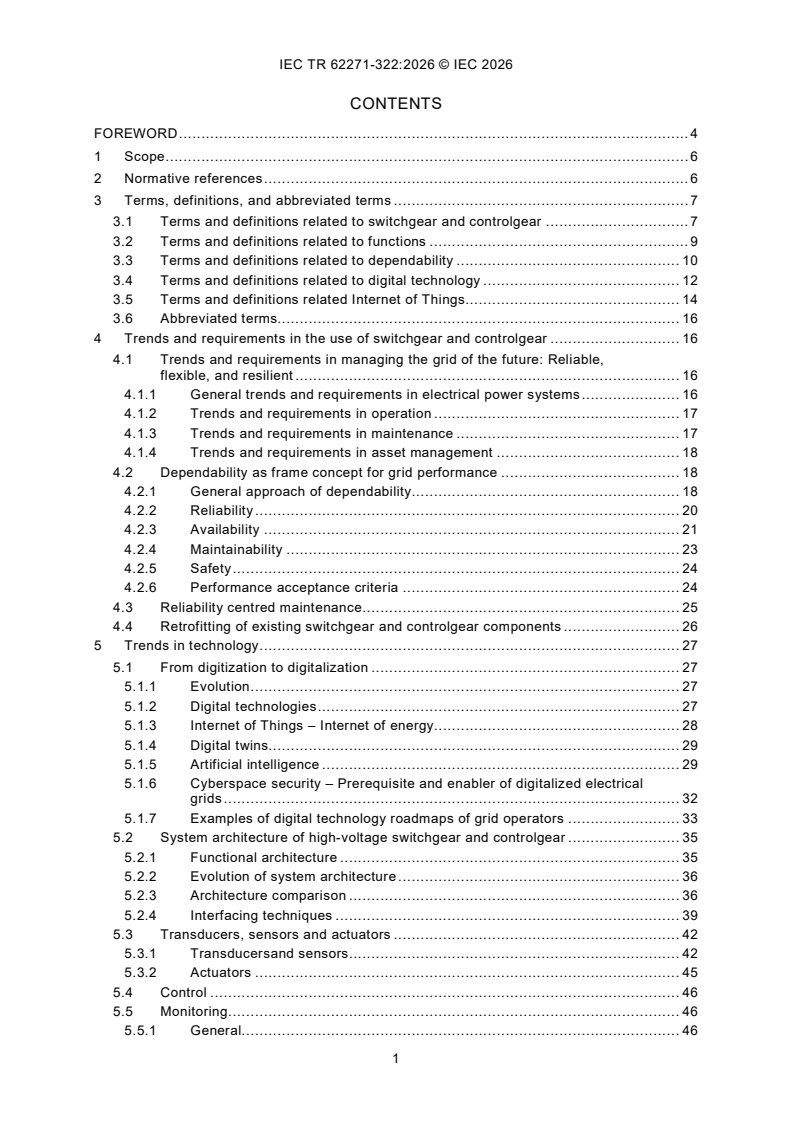
CONTENTS
FOREWORD . 4
1 Scope . 6
2 Normative references . 6
3 Terms, definitions, and abbreviated terms . 7
3.1 Terms and definitions related to switchgear and controlgear . 7
3.2 Terms and definitions related to functions . 9
3.3 Terms and definitions related to dependability . 10
3.4 Terms and definitions related to digital technology . 12
3.5 Terms and definitions related Internet of Things . 14
3.6 Abbreviated terms. 16
4 Trends and requirements in the use of switchgear and controlgear . 16
4.1 Trends and requirements in managing the grid of the future: Reliable,
flexible, and resilient . 16
4.1.1 General trends and requirements in electrical power systems . 16
4.1.2 Trends and requirements in operation . 17
4.1.3 Trends and requirements in maintenance . 17
4.1.4 Trends and requirements in asset management . 18
4.2 Dependability as frame concept for grid performance . 18
4.2.1 General approach of dependability. 18
4.2.2 Reliability . 20
4.2.3 Availability . 21
4.2.4 Maintainability . 23
4.2.5 Safety . 24
4.2.6 Performance acceptance criteria . 24
4.3 Reliability centred maintenance . 25
4.4 Retrofitting of existing switchgear and controlgear components . 26
5 Trends in technology . 27
5.1 From digitization to digitalization . 27
5.1.1 Evolution . 27
5.1.2 Digital technologies . 27
5.1.3 Internet of Things – Internet of energy. 28
5.1.4 Digital twins. 29
5.1.5 Artificial intelligence . 29
5.1.6 Cyberspace security – Prerequisite and enabler of digitalized electrical
grids . 32
5.1.7 Examples of digital technology roadmaps of grid operators . 33
5.2 System architecture of high-voltage switchgear and controlgear . 35
5.2.1 Functional architecture . 35
5.2.2 Evolution of system architecture . 36
5.2.3 Architecture comparison . 36
5.2.4 Interfacing techniques . 39
5.3 Transducers, sensors and actuators . 42
5.3.1 Transducersand sensors . 42
5.3.2 Actuators . 45
5.4 Control . 46
5.5 Monitoring . 46
5.5.1 General. 46
5.5.2 Diagnostic connector . 47
5.5.3 Add-on monitoring system. 47
5.5.4 Integrated system for control and monitoring. 48
5.6 Interface and connection . 48
5.6.1 General. 48
5.6.2 Interoperability. 49
5.6.3 Temporary connections . 50
6 State-of-the-art for specification, qualification, and use of digital technologies in
substations . 51
6.1 Identify appropriate digital technologies improving the performance . 51
6.2 Specification and qualification . 51
6.2.1 Specification. 51
6.2.2 Electrical tests – Insulation tests . 52
6.2.3 Electrical tests – Electromagnetic compatibility (EMC) tests . 52
6.2.4 Mechanical tests – Vibration and shock test . 53
6.2.5 Climate tests – Temperature . 53
6.2.6 Climate tests – Humidity . 53
6.3 Installation . 54
6.4 Transducers and actuators . 54
6.5 Dielectric aspects . 55
6.6 Safety and security . 55
6.7 Degree of protection . 56
6.8 Maintenance . 56
6.8.1 Guidance for the manufacturer . 56
6.8.2 Availability of spares . 56
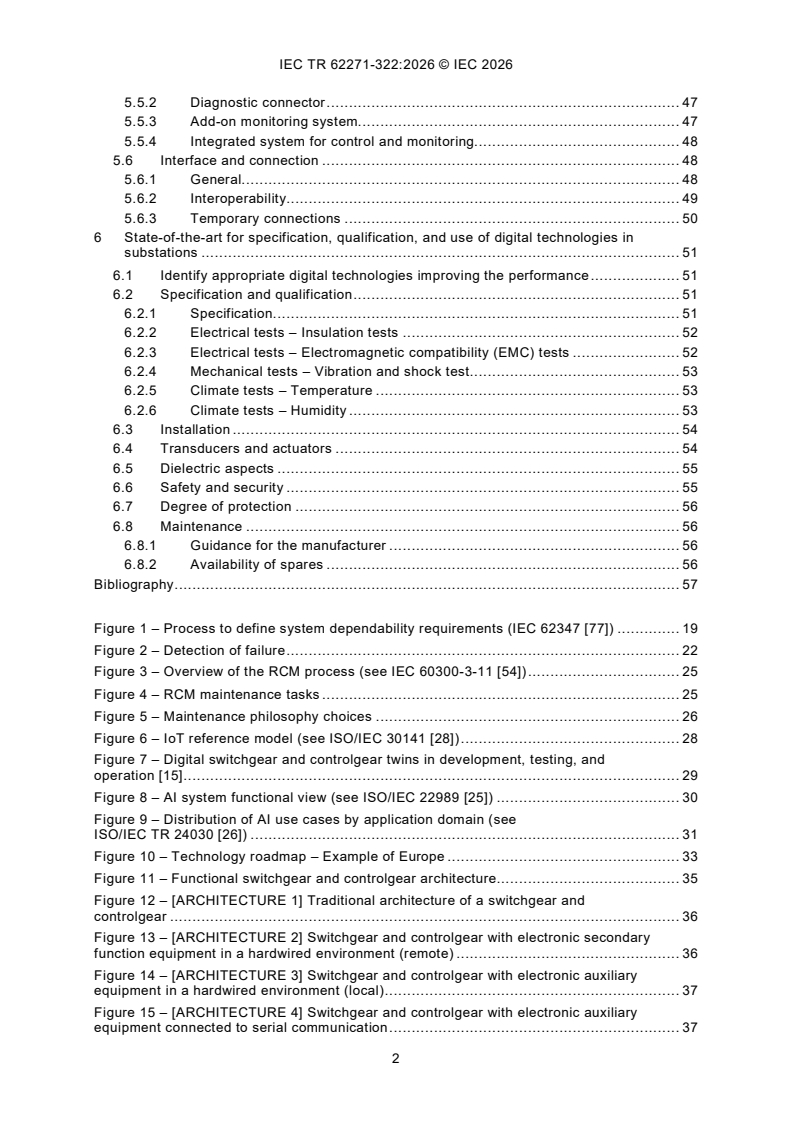
Bibliography . 57
Figure 1 – Process to define system dependability requirements (IEC 62347 [77]) . 19
Figure 2 – Detection of failure . 22
Figure 3 – Overview of the RCM process (see IEC 60300-3-11 [54]) . 25
Figure 4 – RCM maintenance tasks . 25
Figure 5 – Maintenance philosophy choices . 26
Figure 6 – IoT reference model (see ISO/IEC 30141 [28]) . 28
Figure 7 – Digital switchgear and controlgear twins in development, testing, and
operation [15] . 29
Figure 8 – AI system functional view (see ISO/IEC 22989 [25]) . 30
Figure 9 – Distribution of AI use cases by application domain (see
ISO/IEC TR 24030 [26]) . 31
Figure 10 – Technology roadmap – Example of Europe . 33
Figure 11 – Functional switchgear and controlgear architecture. 35
Figure 12 – [ARCHITECTURE 1] Traditional architecture of a switchgear and
controlgear . 36
Figure 13 – [ARCHITECTURE 2] Switchgear and controlgear with electronic secondary
function equipment in a hardwired environment (remote) . 36
Figure 14 – [ARCHITECTURE 3] Switchgear and controlgear with electronic auxiliary
equipment in a hardwired environment (local) . 37
Figure 15 – [ARCHITECTURE 4] Switchgear and controlgear with electronic auxiliary
equipment connected to serial communication . 37
Figure 16 – [ARCHITECTURE 5] Monitoring functions provided by independent add-on
device (hardwired links) . 37
Figure 17 – [ARCHITECTURE 6] Monitoring functions provided by independent add-on
device (serial links) . 38
Figure 18 – [ARCHITECTURE 7] Monitoring functions integrated in electronic auxiliary
equipment of the switchgear and controlgear . 38
Figure 19 – Typical architecture of a digital substation . 39
Figure 20 – [ARCHITECTURE 8] Digitalization of a switchgear and controlgear based
on IEC 61850 series [71] concept . 39
Figure 21 – Remote terminal block (RTB) . 40
Figure 22 – RTB interface to level 1 equipment . 41
Figure 23 – Transducers interfacing . 44
Table 1 – Availability level according to technology . 22
Table 2 – Maintainability according to technology . 23
Table 3 – Relationship between autonomy, heteronomy, automation
(see ISO/IEC 22989 [25]) . 30
Table 4 – Connection compatibility . 50
Table 5 – Guidance for installation of transducers and actuators . 55
INTERNATIONAL ELECTROTECHNICAL COMMISSION
____________
High-voltage switchgear and controlgear -
Part 322: The use of digital technologies
FOREWORD
1) The International Electrotechnical Commission (IEC) is a worldwide organization for standardization comprising
all national electrotechnical committees (IEC National Committees). The object of IEC is to promote international
co-operation on all questions concerning standardization in the electrical and electronic fields. To this end and
in addition to other activities, IEC publishes International Standards, Technical Specifications, Technical Reports,
Publicly Available Specifications (PAS) and Guides (hereafter referred to as “IEC Publication(s)”). Their
preparation is entrusted to technical committees; any IEC National Committee interested in the subject dealt with
may participate in this preparatory work. International, governmental and non-governmental organizations liaising
with the IEC also participate in this preparation. IEC collaborates closely with the International Organization for
Standardization (ISO) in accordance with conditions determined by agreement between the two organizations.
2) The formal decisions or agreements of IEC on technical matters express, as nearly as possible, an international
consensus of opinion on the relevant subjects since each technical committee has representation from all
interested IEC National Committees.
3) IEC Publications have the form of recommendations for international use and are accepted by IEC National
Committees in that sense. While all reasonable efforts are made to ensure that the technical content of IEC
Publications is accurate, IEC cannot be held responsible for the way in which they are used or for any
misinterpretation by any end user.
4) In order to promote international uniformity, IEC National Committees undertake to apply IEC Publications
transparently to the maximum extent possible in their national and regional publications. Any divergence between
any IEC Publication and the corresponding national or regional publication shall be clearly indicated in the latter.
5) IEC itself does not provide any attestation of conformity. Independent certification bodies provide conformity
assessment services and, in some areas, access to IEC marks of conformity. IEC is not responsible for any
services carried out by independent certification bodies.
6) All users should ensure that they have the latest edition of this publication.
7) No liability shall attach to IEC or its directors, employees, servants or agents including individual experts and
members of its technical committees and IEC National Committees for any personal injury, property damage or
other damage of any nature whatsoever, whether direct or indirect, or for costs (including legal fees) and
expenses arising out of the publication, use of, or reliance upon, this IEC Publication or any other IEC
Publications.
8) Attention is drawn to the Normative references cited in this publication. Use of the referenced publications is
indispensable for the correct application of this publication.
9) IEC draws attention to the possibility that the implementation of this document may involve the use of (a)
patent(s). IEC takes no position concerning the evidence, validity or applicability of any claimed patent rights in
respect thereof. As of the date of publication of this document, IEC had not received notice of (a) patent(s), which
may be required to implement this document. However, implementers are cautioned that this may not represent
the latest information, which may be obtained from the patent database available at https://patents.iec.ch. IEC
shall not be held responsible for identifying any or all such patent rights.
IEC TR 62271-322 has been prepared by IEC technical committee 17: High-voltage switchgear
and controlgear. It is a Technical Report.
This first edition cancels and replaces the first edition of IEC TR 62063 published in 1999. This
edition constitutes a technical revision.
This edition includes the following significant technical changes with respect to the previous
edition:
a) IEC numbering has been modified;
b) title has been modified;
c) updates in the field of digital technologies, like Internet of Things, cloud and edge
computing, digital twins, artificial intelligence and cybersecurity have been added; in
accordance with the IEC strategy themes and goals;
d) synchronization and updates in the context of the latest standards of TC 17: IEC 62271-1
and IEC 62271-3;
e) Bibliography has been added.
The text of this Technical Report is based on the following documents:
Draft Report on voting
17/1190/DTR 17/1197/RVDTR
Full information on the voting for its approval can be found in the report on voting indicated in
the above table.
The language used for the development of this Technical Report is English.
This document was drafted in accordance with ISO/IEC Directives, Part 2, and developed in
accordance with ISO/IEC Directives, Part 1 and ISO/IEC Directives, IEC Supplement, available
at www.iec.ch/members_experts/refdocs. The main document types developed by IEC are
described in greater detail at www.iec.ch/publications.
A list of all parts in the IEC 62271 series, published under the general title High-voltage
switchgear and controlgear, can be found on the IEC website.
The committee has decided that the contents of this document will remain unchanged until the
stability date indicated on the IEC website under webstore.iec.ch in the data related to the
specific document. At this date, the document will be
– reconfirmed,
– withdrawn, or
– revised.
1 Scope
Digital technologies, intelligently combined with switchgear and controlgear in electrical grids,
can be enablers of reliable, sustainable, and affordable energy systems and an all-electric
society. This document gives guidance for network operators, manufacturers and all parties
driving the energy and electrical grid transition through the application of digital technologies.
Relevant references and definitions of state-of-the-art digital technologies, like the Internet of
Things (IOT), Industrial Internet of Things (IIOT), cloud and edge computing, digital twins,
artificial intelligence, and cybersecurity are listed. Trends and examples in the use of network
operation, service and asset management are described and examples of transition roadmaps
of network operators given. Trends and the integration of adequate state-of-the-art digital
technologies and application examples are described. Finally, guidance based on experiences
for the identification, specification, qualification, and integration of digital technologies is given.
High-voltage switchgear and controlgear can be considered in terms of its two sub-parts:
– switching devices and equipment, i.e. the high-voltage part of the switchgear and
controlgear, dedicated to high-voltage functions, e.g. current flow, insulation and switching;
– associated control and auxiliary devices and equipment, i.e. the low voltage part of the
switchgear and controlgear, dedicated to the control, measuring, protective, regulating, and
monitoring functions of the switching devices and equipment.
The boundary of switchgear and controlgear is then easily identified as being generally the
cable connections for the switching devices and equipment and the terminal block for the
auxiliary equipment.
Introducing electronic and digital technologies results in significant changes on several points:
– The location of the auxiliary equipment is not necessarily confined to the related switchgear
and controlgear, but can be distributed at any location, at the local control cubicle of the
switchgear and controlgear or the control room of the substation or directly at the switchgear
and controlgear device with local intelligence (edge computing technology) or physically
disconnected of the substation (cloud computing technology).
– Different components of the auxiliary equipment might be supplied by different
manufacturers and integrated into the switchgear and controlgear independently of the
manufacturer of the switchgear and controlgear equipment.
– Electronic and digital technologies using distributed architectures, microprocessor-based
components, and digital communications induce new concepts in dependability. That results
in modifications of maintenance policies, and asset management as well as user operation
of the switchgear and controlgear.
This document describes trends and the state-of-the-art of digital technologies enabling their
use in switchgear and controlgear along their life cycle. The report is a guidance for the
IEC TC17 and supported by use cases or by emerging technologies, able to be implemented in
power grids. The report can be used by designers, asset managers and any stakeholder dealing
with interoperable and digital technologies for a switchgear and controlgear over their whole
life cycle. The document consists of three main parts.
Clause 4 describes the trends in user exploitation of digital technologies within the switchgear
and controlgear. Clause 5 focuses on trends regarding technology and consequences for
system architectures. Clause 6 gives guidance for use of new technologies in substations.
2 Normative references
There are no normative references in this document.
3 Terms, definitions, and abbreviated terms
For the purposes of this document, the following terms and definitions apply.
ISO and IEC maintain terminology databases for use in standardization at the following
addresses:
– IEC Electropedia: available at https://www.electropedia.org/
– ISO Online browsing platform: available at https://www.iso.org/obp
3.1 Terms and definitions related to switchgear and controlgear
3.1.1
switchgear and controlgear
general term covering switching devices and their combination with associated control,
measuring, protective and regulating equipment, also assemblies of such devices and
equipment with associated interconnections, accessories, enclosures and supporting structures
[SOURCE: IEC 60050-441:1984 [82], 441-11-01]
3.1.2
equipment
single apparatus or set of devices or apparatuses, or the set of main devices of an installation,
or all devices necessary to perform a specific task
Note 1 to entry: Examples of equipment are a power transformer, the equipment of a substation, measuring
equipment
[SOURCE: IEC 60050-151:2001 [83], 151-11-25]
3.1.3
device
material element or assembly of such elements intended to perform a required function
Note 1 to entry: A device may form part of a larger device
[SOURCE: IEC 60050-151:2001, [83] 151-11-20]
3.1.4
(signal) transducer
device for transforming a physical quantity representing information into a physical quantity of
different kind representing the same information, one of the two quantities being electric
[SOURCE: IEC 60050-151:2001 [83], 151-13-37]
3.1.5
sensor
measuring element
part of a measuring instrument, or measuring chain, which is directly affected by the measurand
and which generates a signal related to the value of the measurand
[SOURCE: IEC 60050-311:2001 [84], 311-05-01]
3.1.6
(electric) sensor
device which, when excited by a physical phenomenon, produces an electric signal
characterizing the physical phenomenon
[SOURCE: IEC 60050-151:2001 [83], 151-13-48]
3.1.7
sensor
IoT device that measures one or more properties of one or more physical
entities and outputs digital data that can be transmitted over a network
Note 1 to entry: In the definition “digital data” means “data in the form of a structured sequence on bits/bytes that
represents information”
[SOURCE: IEC 60050-741:2020 [85], 741-02-09]
3.1.8
actuator
part of the actuating system to which an external actuating force
is applied
Note 1 to entry: The actuator may take the form of a handle, knob, push-button, roller, plunger, etc.
[SOURCE: IEC 60050-441:1984 [82], 441-15-22]
3.1.9
actuator
functional unit that generates the manipulated variable, required to drive
the final controlling element, from the output variable of the controlling element
Note 1 to entry: If the final controlling element is mechanically actuated, it is controlled via an actuating drive. The
actuator drives the actuating drive in this case.
[SOURCE: IEC 60050-351:2013 [86], 351-49-07, modified – The Example, Note 2, Figure 1 and
Figure 2 have been removed.]
3.1.10
intelligent electronic device
IED
any device incorporating one or more processors with the capability of receiving or sending
data/controls from or to an external source (for example, electronic multifunction meters, digital
relays, controllers)
[SOURCE: IEC TR 61850-1;2013 [72], 3.1.6]
3.1.11
smart grid
intelligent grid
electric power system that utilizes information exchange and control technologies, distributed
computing and associated sensors and actuators, for purposes such as:
– to integrate the behaviour and actions of the network users and other stakeholders;
– to efficiently deliver sustainable, economic and secure electricity supplies
[SOURCE: IEC 60050-617:2011 [87], 617-04-13]
3.1.12
intelligent switchgear and controlgear
switchgear and controlgear that utilizes information exchange and control technologies,
distributed computing and associated sensors and actuators, for purposes such as:
– to integrate the behaviour and actions of the network users and other stakeholders;
– to efficiently deliver sustainable, economic and secure electricity supplies
Note 1 to entry: The definition is based on the definition of smart grid (3.1.11).
3.2 Terms and definitions related to functions
3.2.1
primary function
function providing the intended purpose
Note 1 to entry: Examples of primary functions of switchgear and controlgear are switching, measuring, interlocking,
and communication
[SOURCE: IEC 60050-904:2014 [88], 904-03-02, modified – Note 1 has been removed and a
new Note 1 to entry has been added.]
3.2.2
secondary function
function that enables, supplements or enhances a primary function
Note 1 to entry: Examples of such functions are operation counter, early warning alarms (gas loss), pole
discrepancy, closing and opening times, travel curve acquisition, blocking according to stored energy (O-CO block),
gas density monitoring, etc.
[SOURCE: IEC 60050-904:2014 [88], 904-03-03, modified – Note 1 has been removed and a
new Note 1 to entry has been added.]
3.2.3
monitoring
observation of the operation of a system or part of a system to verify correct functioning by
detecting incorrect functioning, this being done by measuring one or more variables of the
system and comparing the measured values with the specified values
[SOURCE: IEC 62271-1:2017 [73], 3.1.16, modified – Note 1 to entry has been removed.]
3.2.4
parallel transmission
simultaneous transmission of the signal elements of a character signal or block signal on
separate channels
[SOURCE: IEC 60050-721:1991 [89], 721-11-17]
3.2.5
serial transmission
transmission of the signal elements of a character signal or block signal at successive time
intervals, either contiguous or not
[SOURCE: IEC 60050-721:1991 [89], 721-11-16]
3.2.6
stability
ability of a measuring instrument to keep its performance characteristics unchanged during a
specified time interval, all other conditions being the same
[SOURCE: IEC 60050-311:2001 [84], 311-06-12]
3.3 Terms and definitions related to dependability
3.3.1
durability
ability to perform as required, under given conditions of use and maintenance,
until the end of useful life
[SOURCE: IEC 60050-192:2015 [90], 192-01-21]
3.3.2
durability
ability to perform as required, under specified
conditions of use, maintenance, and repair until the end-of-life is reached
Note 1 to entry: The criteria for transition from non-functional state to end-of-life should be specified. The criteria
is based on predictable aspects (e.g. technical aspects) so that the durability can be estimated.
Note 2 to entry: Durability can be expressed in units appropriate to the part or product concerned, e.g., calendar
time, operating cycles, distance run, etc.
Note 3 to entry: The term durability is also defined in the context of an item in dependability (IEV 192-01-21)
[SOURCE: IEC 60050-193:– [91],193-05-03 , modified – “technical end of life” has been
replaced with “end of life is reached”, Notes 1,4 and 5 have been removed and the figure has
been removed.]
3.3.3
dependability
ability to perform as and when required
Note 1 to entry: Dependability includes availability, reliability, recoverability, maintainability, and maintenance
support performance, and, in some cases, other characteristics such as durability, safety and security.
Note 2 to entry: Dependability is used as a collective term for the time-related quality characteristics of an item.
[SOURCE: IEC 60050-192:2015, 192-01-22]
3.3.4
availability
ability to be in a state to perform as required
Note 1 to entry: Availability depends upon the combined characteristics of the reliability, recoverability, and
maintainability of the item, and the maintenance support performance.
Note 2 to entry: Availability may be quantified using measures defined in availability related measures.
[SOURCE: IEC 60050-192:2015 [90], 192-01-23, modified – the domain has been added,
“under given conditions” removed from the definition and Notes 1, 3 and 4 removed.]
3.3.5
instantaneous availability
probability that an item is in a state to perform as required at a given instant
[SOURCE: IEC 60050-192:2015 [90], 192-08-01]
3.3.6
reliability
ability to perform as required, without failure, for a given time interval, under given
conditions
[SOURCE: IEC 60050-192:2015 [90], 192-01-24, modified – Notes 1 to 3 to entry have been
removed.]
3.3.7
maintainability
ability to be retained in, or restored to a state to perform as required, under given conditions of
use and maintenance
[SOURCE: IEC 60050-192:2015 [90], 192-01-27 , modified – Notes 1 and2 to entry have been
removed.]
3.3.8
maintenance
combination of all technical and management actions intended to retain an item in, or restore it
to, a state in which it can perform as required
[SOURCE: IEC 60050-192:2015 [90], 192-06-01, modified – Note 1 to entry has been removed.]
3.3.9
corrective maintenance
maintenance carried out after fault detection to effect restoration
[SOURCE: IEC 60050-192:2015 [90], 192-06-06, modified – Note 1 to entry has been removed.]
3.3.10
preventive maintenance
maintenance carried out to mitigate degradation and reduce the probability of failure
[SOURCE: IEC 60050-192:2024 [90], 192-06-05, modified – The second term “preventative
maintenance” has been removed and Notes 1 to 2 to entry have been removed.]
3.3.11
condition-based maintenance
preventive maintenance based on the assessment of physical condition
[SOURCE: IEC 60050-192:2024 [90], 192-06-07, modified – Note 1 to entry has been removed.]
3.3.12
prediction
computation process used to obtain the predicted value of a quantity
[SOURCE: IEC 60050-192:2015 [90], 192-11-01]
3.3.13
predictive maintenance
maintenance that is carried out on the basis of prediction of failure occurrence and required
intervention probability
3.3.14
reliability centred maintenance
RCM
systematic method for determining the respective maintenance actions and associated
frequencies, based on the probability and consequences of failure
Note 1 to entry: RCM studies may be conducted at any indenture level of a system.
[SOURCE: IEC 60050-192:2015 [90], 192-06-08, modified – Notes 2 and 3 to entry have been
removed.]
3.4 Terms and definitions related to digital technology
3.4.1
information
knowledge concerning objects, such as facts, events, things, processes, or ideas (including
concepts) that, within a certain context, has a particular meaning
Note 1 to entry: Information can be represented for example by signs, symbols, pictures or sounds.
[SOURCE: IEC 60050-171:2015 [92], 171-01-01]
3.4.2
data
representation of information in a formalized manner suitable for human or automatic
processing
[SOURCE: IEC 60050-171:2019 [92], 171-01-02, modified – Notes 1 and 2 to entry have been
removed.]
3.4.3
signal
physical phenomenon whose presence, absence, or variation is considered as representing
information
[SOURCE: IEC 60050-171:2019 [92], 171-01-03, modified – Notes 1 to 3 to entry have been
removed.]
3.4.4
analogue
pertaining to the representation of information by means of a quantity that can, at any instant
within a continuous time interval, assume any value within a continuous interval of values
[SOURCE: IEC 60050-171:2019 [92], 171-01-04, modified – Note 1 to entry has been removed.]
3.4.5
digital, adj.
pertaining to the representation of information by distinct states or discrete values at distinct
instants
[SOURCE: IEC 60050-171:2019 [92], 171-01-07]
3.4.6
digital technology
technology using a digital representation of information
[SOURCE: IEC 60050-171:2019 [92], 171-01-16]
3.4.7
interface
shared boundary between two functional units, defined by functional characteristics, signal
characteristics, or other characteristics as appropriate
Note 1 to entry: The concept of interface includes the specification of the connection of two devices having different
functions.
[SOURCE: IEC 60050-171:2019 [92], 171-01-24]
3.4.8
application software
app
software that is specific to the solution of a problem submitted by an end user
[SOURCE: IEC 60050-171:2019 [92], 171-05-04, modified – The second term “app” has been
added.]
3.4.9
artificial intelligence
AI
capability of a functional unit to perform functions that are generally associated
with human intelligence, such as reasoning and learning
[SOURCE: IEC 60050-171:2019 [92], 171-09-17]
3.4.10
security
freedom from unacceptable risk to the physical units considered from the outside
Note 1 to entry: In many other languages than English there is only one word for safety and security.
[SOURCE: IEC 60050-351:2013 [86], 351-57-07]
3.4.11
cyberspace
whole of interconnected information processing systems, including the internet, and of data they
are processing
[SOURCE: IEC 60050-171:2019 [92], 171-08-03]
3.4.12
cyberspace security
freedom from unacceptable risk in cyberspace
[SOURCE: IEC 60050-171:2019 [92], 171-08-04]
3.4.13
digital twin
digital representation (3.4.14) of a target entity (3.4.15) with data connections that enable
convergence between the physical and digital states at an appropriate rate of synchronization
Note 1 to entry: Digital twin has some or all of the capabilities of connection, integration, analysis, simulation,
visualization, optimization, collaboration, etc.
Note 2 to entry: Digital twin can provide an integrated view throughout the life cycle of the target entity.
[SOURCE: ISO/IEC 30173:2023 [30], 3.1.1]
3.4.14
digital representation
digital entity representing either a set of properties or behaviours or both of one or more
observable elements
[SOURCE: ISO/IEC 30173:2023 [30], 3.1.8]
3.4.15
target entity
entity providing a functional purpose in reality which is the subject of digital representation
(3.4.14)
Note 1 to entry: The target entity, which provides some functional purpose in reality, can be either physical or digital
under consideration.
[SOURCE: ISO/IEC 30173:2023 [30], 3.1.3]
3.4.16
digital twin
virtual representation of an existing or to be created real object
consisting of an identifying component, the description of its attributes as well as its functional
properties
Note 1 to entry: It is coupled with its real object and accompanies it from the initial idea to recycling (lifecycle
capability).
Note 2 to entry: This coupling with the real object is to be carried out autonomously by means of a digital
communication infrastructure, whereby manual indirect coupling is also possible.
Note 3 to entry: The definition is based on the English translation of [1].
3.4.17
digital nameplate
electronically readable product marking string encoded in an optically readable medium, a radio
frequency transponder or the product firmware
Note 1 to entry: In contrast to a conventional nameplate, a digital nameplate is not human readable.
[SOURCE: IEC 63365:2022 [80], 3.2, modified – Notes 2 and 3 to entry have been removed]
3.5 Terms and definitions related Internet of Things
3.5.1
Internet of Things
IoT
infrastructure of interconnected entities, people, systems, and information resources together
with services which processes and reacts to information from the physical world and virtual
world
[SOURCE: ISO/IEC 20924:2024 [24], 3.2.8]
3.5.2
IoT system
system providing functionalities of IoT
Note 1 to entry: An IoT system can include, but not be limited to, IoT devices, IoT gateways, sensors, and actuators.
[SOURCE: ISO/IEC 20924:2024 [24], 3.2.15]
3.5.3
IoT device
endpoint that interacts with the physical world through sensing and actuating
Note 1 to entry: An IoT device can be a sensor or an actuator.
[SOURCE: ISO/IEC 20924:2024 [24], 3.2.11]
3.5.4
IoT gateway
entity of an IoT system that connects one or more proximity networks and the IoT devices on
those networks to each other and to one or more access networks with different protocols
[SOURCE: ISO/IEC 20924:2024 [24], 3.2.14]
3.5.5
IoT trustworthiness
trustworthiness of an IoT system with characteristics including security, privacy, safety,
reliability, and resilience
[SOURCE: ISO/IEC 20924:2024 [24], 3.2.16]
3.5.6
architecture
set of fundamental concepts or properties of an entity in its environment
[SOURCE: ISO/IEC 20924:2024 [24], 3.1.2]
3.5.7
cloud computing
data processing delivered as a service over a network, typically the internet
Note 1 to entry: Cloud computing provides shared computer resources on demand.
[SOURCE: IEC 60050-171:2019 [92], 171-09-12]
3.5.8
cloud computing
paradigm for enabling network access to a scalable and elastic pool of shareable physical
or virtual resources with self-service provisioning and administration on-demand
[SOURCE: ISO/IEC 20924:2024 [24], 3.1.5]
3.5.9
edge computing
distributed computing that takes place at or near the edge, where the nearness is defined by
the system's requirements
[SOURCE: ISO/IEC TR 30164:2020 [29], 3.2]
3.5.10
interoperability
ability of two or more systems or applications to exchange information and to mutually use the
information that has been exchanged
[SOURCE: ISO/IEC 20924:2024 [24], 3.1.23]
3.6 Abbreviated terms
AI Artificial intelligence
AIS Air-insulated switchgear
BCU Bay control unit
BIOI Binary input output IED
CIT Conventional instrument transformer
DSO Distribution system operator
EMC Electromagnetic compatibility
FACTS Flexible AC transmission system
GIS Gas-insulated switchgear
GOOSE Generic object-oriented substation event
IED Intelligent electronic device
IoT Internet of Things
LPIT Low-power instrument transformer
ML Machine learning
MOSFET Metal-oxide-semiconductor field-effect transistor)
MU Merging unit
PST Phase shifting transformers
RCM Reliable centred maintenance
RTB Remote terminal block
SAMU Stand-alone merging unit
SCU Switch control unit
TSO Transmission system operator
VSR Variable shunt reactor
4 Trends and requirements in the use of switchgear and controlgear
4.1 Trends and requirements in managing the grid of the future: Reliable, flexible, and
resilient
4.1.1 General trends and requirements in electrical power systems
Today’s trends reflect the changes in electric power systems. These trends lead to new or partly
new requirements:
– massive installation of renewables in electric power generation replacing fossil power
plants;
– requirements for transporting large amounts of electric power for a long distance;
– implementation of environmentally friendly solutions;
– increasing introduction of distributed renewable energy generation and new electrical
consumptio
...