


Lamp Caps and Holders: Essential Standards for Safe, Efficient, and Scalable Lighting Solutions
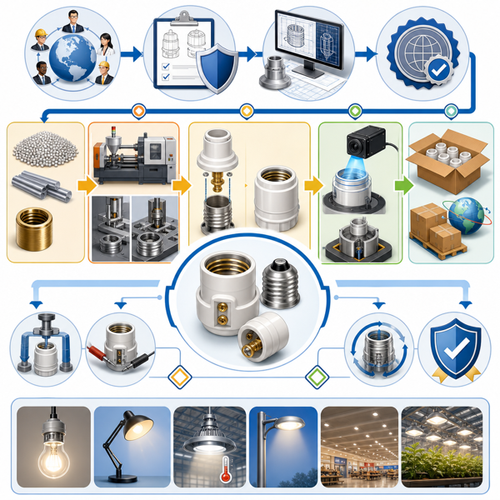
Lighting is at the heart of every home, workplace, and public space, driving comfort, safety, and productivity. Behind the scenes, rigorous international standards ensure that lamp caps and holders—not to mention the gauges that control their safety and interchangeability—continue to meet the ever-higher demands of today’s technology-driven world. For businesses and engineers, compliance with these standards is more than a checkbox: it’s a pathway to safer products, higher efficiency in installation and maintenance, and assurance that scaling up or adopting new lighting technologies happens seamlessly and securely. This article demystifies four key European standards guiding lamp caps, holders, and the precise gauges that connect them, providing a foundation for anyone involved in the design, installation, or operation of lighting systems.
Overview / Introduction
In electrical engineering, lighting systems must deliver more than just brightness—they must guarantee safety, reliability, and ongoing compatibility as technologies evolve. Lamp caps (the connectors that attach bulbs to power), lampholders (which house these caps), and the gauges used to test them, are critical components ensuring that lighting products perform efficiently and safely.
Implementing robust standards in lamp caps and holders directly impacts:
- Product safety (minimizing risk of electric shock, fire, or malfunction)
- Interchangeability (ensuring bulbs and holders from different sources work together seamlessly)
- Innovation adoption (e.g., supporting smart LED retrofits)
- Business scalability and cost-efficiency
- Customer confidence and regulatory compliance
In this guide, you’ll discover the essence of four essential standards—all recently updated—that serve as pillars for lamp cap and holder safety, interoperability, and performance. Whether you’re a lighting manufacturer, contractor, facilities manager, or procurement specialist, understanding these standards can help you future-proof your lighting assets as the industry races ahead.
Detailed Standards Coverage
EN 60061-1:1993/A64:2025 – Lamp Caps
Full Standard Title: Lamp caps and holders together with gauges for the control of interchangeability and safety – Part 1: Lamp caps
The EN 60061-1:1993/A64:2025 standard defines the precise requirements and profiles for lamp cap designs—including screw, bayonet, bi-pin, prefocus, wedge, and specialized smart connectors. These specifications govern the dimensions, tolerances, and electrical characteristics of caps on all types of lamps, from standard household bulbs to advanced industrial and automotive lighting.
Implementing this standard means that lamps of varying technology—LED, halogen, CFL, or IoT-enabled—can safely connect to compatible lampholders without risk of poor contact, overheating, or electric shock. The standard’s comprehensive catalogue of profiles, including E14, E26, G13, BA15d, and more, enables not only safety but also interchangeability across the entire supply chain.
Key requirements and scope:
- Detailed specifications for dimensions and materials of every recognized lamp cap type
- Interchangeability rules to guarantee cross-brand compatibility and easy maintenance
- Safety measures, minimizing electrical and mechanical risks at connection points
- Support for new cap types as lighting technology evolves
Who should comply:
- Lighting manufacturers and OEMs
- Electrical product designers and engineers
- Facilities managers/procurement in large organizations
Practical implications:
Adhering to EN 60061-1 ensures that lamps will always fit and function in approved holders, reducing service calls, increasing customer satisfaction, and supporting rapid innovation/planned LED upgrades within existing infrastructure. For businesses, compliance brings a clear path to scaling operations—adding or replacing lighting units with minimal disruption.
Key highlights:
- Unifies the wide variety of lamp cap profiles (bayonet, screw, bi-pin, wedge, etc.)
- Sets mechanical and electrical tolerances to prevent unsafe or unreliable installations
- Establishes a framework for ongoing compatibility as new lighting tech appears
Access the full standard:View EN 60061-1:1993/A64:2025 on iTeh Standards
EN 60061-2:1993/A59:2023 – Lampholders
Full Standard Title: Lamp caps and holders together with gauges for the control of interchangeability and safety – Part 2: Lampholders
This standard is the essential companion to Part 1, covering the lampholders themselves—the devices that safely receive lamp caps and provide the electrical connection. EN 60061-2:1993/A59:2023 lays out dimensional, mechanical, and electrical requirements for hundreds of lampholder types found in commercial, industrial, residential, and vehicle lighting applications. It covers both traditional sockets (such as E27 and B22d) and more specialized types for advanced lighting, supporting not only classic bulbs but also modern smart and modular lighting modules.
Scope and specifications:
- Defines precise dimensions for mounting, threading, and contact points
- Specifies safety aspects such as insulation distances and material requirements
- Ensures secure mechanical fit and reliable electrical contact for every listed cap/holder pair
- Contains rules for mounting distances and holder combinations, supporting rapid luminaire assembly
Who needs this standard:
- Lamp and lighting fixture manufacturers
- Electrical contractors/installers
- Quality assurance/maintenance staff
Implementation & impact:
By complying with these requirements, businesses benefit from minimized incompatibility, reduced risk of field failures, and enhanced product safety. It also streamlines maintenance and upgrade cycles, allowing lighting systems to evolve with minimal downtime or retraining.
Key highlights:
- Guarantees compatibility between multi-vendor caps and lampholders
- Prioritizes user safety through insulation and retention specifics
- Supports design for maintainability and flexible upgrades
Access the full standard:View EN 60061-2:1993/A59:2023 on iTeh Standards
EN 60061-3:1993/A59:2023 – Gauges (2023 Edition)
Full Standard Title: Lamp caps and holders together with gauges for the control of interchangeability and safety – Part 3: Gauges
Gauges are specialized tools used to verify whether lamp caps and holders conform to dimensional and functional requirements. EN 60061-3:1993/A59:2023 specifies all the required go/no-go gauges, plug gauges, and tooling methods for the control of lamp cap/holder interchangeability and safety, as updated in the 2023 amendment.
Scope:
- Lists the design and usage specs for gauges that verify the fit and safety of every cap/holder combination
- Includes gauges for threaded, bayonet, bi-pin, wedge, and prefocus connectors
- Establishes the criteria for passing/failing a lamp or a holder
- Ensures consistent quality assurance from manufacturers to field testing
Requirements and practical use:
Manufacturers use these gauges at production, R&D, and incoming inspection stages to guarantee every lamp and holder meets the prescribed safety and compatibility requirements. Service teams and quality inspectors rely on these standards for field checks, minimizing failures and liability.
Key highlights:
- Standardizes inspection tools across the industry, ensuring product quality
- Supports comprehensive safety checks (e.g., contact pressure, insulation clearance)
- Enables businesses to rapidly identify and address non-compliance or counterfeits
Access the full standard:View EN 60061-3:1993/A59:2023 on iTeh Standards
EN 60061-3:1993/A60:2024 – Gauges (2024 Edition)
Full Standard Title: Lamp caps and holders together with gauges for the control of interchangeability and safety – Part 3: Gauges
The 2024 amendment to Part 3 further refines and expands the measurement and test regime for gauges used in quality assurance of lamp caps and holders. The update recognizes new cap/holder types—especially those relevant to smart lighting and new LED modules—while tightening test requirements for established types.
Enhanced scope and specifications:
- Incorporates new gauge profiles addressing emerging connector types supporting IoT, wireless lighting, and high-efficiency LED modules
- Updates critical tolerance checks and testing procedures to align with contemporary manufacturing tolerances
- Augments go/no-go test coverage for mechanical and electrical performance
Who benefits:
- Manufacturers updating product lines to support new lighting tech
- Technology integrators performing large-scale retrofits
- Certification laboratories and procurement agencies
Implementation implications:
This amendment is essential for organizations scaling up deployment of new, energy-efficient, and interconnected lighting systems. Adopting the latest gauge standards minimizes risk of fit issues, early failures, and product recalls, ensuring market access in the EU and beyond.
Key highlights:
- Recognizes and tests compatibility for latest lighting technologies
- Reduces the likelihood of mismatched or sub-standard components
- Helps businesses maintain global competitiveness and compliance
Access the full standard:View EN 60061-3:1993/A60:2024 on iTeh Standards
Industry Impact & Compliance
Implementing these lamp caps, holders, and gauges standards is not just about meeting regulatory mandates—it’s about gaining a competitive edge in a rapidly evolving lighting sector.
How Standards Affect Businesses
- Faster adoption of new lighting technology (e.g., LED or smart lighting) thanks to predictable compatibility
- Safer work environments by minimizing the risk of electrical faults or misfitted components
- Lower maintenance and replacement costs over the lifetime of lighting assets
- Improved customer satisfaction as a result of fewer fitting errors or product compatibility issues
Compliance Considerations
- Required for market access (especially in Europe)
- Supports product certification, due diligence, and bid compliance for contracts
- Non-compliance can result in recalls, legal risks, and reputational damage
Benefits of Adopting These Standards
- Enhanced productivity: Streamlined installation/upgrades, less rework
- Security: Reduced risk of fire, shock, or installation errors
- Scalability: Easier standardization and rollout across multiple facilities or product lines
- Risk Mitigation: Defends against counterfeit and sub-standard products
Implementation Guidance
Common Implementation Approaches
- Integrate standards at the design phase: Incorporate EN 60061 profiles and tolerances into every new product design or lighting system schematic.
- Supply chain audit: Source components only from vendors declaring full compliance with referenced standards; request test reports and certification where possible.
- Routine inspection and QA: Use standardized gauges to inspect both incoming goods and field installations.
- Training: Ensure installation and maintenance teams are familiar with fitment tolerances and gauge use, enabling quick troubleshooting and minimal downtime.
- Upgrade paths: Select lighting systems that allow for modular upgrades using approved caps and holders, ensuring ongoing compatibility as technologies (e.g., smart, wireless, high-efficiency) evolve.
Best Practices for Adopting These Standards
- Map existing inventory to EN 60061 parts—identify and replace legacy or non-compliant components
- Specify standard conformity in procurement and tender documentation
- Collaborate with accredited testing labs for periodic compliance audits
- Establish clear documentation and labeling protocols for all lighting assets
Resources for Organizations
- Access the full text and latest amendments of EN 60061 standards via iTeh Standards
- Leverage manufacturer technical bulletins summarizing key changes for rapid implementation
- Engage with professional associations and forums to share best practices and stay ahead of new developments
Conclusion / Next Steps
As lighting technology moves towards smarter, more energy-efficient, and flexible systems, alignment with robust international standards—like EN 60061’s parts for lamp caps, holders, and gauges—is more critical than ever. Whether upgrading existing facilities, pioneering next-generation fixtures, or simply seeking to minimize operational risks, these standards provide a proven blueprint for quality, safety, and future readiness.
Key takeaways:
- Compliance with lamp cap and holder standards boosts safety, efficiency, and market access
- Modern gauge requirements streamline inspection and support evolving technologies
- Integrating standards into daily practice enables scaling and innovation with confidence
Recommended next steps:
- Review and update your organization’s lighting policies and procurement practices to ensure compliance
- Train staff and partners on the latest compatibility and safety checks
- Explore the full family of EN 60061 standards on iTeh Standards and stay updated as the industry advances
Staying compliant and proactive with these essential standards isn’t just regulatory—it’s transformative for any business seeking excellence and competitiveness in electrical engineering and lighting technology.
Categories
- Latest News
- New Arrivals
- Generalities
- Services and Management
- Natural Sciences
- Health Care
- Environment
- Metrology and Measurement
- Testing
- Mechanical Systems
- Fluid Systems
- Manufacturing
- Energy and Heat
- Electrical Engineering
- Electronics
- Telecommunications
- Information Technology
- Image Technology
- Precision Mechanics
- Road Vehicles
- Railway Engineering
- Shipbuilding
- Aircraft and Space
- Materials Handling
- Packaging
- Textile and Leather
- Clothing
- Agriculture
- Food technology
- Chemical Technology
- Mining and Minerals
- Petroleum
- Metallurgy
- Wood technology
- Glass and Ceramics
- Rubber and Plastics
- Paper Technology
- Paint Industries
- Construction
- Civil Engineering
- Military Engineering
- Entertainment