


Lamp Caps and Holders Standards: Ensuring Safety, Interchangeability, and Efficiency in Modern Lighting
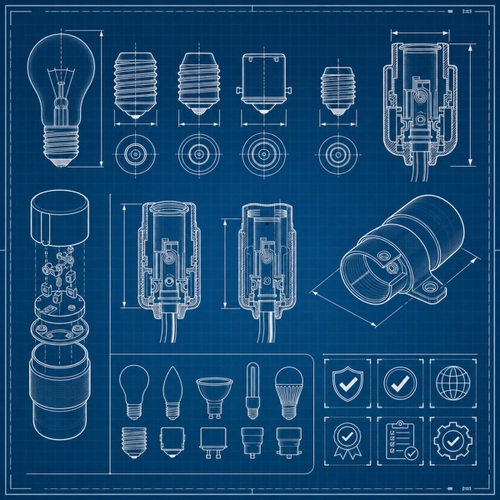
Lighting technologies are transforming the way we live, work, and interact with our environments. For manufacturers, designers, and businesses operating in electrical engineering or lighting sectors, implementing the right standards is not just a regulatory obligation—it’s a competitive advantage. This article offers an in-depth look at four key standards governing lamp caps, holders, and gauges—critical components for the safe and efficient operation of electrical lighting systems. By understanding and applying these standards, organizations can enhance safety, support modern technology integration, boost productivity, and scale with greater security and confidence.
Overview / Introduction
Lighting is at the forefront of innovation from homes and offices to smart cities and high-tech industries. As lighting products become more sophisticated—with the rise of LED, IoT-enabled luminaires, and globalized supply chains—the need for solid, universally accepted standards is more pressing than ever.
The EN 60061 series underpins safety, compatibility, and performance for lamp caps and holders by establishing precise specifications and detailed test methods. These standards streamline the design, manufacturing, and application processes for components, ensuring they meet strict criteria for electrification, mechanical fit, and interchangeability. For organizations, staying aligned with EN 60061 is vital not just for legal compliance, but for adopting new technologies, maintaining product quality, and staying agile in a fast-evolving market.
In this comprehensive guide, we break down four pillar standards:
- EN 60061-1:1993/A64:2025 (Lamp caps)
- EN 60061-2:1993/A59:2023 (Lampholders)
- EN 60061-3:1993/A59:2023 (Gauges)
- EN 60061-3:1993/A60:2024 (Gauges)
You’ll learn what each standard covers, why it matters, and how compliance can drive safety, efficiency, and growth for your business.
Detailed Standards Coverage
EN 60061-1:1993/A64:2025 – Definitive Standards for Lamp Caps
Lamp caps and holders together with gauges for the control of interchangeability and safety – Part 1: Lamp caps
EN 60061-1:1993/A64:2025 sets the foundational requirements for the design, dimensions, and performance of lamp caps—the metallic interfaces connecting light sources to power via lampholders. It details the full catalog of cap types (including bi-pin, bayonet, screw, wedge, and prefocus caps) alongside dimensioned profiles and their associated tolerances.
Key requirements:
- Strict dimensional requirements for each lamp cap variant (from E27 screw to GU10 bipin, and highly specialized caps)
- Mechanical strength and electrical contact criteria to ensure reliable operation
- Clear profiles for emerging application areas (e.g., automotive, LED, projector, festoon, and infrared lamps)
- Updated gauge sheets to test for mechanical fit and interchangeability
- Inclusion of new cap types and amendments for compatibility with next-gen lighting
This standard is indispensable for lamp manufacturers, OEMs, electrical designers, and QA engineers. It provides the baseline for ensuring any cap produced will mate safely and effectively with standardized lampholders—minimizing safety risks and facilitating global market acceptance.
Key highlights:
- Comprehensive catalog of lamp cap types, including recent amendments for modern lighting needs
- Emphasis on interchangeability for global compatibility
- Reference to detailed gauge test procedures for cap conformity
Access the full standard:View EN 60061-1:1993/A64:2025 on iTeh Standards
EN 60061-2:1993/A59:2023 – Unifying Lampholder Design and Safety
Lamp caps and holders together with gauges for the control of interchangeability and safety – Part 2: Lampholders
EN 60061-2:1993/A59:2023 focuses on the requirements for lampholders—the components that receive lamp caps and supply electrical power. Its guidance applies across the lighting industry, from domestic lighting fixtures to complex industrial luminaires.
Key requirements:
- Mechanical and electrical interface specifications for all standard cap types (screw, bayonet, bi-pin, wedge, etc.)
- Requirements for mounting, thread position, and holder profiles to ensure compatibility across lamp types
- Test procedures for contact reliability, insertion and withdrawal forces, and safe electrical connection
- Safety protocols to prevent misalignment, loose connections, and accidental contact
- Principles for lampholder construction in special cases (printed circuit boards, automotive, photo-flash lamps)
Whether you’re an OEM, electrical contractor, or QA lab, adherence ensures every lampholder you design, produce or specify will universally fit with compliant lamp caps, boosting user safety and product interoperability worldwide.
Key highlights:
- Standardized profiles and dimensions for every mainstream lampholder
- Safety-driven requirements to protect users and equipment
- Detailed mounting and assembly criteria to streamline fixture design
Access the full standard:View EN 60061-2:1993/A59:2023 on iTeh Standards
EN 60061-3:1993/A59:2023 – Precision Gauges for Lighting Compatibility
Lamp caps and holders together with gauges for the control of interchangeability and safety – Part 3: Gauges
EN 60061-3:1993/A59:2023 details the gauges and measuring tools utilized for verifying lamp cap and holder conformity. This part enumerates “go”/“no-go” gauges, plug and slot gauges, and detailed procedures for confirming physical and electrical compatibility between components.
Key requirements:
- Dimensional standards for all measuring gauges used in lamp and lampholder testing
- Procedures for substantiating if a lamp cap/holder meets the prescribed mechanical tolerances
- Special tools and methods for confirming insertion, retention, and contact making (for both manufacturer and third-party testing bodies)
- Updates and new gauges introduced for emerging cap/holder formats
Implementing this standard is critical for testing laboratories, manufacturers, and regulatory authorities. It provides the means to ensure that every lamp and holder not only meets its profile but truly fits and functions together safely—a must for mass production and cross-border trade.
Key highlights:
- Exhaustive list of gauge types for every cap and holder, including latest updates
- Clear, replicable methods for quality assurance
- Foundation for accredited testing and certification
Access the full standard:View EN 60061-3:1993/A59:2023 on iTeh Standards
EN 60061-3:1993/A60:2024 – Latest Advances in Gauge Specifications
Lamp caps and holders together with gauges for the control of interchangeability and safety – Part 3: Gauges
The A60:2024 amendment delivers the most current updates to the gauge requirements laid down in Part 3, introducing new profiles and improvements that reflect evolving industry needs, advanced manufacturing techniques, and novel lighting technologies.
Key requirements:
- Inclusion and revision of gauge profiles for recently developed cap and holder types (covering next-generation LED, smart lighting, and special application lamps)
- Alignment of gauge tolerances to address tighter safety and compatibility demands in modern fixtures
- Expanded coverage for plug gauges, not-go gauges, and composite devices to simplify complex testing scenarios
- Recommendations for correct calibration, storage, and regular inspection of gauges to ensure long-term accuracy
For organizations seeking to future-proof their compliance and product quality, adopting the latest version ensures readiness for new product launches and seamless supply chain integration.
Key highlights:
- Up-to-date gauge requirements matched with evolving lamp formats
- Expanded guidance for maintaining and validating test equipment
- Harmonization with global certification expectations
Access the full standard:View EN 60061-3:1993/A60:2024 on iTeh Standards
Industry Impact & Compliance
Adopting the EN 60061 series is a must for both legacy and emerging players in the electrical engineering, lighting manufacturing, and smart technology sectors. Here’s how these standards shape the industry:
Impact Areas
- Product Safety: Reduces risk of fire, shock, and injury by guaranteeing secure connections and correct fit.
- Interchangeability: Supports global trade and supply chain flexibility through strict dimensional control.
- Quality Assurance: Provides benchmarks for repeatable, reliable, and auditable manufacturing.
- Innovation Readiness: Enables rapid adoption of new lamp and fixture types (e.g., LED, smart lamps) without reworking fundamental interfaces.
- Compliance and Certification: Meets regulatory and customer requirements for CE Mark, safety certifications, and international market access.
Risks of Non-Compliance
- Increased recall, liability, or withdrawal costs due to incompatibility or unsafe products
- Delays in product launches or market access
- Erosion of brand reputation and customer trust
- Barriers to implementing new technology or entering high-growth markets
Benefits of Compliance
- Streamlined product development and reduced time-to-market
- Lower testing/failure costs and efficient QA/QC processes
- Harmonized approach with suppliers, partners, and customers globally
- Confidence in scaling from pilot to mass production
Implementation Guidance
Success with the EN 60061 series means integrating standards into technical, operational, and commercial workflows. Here’s how organizations can optimize implementation:
Common Approaches
- Design Engineering: Reference EN 60061-1 and 2 throughout electrical and mechanical CAD/CAE design to ensure components meet dimensional and interface requirements.
- Procurement and Supply Chain: Specify compliance to relevant parts of EN 60061 for all sourced lamp caps, holders, and accessories.
- Production and Testing: Employ EN 60061-3 gauges and protocols in routine QA, incoming inspection, and batch testing.
- Certification and Documentation: Maintain complete records of standard conformity and test results for regulatory and customer audits.
- Continuous Training: Provide periodic training for engineers, designers, and technicians on the latest amendments and best practices.
Best Practices
- Cross-Functional Collaboration: Engage R&D, production, and quality teams early when new lamp types emerge or amendments are issued.
- Supplier Alignment: Ensure tier-1 and tier-2 suppliers can demonstrate compliance with the EN 60061 series.
- Calibration and Maintenance: Schedule regular calibration and revalidation of gauges to ensure sustained measurement accuracy.
- Digital Integration: Use digital twins and PLM systems to embed requirements directly into product specifications and BOMs.
Resources
- Official Standards: Always refer to current documents from recognized bodies and authorized distributors.
- Training Modules and Workshops: Leverage available courses and webinars from industry associations and standards organizations.
- Consultancy Support: Consider expert consultation for complex projects, new technology adoption, or international product launches.
Conclusion / Next Steps
The lighting landscape is changing rapidly—driven by new technologies, higher user expectations, and fierce competition. The EN 60061 standards series remains indispensable, providing both the foundation and adaptability needed for safe, compatible, and innovative lighting solutions.
Key takeaways:
- The EN 60061 family ensures lamp caps, holders, and gauges are designed for maximum safety and global compatibility.
- Compliance is not solely about avoiding penalties; it provides a springboard for quality, efficiency, and technological advancement.
- Early adoption of amendments (A59, A60, A64) positions companies to lead in future-ready lighting, smart infrastructure, and sustainable design.
Recommendations:
- Regularly review and update your product compliance against the latest EN 60061 amendments.
- Equip your teams with standards education and ensure your supply chain matches your quality expectations.
- Use iTeh Standards as your authoritative resource for accessing, understanding, and implementing international standards.
Ready to enhance your lighting products’ safety, compatibility, and market reach?
Explore the full EN 60061 series and stay ahead with current standards at iTeh Standards.
Categories
- Latest News
- New Arrivals
- Generalities
- Services and Management
- Natural Sciences
- Health Care
- Environment
- Metrology and Measurement
- Testing
- Mechanical Systems
- Fluid Systems
- Manufacturing
- Energy and Heat
- Electrical Engineering
- Electronics
- Telecommunications
- Information Technology
- Image Technology
- Precision Mechanics
- Road Vehicles
- Railway Engineering
- Shipbuilding
- Aircraft and Space
- Materials Handling
- Packaging
- Textile and Leather
- Clothing
- Agriculture
- Food technology
- Chemical Technology
- Mining and Minerals
- Petroleum
- Metallurgy
- Wood technology
- Glass and Ceramics
- Rubber and Plastics
- Paper Technology
- Paint Industries
- Construction
- Civil Engineering
- Military Engineering
- Entertainment