

October 2026: Electronics Standards Advance Flexible Circuits and High-Frequency Connectors
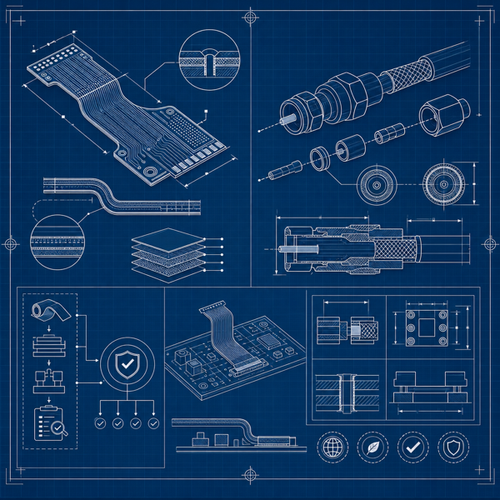
The electronics industry has reached new benchmarks in product reliability and performance with the October 2026 publication of two pivotal international standards. These fresh releases—IEC 63516:2026 and EN IEC 61076-2-117:2026—set forth clear procedures for folding durability in flexible opto-electric circuit boards and detail the latest requirements for a critical class of circular connectors, respectively. Together, they address enduring needs for robust design, precise testing, and seamless connectivity in today's fast-evolving electronics sector. Compliance with these standards is highly advised for organizations involved in the design, manufacturing, and integration of advanced electronics systems.
Overview / Introduction
The field of electronics underpins advances in every modern industry—from industrial automation to telecommunications, automotive, healthcare, and more. As devices become more compact, versatile, and data-driven, ensuring the longevity and integrity of connections and materials becomes a high-stakes challenge. International standards provide the common language and best practices necessary for manufacturers, system integrators, and quality managers to assure safety, interoperability, and future-proof design.
In this Part 3 of our October 2026 coverage for Electronics standards, we highlight two newly published standards:
- IEC 63516:2026 – Establishing a test method for the fixed folding durability of flexible opto-electric circuit boards (FOECBs)
- EN IEC 61076-2-117:2026 – Defining performance, mechanical, and environmental requirements for shielded and unshielded circular connectors M12 to M40 for applications up to 600 MHz
Read on for in-depth analysis of each standard, compliance guidance, and actionable technical insight.
Detailed Standards Coverage
IEC 63516:2026 - Fixed Folding Durability Test Method for Flexible Opto-Electric Circuit Boards
Fixed folding durability test method for flexible opto-electric circuit boards
IEC 63516:2026 is a landmark standard that delivers a rigorous, uniform method for evaluating the long-term mechanical durability of flexible opto-electric circuit boards (FOECBs), particularly those integrating both optical fibers and electrical pathways on a flexible substrate. This method is critical for industries where bending, folding, or movement of circuit substrates is expected—such as flexible displays, wearable electronics, advanced sensors, and next-generation data transmission modules.
The standard precisely defines:
- The apparatus setup required for testing, including fixtures for both tension and free-tension folding states
- Use of optical source (laser), photodetector, and data acquisition systems to monitor real-time signal transmission during stress
- Comprehensive sample preparation, measurement protocols (pre- and post-bending, optical and electrical performance assessments), and criteria for failure endpoint
- Test template guidelines covering both monofiber and multifiber circuit board geometries
Key requirements and specifications:
- Sample Preparation: Uniform handling protocols ensure comparability between tests and across organizations
- Test Conditions: Both tensioned and non-tensioned folding states are simulated, replicating real-world use environments
- Pass/Fail Criteria: Based on optical transmission loss or circuit breakage as monitored electrically and optically during prolonged folding
- Reporting: Documentation requirements for publishing results in a clear, actionable format
Who needs to comply:
- Manufacturers of flexible circuit boards with integrated opto-electric functionality
- Device integrators in consumer electronics, automotive, aerospace, and medical device sectors using flexible substrates
- Testing laboratories and quality assurance professionals certifying next-gen electronic assemblies
Practical implications: Implementing IEC 63516:2026 provides supply chain stakeholders with validated durability data, mitigating warranty costs and recalls. It also enhances market confidence in flexible opto-electronic solutions by introducing transparent, reproducible assessment criteria.
Key highlights:
- Standardizes fixed folding durability testing for FOECBs across global supply chains
- Supports development of robust, long-life flexible electronic systems
- Applies to diverse applications: wearables, foldable displays, automotive sensors, and more
Access the full standard:View IEC 63516:2026 on iTeh Standards
EN IEC 61076-2-117:2026 - Specification for Shielded and Unshielded Connectors M12 to M40
Connectors for electrical and electronic equipment — Product requirements — Part 2-117: Detail specification for shielded and unshielded, free and fixed connectors M12 to M40 for power, auxiliary and data transmission with frequencies up to 600 MHz
EN IEC 61076-2-117:2026 sets a new level of clarity and performance for circular connectors—a backbone technology in industrial automation, telecommunications infrastructure, and any application requiring reliable high-frequency, high-power interconnects. The standard details the requirements for shielded and unshielded connectors (sizes M12, M17, M23, M40) capable of supporting power, auxiliary, and data transmission up to 600 MHz.
What the standard covers:
- Dimensional, mechanical, and environmental attributes for M12–M40 connectors
- Key electrical performance criteria: current carrying capacity (up to 70 A, 600 V), insulation resistance, voltage proof, and shielding effectiveness
- Signal integrity requirements for data applications including Ethernet to 10GBASE-T and beyond
- Full suite of test procedures and schedules covering endurance (mechanical/electrical), climatic resistance, vibration, shock, and insertion/withdrawal forces
- Codings to prevent mismating, with each size and variant supporting specific pin layouts and applications
Key requirements and specifications:
- Robustness: Enhanced ratings for mechanical operations and environmental stresses
- Signal Performance: Specifies permissible insertion/return losses, crosstalk, and impedance for high-frequency transmission
- Modularity: Supports fixed, free, rewirable and non-rewirable variants; male and female contacts
- Environment Ratings: IP degree of protection, chemical and climate resistance
Who needs to comply:
- Manufacturers and suppliers of industrial circular connectors
- System integrators, panel designers, and field service engineers in automation, transportation, robotics, process industries, and networks
- Procurement specialists evaluating components for high-data-rate or high-power environments
Practical implications: Complying with EN IEC 61076-2-117:2026 ensures compatibility and reliability across diverse applications, minimizes risk of field failures, and facilitates interoperability—especially important for environments combining data and power delivery within the same connector type.
Key highlights:
- Details comprehensive requirements for M12–M40 circular connectors up to 600 MHz
- Covers high power and high frequency needs in advanced automation and smart infrastructure
- Mandates rigorous testing for endurance, safety, and electromagnetic compatibility (EMC)
Access the full standard:View EN IEC 61076-2-117:2026 on iTeh Standards
Industry Impact & Compliance
Raising the Bar for Durability and Connectivity
Industry-wide adoption of these standards will help organizations:
- Reduce product failure rates and returns due to improved quality assurance
- Align with international best practices, supporting global market access and customer confidence
- Meet regulatory and client-driven documentation, as standardized test results and connector specifications are easier to validate
Compliance considerations:
- Transition periods should be integrated into quality and procurement processes; suppliers may need to certify new or existing product lines for compliance
- End-user industries (e.g., automotive, consumer electronics, industrial automation) should collaborate with suppliers to update conformance records and ensure backwards compatibility where needed
- Contact certification bodies or accredited testing labs for conformance testing; leverage published test schedules to streamline certification
Benefits of adoption:
- Enhanced reliability in flexible and high-frequency electronic assemblies
- Improved interoperability and integration between multi-vendor equipment
- Faster time to market due to clear, recognized specification frameworks
Risks for non-compliance:
- Increased probability of field returns, failures, or requalification requirements by major clients
- Potential loss of access to regulated or standards-driven markets
- Reputation risks from subpar product performance or safety incidents
Technical Insights
Common Technical Requirements
- Testing Under Realistic Conditions: Both standards contribute to more meaningful product validation by replicating end-use stresses—be it repeated folding for FOECBs, or the multitude of electrical, mechanical, and environmental tests for connectors
- Performance Monitoring: Real-time optical/electrical measurement in circuit boards; signal integrity and crosstalk validation in connectors
- Documentation: Both require extensive reporting and traceability, supporting robust supplier audits and long-term quality control
Implementation Best Practices
- Early Collaboration: Engage both design and test/QA teams at the earliest stages to select compliant materials, layouts, and components
- Supplier Integration: Include compliant test/certification results in procurement records; regularly review supplier technical data sheets for standards alignment
- Training: Provide ongoing training for engineering, production, and inspection staff on updated test methods, metrics, and compliance documentation
- Product Lifecycle Planning: Build standards compliance into product updates, and monitor stability dates for published standards to anticipate revisions
Testing and Certification Considerations
- Equipment: Invest in up-to-date test hardware (laser sources, photodetectors, data acquisition systems, connector mating force gauges)
- Certification: Leverage accredited third-party testing wherever possible for impartiality
- Continuous Improvement: Use standards as baselines for internal audits and supplier reviews
Conclusion / Next Steps
The October 2026 publication of IEC 63516:2026 and EN IEC 61076-2-117:2026 marks a significant moment for the electronics sector—one where durability, reliability, and performance can be assured at higher levels for both flexible circuit assemblies and critical circular connector interfaces.
Key takeaways:
- These standards deliver robust frameworks for testing and specifying flexible circuit durability and connector performance in advanced electronics
- Early adoption yields quality assurance improvements, regulatory compliance, and increased market competitiveness
Recommended actions for organizations:
- Review product and process conformance against the latest standard editions
- Engage with supply chain partners to update procurement and test documentation
- Access full standards documentation on iTeh Standards to ensure comprehensive understanding
- Stay proactive: monitor upcoming standard revisions and enhancements
Adopting these standards is more than a compliance exercise—it’s an investment in the longevity and global readiness of your electronics offerings.
Categories
- Latest News
- New Arrivals
- Generalities
- Services and Management
- Natural Sciences
- Health Care
- Environment
- Metrology and Measurement
- Testing
- Mechanical Systems
- Fluid Systems
- Manufacturing
- Energy and Heat
- Electrical Engineering
- Electronics
- Telecommunications
- Information Technology
- Image Technology
- Precision Mechanics
- Road Vehicles
- Railway Engineering
- Shipbuilding
- Aircraft and Space
- Materials Handling
- Packaging
- Textile and Leather
- Clothing
- Agriculture
- Food technology
- Chemical Technology
- Mining and Minerals
- Petroleum
- Metallurgy
- Wood technology
- Glass and Ceramics
- Rubber and Plastics
- Paper Technology
- Paint Industries
- Construction
- Civil Engineering
- Military Engineering
- Entertainment