


Plug-and-Socket Device and Connector Standards: Boosting Safety, Reliability, and Business Scalability
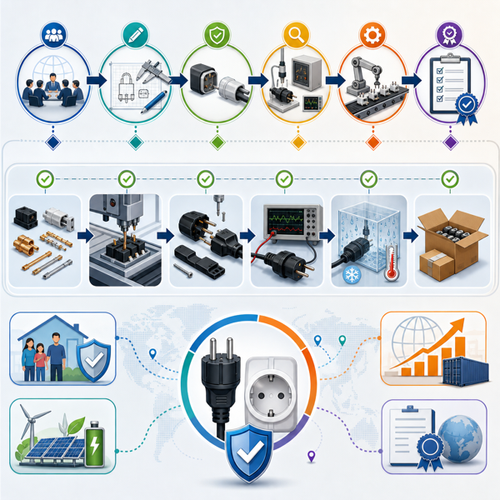
Plug-and-Socket Device and Connector Standards: Boosting Safety, Reliability, and Business Scalability
Plug-and-socket devices and electronic connectors are the invisible workhorses of modern electronic, IT, and industrial systems. Ensuring the safety, performance, and reliability of these essential components is critical—not just for compliance, but also for enabling innovation, secure data transmission, and scaling up business operations. This article explores four foundational international standards for connectors in the electronics sector. By understanding and adopting these standards, organizations can maximize safety, reduce downtime, improve system interoperability, and future-proof their technology investments.
Overview / Introduction
Today’s electronics industry is built on seamless connections—literally. From high-speed data centers and telecommunications to industrial automation and process control, plug-and-socket devices and connectors form the backbone of physical infrastructure. With rapid technological advancements, increasing network demands, and evolving cybersecurity threats, the need for standardized, high-performance connectors is more pressing than ever.
Standards define the requirements, tests, and specifications that plug-and-socket devices and connectors must meet to ensure safe, consistent, and reliable operation worldwide. For electronics manufacturers, integrators, and end-users, standards provide:
- A benchmark for compatibility and performance
- Enhanced safety and reduced risk of failure
- Interoperability across systems and vendors
- Support for high-speed, high-frequency data transmission
- Streamlined compliance, certification, and market acceptance
This in-depth overview covers four key standards:
- IEC 60603-7-3:2010 – 8-way, shielded connectors for data up to 100 MHz
- IEC 60603-7-7:2010 – 8-way, shielded connectors for data up to 600 MHz
- IEC 61076-2-105:2008 – Circular M5 connectors for industrial use
- IEC TS 61586:1997 – Reliability estimation for electrical connectors
You’ll gain practical insight into what each standard covers, their technical requirements, the value of implementation, and best practices for compliance—all in accessible, jargon-free language.
Detailed Standards Coverage
IEC 60603-7-3:2010 – 8-Way, Shielded Connectors Up to 100 MHz
Connectors for electronic equipment – Part 7-3: Detail specification for 8-way, shielded, free and fixed connectors, for data transmission with frequencies up to 100 MHz
This standard specifies requirements for 8-way, shielded connectors used in electronic equipment and structured cabling systems. It’s essential for components like modular plugs and jacks commonly used in IT networks, voice/data applications, and industrial controls.
Scope and Requirements
IEC 60603-7-3 sets out the mechanical, electrical, and transmission-performance criteria for connectors supporting data frequencies up to 100 MHz—making them suitable for Category 5 (Cat 5) and Class D structured cabling as defined by ISO/IEC 11801.
- Dimensional compatibility: Ensures connectors can be mated with other IEC 60603-7 series components.
- Shielding: Provides improved interference protection compared to unshielded types.
- Electrical, environmental, and mechanical tests are referenced from IEC 60603-7 and IEC 60603-7-1.
- Backward compatibility: Guarantees that new connectors work with earlier versions, protecting infrastructure investments.
Key Technical Specifications
- Insertion loss, return loss, NEXT, FEXT: These parameters define the quality of signals passing through the connector.
- Transmission requirements: Strict thresholds are established for crosstalk and delay, minimizing data loss or corruption.
- Standard test schedules: Defined for quality assurance in manufacturing.
Who Needs to Comply?
Electronics manufacturers, cabling and networking companies, data center operators, and anyone supplying or installing Ethernet and structured cabling systems. Compliance is also critical for manufacturers targeting international markets.
Practical Implications
- Ensures that connectors perform reliably for high-speed local area networks (LANs), VoIP, and industrial Ethernet.
- Reduces the risk of network downtime and maintenance costs.
- Guarantees seamless integration into existing infrastructures, supporting organizational growth and scalability.
Key highlights:
- Backward-compatible shielded 8-way connectors
- Performance parameters up to 100 MHz for Class D/Cat 5 applications
- Harmonized testing and interoperability across vendors
Access the full standard:View IEC 60603-7-3:2010 on iTeh Standards
IEC 60603-7-7:2010 – 8-Way, Shielded Connectors Up to 600 MHz
Connectors for electronic equipment – Part 7-7: Detail specification for 8-way, shielded, free and fixed connectors for data transmission with frequencies up to 600 MHz
This standard takes high-speed data transmission to the next level, defining requirements for connectors fit for Category 7 (Cat 7) and Class F cabling, supporting frequencies up to 600 MHz. These are crucial for future-proofing high-performance data centers and enterprise networks.
Scope and Requirements
The scope encompasses 8-way, shielded connectors—both free (plugs) and fixed (outlets or jacks)—designed for advanced high-frequency data transmission. The standard references core characteristics from IEC 60603-7 and 60603-7-1 but introduces critical enhancements:
- Updated electrical and transmission criteria: For operation at much higher frequencies, minimizing signal loss and crosstalk.
- Backward compatibility: Ensures interoperability with lower category connectors.
- Harmonized testing: Test methods are now referenced to IEC 60512-26-100, improving consistency.
- TCL (Transverse Conversion Loss) and TCTL (Transverse Conversion Transfer Loss): Newly added requirements address electromagnetic compatibility and reduce signal disturbance.
Key Technical Specifications
- Insertion loss, return loss, NEXT, FEXT, TCL, TCTL: All specified for 1–600 MHz operation.
- Mechanical strength and environmental resistance: Inherited from the base series.
Who Needs to Comply?
Manufacturers and integrators designing or deploying data center infrastructure, high-speed Ethernet, and telecom networks, as well as OEMs producing Category 7 connectors and cabling systems.
Practical Implications
- Enables reliable, error-free Gigabit and multi-Gigabit Ethernet performance.
- Supports media-rich applications including video streaming, cloud services, and industrial automation.
- Maintains compatibility across upgrades, allowing cost-effective infrastructure scaling.
Key highlights:
- High-frequency shielded connectors for Cat 7/Class F
- Enhanced tests for TCL and TCTL (electromagnetic compatibility)
- Streamlined compliance through harmonized testing
Access the full standard:View IEC 60603-7-7:2010 on iTeh Standards
IEC 61076-2-105:2008 – Circular M5 Connectors with Screw-Locking
Connectors for electronic equipment – Product requirements – Part 2-105: Circular connectors – Detail specification for M5 connectors with screw-locking
This standard addresses the design and performance of M5 circular connectors used in industrial process automation, measurement, and control. These connectors are ideal for sensor networks, fieldbus connections, and other robust industrial applications.
Scope and Requirements
IEC 61076-2-105 outlines the dimensional, mechanical, electrical, and environmental requirements for M5 screw-locking connectors:
- Connector types: Includes fixed (panel-mount), free (cable-mount), non-rewireable, and rewireable variants.
- Contact arrangements: 3 or 4 contacts, male and female options.
- Termination methods: Screw, crimp, insulation displacement, solder, and more.
Key Technical Specifications
- Electrical ratings: 60V AC/DC, 1A per contact
- Insulation resistance: 10⁸ Ω minimum
- Ingress protection: Design for industrial environments (consult IEC 60529 for IP rating specifics)
- Mechanical endurance: Insertion/withdrawal forces, vibration resistance, contact retention
- Climatic suitability: Tested per IEC 60068 for industrial temperature/humidity ranges
Who Needs to Comply?
Component manufacturers, industrial automation providers, engineers designing process control panels, and integrators of machine-to-machine communication systems.
Practical Implications
- Guarantees reliable, maintenance-friendly connections for sensors and actuators
- Supports miniaturization in compact industrial environments
- Reduces downtime thanks to robust lock and endurance specifications
Key highlights:
- Defines robust, small-form connectors for harsh industrial use
- Wide variety of termination and mounting styles
- Ensures high resistance to vibration, ingress, and mechanical stress
Access the full standard:View IEC 61076-2-105:2008 on iTeh Standards
IEC TS 61586:1997 – Estimation of the Reliability of Electrical Connectors
Estimation of the reliability of electrical connectors
Reliability is a mission-critical factor for any system where connectors are used—not just for safety, but also for reducing costly failures and maximizing uptime. IEC TS 61586 provides a technical specification (type 2 report) for the systematic estimation of electrical connector reliability, using rigorous accelerated test programs and statistical analysis methods.
Scope and Requirements
The specification outlines a structured methodology for:
- Identifying intrinsic and extrinsic degradation mechanisms
- Designing accelerated test programs (environment, cycles, stress)
- Collecting failure and lifetime data for statistical analysis
- Applying mathematical models to estimate the probability of sustained connector performance over time
- Defining acceptance criteria relevant to specific applications
Key Technical Guidance
- Statistical analysis: Utilizes methods for estimating connector reliability based on test data, including consideration of extreme-value distributions.
- Test protocols: Encourages accelerated life testing to simulate long-term environmental and operational conditions.
- Failure modes: Provides a framework for understanding and categorizing failure modes, ensuring effective quality management.
Who Needs to Comply?
Manufacturers aiming for high-reliability connectors, OEMs in aerospace, defense, medical, or mission-critical industrial applications, and reliability engineers seeking to validate connector fitness for purpose.
Practical Implications
- Helps organizations quantify component reliability, supporting preventive maintenance planning
- Reduces risk of unforeseen failures, enhances system safety, and boosts customer confidence
- Supports certification and competitive differentiation in quality-driven markets
Key highlights:
- Systematic guidance for accelerated reliability estimation
- Guidance for robust, statistically-valid quality assurance
- Critical tool for design, procurement, and certification in safety-sensitive fields
Access the full standard:View IEC TS 61586:1997 on iTeh Standards
Industry Impact & Compliance
Business Risks and Opportunities
Implementing these IEC standards is far more than a checkbox for regulatory compliance—it is a strategic investment in reliability and scalability. The business advantages include:
- Consistent global quality: Ensuring that products and systems function as expected, regardless of geography.
- Enhanced safety: Minimizing risks of electrical faults, failures, and data loss.
- Productivity: Reducing unplanned downtime and costly troubleshooting.
- Interoperability: Facilitating integration with global supply chains, expanding market reach.
- Future-proofing: Standards provide a pathway for seamless upgrades (backward compatibility).
- Cybersecurity: Shielded and high-spec connectors play a role in defending against electromagnetic interference and eavesdropping.
Compliance Considerations
- Documentation and traceability are essential for proving adherence to standards.
- Testing and certification should be structured around the formal test schedules outlined in each standard.
- Regular reviews of standards are necessary to keep up with technology advances and emerging risks.
Risks of Non-Compliance
- Increased product recalls or safety incidents
- Loss of market access due to insufficient certification
- Incompatibility leading to costly system rework or downtime
- Higher warranty and maintenance costs
Implementation Guidance
Practical Steps for Adoption
- Gap Analysis: Audit existing connectors and cabling to identify any non-compliant elements.
- Supplier Verification: Choose suppliers and partners that demonstrate ongoing compliance.
- Testing and Certification: Leverage accredited labs for critical verification.
- Technical Training: Ensure key engineering and installation staff are familiar with the relevant standards and their implications.
- Continuous Improvement: Monitor for updated editions and industry best practices.
Best Practices
- Proactive Design: Integrate standards into the design process from the start, rather than as an afterthought.
- Cross-Department Collaboration: Ensure quality, engineering, procurement, and IT teams work together in selecting and verifying connectors.
- Lifecycle Management: Use connector reliability data for preventive maintenance and upgrades.
- Global Alignment: Track both IEC and regional/national standards for complete market coverage.
Resources for Organizations
- Consult the iTeh Standards [https://standards.iteh.ai] platform for up-to-date documents and cross-references.
- Engage with accredited certification bodies for conformity assessment.
- Access technical forums and industry groups for peer advice and lessons learned.
Conclusion / Next Steps
The landscape of plug-and-socket devices and connectors is evolving rapidly to address increased data demands, security concerns, and system complexity. The four cornerstone standards covered here—IEC 60603-7-3, IEC 60603-7-7, IEC 61076-2-105, and IEC TS 61586—equip businesses with the framework to deliver reliable, high-performance, and globally compatible products.
Organizations stand to gain improved productivity, fewer failures, and greater agility by embedding these standards into product development, procurement, and compliance strategies. Staying current with standards is not just about meeting today’s requirements, but enabling tomorrow’s possibilities.
Ready to enhance reliability and future-proof your infrastructure?
- Audit your current connector and cabling systems against the latest IEC standards.
- Explore the full specifications and implementation resources via iTeh Standards for a competitive and compliant future.
- Foster a culture of quality and standardization—your customers, teams, and bottom line will thank you.
Categories
- Latest News
- New Arrivals
- Generalities
- Services and Management
- Natural Sciences
- Health Care
- Environment
- Metrology and Measurement
- Testing
- Mechanical Systems
- Fluid Systems
- Manufacturing
- Energy and Heat
- Electrical Engineering
- Electronics
- Telecommunications
- Information Technology
- Image Technology
- Precision Mechanics
- Road Vehicles
- Railway Engineering
- Shipbuilding
- Aircraft and Space
- Materials Handling
- Packaging
- Textile and Leather
- Clothing
- Agriculture
- Food technology
- Chemical Technology
- Mining and Minerals
- Petroleum
- Metallurgy
- Wood technology
- Glass and Ceramics
- Rubber and Plastics
- Paper Technology
- Paint Industries
- Construction
- Civil Engineering
- Military Engineering
- Entertainment