


Safety of Machinery: Key Environmental Standards for Electro-sensitive Devices, Software, and Press Brakes
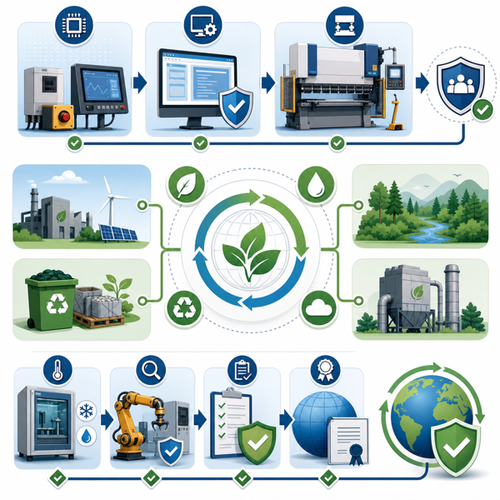
When it comes to the safety of machinery in modern industrial environments, adherence to international standards is no longer optional—it is essential. Businesses face increasing demands to guarantee productivity, security, and the ability to scale operations efficiently while leveraging new technologies. With constant innovation in machine tools, automation, and integrated safety systems, the risks associated with equipment have evolved in complexity and consequence. This article highlights three pivotal international standards that ensure safer machinery environments: IEC 61496-3:2025 for electro-sensitive protective equipment, IEC TR 61508-3-3:2025 addressing object-oriented safety-related software, and ISO 6909:2026 focusing on press brake safety. By embracing these standards, organizations can confidently navigate regulatory landscapes, minimize downtime, protect personnel, and safeguard investments in advanced technologies.
Overview / Introduction
Machinery safety within the environmental sector is undergoing rapid transformation. As equipment grows more sophisticated—fueled by automation, sensor technologies, and software-driven controls—the imperative for robust safety standards grows with it. Beyond regulatory compliance, adherence to these guidelines secures operational excellence, reduces workplace accidents, and supports long-term sustainability initiatives.
This guide unpacks three up-to-date international standards at the core of machinery safety today:
- Electro-sensitive protective equipment responsive to diffuse reflection (IEC 61496-3:2025)
- Object-oriented software safety for programmable electronic systems (IEC TR 61508-3-3:2025)
- Safety requirements for press brakes (ISO 6909:2026)
Each standard serves a unique role in fortifying the safety ecosystem around industrial machinery. In the following sections, we explore their scope, practical implementation, and why modern businesses cannot afford to ignore them.
Detailed Standards Coverage
IEC 61496-3:2025 – Advanced Safety with Electro-sensitive Protective Equipment
Safety of machinery – Electro-sensitive protective equipment – Part 3: Particular requirements for active opto-electronic protective devices responsive to diffuse reflection (AOPDDR)
Scope and Applicability: IEC 61496-3:2025 sets forth stringent requirements for the design, construction, and testing of electro-sensitive protective equipment (ESPE), focusing on devices that detect people or body parts using active opto-electronic principles responsive to diffuse reflection (AOPDDR). The technology underpins non-contact safety—ensuring machinery halts or reverts to a safe state when a person unexpectedly enters a hazardous zone. This is especially relevant in complex and high-risk environments using robotics, conveyors, or automated guided vehicles (AGVs).
Key Requirements and Specifications: IEC 61496-3:2025 details requirements for:
- Two- and three-dimensional detection zones—AOPDDR-2D and AOPDDR-3D, allowing flexible application for various machinery layouts
- Emission wavelength constraints (820 nm to 1100 nm), ensuring compatibility and safety of emissions within defined infrared ranges
- Performance testing to guarantee reliable detection of human presence with minimum object sizes ranging from 30 mm to 200 mm
- Testing for fault detection and light interference, ensuring device reliability even in challenging industrial lighting or reflective backgrounds
- Compatibility with functional safety standards, such as IEC 61496-1:2020 and ISO 12100, for holistic risk reduction strategies
- Marking, documentation, and manufacturer-provided information covering identification, safe use, and maintenance
Who Needs to Comply: Manufacturers, system integrators, and machinery users in almost every sector—automotive, packaging, materials handling, and more—who deploy non-contact safety solutions must comply. This is particularly critical where automated systems operate alongside people or handle valuable or dangerous materials.
Implementation Implications: Compliant systems must:
- Integrate AOPDDR devices with machinery controls to enable autonomous hazard detection
- Ensure rigorous initial and ongoing testing, as failures may dramatically increase injury risk
- Follow device specification for detection zone size and layout, as these impact risk reduction capability
- Maintain detailed records for audits or regulatory inspections
Notable Features:
- Does not cover outdoor applications but can be used as guidance for non-standard wavelengths
- Includes technical revisions, consolidating some requirements from broader safety standards for greater clarity
- Optional features (e.g., use as trip devices) are defined to support a wide range of safety architectures
Key highlights:
- Clearly defines safety criteria for modern opto-electronic protective devices
- Facilitates integration with other safety systems
- Supports diverse machine configurations (2D and 3D detection zones)
Access the full standard:View IEC 61496-3:2025 on iTeh Standards
IEC TR 61508-3-3:2025 – Object-Oriented Software in Functional Safety Systems
Functional safety of electrical/electronic/programmable electronic safety-related systems – Part 3-3: Object-oriented software in safety-related systems
Scope and Applicability: IEC TR 61508-3-3:2025 offers robust guidance on the design of object-oriented software for safety-related programmable electronic systems—fundamental for factories leveraging automation, digital twins, or advanced control software. As object-oriented languages become the norm, this standard addresses their unique challenges for functional safety in machinery and process environments.
Key Requirements and Specifications:
- Offers a comprehensive framework for evaluating and mitigating systematic software faults using object-oriented design (OOP)
- Supplements existing IEC 61508 rules, notably those on software lifecycle management, assessment, modularization, and information hiding
- Provides techniques and methods for:
- Encapsulation and inheritance management
- Contracts and interface verification (via Liskov Substitution Principle, invariants, pre- and post-conditions)
- Managing dynamic objects and memory to avoid unpredictable behaviors
- Exception handling, runtime checking, and formal correctness verification
- Focuses on SIL (Safety Integrity Level) alignment for each mitigation measure, guiding organizations on how rigorously to apply specific software techniques
Who Needs to Comply: Software engineers, safety managers, and system architects for industries running safety-critical machinery, such as manufacturing, energy, chemicals, or transportation, should apply this recommendation. It is particularly relevant for those using object-oriented programming in PLCs, distributed control systems, or embedded safety controllers.
Implementation Implications:
- Mandates the planning and application of accepted OO software patterns, frameworks, and coding standards
- Requires risk-driven selection of development and verification techniques tailored to the intended SIL
- Demands thorough documentation and traceability of all safety-related software modules
- Encourages use of formal verification tools, testing frameworks, and contract-oriented programming where appropriate
Notable Features:
- Provides tailoring of techniques according to the desired level of systematic capability
- Delivers actionable measures for major OOP concepts (encapsulation, inheritance, polymorphism, and dynamic object management)
- Supports seamless integration and verification in complex modular safety environments
Key highlights:
- Establishes ‘state-of-the-art’ best practices for object-oriented software in safety-critical systems
- Reduces the risk of software-induced failures in machinery
- Facilitates compliance with existing IEC 61508 requirements
Access the full standard:View IEC TR 61508-3-3:2025 on iTeh Standards
ISO 6909:2026 – Comprehensive Safety for Press Brakes in the Machine Tool Industry
Machine tools — Safety — Press brakes
Scope and Applicability: ISO 6909:2026 is the definitive safety standard for the design, manufacture, and supply of press brakes, including hydraulic, servo-drive (hydraulic, screw, belt-spring), and similar sheet material handling equipment. It covers cold metalworking as well as other process materials (cardboard, plastics, rubber, leather), recognizing the wide use of press brakes across manufacturing and fabrication sectors.
Key Requirements and Specifications:
- Specifies safety requirements for all stages of a machine’s lifecycle—design, installation, operation, and maintenance
- Mandates protective measures against mechanical and non-mechanical hazards, including:
- Safeguarding access to moving parts and tool areas using fixed and interlocked guards, light curtains, and ESPEs
- Control system safety, including manual controls, failure modes, and response to power issues
- Noise, electrical, hydraulic, thermal, and ergonomic risk controls
- Specific requirements for redundant and monitored hydraulic control systems, isolation, and energy dissipation
- Emphasizes risk assessment and reduction based on ISO 12100 principles, ensuring all significant hazards are identified and mitigated
- Covers marking, information for use, and technical documentation to support safe operation and maintenance
- Integrates guidance for integration with manufacturing systems while maintaining operator safety
Who Needs to Comply: Manufacturers and integrators of press brakes, fabricators using such machinery, and anyone responsible for workplace safety in metalworking or materials processing must adopt these requirements. As automation and integration become more common, this standard is vital for safe system design and operation.
Implementation Implications:
- All new machines must be designed and documented from the ground up for compliance—unsafe legacy machines are out of scope
- Operators and maintenance teams need proper training and access to detailed safety instructions
- Automatic workpiece handling equipment (where used) should be specified in line with additional standards referenced (such as ISO 11161)
Notable Features:
- Addresses hazards specific to modern press brake architectures—servo, hydraulic, or hybrid
- Ensures compliance with the latest machinery safety and ergonomics standards
- Includes detailed annexes on test codes, system response, and integration with opto-electronic safety devices
Key highlights:
- Provides a single, authoritative source for press brake safety
- Comprehensive lifecycle coverage: from concept to decommissioning
- Aids in regulatory compliance and market acceptance across regions
Access the full standard:View ISO 6909:2026 on iTeh Standards
Industry Impact & Compliance
The adoption of these standards yields far-reaching benefits and is quickly becoming a competitive necessity. As governments and clients demand ever-higher safety and environmental stewardship, demonstrating compliance with globally recognized specifications is a critical business enabler.
Industry Impact:
- Increases operational uptime by preventing accidents and safe-stopping machinery in hazardous events
- Protects companies from costly regulatory penalties, product recalls, or site shutdowns
- Strengthens market reputation by upholding industry best practices in safety and environmental care
Compliance Considerations:
- Third-party certification and independent safety assessment are often required for high-risk installations or export
- Up-to-date records (test, maintenance, software verification) are mandatory for regulatory audits
- Non-compliance can result in legal action, insurance difficulties, reputational damage, and in some cases criminal liability
Benefits of Adopting These Standards:
- Enhanced personnel safety reduces injury-related downtime and compensation costs
- Streamlined scaling and technology upgrades thanks to standardized safety interfaces and controls
- Improved machinery performance and lifecycle through ongoing compliance and rigorous testing
- Competitive differentiation for markets demanding demonstrated environmental stewardship
Risks of Non-Compliance:
- Increased likelihood of workplace accidents and costly downtime
- Barriers to selling machinery in regulated markets
- Difficulty in insuring non-compliant machinery or systems
Implementation Guidance
Implementing international safety standards for machinery involves strategic planning, cross-department collaboration, and detailed project execution. Here are essential steps and best practices for smooth integration and compliance:
Common Implementation Approaches
- Conduct comprehensive risk assessment – Use ISO 12100 methodologies to identify all relevant hazards for each machine or system.
- Select and integrate compliant technologies – Source devices (such as ESPE/AOPDDR) certified to current standards for all critical applications.
- Develop and enforce safety-related control system architectures – Ensure software (object-oriented or otherwise) follows the prescribed design, testing, and validation protocols for required safety integrity levels.
- Document everything – Maintain traceable records for all safety-related design, manufacturing, installation, and testing processes.
- Train personnel – Operators, engineers, and maintenance staff must be thoroughly trained in safe operation, troubleshooting, and emergency response.
Best Practices
- Perform lifecycle-oriented safety planning, including regular reviews and upgrades as standards evolve
- Use established frameworks and pre-validated components where possible to save time and ensure compliance
- Engage independent certified bodies for validation, especially when entering new markets or deploying ground-breaking technologies
- Leverage digital tools for documentation, simulation, and maintenance scheduling to streamline auditing and compliance efforts
Useful Resources
- International safety bodies (e.g., IEC, ISO)
- Industry associations (e.g., European Machinery Directive networks, American National Standards Institute)
- Accredited certification organizations
- Professional training providers for machinery safety, software development, and risk assessment
Conclusion / Next Steps
As technology and regulation move swiftly forward, the need for robust, harmonized safety measures in machines and their control systems is more critical than ever. IEC 61496-3:2025, IEC TR 61508-3-3:2025, and ISO 6909:2026 collectively provide a foundation for building and maintaining safe, productive, and scalable operations.
Key Takeaways:
- These standards address both hardware (devices, controls) and software (object-oriented programming, functional safety) for machinery safety
- Implementation shields organizations from the most serious risks and positions them for seamless integration of new automation and digital technologies
- Tapping into global best practices not only enhances safety but also boosts competitiveness and market access
Recommendations for Organizations:
- Assess current machinery and safety practices against these standards
- Plan for phased or comprehensive upgrades to meet or exceed applicable requirements
- Engage with training, third-party certification, and industry networks to maintain continuous compliance and improvement
- Explore the full library of related standards on iTeh Standards for ongoing guidance
Stay at the forefront of safe, productive, and future-proof industrial environments—adopt these key safety standards today.
https://standards.iteh.ai/catalog/standards/iec/373cda83-ec8d-4564-97d8-2437b46f52e3/iec-61496-3-2025https://standards.iteh.ai/catalog/standards/iec/6dad39fe-dbd1-4276-87dd-52501c2af035/iec-tr-61508-3-3-2025https://standards.iteh.ai/catalog/standards/iso/4383d753-80b7-492f-a285-a6c8a689fc69/iso-6909-2026
Categories
- Latest News
- New Arrivals
- Generalities
- Services and Management
- Natural Sciences
- Health Care
- Environment
- Metrology and Measurement
- Testing
- Mechanical Systems
- Fluid Systems
- Manufacturing
- Energy and Heat
- Electrical Engineering
- Electronics
- Telecommunications
- Information Technology
- Image Technology
- Precision Mechanics
- Road Vehicles
- Railway Engineering
- Shipbuilding
- Aircraft and Space
- Materials Handling
- Packaging
- Textile and Leather
- Clothing
- Agriculture
- Food technology
- Chemical Technology
- Mining and Minerals
- Petroleum
- Metallurgy
- Wood technology
- Glass and Ceramics
- Rubber and Plastics
- Paper Technology
- Paint Industries
- Construction
- Civil Engineering
- Military Engineering
- Entertainment