


Optical Equipment Standards: Ensuring Performance, Quality, and Innovation in Image Technology
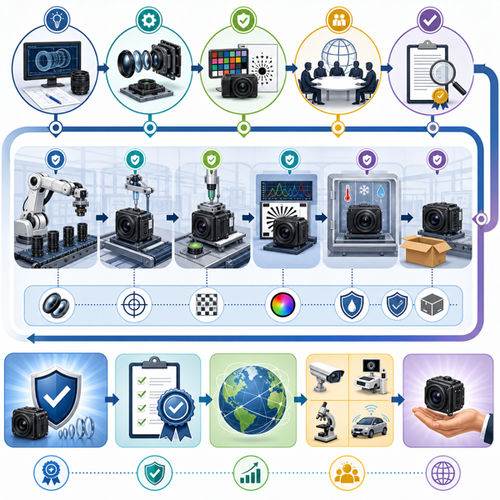
In the rapidly evolving landscape of image technology and optical equipment, ensuring consistency, performance, and innovation hinges on adherence to rigorous standards. Optical components today underpin everything from telecommunications and medical devices to high-precision manufacturing and scientific research. As industries adopt new technologies, global standards form the backbone for reliable product development, smooth scaling, and secure operations. This article explores three pivotal international standards: ISO 10110-5:2026, ISO 11382:2022, and ISO 25387:2026—each shaping the future of optical equipment by defining critical requirements for design, materials, and measurement accuracy. By understanding and implementing these standards, organizations boost productivity, facilitate safe integration of new technologies, and create scalable, secure foundations for growth in image technology.
Overview / Introduction
Image technology powers some of the world’s most advanced industries, from the precision lenses in scientific instruments to the sensors in autonomous vehicles and the optics that drive next-generation telecommunications. The complexity of modern optical systems means that even minor deviations in surface form, material properties, or measurement methods can result in critical performance issues. This is why specialized international standards are more essential than ever.
Why do these standards matter?
- They provide a common language for design and quality, which is vital for collaboration between global partners.
- Standards ensure integrity and reliability, minimizing costly errors and non-compliant outputs.
- Adhering to internationally recognized optical equipment standards supports innovation, enhances scalability, and improves security in data- and image-sensitive applications.
What will you learn in this article?
- A clear, accessible breakdown of three leading standards in optical equipment, offering guidance for both seasoned professionals and newcomers.
- The practical requirements, scope, and application of each standard.
- Concrete benefits for business, including increased productivity, smoother technology scaling, and improved system security.
Whether you’re in R&D, manufacturing, quality assurance, or procurement, understanding these standards is vital for implementing new technologies and staying ahead in the image technology sector.
Detailed Standards Coverage
ISO 10110-5:2026 – Surface Form Tolerances for Optical Elements
Optics and photonics — Preparation of drawings for optical elements and systems — Part 5: Surface form tolerances
This standard provides the detailed framework for indicating surface form tolerances on optical drawings within the ISO 10110 series. ISO 10110-5:2026 covers rules for specifying maximum allowable surface deviation for optical elements—crucial for ensuring components like lenses and mirrors consistently meet stringent performance demands. The standard now emphasizes nanometres as the preferred unit for surface deviation, recognizing the industry’s shift toward more precise, software-driven measurements.
What does the standard cover?
- Methods to indicate tolerances for surface forms, such as plano, spherical, aspheric, cylindric, toric, and more complex geometries.
- Both interferometric and non-interferometric measurement approaches, ensuring compatibility with the latest metrology technologies.
- Code systems and tabular formats for including tolerances directly on technical drawings.
- Use of Zernike polynomials for representing complex surface deviations, catering to advanced design and analysis software.
Key requirements & applications
- Tolerance indications for power deviation, irregularity, local slope, local curvature, and Zernike residuals.
- Specifications must include units (preferably nanometres) and reference any base wavelength when using alternative units like fringe spacings.
- Targeted at manufacturers, designers, and quality assurance teams involved with optical components, from single lenses to entire imaging systems.
Implementing this standard ensures precision manufacturing, minimizes ambiguity in communications, and enables seamless scaling from prototype to mass production. Explicit, standardized tolerance indications also streamline global supply chains and reduce costly errors.
Key highlights:
- Defines explicit codes and formats for surface form indications
- Preferential use of nanometres, compatible with modern digital metrology
- Incorporates both classic and advanced measurement/statistical methodologies
Access the full standard:View ISO 10110-5:2026 on iTeh Standards
ISO 11382:2022 – Characterization of Optical Materials in the Infrared
Optics and photonics — Optical materials and components — Characterization of optical materials used in the infrared spectral range from 0.78 µm to 25 µm
As infrared imaging expands into new domains—including defense, remote sensing, and high-speed communications—the ability to accurately characterize the optical materials used becomes vital. ISO 11382:2022 sets forth clear guidelines for describing and measuring the essential properties of materials intended for passive infrared optical components.
What does the standard cover?
- Standardizes the terminology, nomenclature, and datasheet requirements for a wide range of infrared materials.
- Specifies parameters needed for full material characterization: transmittance, refractive index, absorption, birefringence, and more, across the 0.78 µm to 25 µm spectral range.
- Defines methods for property measurement, accounting for both material structure and manufacturing process variations.
- Addresses additional physical and thermal properties important in demanding environments (e.g., thermal expansion, hardness, and optical homogeneity).
Key requirements & applications
- Essential for manufacturers, specifiers, and users of IR optics in imaging systems, sensors, and remote-sensing instruments.
- Provides a baseline for comparing materials from different suppliers, ensuring component interchangeability and consistent system behavior.
- Reduces risk of device failure or degraded performance due to inaccuracies in material data.
By ensuring that infrared materials are accurately and consistently described, the standard supports reliable supply chains, reduces integration risk, and accelerates time-to-market for new IR technologies.
Key highlights:
- Comprehensive datasheet structure for infrared optical materials
- Specifies transmittance, refractive index, and homogeneity metrics
- Applies to all passive IR optical components, across multiple industries
Access the full standard:View ISO 11382:2022 on iTeh Standards
ISO 25387:2026 – Measuring Point Resolution in High-Resolution Electron Microscopy
Microbeam analysis — Analytical electron microscopy — Procedures for determining the point resolution of high-resolution transmission electron microscope
High-resolution transmission electron microscopy (HRTEM) is a cornerstone tool for characterizing nanoscale materials with atomic-level detail. The critical metric of HRTEM performance is its point resolution (Scherzer resolution), directly impacting the ability to image and analyze the smallest features in materials science, semiconductors, and life sciences. ISO 25387:2026 defines universal procedures for determining this crucial metric and the spherical aberration coefficient of the objective lens.
What does the standard cover?
- Details a process for determining Scherzer resolution using FFT analysis of images from amorphous thin films.
- Specifies how to identify and measure at least three dark rings in FFT patterns, calibrate spatial frequency axes, and calculate the real spherical aberration coefficient of the microscope.
- Restricts application to HRTEMs where these features are observable, excluding Cs-corrected TEMs (where performance limits are set by different criteria).
Key requirements & applications
- Used by laboratory scientists, quality controllers, and equipment vendors to benchmark, calibrate, and validate high-resolution TEM instruments.
- Provides standard operating procedures for measurement and quantification, making instrument comparisons and certifications reliable across laboratories and countries.
- Critical for research-intensive industries, semiconductor fabrication, nanotechnology, metallurgy, and advanced materials engineering.
Adopting this standard assures accurate, consistent assessment of state-of-the-art nanostructure imaging, which underpins innovation in new materials and device development.
Key highlights:
- Universal procedure for Scherzer resolution determination
- Includes calibration and error estimation for FFT-based measurement
- Ensures instrument comparability and measurement traceability
Access the full standard:View ISO 25387:2026 on iTeh Standards
Industry Impact & Compliance
How Do These Standards Affect Businesses and Organizations?
Implementation of these optical equipment standards has become a strategic necessity for organizations—especially those bringing new technologies to market or scaling up production of imaging devices. Key benefits of compliance include:
- Demonstrable Quality Assurance: Clear, quantifiable specifications drive reliable, reproducible manufacturing and testing, opening doors to quality certifications and regulatory approval.
- Global Market Access: Harmonized standards remove technical barriers and facilitate international trade, collaboration, and interoperability.
- Operational Efficiency: Precise standards reduce ambiguity and rework, streamlining communication between design, manufacturing, and testing teams.
- Risk Mitigation: Standards lower the risk of costly recalls, warranty claims, or failed integrations.
- Rapid Innovation: With uniform technical requirements, organizations can accelerate product development, integrate new optics or materials, and leverage advances in metrology and automation.
- Security & Data Integrity: Consistency in imaging and measurement is critical for security-centric sectors such as medical imaging, surveillance, and semiconductor manufacturing.
Compliance Considerations
- Documentation and Traceability: Maintaining records of compliance, testing methodologies, and calibration is crucial.
- Supplier Management: Ensure that upstream and downstream partners understand and fulfill standard requirements.
- Continuous Training: Stay updated as new editions are released, and ensure personnel are skilled in implementation and verification techniques.
- Audit Readiness: Regular internal and external audits help guarantee ongoing compliance and speed up regulatory inspections.
Failure to comply can lead to product rejection, contractual losses, legal liability, and loss of market share—especially in sectors where safety, security, or performance is tightly regulated.
Implementation Guidance
Best Practices for Adopting Optical Equipment Standards
Successfully implementing optical equipment standards—such as those for drawings and tolerances, material characterization, and performance measurement—requires organization-wide commitment and a systematic approach.
Common Implementation Steps:
- Gap Analysis: Review existing processes and specifications against the chosen standards (e.g., ISO 10110-5, ISO 11382, ISO 25387).
- Training and Skill Development: Educate engineering, QA, and procurement teams on standard requirements and interpretation.
- Process Integration: Embed standards into CAD/CAE workflows, metrology SOPs, supplier specs, and quality documentation.
- Calibration and Equipment Upgrades: Ensure your measurement instruments—interferometers, spectrometers, and electron microscopes—are capable of the precision required by the standards, and are regularly calibrated.
- Supplier Engagement: Collaborate with material and component suppliers to guarantee data and documentation align with international standard requirements.
- Regular Auditing: Periodically review processes to confirm ongoing compliance as standards evolve.
Best Practices:
- Use digital platforms (like iTeh Standards) to access up-to-date standard texts and related resources.
- Leverage sample documentation templates provided by the standards to build traceable, compliant records.
- Foster a culture of standardization and continuous improvement by integrating standards training into onboarding and development programs.
- Use advanced software tools for drawing preparation and measurement analysis that support direct import/export of standard-compliant data.
Resources
- iTeh Standards: Comprehensive international standards catalog, technical documentation, and purchasing platform (https://standards.iteh.ai).
- Vendor Technical Support: Many equipment and material suppliers offer documentation, calibration, and compliance consulting tailored to ISO and IEC standards.
- Industry Associations: Professional societies like the Optical Society (OSA) and SPIE often provide training and networking on optics standards.
Conclusion / Next Steps
Optical equipment forms the core infrastructure behind countless innovations in science, industry, and daily life. As systems become ever more complex and precision-driven, adopting and implementing international standards is no longer optional—it is essential for competitive differentiation, risk management, and accelerated growth.
From specifying the tiniest surface tolerance on a drawing (ISO 10110-5:2026), to ensuring your infrared materials are reliable (ISO 11382:2022), to benchmarking your nanometrology instrument (ISO 25387:2026), these standards are the foundation for productivity, quality, security, and scalable deployment in image technology.
Key takeaways:
- Standards future-proof your organization as new technologies, measurement methods, and materials emerge.
- They provide the structure for compliance, innovation, and continuous improvement.
- Sharpen your competitive edge by engaging with international standards, training teams, and integrating best practices throughout your workflow.
Next steps:
- Explore the full text of each standard via iTeh Standards.
- Assess your current compliance and put a plan in place for adoption or update.
- Stay informed: As standards evolve, periodic review ensures your business remains ahead of regulatory and market requirements.
Unlock reliability, boost productivity, and secure your place at the forefront of image technology by implementing industry-leading optical equipment standards today.
Categories
- Latest News
- New Arrivals
- Generalities
- Services and Management
- Natural Sciences
- Health Care
- Environment
- Metrology and Measurement
- Testing
- Mechanical Systems
- Fluid Systems
- Manufacturing
- Energy and Heat
- Electrical Engineering
- Electronics
- Telecommunications
- Information Technology
- Image Technology
- Precision Mechanics
- Road Vehicles
- Railway Engineering
- Shipbuilding
- Aircraft and Space
- Materials Handling
- Packaging
- Textile and Leather
- Clothing
- Agriculture
- Food technology
- Chemical Technology
- Mining and Minerals
- Petroleum
- Metallurgy
- Wood technology
- Glass and Ceramics
- Rubber and Plastics
- Paper Technology
- Paint Industries
- Construction
- Civil Engineering
- Military Engineering
- Entertainment