

September 2026: Essential Agriculture Standards Released for Machinery, Feed, and Fertilizers
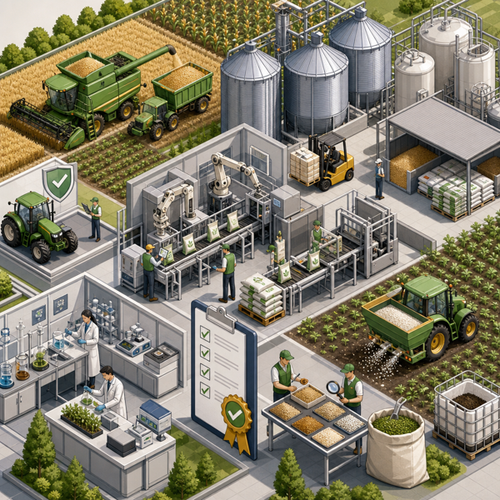
Agriculture continues to evolve with technology and regulation converging to ensure safer, more efficient, and environmentally responsible practices. In September 2026, four pivotal international standards were published for the agriculture sector, bringing new safety protocols, analytical methods, and product requirements. These standards address machinery safety in feed mills, contaminant risk in vaping products, the measurement of metals in fertilizers, and crucial updates to agricultural machinery. Understanding and implementing these standards is vital for agriculture professionals looking to optimize safety, compliance, and product quality.
Overview / Introduction
The agriculture industry faces mounting pressure to enhance safety, product integrity, and environmental sustainability. International standards are the backbone that supports these objectives, offering robust frameworks and tested methodologies for tackling industry-specific risks. By aligning operations with up-to-date standards, organizations can achieve regulatory compliance, drive product improvement, and reinforce customer trust.
This article explores the four newly published standards for agriculture in September 2026, providing insights into their scope, key requirements, and their impact on industry stakeholders. Whether you're a compliance officer, quality manager, researcher, or procurement specialist, understanding these updates will help you make informed decisions for your facility, products, or clients.
Detailed Standards Coverage
ISO 24142:2026 - Safe Design Aspects for Machinery in Feed Processing Mills
Safe design aspects for machinery in feed processing mills
This new ISO standard sets out detailed safety principles and requirements for machinery used in animal feed processing mills. Filling a notable gap, it addresses hazards and risks unique to animal feed equipment that existing generic machinery standards often overlook. Covering every phase of the machine life cycle—from initial design to maintenance—ISO 24142:2026 empowers manufacturers, facility managers, and safety officers to proactively assess and control mechanical, electrical, thermal, and ergonomic risks.
Key areas:
- Mechanical Safety: All exposed moving parts require protective devices; particular focus is given to guarding, interlocking mechanisms, and fail-safes for maintenance.
- Electrical Safety: Machinery must comply with stringent enclosure and bonding requirements to prevent electrical shock and static discharge.
- Fire and Explosion Prevention: Rigorous controls must be in place to manage dust and static, referencing additional standards for explosive atmospheres where applicable.
Who should comply:
- Manufacturers of feed processing machinery
- Feed mill operators
- Maintenance service providers
- Health and safety regulators
Practical implications:
- Enhanced design protocols lead to safer workplaces, reduced accident rates, and easier regulatory clearance.
- Provides a base for training programs and aligns with international market requirements.
Notable changes:
- Focused specifically on feed mills and excludes food for human consumption and non-solid feeds.
- Expands on mechanical risk, operator ergonomics, confined space controls, and provides guidance on consistent labeling and documentation.
Key highlights:
- Systematic risk analysis anchored in ISO 12100
- Specific solutions for safeguarding rotating parts and access platforms
- Requirements for spill management and fire/explosion extraction systems
Access the full standard:View ISO 24142:2026 on iTeh Standards
CEN/TS 18334:2026 - Extractables and Leachables Assessment in Vaping Products
Extractables and leachables assessment in vaping products
Although vaping products may seem on the periphery of agriculture, their raw materials, carrier solvents, and even flavorings frequently intersect with agricultural production. This technical specification introduces a detailed, stepwise process for evaluating extractable and leachable chemicals that may migrate from product containers or device components into e-liquids and aerosols.
Scope and requirements:
- Applies to electronic cigarettes, e-liquids, cartridges, and refill containers
- Enforces a risk-based approach, starting with a desk assessment and escalating to laboratory extraction studies based on risk
- Demands robust analytical methods, including non-targeted screening, threshold calculations, and toxicological risk assessment
Who should comply:
- Manufacturers of e-cigarettes and refill containers
- Supplier quality engineers and toxicologists
- Procurement procurement managers
Practical implications:
- Early risk assessment can save costs by limiting unnecessary testing
- Provides transparent benchmarks for ingredient and material sourcing
- Protects consumers and minimizes the risk of regulatory sanctions
Notable features:
- Does not address shelf life directly but links leachables limits to predicted product life
- Introduces Analytical Evaluation Thresholds (AET) and Permitted Daily Exposure (PDE) concepts
- Stresses laboratory traceability, method validation, and reporting thresholds
Key highlights:
- Robust decision-tree for risk profiling and test requirement escalation
- Semi-quantitative and targeted analysis requirements for chemicals
- Alignment with toxicological thresholds and industry best practices
Access the full standard:View CEN/TS 18334:2026 on iTeh Standards
EN 16319:2026 - Inorganic Fertilizers and Liming Materials: Determination of Specific Elements
Inorganic fertilizers and liming materials - Determination of cadmium, chromium, copper, lead, nickel and zinc by ICP-AES after aqua regia dissolution
This European standard is crucial for fertilizer producers, agriculture labs, and regulatory agencies requiring precise quantification of heavy metals in fertilizers and liming products. The standard prescribes the use of inductively coupled plasma-atomic emission spectrometry (ICP-AES) after specifically defined aqua regia digestion, ensuring accuracy and reproducibility for cadmium (Cd), chromium (Cr), copper (Cu), lead (Pb), nickel (Ni), and zinc (Zn) content.
Scope and requirements:
- Applies to inorganic fertilizers and blends where these components are the major fraction by mass
- Outlines stepwise sample preparation, digestion, calibration, and analysis methodologies
- Specifies trace detection and correction for matrix effects
Who should comply:
- Fertilizer manufacturers and blenders
- Agricultural chemistry labs
- Compliance and regulatory agencies
Practical implications:
- Ensures products remain under legal heavy metal limits
- Facilitates traceability, batch recordkeeping, and customer confidence
- Supports market entry for fertilizers in regulated markets
Notable updates from previous version:
- Now includes copper and zinc measurement
- Enhanced procedures for sample preparation and matrix adjustment
- Updated normative references, precision, and inter-laboratory validation data
Key highlights:
- Quantification limits as low as 0.3 mg/kg for cadmium
- Addresses blends and products with complex matrices
- Guides on calibration, quality assurance, and method validation
Access the full standard:View EN 16319:2026 on iTeh Standards
ISO 3410:2026 - Agricultural Machinery: Variable-Speed V-Belts and Groove Sections of Pulleys (Datum System)
Agricultural machinery — Variable-speed V-belts and groove sections of pulleys (Datum system)
This globally recognized ISO standard specifies the critical dimensions and tolerances for variable-speed V-belts and associated pulley groove profiles, with significant relevance for harvester-threshers and other agricultural equipment requiring reliable power transmission.
Scope and requirements:
- Defines dimensional criteria for endless variable-speed V-belts
- Includes parameters for fixed and variable-diameter pulley groove sections using the datum system
- Details tolerances on belt length, section, and center distance variation
Who should comply:
- Agricultural machinery designers and manufacturers
- Replacement part suppliers
- Maintenance engineers
Practical implications:
- Guarantees belt and pulley compatibility, minimizing equipment downtime
- Helps standardize spare part production and repairs across international markets
- Reduces variance in machine performance due to dimensional deviations
Notable revisions:
- Updates to cross-section permission and Table 3
- Clarifies groove profile measurements and checking methodology
Key highlights:
- Ensures harmonization in agricultural drive systems
- Covers both initial manufacture and maintenance/inspection benchmarks
- Enhances reliability and service life of critical machine components
Access the full standard:View ISO 3410:2026 on iTeh Standards
Industry Impact & Compliance
The publication of these four standards marks a significant advancement for the agriculture sector, touching on occupational safety, product safety, quality assurance, and environmental compliance.
Impacts on businesses:
- Immediate compliance obligations for new feed machinery and fertilizer batches
- Structured frameworks for risk assessment and product validation in vaping-related agricultural components
- Harmonized design references for agricultural machinery parts—vital for global manufacturing and maintenance
Compliance considerations:
- Review and update existing policies, particularly on machinery procurement, maintenance, and operator training
- Audit supplier and in-house lab capabilities against the latest analytical requirements
- Integrate toxicological risk analysis into product development and quality assurance workflows
Benefits of adoption:
- Enhanced workplace and consumer safety
- Increased market confidence and regulatory acceptance
- Operational efficiencies from standardized procedures and test methods
Risks of non-compliance:
- Regulatory penalties and product recalls
- Exclusion from key export markets
- Increased incidence of workplace accidents and equipment failures
Technical Insights
Across these standards, a number of shared technical requirements and considerations emerge:
- Comprehensive risk evaluation: From machinery design (ISO 24142:2026) to chemical migration risk (CEN/TS 18334:2026), risk-based thinking underpins compliance.
- Validated analytical methods: EN 16319:2026 and CEN/TS 18334:2026 both stress method validation, calibration, and detection limits—ensuring reproducibility and trust in results.
- Compatibility and dimensional accuracy: ISO 3410:2026 codifies physical interchangeability, reducing the risk of fitment errors in agricultural equipment.
- Documentation and traceability: All standards demand robust recordkeeping—vital for internal monitoring, supplier management, and regulatory audits.
- Best practices for implementation:
- Conduct gap assessments against each standard’s requirements
- Train staff on new protocols and update internal SOPs
- Work with accredited labs and suppliers adhering to the latest editions
Conclusion / Next Steps
September 2026’s suite of agriculture standards delivers crucial updates for anyone involved in feed production, fertilizer manufacturing, agricultural machinery design, or vaping product supply chains. By adopting these standards, organizations can boost safety, compliance, and operational reliability—while opening the door to new markets and continuous improvement.
Recommendations:
- Download and review each standard in full from iTeh Standards
- Integrate new requirements into purchasing, training, and audit cycles
- Engage with certified professionals and accredited laboratories
- Ensure ongoing monitoring of compliance developments as international norms continue to evolve
Explore the latest agriculture standards:Visit iTeh Standards Agriculture Collection
Stay tuned for further updates and insights to keep your agriculture operations at the cutting edge of safety, compliance, and quality.
Categories
- Latest News
- New Arrivals
- Generalities
- Services and Management
- Natural Sciences
- Health Care
- Environment
- Metrology and Measurement
- Testing
- Mechanical Systems
- Fluid Systems
- Manufacturing
- Energy and Heat
- Electrical Engineering
- Electronics
- Telecommunications
- Information Technology
- Image Technology
- Precision Mechanics
- Road Vehicles
- Railway Engineering
- Shipbuilding
- Aircraft and Space
- Materials Handling
- Packaging
- Textile and Leather
- Clothing
- Agriculture
- Food technology
- Chemical Technology
- Mining and Minerals
- Petroleum
- Metallurgy
- Wood technology
- Glass and Ceramics
- Rubber and Plastics
- Paper Technology
- Paint Industries
- Construction
- Civil Engineering
- Military Engineering
- Entertainment