


June 2026: New Automotive Standards Advance Electric Charging and Automated Driving
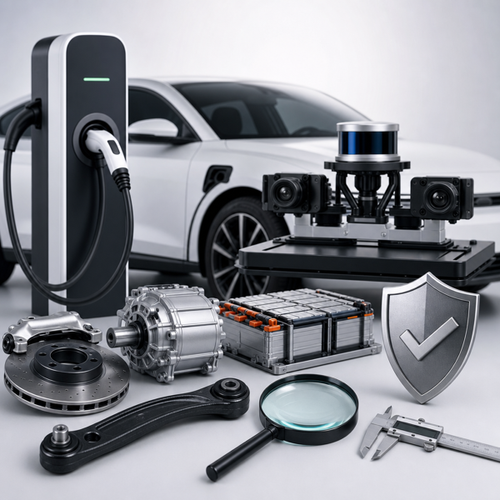
June 2026 Brings Key Automotive Standards Advancements: Electric Charging and Automated Driving
The automotive sector is experiencing a wave of innovation driven by electrification and automation. In June 2026, five influential standards were published that redefine protocols for electric vehicle supply equipment (EVSE) integration and enhance the logical interfaces between vehicle sensors and data fusion units for automated driving. These standards aim to increase interoperability, safety, and innovation in the rapidly evolving field of automotive and road vehicles. This article—Part 1 of a comprehensive two-part series—delivers expert analysis on the new standards, vital requirements, and practical implications for industry professionals.
Overview
The Automotive and Road Vehicles sector is approaching a pivotal transformation, as the adoption of electric vehicles (EVs) and automated driving technologies accelerates worldwide. Industry standards are at the heart of this progress, ensuring that new solutions are safe, interoperable, and future-ready. For engineers, compliance officers, quality managers, researchers, and procurement leaders, understanding these standards is essential for market success and regulatory alignment.
In this article, we dive into five newly published ISO and ISO/IEC standards:
- Two application-layer protocols for advanced EVSE charger communications
- Three logical interface specifications for sensors in automated driving systems (general, radar, and lidar)
You’ll gain clarity on:
- What each standard covers
- The requirements and use cases
- Who needs to comply
- Best practices and technical considerations for implementation
Detailed Standards Coverage
ISO/IEC 14543-4-303:2026 – Interoperable Communications for EVSE Chargers
Information technology — Home electronic system (HES) architecture — Part 4-303: Application protocol for electric vehicle supply equipment (EVSE) chargers and controllers
This standard sets the application-layer protocol for communications between EVSE chargers and their controllers, leveraging the Network Enhanced Communications Device (NECD) protocol. It provides crucial guidelines to foster interoperability across products from different manufacturers, making EV charging infrastructure more unified and future-proof.
The protocol operates over UDP (using IPv4 or IPv6; TCP is optional) and specifies message structure, command sequences, timeout management, and required command sets. It facilitates energy management services, remote control operations, startup routines, and fault notifications—enabling both residential and commercial settings to seamlessly integrate EVSEs into home energy systems and smart grids.
Key highlights:
- NECD protocol implementation for EVSE chargers and controllers
- Detailed definitions for message exchange, command sequencing, and property handling
- Start-up, normal, and fault handling operations for robust system management
Access the full standard:View ISO/IEC 14543-4-303:2026 on iTeh Standards
ISO/IEC 14543-4-304:2026 – Protocol for Bidirectional EVSE Charging/Discharging
Information technology — Home electronic system (HES) architecture — Part 4-304: Application protocol for electric vehicle supply equipment (EVSE) charger and dischargers and controllers
Expanding on the foundation established in ISO/IEC 14543-4-303, this standard introduces an application-layer protocol for bidirectional communications—enabling both charging and discharging between EVSE units and their controllers. This enhancement supports technologies such as Vehicle-to-Grid (V2G) and Vehicle-to-Home (V2H) energy transfer, which are pivotal for grid stability and energy efficiency.
The protocol again utilizes the NECD framework over UDP/IP, delivering definitions for command and status messaging, attribute information retrieval, and nuanced scenarios such as fault management and remote operational control. The technical content distinguishes between charger and discharger roles, ensures interoperability, and enables integration with home energy management systems and utility signals.
Key highlights:
- Complete protocol for both charging and discharging operations in EVSE systems
- Advanced support for V2G and decentralized energy marketplace roles
- Harmonized interface models for management, run-time communication, and remote control
Access the full standard:View ISO/IEC 14543-4-304:2026 on iTeh Standards
ISO 23150-11:2026 – Logical Interfaces for Radar Sensors in Automated Driving
Road vehicles — Logical interface between sensors and data fusion unit for automated driving functions — Part 11: Radar specific interfaces
Automated driving requires seamless data flow between radar sensors and data fusion units. ISO 23150-11:2026 specifies technology-specific logical interfaces for radar sensors or clusters used in vehicles with automated driving capabilities. It formalizes the detection level interface (DLI), defining data structures for radar detection headers, measurement signals, ambiguity indicators, object classification, and signal-to-noise ratios. The standard leverages principles defined in ISO 23150-1:2026 to promote modular and semantic interface design.
The interface definitions accommodate diverse operational profiles, including mandatory and optional radar detection features, ambiguity handling (for radial velocity or angle domains), and detection status tracking. This advances the accuracy, reliability, and safety of automated driving systems by ensuring compatibility across multi-vendor radar sensors and fusion units.
Key highlights:
- Modular, technology-specific logical detection level interfaces for radar sensors
- Comprehensive coverage of detection attributes, ambiguity handling, and data qualifiers
- Aligned with the ISO 23150 sensor data fusion architecture
Access the full standard:View ISO 23150-11:2026 on iTeh Standards
ISO 23150-1:2026 – General Principles for Sensor–Fusion Interfaces in Automated Driving
Road vehicles — Logical interface between sensors and data fusion unit for automated driving functions — Part 1: General information and principles
This foundational standard introduces the general architecture and modular principles for logical interfaces between environmental perception sensors and data fusion units in automated road vehicles. By providing generic templates covering different abstraction levels (feature, advanced detection, detection), ISO 23150-1 enables vendors to implement sensor fusion systems that are interoperable, scalable, and maintainable across evolving technology stacks.
Coverage includes nomenclature, architectural context, interface levels, signal groupings, and best-practice profiles for vehicle coordinate systems, sensor clusters, and detection classification. Implementation avoids prescribing electrical or raw data interfaces—focusing solely on logical, algorithm-friendly communication.
Key highlights:
- Universal, modular templates for all types of perception sensor interfaces (radar, lidar, camera, etc.)
- Semantic data modeling for flexible system integration
- Industry baseline for all subsequent ISO 23150 sensor interface standards
Access the full standard:View ISO 23150-1:2026 on iTeh Standards
ISO 23150-12:2026 – Lidar Sensor Logical Interfaces for Automated Driving
Road vehicles — Logical interface between sensors and data fusion unit for automated driving functions — Part 12: Lidar specific interfaces
As lidar technology becomes central to automated driving, standardized logical interfaces are vital for consistent system integration and vendor neutrality. ISO 23150-12:2026 specifies technology-specific logical interfaces for lidar sensors or clusters. Like its radar counterpart, it defines detection level interface (DLI) protocols, providing structured communication for measurements, detection attributes, ambiguity profiles, and error models.
The standard directly references the semantic, modular guidelines of ISO 23150-1 and scopes out both feature level interface (FLI) and advanced detection level interface (ADLI) for lidar deployment scenarios. The aim is to enhance the reliability, safety, and interoperability of lidar-based environmental sensing in complex driving environments.
Key highlights:
- Detection level interface specifically structured for lidar data streams
- Profiles to support unique lidar measurement and ambiguity characteristics
- Supports robust data fusion and high-level semantic scene interpretation
Access the full standard:View ISO 23150-12:2026 on iTeh Standards
Industry Impact & Compliance
The June 2026 standards present significant implications for various industry players:
- Automotive manufacturers must update or verify that their electric charging solutions and automated driving architectures align with the latest interoperability and data management requirements.
- EVSE manufacturers are now better positioned to bring cross-compatible, grid-enabled chargers to market, boosting consumer and infrastructure confidence.
- Software developers and system integrators dealing with ADAS (Advanced Driver-Assistance Systems) can leverage standardized logical interfaces for streamlined sensor integration and validation, driving safety and innovation.
- Compliance officers and quality managers gain a clear, internationally recognized framework for testing, documentation, and regulatory reporting.
Compliance considerations:
- Organizations should review certification requirements and plan for design reviews or audits to demonstrate conformance
- Early adoption allows access to emerging markets and facilitates integration with future legislative frameworks, especially in regions with proactive EV and autonomous vehicle regulations
- Non-compliance can increase risks (product recalls, liability, loss of market access), while alignment reduces operational costs and technical debt
Business benefits:
- More efficient R&D with plug-and-play components
- Long-term cost savings via futureproof system architectures
- Increased customer trust through standard-conformant solutions
Technical Insights
Common Technical Requirements:
- All the reviewed standards emphasize modular, semantic, and logical abstraction—enabling future flexibility as automotive technologies evolve
- UDP over IPv4/IPv6 ensures performance for time-sensitive charging and control commands; TCP is available for enhanced reliability when required
- Detection level interfaces for both radar and lidar share core structural elements, supporting flexible, multi-sensor data fusion crucial for vehicle autonomy
Implementation Best Practices:
- Prioritize semantic modeling: Use the standard’s recommended templates for all interfaces—this ensures compatibility and smoother system evolution
- Plan for interoperability: Implement all mandatory properties and options for both NECD protocols (for EVSE) and automated driving sensor interfaces
- Test extensively: Simulate both normal and fault conditions to confirm robust protocol handling and to meet industry quality benchmarks
- Integrate version management: Properly manage interface versions and profiles as specified for lifecycle compatibility
Testing and Certification Considerations:
- Use conformance and error models provided in the standards for robust QA/QC
- Work with recognized laboratories or certification bodies to document compliance, especially for new product launches or when entering regulated markets
- Develop internal checklists based on both mandatory and conditional requirements to speed up audits
Conclusion & Next Steps
The June 2026 release of these five automotive standards marks a transformative step in unifying electric vehicle charging and automated driving system integration. For industry stakeholders—engineers, compliance teams, and decision-makers—the imperative is clear: stay ahead of technical and regulatory shifts by reviewing, integrating, and certifying against these standards.
Next steps for organizations:
- Obtain and study the full texts of the relevant standards (see direct links above)
- Conduct internal gap assessments and update R&D or design processes accordingly
- Stay tuned for Part 2 of this series for additional standards published this month
- Subscribe to iTeh Standards alerts for ongoing updates in automotive standardization
Compliant, forward-thinking adoption not only ensures operational and regulatory security but also fuels innovation in the age of smart, sustainable mobility.
For further reading and to access the complete collection of standards, visit iTeh Standards.
Categories
- Latest News
- New Arrivals
- Generalities
- Services and Management
- Natural Sciences
- Health Care
- Environment
- Metrology and Measurement
- Testing
- Mechanical Systems
- Fluid Systems
- Manufacturing
- Energy and Heat
- Electrical Engineering
- Electronics
- Telecommunications
- Information Technology
- Image Technology
- Precision Mechanics
- Road Vehicles
- Railway Engineering
- Shipbuilding
- Aircraft and Space
- Materials Handling
- Packaging
- Textile and Leather
- Clothing
- Agriculture
- Food technology
- Chemical Technology
- Mining and Minerals
- Petroleum
- Metallurgy
- Wood technology
- Glass and Ceramics
- Rubber and Plastics
- Paper Technology
- Paint Industries
- Construction
- Civil Engineering
- Military Engineering
- Entertainment