


August 2026 Brings New Standards for Glass Structures, Acoustics, and Motor Protection in Construction
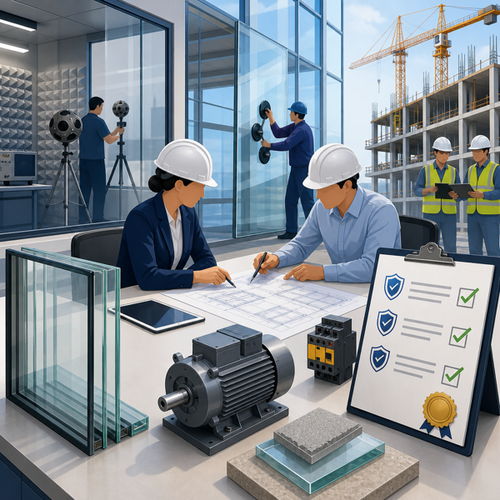
August 2026 marks a pivotal month for the Construction Materials sector, with the publication of three significant international standards. These new and revised documents set best-practice benchmarks for the design and safety of glass structures, the measurement of acoustic performance in modern workspaces, and the electrical protection of asynchronous motors. For architects, engineers, facilities managers, and procurement specialists, understanding these standards is essential for ensuring compliance, improving performance, and staying ahead in a competitive, regulation-driven market.
Overview
The construction and building materials industry is experiencing rapid change, driven by advances in technology, stricter safety requirements, and evolving use cases. International standards ensure that construction materials, building systems, and related equipment are consistently safe, high-quality, and efficient across global markets. New standards published in August 2026 address several emerging issues:
- Structural safety and resilience of glass assemblies under in-plane loads
- Field acoustic performance of office pods and furniture-based enclosures
- Application guidance for the protection and reliable operation of low-voltage asynchronous motors in building services
This article provides a comprehensive overview and analysis of these three standards, highlighting their content, intended application, compliance considerations, and expected impact on the building sector.
Detailed Standards Coverage
EN 19100-3:2026 - Design of In-Plane Loaded Glass Components
Eurocode 10 - Design of glass structures - Part 3: In-plane loaded glass components
Scope & Application: EN 19100-3:2026 delivers authoritative design rules for glass components and assemblies that are primarily subjected to in-plane loading—such as shear walls, glass bracing systems, and certain partitions. The standard covers both loads acting in-plane and parallel to the pane (relating to the neutral axes of glass elements) and offers construction guidance for joints connecting such components.
It should be used in conjunction with foundational Eurocodes (e.g., EN 1990-1, EN 1991 series) and other related standards.
Key Requirements:
- Limit state design methodology for glass components under in-plane stresses
- Robustness and redundancy requirements to prevent progressive collapse after fracture
- Safety verifications across Ultimate, Fracture, and Post-Fracture Limit States (ULS, FLS, PFLS)
- Provisions for evaluation by testing or validated theoretical assessment
- Rules for joint connections (sleeve bearings, lapped splices, friction connections)
- Application to both monolithic and laminated glass configurations
Who Should Comply:
- Structural engineers
- Architects specifying glass curtain walls, partitions, and bracing
- Manufacturers and installers of large-area glass assemblies
- Certifying bodies and quality managers
Practical Implications: Adoption of EN 19100-3:2026 will ensure that glass structures built for in-plane loads meet stringent safety criteria, resist failure after ply fracture, and can be reliably evaluated using testing or calculation. Design and verification procedures have been updated to reflect advances in material science and building techniques, with stronger emphasis on redundancy, risk assessment, and national choices via National Annexes.
Notable Changes from Previous Edition (CEN/TS 19100-3:2021):
- Expanded scope and updated references to harmonize with the second generation of Eurocodes
- Refined terminology and design approach for limit states
- More detailed requirements for robustness, fracture behavior, and repair options
Key highlights:
- Comprehensive design methodology for complex glass assemblies
- Enhanced safety protocols, especially for ply fracture and redundancy
- Validated testing/theoretical models for real-world conditions
Access the full standard:View EN 19100-3:2026 on iTeh Standards
ISO 23351-2:2026 - Field Method for Speech Level Reduction in Furniture Ensembles and Enclosures
Acoustics — Measurement of speech level reduction of furniture ensembles and enclosures — Part 2: Field method
Scope & Application: ISO 23351-2:2026 specifies engineering-grade procedures for measuring the apparent speech level reduction (ASLR) provided by furniture ensembles and enclosures—such as office pods, phone booths, meeting booths, and other modular acoustic furniture—under field conditions. It is designed to provide standardized, repeatable test results outside the laboratory, enabling the assessment of installed products in real workplace environments.
Key Requirements:
- Outlines the measurement approach for both partial and full enclosures intended for one or more users
- Defines the microphone positioning, measurement surfaces, and minimum environmental criteria
- Specifies test object preparation, including real-life operational states of doors, windows, fans, and electrical systems
- Establishes how to document deviations, uncertainties, and test results for reporting
- Ensures comparability with laboratory measurements for robust product benchmarking
Who Should Comply:
- Furniture manufacturers and acoustic product suppliers
- Acoustic consultants, specifiers, and building engineers
- Facility and office managers assessing solutions for open-plan speech privacy
- Buyers procuring office pods, booths, or acoustic separation products
Practical Implications: The standard enables reliable, field-based verification of speech privacy and acoustic performance for modular furniture and enclosures, supporting claims made by manufacturers and informing purchasing decisions. By prioritizing comparability and engineering-grade accuracy, it sets expectations for consistent acoustic performance in real-use scenarios.
Notable Features:
- Inclusion of both omnidirectional sound sources and artificial mouths for testing
- Adaptable test setups for different room types and enclosure sizes
- Emphasis on documentation and management of measurement uncertainty
Key highlights:
- Allows robust field evaluation of acoustic privacy solutions
- Supports buyers and users in both performance verification and product selection
- Standardizes the test methodology for diverse workplace environments
Access the full standard:View ISO 23351-2:2026 on iTeh Standards
IEC TS 61200-201:2026 - Application Guidance for Asynchronous Motor Starting and Protection
Application guidance based on the IEC 60364 series - Part 201: Asynchronous motor starting and protection
Scope & Application: IEC TS 61200-201:2026 provides comprehensive implementation guidance—following the IEC 60364 series—for protective measures applied to low-voltage asynchronous motors. Applicable to both squirrel cage and wound rotor motors, this document covers control strategies, electrical protection (against shock, overload, and thermal effects), and isolation procedures vital for building services and industrial installations.
Key Requirements:
- Details on selection and configuration of isolation, overload, and earth fault protection devices
- Distinctions between basic protection, fault protection, and additional protection provisions
- Guidance for multiple starting methods: direct-on-line, star-delta, auto-transformer, soft-starter, and variable frequency drives
- Coordination procedures between control and protective devices
- Extended annexes with detailed application scenarios, variable frequency drive systems, and recommendations for device positioning
Who Should Comply:
- Electrical engineers and contractors installing or maintaining building motor systems
- Facilities managers responsible for HVAC, pumps, lifts, and process machinery
- OEMs and panel builders producing starter assemblies
- Building compliance officers
Practical Implications: Ensuring proper protection and control for asynchronous motors directly affects personnel safety, system uptime, and energy efficiency. This guidance facilitates correct device selection, minimizes electrical hazards, and avoids costly equipment failures or unplanned production downtime.
Key highlights:
- Covers mandatory and recommended protective measures for all common low-voltage motor categories
- Addresses the challenges posed by frequent starts, large inrush currents, and complex load scenarios
- Up-to-date with modern controlgear, including soft-starters and variable frequency drives
Access the full standard:View IEC TS 61200-201:2026 on iTeh Standards
Industry Impact & Compliance
The publication of these three standards will have a far-reaching impact across the construction materials, building systems, and fit-out industries.
Compliance Considerations:
- Mandatory application varies by national adoption (especially for Eurocodes); organizations should verify jurisdictional requirements.
- Documentation and verification: New and revised standards expect rigorous verification through calculation, documentation of National Annex choices, and testing where appropriate (especially for glass structures and acoustic enclosures).
- Transition timelines: Early engagement is recommended to understand the effective dates and to roadmap compliance—especially for projects already in design or tender phases.
Benefits of Adoption:
- Heightened safety and reliability for buildings and occupants
- Clear specification language for procurement and contracting
- Improved product performance and consistency for both traditional and hybrid workspaces
- Faster, more reliable inspection and certification workflows
Risks of Non-Compliance:
- Legal liability in case of system failure, collapse, or safety incidents
- Reduced competitive advantage for non-compliant products
- Rejection of building plans or products in regulated markets
- Increased risk of post-construction retrofit costs due to inadequate early design
Technical Insights
While these standards address distinct technical domains, several common threads emerge:
- Risk-based Design: Emphasizing the identification and mitigation of failure modes—whether sudden glass fracture, acoustic leakage, or electrical hazards.
- Testing and Validation: Both EN 19100-3 and ISO 23351-2 emphasize that physical verification (mock-ups, field tests) is as critical as theoretical or numerical modeling.
- System Coordination: IEC TS 61200-201 illustrates the importance of coordinating protective devices with specific load and starter configurations, mirroring the integrative approach found in the Eurocodes between different materials and load paths.
Best Practices for Implementation:
- Early Engagement: Integrate compliance checks at the earliest design and procurement stages.
- Use Certified Products and Tools: Specify hardware and materials verified according to the latest standards.
- Train Technical Staff: Ensure engineers, installers, and assessors are familiar with new procedures and compliance requirements.
- Leverage Digital Tools: Building information modeling (BIM) systems and acoustical modeling software can streamline compliance documentation.
Testing & Certification Considerations:
- Prepare for robust documentary evidence—test reports, calibration certificates, simulation validations—especially when required by regulatory agencies or third-party certifiers.
- Factor field-conditions testing into project schedules and budgets for both acoustic and structural components.
Conclusion & Next Steps
August 2026’s new standards set a higher bar for construction materials, building safety, acoustics, and building equipment protection—empowering stakeholders to deliver better-performing, safer, and more reliable structures.
Key takeaways:
- EN 19100-3:2026 strengthens the design integrity of in-plane loaded glass structures
- ISO 23351-2:2026 provides a practical and field-ready method for verifying acoustic privacy in enclosures
- IEC TS 61200-201:2026 ensures the protection and reliable starting of asynchronous building motors
Recommendations:
- Review each standard in detail and update your design, procurement, and compliance processes accordingly
- Conduct staff training and update your suppliers on new requirements
- Monitor for National Annexes or local guidance that may affect implementation
Stay Ahead: Remain informed about future developments and upcoming standards releases by exploring the full collection on iTeh Standards, which provides authoritative access, version tracking, and implementation support for industry professionals.
Categories
- Latest News
- New Arrivals
- Generalities
- Services and Management
- Natural Sciences
- Health Care
- Environment
- Metrology and Measurement
- Testing
- Mechanical Systems
- Fluid Systems
- Manufacturing
- Energy and Heat
- Electrical Engineering
- Electronics
- Telecommunications
- Information Technology
- Image Technology
- Precision Mechanics
- Road Vehicles
- Railway Engineering
- Shipbuilding
- Aircraft and Space
- Materials Handling
- Packaging
- Textile and Leather
- Clothing
- Agriculture
- Food technology
- Chemical Technology
- Mining and Minerals
- Petroleum
- Metallurgy
- Wood technology
- Glass and Ceramics
- Rubber and Plastics
- Paper Technology
- Paint Industries
- Construction
- Civil Engineering
- Military Engineering
- Entertainment