

ISO 23351-2:2026
(Main)Acoustics — Measurement of speech level reduction of furniture ensembles and enclosures — Part 2: Field method
- Abstract
This document specifies a method to determine the apparent speech level reduction of furniture ensembles and enclosures (hereinafter referred to as test objects) in field conditions meeting engineering grade of accuracy. The method is applicable to furniture ensembles or enclosures, which can be used by one or more occupants. This method is not intended for single components used in workstations, such as a screen, a storage unit, a table, a luminaire, a cupboard, a bookshelf, a standard chair, a wall absorber, or a ceiling absorber.
- Status
- Published
- Publication Date
- 10-Aug-2026
- Technical Committee
- ISO/TC 43/SC 2 - Building acoustics
- Drafting Committee
- ISO/TC 43/SC 2/WG 34 - Speech attenuation
- Current Stage
- 6060 - International Standard published - 60 Publication
- Start Date
- 11-Aug-2026
- Due Date
- 02-May-2026
- Completion Date
- 02-May-2026

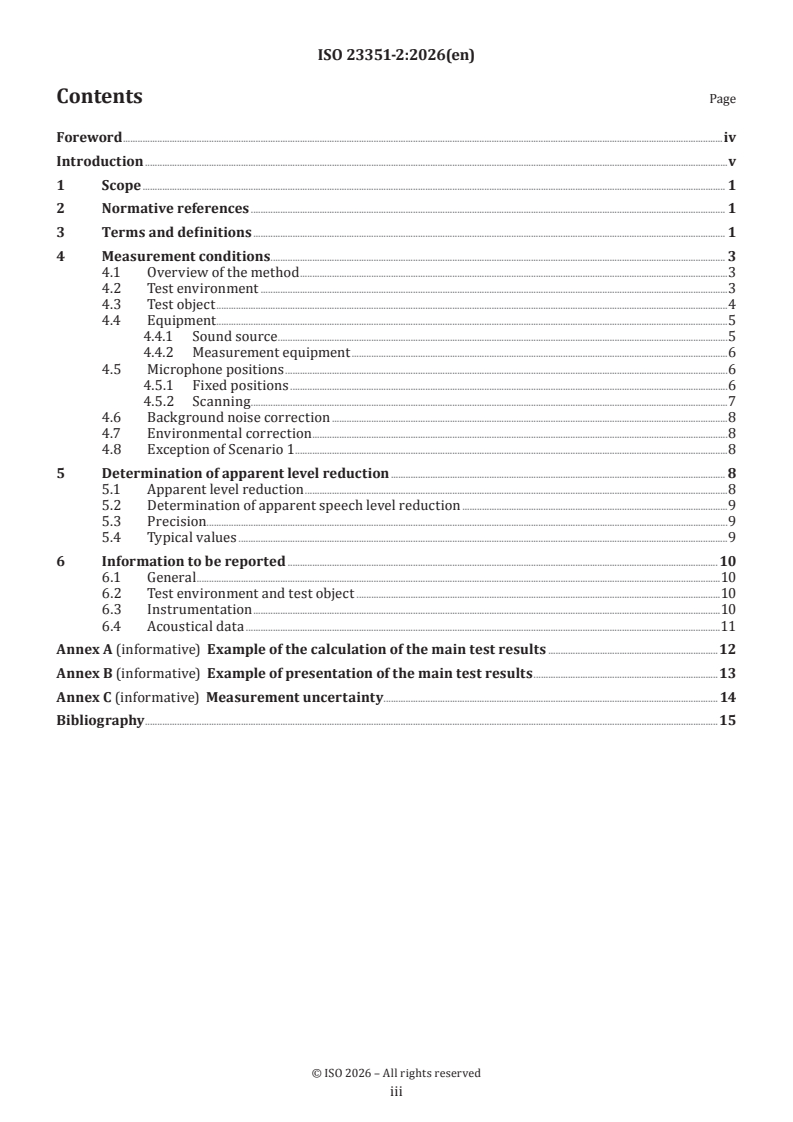
ISO 23351-2:2026 is an International Standard from ISO for measuring the apparent speech level reduction of furniture ensembles and enclosures in field conditions. It specifies a two-scenario acoustic comparison, with the same sound source measured without and with the test object in place, so the result shows how much the test object reduces speech level in practice. The method is intended for test objects used by one or more occupants.
What does ISO 23351-2:2026 specify?
ISO 23351-2:2026 specifies a field method to determine the apparent speech level reduction of furniture ensembles and enclosures, called test objects in the document. It applies to assembled products that can be used by one or more occupants, and it is organized into scope, normative references, terms and definitions, measurement conditions, result calculation, and reporting.
The scope excludes single workstation components such as a screen, storage unit, table, luminaire, cupboard, bookshelf, standard chair, wall absorber, or ceiling absorber. In practice, that means the standard is for complete partial enclosures and enclosures, not for isolated parts used on their own.
| Annex | What it covers |
|---|---|
| Annex A | Example of the calculation of the main test results |
| Annex B | Example of presentation of the main test results |
| Annex C | Measurement uncertainty |
What are the key requirements of ISO 23351-2:2026?
ISO 23351-2:2026 measures speech reduction by comparing the sound power level of a source in two scenarios: first without the test object, then with the test object around the source. The difference in 1/1-octave bands is the apparent level reduction, and a further conversion to standardized speech gives the apparent speech level reduction.
How the room and test object are set up
The test can be carried out in many room types, as long as there is enough space around the test object. In Scenario 2, the test object must be at least 1.5 m from room walls and from nearby furniture that is not part of the test object, and the room must be unoccupied except for the operator.
The room height must be at least 0.5 m larger than the test object. The document gives two measurement-surface options: a low-room option with four sub-surfaces and a high-room option with five sub-surfaces. This matters because the room geometry determines where microphones go and how sound from the top of the object is captured.
The test object must be assembled according to the manufacturer’s instructions, with operable parts in normal working condition. If the object has doors or windows, they are opened and closed at least five times before the test. Fixed accessories that are part of normal use are installed; extra user-brought items are not.
How the sound source is used
The source position must match the most likely mouth position of an occupant, and the position must be reported. For partial enclosures, the document uses an artificial mouth (AM); for enclosures, it uses an omnidirectional sound source (OSS). The source must produce wide-band steady-state noise, and its output must remain the same in both scenarios.
If the test object has several occupant positions, the number of source positions depends on how many occupants the object accommodates, and the position-specific results are averaged. This matters in practice because a larger booth or workstation may not behave the same at every seat.
What equipment and measurement methods are allowed
Measurement equipment must meet the stated Class 1 requirements from IEC 61672-1, IEC 61260-1, and IEC 60942. The complete measurement chain is checked before and after every session, and the calibrator, system, and filter set have defined verification intervals. In practice, this keeps the field method traceable and suitable for comparison between sites.
The standard allows fixed microphone positions or scanning. Fixed positions are placed on the measurement surface 0.5 m from the outer envelope of the test object and are distributed evenly; each position is measured for at least 10 s. Scanning uses horizontal lines, with line spacing between 0.5 m and 1.0 m and a maximum speed of 1.0 m/s. If scanning is used, the background noise measurement is scanned too.
How the corrections and result are determined
ISO 23351-2:2026 uses background noise correction and environmental correction according to ISO 3744. The environmental correction is based on the room absorption method and reverberation time from ISO 3382-2, not on the absolute comparison test. This is important because the method is designed to give comparable results across different rooms.
The apparent speech level reduction is calculated from the octave-band reduction by replacing the measured source spectrum with the standardized speech spectrum in the document. The result is a single number in dB, and typical values are said to be similar to those from ISO 23351-1. The document also gives an uncertainty summary, which helps readers judge how much variation to expect between operators, rooms, and setups.
What terms does ISO 23351-2:2026 define?
- Apparent level reduction - A frequency-dependent measure of how much the test object reduces sound power level in 1/1-octave bands from 125 Hz to 8 000 Hz.
- Apparent speech level reduction - The reduction in A-weighted sound power level of speech caused by the test object, given as a single-number result.
- Artificial mouth (AM) - The sound source used for partial enclosures; its requirements are given in ITU-T P.51.
- Enclosure - A single object enclosed with walls, ceiling, and door, with or without its own floor structure.
- Furniture ensemble - A set of furniture items, such as tables, screens, storage units, or connected sofas, treated as one object.
- Measurement surface - The imaginary box around the test object where microphone positions or scanning paths are located.
- Omnidirectional sound source (OSS) - The sound source used for enclosures; its directivity follows ISO 3382-1.
- Sound power level of speech - The standardized sound power level of normal-effort genderless speech used to convert the measured reduction into apparent speech level reduction.
Who uses ISO 23351-2:2026?
ISO 23351-2:2026 is used by manufacturers, acoustic test labs, consultants, buyers, and quality managers who need to assess acoustic performance of furniture ensembles and enclosures. It is relevant in offices, education spaces, health-care premises, industrial spaces, and public interiors.
Manufacturers use it for product development and for comparing large or site-installed products that are not practical to test in a laboratory. Buyers, tenants, and lessors use it to verify declared performance in situ. Test laboratories and acoustic engineers use it to document comparable field results for partial enclosures and booths.
Which standards are used with ISO 23351-2:2026?
| Standard | Contribution |
|---|---|
| ISO 3744 | Basis for sound power measurement, background noise correction, and environmental correction |
| ISO 3382-2 | Method for measuring reverberation time used in the room absorption method |
| IEC 60942 | Requirements for the sound calibrator |
| IEC 61260-1 | Requirements for the octave-band and fractional-octave-band filters |
| IEC 61672-1 | Requirements for Class 1 sound level meters and related instrumentation |
| ISO 23351-1 | Laboratory counterpart used for comparison with field results |
| ISO 3382-1 | Directivity specification referenced for the OSS |
| ITU-T P.51 | Requirements referenced for the AM |
What does the ISO 23351-2:2026 document contain?
ISO 23351-2:2026 contains the measurement setup, the room and test-object conditions, the equipment requirements, and the calculation steps needed to determine apparent speech level reduction. Clause 4 covers the test environment, measurement surface, source placement, microphone arrangements, corrections, and the special handling of Scenario 1.
Clause 5 gives the formulas for apparent level reduction and apparent speech level reduction, including the A-weighted speech spectrum used for the conversion. Annex A shows a worked calculation, Annex B shows an example report layout, and Annex C summarizes measurement uncertainty from the reported studies. The document also includes a table of standardized speech band values and figures that illustrate furniture ensembles, enclosures, measurement arrangements, and scanning paths.
Get Certified
Connect with accredited certification bodies for this standard

DIBt (Deutsches Institut für Bautechnik)
German Institute for Building Technology.

DIN CERTCO
DIN Group product certification.

Aboma Certification B.V.
Specialized in construction, metal, and transport sectors.
Sponsored listings
Frequently Asked Questions
ISO 23351-2:2026 is a standard published by the International Organization for Standardization (ISO). Its full title is "Acoustics — Measurement of speech level reduction of furniture ensembles and enclosures — Part 2: Field method". This standard covers: This document specifies a method to determine the apparent speech level reduction of furniture ensembles and enclosures (hereinafter referred to as test objects) in field conditions meeting engineering grade of accuracy. The method is applicable to furniture ensembles or enclosures, which can be used by one or more occupants. This method is not intended for single components used in workstations, such as a screen, a storage unit, a table, a luminaire, a cupboard, a bookshelf, a standard chair, a wall absorber, or a ceiling absorber.
This document specifies a method to determine the apparent speech level reduction of furniture ensembles and enclosures (hereinafter referred to as test objects) in field conditions meeting engineering grade of accuracy. The method is applicable to furniture ensembles or enclosures, which can be used by one or more occupants. This method is not intended for single components used in workstations, such as a screen, a storage unit, a table, a luminaire, a cupboard, a bookshelf, a standard chair, a wall absorber, or a ceiling absorber.
ISO 23351-2:2026 is classified under the following ICS (International Classification for Standards) categories: 91.120.20 - Acoustics in building. Sound insulation. The ICS classification helps identify the subject area and facilitates finding related standards.
ISO 23351-2:2026 is available in PDF format for immediate download after purchase. The document can be added to your cart and obtained through the secure checkout process. Digital delivery ensures instant access to the complete standard document.
Standards Content (Sample)
Contents
- Introduction
- 1 Scope
- 2 Normative references
- 3 Terms and definitions
- 3.1 apparent level reduction
- 3.2 apparent speech level reduction
- 3.3 artificial mouth
- 3.4 enclosure
- 3.5 furniture ensemble
- 3.6 measurement surface
- 3.7 omnidirectional sound source
- 3.8 sound power level of speech
- 4 Measurement conditions
- 4.1 Overview of the method
- 4.2 Test environment
- 4.3 Test object
- 4.4 Equipment
- 4.5 Microphone positions
- 4.6 Background noise correction
- 4.7 Environmental correction
- 5 Determination of apparent level reduction
- 5.1 Apparent level reduction
- 5.2 Determination of apparent speech level reduction
- 5.3 Precision
- 5.4 Typical values
- 6 Information to be reported
- 6.1 General
- 6.2 Test environment and test object
- 6.3 Instrumentation
- 6.4 Acoustical data
- Annex A
- Annex B
- Annex C
- Bibliography
Introduction
Furniture ensembles and enclosures are used to improve the acoustic quality of workspaces, e.g. in offices, education spaces, health-care premises, industrial spaces and public interiors. Furniture ensembles (partial enclosures) are, for example, partially enclosed workstations, sofa groups, and working zones with mobile screens, curtains, or other space dividers. Enclosures are for example movable one-person phone booths (pods), movable one- or two-person working booths, and demountable or configurable meeting booths for numerous occupants. Enclosures are typically equipped at least with walls, ceiling, door, electric outlets, lighting, glazing, furniture and a ventilation fan. An enclosure can also involve a floor element, but it is not necessary. Some enclosures can also be equipped with air-conditioning systems or openable ceilings due to fire protection reasons. Both furniture ensembles and enclosures (herein called "test objects") are usually assembled using elements or modules, which can be transferred into any room through normal-sized passage doors. Test objects are typically assembled in a finished room and not during the construction of the building. They are usually purchased by the tenant or lessor, but they can also be leased. They are not considered as fixed parts of the building, and their application does not require a building permit. Both diversity and the market of the above-mentioned test objects have grown. Where possible, it is recommended to test their acoustic performance according to ISO 23351-1 in laboratory conditions. However, ISO 23351-1 gives an upper limit for the volume of the test object. Therefore, very large test objects cannot be tested by ISO 23351-1. In addition, it would be beneficial to be able to determine the speech level reduction in alternative environments. For example, the manufacturer should be able to conduct a preliminary test in the product development environment, or the user (buyer) should be able to verify by measurement in situ that the declared speech level reduction was fulfilled.
This document provides a method to determine the apparent speech level reduction of above-mentioned test objects in rooms that do not fulfil the requirements of ISO 3741. The aim of the method is to describe the acoustic performance in such a way that the result is comparable to results obtained in any other room or to the result obtained by ISO 23351-1. The measurement uncertainty of this method is small (engineering grade of accuracy). This way, the test results obtained for different test objects can be reliably compared. This is important for buyers so that they can make product selection reliably. Small measurement uncertainty is only possible by setting high requirements for the placement of the test object in the room during the measurement. As a result, the actual position of the test object in the room may not be acceptable and the test object may need to be moved during the test. [1] One study showed that ISO 23351-1 and this document produced similar results for an enclosure and for a partial enclosure.
The aim of this method is not to determine how much the test object mounted in a specific location in the room provides insertion loss to specific positions of the room. While speech level reduction is a constant property of a test object, insertion loss depends on the position of the test object in the room.
International Standard ISO 23351-2:2026(en) Acoustics — Measurement of speech level reduction of furniture ensembles and enclosures — Part 2:
Field method
1 Scope
This document specifies a method to determine the apparent speech level reduction of furniture ensembles and enclosures (hereinafter referred to as test objects) in field conditions meeting engineering grade of accuracy.
The method is applicable to furniture ensembles or enclosures, which can be used by one or more occupants. This method is not intended for single components used in workstations, such as a screen, a storage unit, a table, a luminaire, a cupboard, a bookshelf, a standard chair, a wall absorber, or a ceiling absorber.
2 Normative references
The following documents are referred to in the text in such a way that some or all of their content constitutes requirements of this document. For dated references, only the edition cited applies. For undated references, the latest edition of the referenced document (including any amendments) applies. ISO 3744, Acoustics — Determination of sound power levels and sound energy levels of noise sources using sound pressure — Engineering methods for an essentially free field over a reflecting plane ISO 3382-2, Acoustics — Measurement of room acoustic parameters — Part 2: Reverberation time in ordinary rooms IEC 60942, Electroacoustics — Sound calibrators IEC 61260-1, Electroacoustics — Octave-band and fractional-octave-band filters — Part 1: Specifications IEC 61672-1, Electroacoustics — Sound level meters — Part 1: Specifications
3 Terms and definitions
For the purposes of this document, the following terms and definitions apply. ISO and IEC maintain terminology databases for use in standardization at the following addresses:
- ISO Online browsing platform: available at https:// www .iso .org/ obp
- IEC Electropedia: available at https:// www .electropedia .org/
3.1 apparent level reduction
D’
frequency-dependent measure describing how much the sound power level is reduced by the test object in 1/1-octave frequency bands from 125 Hz to 8 000 Hz
ISO 23351-2:2026(en)
3.2 apparent speech level reduction
D’ S,A reduction of A-weighted sound power level of speech caused by the test object
3.3 artificial mouth
AM instrument primarily used as the sound source for measuring the apparent level reduction (3.1) of furniture ensembles [2] Note 1 to entry: Requirements for an AM are specified in ITU-T P.51 .
3.4 enclosure
single object that is enclosed with walls, ceiling and door Note 1 to entry: Examples for enclosures are given in Figure 1 d) and e). Note 2 to entry: Enclosures can also have their own floor structure. EXAMPLE Examples of enclosures are mobile phone booths, mobile working booths and mobile meeting booths.
3.5 furniture ensemble
setup of furniture consisting of items such as tables, screens, storage units, connected sofas or any specified combination considered as a single object Note 1 to entry: Furniture ensembles are also called as partial enclosures. Note 2 to entry: Examples for furniture ensembles are given in Figure 1 a) to c). EXAMPLE Furniture ensembles can be conventional workstations consisting of, for example, screen(s), storage unit(s) and a table, working booths, meeting booths, partially enclosed sofa groups, and partially enclosed chairs.
3.6 measurement surface
box-shaped imaginary envelope within which the test object is located during Scenario 2 and on which the microphone positions or scanning paths are located in Scenarios 1 and 2 Note 1 to entry: The measurement surface is not a tangible object. Note 2 to entry: Scenarios 1 and 2 are defined in Clause 4.
3.7 omnidirectional sound source
OSS instrument used as the sound source for measuring the apparent level reduction (3.1) of enclosures (3.4) [8] Note 1 to entry: The directivity of OSS fulfils the specifications given in ISO 3382-1 .
3.8 sound power level of speech
L W,S,1 sound power level of normal effort genderless speech Note 1 to entry: Genderless speech is the mean of female and male speech and the values are reported in Table 1.
ISO 23351-2:2026(en) a) Workstation b) Workstation c) Sofa group for d) Mobile work- e) Meeting booth without ceiling with closed ceiling meetings ing booth for one for 6 persons person Figure 1 — Examples of furniture ensembles and enclosures
4 Measurement conditions
4.1 Overview of the method
In this method, the sound power level produced by the sound source is determined in two scenarios:
a) without the test object; b) with the test object.
In both scenarios, the measurement method of sound power level is developed from that described in ISO 3744.
Scenario 1 is needed to determine the sound power level of the sound source. Scenario 2 is needed to determine the sound power level of the sound source when it is surrounded by the test object. In both scenarios, the sound source should have the same position, which corresponds to the occupant’s position inside the test object in Scenario 2. Apparent level reduction is the difference in the sound power levels measured in the two scenarios in 1/1-octave frequency bands from 125 Hz to 8 000 Hz. Apparent speech level reduction is a single-number quantity that expresses the corresponding reduction in A-weighted sound power level of standard speech within the entire frequency range from 125 Hz to 8 000 Hz. The sound power level of the sound source shall be the same during Scenario 1 and Scenario 2. Audio amplifiers and signal generators that have step-by-step volume control should be used instead of stepless volume control to avoid unintentional change of sound power level between Scenarios 1 and 2.
4.2 Test environment
Reference [1] and [3] showed that the effect of room volume and room reverberation time on D’ are S,A negligible. Therefore, the test can be conducted in all kinds of rooms provided there is sufficiently space around the test object. The requirement of ISO 3744 for the environmental correction K of the room
(K ≤4 dB) is not applied.
During the measurement of Scenario 2, the test object shall be located so that the distance to the walls of the room is at least 1,5 m. In addition, the distance to nearby furniture items not belonging to the test object shall be at least 1,5 m.
Deviations from these minimum distance requirements shall be clearly documented in the report, along with an assessment of their impact on measurement uncertainty. If the widths of the walls of the test object are larger than 1,5 m, the room walls and test object walls should not be parallel to avoid reactive sound field. This is especially important if the room walls are strongly sound-reflective.
ISO 23351-2:2026(en) The room height shall be at least 0,5 m larger than the test object. Otherwise, another room shall be chosen for the measurement.
Two options (see Figure 2) are possible for determining the measurement surface. - Option A: low room. The room height is 0,5 to 1,5 m larger than the test object. The measurement surface has four sub-surfaces surrounding the test object. The height of the box is equivalent to the room height. The sound absorption coefficient of the ceiling shall be small (such as hard unperforated building board made of wood, gypsum or steel, concrete slab, or wood slab) to guarantee that all sound radiated by the test object’s ceiling is reflected by the room ceiling and propagates to the vertical sub-surfaces, where all measurements are undertaken.
- Option B: high room. The room height is at least 1,5 m larger than the test object. The measurement surface has five sub-surfaces surrounding the test object. There are no requirements for the sound absorption properties of the ceiling.
In both options, the measurement surface is located 0,5 m away from the outer envelope of the test object. The minimum distance between midpoint of sound source and microphone position is 1,0 m. Option A does not have a horizontal measurement surface above the test object unlike Option B. The positions of microphones should be the same in both Scenarios 1 and 2 if engineering grade of accuracy is desired. Therefore, the test object should be absent during Scenario 1. The exception to this requirement is detailed in 4.8.
Any elements of the room, within which the test is undertaken which may affect the performance of the test object (e.g. ventilation grilles within a raised access floor of the room) should be mitigated prior to the tests. Where this is not possible, this should be clearly described within the test report. The room shall be unoccupied during the measurements excluding the test operator. The floor of the room under the measurement surface shall be sound reflective (such as concrete, laminate, vinyl or parquet) if the test object does not contain a fixed floor element. If the enclosure has a fixed floor element, textile carpet thinner than 12 mm is allowed because of the evidence of Reference [1].
4.3 Test object
Test object tested according to this document shall have a predefined size, geometry, and material listing. The position(s) of the occupant(s) shall be clearly identifiable. The test object shall be tested at least in one position in the room. Additional tests in another position in the same or another room may be used.
The test object shall be assembled according to manufacturer’s installation instructions. Operable parts, such as doors or windows, shall be in normal operable condition. The pressure loss of ventilation openings shall be the same as in normal operation conditions. However, the position of the test object in the room shall fulfil the requirements given in 4.2.
...