


June 2026 Update: New Standard for Dental Handpiece Connectors Enhances Safety
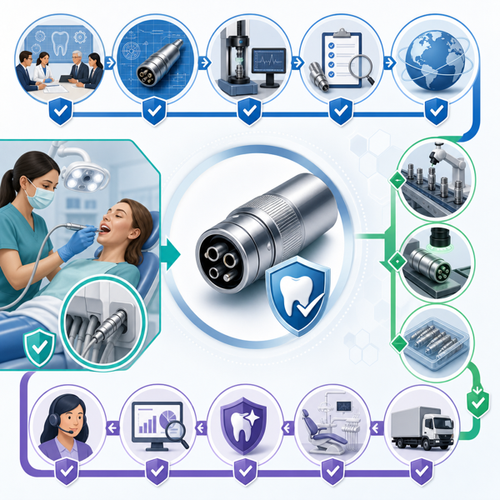
Dental professionals and manufacturers have new requirements to consider this June 2026 with the release of ISO 3964-1:2026, a groundbreaking standard addressing the mechanical properties of connectors used in dental handpieces. This single, highly specialized standard will influence how dental equipment is designed, tested, and implemented on a global scale, ensuring enhanced patient safety, product reliability, and seamless compatibility across diverse dental unit technologies.
Overview / Introduction
The dental technology sector relies on precise engineering and universally recognized specifications to deliver reliable, safe, and effective care. Standards in this industry underpin product compatibility, patient safety, and the overall quality of dental services. With the release of ISO 3964-1:2026: Dentistry — Coupling dimensions for handpiece connectors — Part 1: Mechanical properties, health care technology professionals now have a robust reference for the crucial interfaces between dental handpieces and motors—components fundamental to daily dental operations.
This article provides a detailed look into the new requirements, practical implications for manufacturers and clinicians, and actionable advice for compliance and implementation.
Detailed Standards Coverage
ISO 3964-1:2026 - Mechanical Properties of Dental Handpiece Connectors
Dentistry — Coupling dimensions for handpiece connectors — Part 1: Mechanical properties
ISO 3964-1:2026 establishes strict and clear criteria for the design and testing of connectors between dental handpieces and their driving motors. It applies to coupling systems that supply the handpiece with water, air, light, and rotation energy—but excludes connectors with electronic terminals. By setting out the nominal dimensions, tolerances, and extraction force requirements, it aims to streamline production and simplify maintenance, repair, and equipment upgrades within dental practices.
Scope and Applicability
- Applies to manufacturers and suppliers of dental units, handpieces, and motors worldwide
- Essential for compliance officers, quality-control engineers, procurement teams, and dental practitioners seeking safe and interoperable equipment
Key Requirements and Specifications
- Dimensional Standards: Defines all nominal connector dimensions, tolerances, and configurations for both the handpiece-side and motor-side of the coupling. Referenced through comprehensive, improved technical drawings and tables in the document.
- Extraction Force: Mandates a minimum extraction force for detaching the couplings, ensuring secure, reliable connections during clinical use.
- Classification System: Four types of couplings are identified, based on the presence or absence of internal spray and light supply. This classification supports the selection of the correct connector type according to the clinical or manufacturer application:
- Type 1: No internal spray, no light
- Type 2: Internal spray, no light
- Type 3: Internal spray with light
- Type 4: No internal spray, with light
- Test Methods: Includes detailed procedures for sampling, dimensional verification, and extraction force testing to ensure repeatable results across different products and settings.
Who Needs to Comply?
- Dental equipment manufacturers seeking market access
- Dental clinics and procurement specialists responsible for equipment selection and maintenance
- Quality managers and compliance professionals within dental supply chains
Practical Implications
- Promotes greater equipment compatibility, reducing downtime and costs associated with incompatible connectors
- Eases regulatory approval for products meeting harmonized international benchmarks
- Provides a reliable foundation for equipment maintenance, upgrades, and multi-supplier procurement strategies
Notable Changes from Previous Editions
- Technical drawings have been significantly improved, increasing clarity for manufacturers
- Introduces new connector dimensions and optional configuration figures
- Consolidates and replaces ISO 3964:2016 and its 2018 amendment, streamlining requirements
Key highlights:
- Covers four coupling system classifications for flexible clinical application
- Focuses on mechanical performance, reliability, and user safety
- Establishes comprehensive dimensional and extraction force guidelines
Access the full standard:View ISO 3964-1:2026 on iTeh Standards
Industry Impact & Compliance
The adoption of ISO 3964-1:2026 stands to benefit dental practices, suppliers, and patients by ensuring that all compatible components work seamlessly, regardless of origin or manufacturer. By following the defined requirements, organizations will be able to:
- Facilitate easier procurement and integration of dental units, allowing for mixed-brand systems without loss of performance
- Minimize the clinical risks associated with unexpected connector failures or incompatibility
- Accelerate regulatory approval and market access via internationally recognized compliance
- Reinforce quality assurance practices and simplify equipment servicing/logistics
Compliance considerations and timelines:
- Manufacturers should align product designs with the new dimensional and mechanical requirements immediately for all products entering market post-June 2026
- Procurement and operations teams are advised to review their supplier portfolios for updated compliance and request conformity documentation with new orders
Risks of non-compliance include:
- Product recalls or regulatory barriers
- Equipment performance issues or safety incidents
- Increased costs and downtime due to component incompatibility
Technical Insights
The technical foundation of ISO 3964-1:2026 is rooted in mechanical engineering and reliability assurance:
- Universal dimensions and tolerances for dental connectors simplify global supply chains and reduce customization costs
- Extraction force testing ensures safe, secure connections in clinical operations, critical for maintaining tissue safety and infection control
- Classification by supply functions (water, air, light) enables targeted equipment selection for specific dental procedures
Implementation Best Practices
- Update product designs with the latest dimensional drawings and tolerances from the standard
- Incorporate new test procedures for incoming quality control and manufacturing validation
- Train procurement and maintenance teams to identify compliant components and monitor for connector wear over equipment lifecycle
Testing and Certification Considerations
- Leverage ISO 3964-1:2026 for pre-market testing and internal product validation
- Collaborate with accredited third-party labs to certify extraction force and dimensional conformity
- Document compliance in technical files to streamline regulatory submissions
Conclusion / Next Steps
The publication of ISO 3964-1:2026 marks a significant advancement in health care technology standards for dentistry. Organizations should promptly review and adapt to the new requirements, ensuring all future equipment and components are fully compliant. This not only guarantees safety and interoperability but also positions manufacturers and practitioners at the forefront of best-in-class patient care.
- Stay competitive and compliant—review ISO 3964-1:2026 in detail
- Ensure all procurement, design, and quality processes are updated
- Collaborate with suppliers and certification bodies for validation
For more expert coverage on new and emerging international standards, explore the full library at iTeh Standards.
Categories
- Latest News
- New Arrivals
- Generalities
- Services and Management
- Natural Sciences
- Health Care
- Environment
- Metrology and Measurement
- Testing
- Mechanical Systems
- Fluid Systems
- Manufacturing
- Energy and Heat
- Electrical Engineering
- Electronics
- Telecommunications
- Information Technology
- Image Technology
- Precision Mechanics
- Road Vehicles
- Railway Engineering
- Shipbuilding
- Aircraft and Space
- Materials Handling
- Packaging
- Textile and Leather
- Clothing
- Agriculture
- Food technology
- Chemical Technology
- Mining and Minerals
- Petroleum
- Metallurgy
- Wood technology
- Glass and Ceramics
- Rubber and Plastics
- Paper Technology
- Paint Industries
- Construction
- Civil Engineering
- Military Engineering
- Entertainment