

ISO 3964-1:2026
(Main)Dentistry — Coupling dimensions for handpiece connectors — Part 1: Mechanical properties
- Abstract
This document specifies coupling between handpieces and motors that are connected to dental units. For the purposes of this document, the couplings described in this document are not equipped with electronic terminal(s). This document specifies the nominal dimensions, tolerances and extraction force of coupling systems for use between handpieces and motor which supply the handpiece with water, air and light and rotation energy.
- Status
- Published
- Publication Date
- 02-Jun-2026
- Technical Committee
- ISO/TC 106/SC 4 - Dental instruments
- Drafting Committee
- ISO/TC 106/SC 4 - Dental instruments
- Current Stage
- 6060 - International Standard published
- Start Date
- 03-Jun-2026
- Due Date
- 25-Jul-2026
- Completion Date
- 03-Jun-2026
Buy Documents

ISO 3964-1:2026 - Dentistry — Coupling dimensions for handpiece connectors — Part 1: Mechanical properties

ISO 3964-1:2026 - Médecine bucco-dentaire — Dimensions d'accouplement pour pièces à main dentaires — Partie 1: Propriétés mécaniques
ISO 3964-1:2026 is an International Standard from ISO for dentistry. It specifies the mechanical coupling dimensions, tolerances and extraction force for handpiece connectors between dental-unit handpieces and motors, and it applies to couplings without electronic terminals. Manufacturers, test labs and buyers use it to match connector geometry and mechanical performance for systems that supply water, air, light and rotation energy.
What does ISO 3964-1:2026 specify?
ISO 3964-1:2026 specifies the mechanical interface between handpieces and motors connected to dental units. The document focuses on nominal dimensions, tolerances and the extraction force for coupling systems used to transfer fluid and light supply and rotational energy.
The scope is limited to couplings without electronic terminal(s), so it is aimed at the mechanical connector itself rather than any electronic interface. The document is organized into scope, normative references, terms and definitions, classification, requirements, sampling, and test methods.
What are the key requirements of ISO 3964-1:2026?
ISO 3964-1:2026 centers on connector geometry, type classification and verification by measurement and force testing. In practice, it tells manufacturers how to design the handpiece-side and motor-side connection so parts fit together and can be tested consistently.
Type classification for the supply function
ISO 3964-1:2026 classifies coupling systems into four types based on whether they provide internal spray supply and light supply. This matters because a buyer or designer needs to select the connector family that matches the intended handpiece function, not just the mechanical shape.
Dimensional design of the coupling
ISO 3964-1:2026 defines the dimensions and configuration of the handpiece-side and motor-side interfaces through the figures in Clause 5.2 and the associated tables. The document distinguishes several handpiece length variants and also allows alternative coupling lock designs, which gives manufacturers some design freedom while keeping the interface controlled.
For dimensions that are not individually toleranced, ISO 3964-1:2026 points to ISO 2768-1 and ISO 22081. In practice, that means unspecified size and geometrical details still have a defined tolerance framework, which is important for drawings, tooling and incoming inspection.
The document also requires the handpiece length type to be stated in the manufacturer’s instructions for use. That helps users and purchasing teams confirm which connector version is intended for a given product.
Mechanical retention and release
ISO 3964-1:2026 requires the coupling to provide a specified extraction force, or for the motor to have an appropriate design to release cooling air pressure. In practice, the connection must stay engaged during use but still disconnect in a controlled way, so the handpiece does not come loose unexpectedly and the cooling function is handled safely.
Sampling and verification
ISO 3964-1:2026 calls for one representative sample of each coupling type to be selected for testing. That is a practical quality-control rule: if a company offers several connector variants, each type needs its own verification path.
Dimensional test method
ISO 3964-1:2026 requires dimensional checks with a measuring device accurate to the stated level for linear dimensions and angles. The measurements cover the dimensions shown in Figures 1 to 8, so the test is tied directly to the connector drawings rather than to a generic inspection method.
Coupling-force test method
ISO 3964-1:2026 requires the handpiece and motor to be assembled in accordance with the manufacturer’s instructions, including sterilization procedures, before extraction-force testing. The force is measured with suitable equipment such as a spring force gauge, so test results reflect realistic use and not just a bench setup.
What terms does ISO 3964-1:2026 define?
ISO 3964-1:2026 uses terms from ISO 1942 and ISO 14457, and it adds a few document-specific definitions.
- Coupling dimension - the dimensions of the connector between the motor and the straight or angled handpiece that allow the system to connect and be supplied.
- Coupling system - the combination of connector parts between the motor and the handpiece that makes the connection work as a whole.
- Handpiece - in this context, the dental instrument connected to the motor through the coupling system.
- Motor - the drive unit that connects to the handpiece and provides rotational energy, and in some types also supports fluid and light supply.
- Internal spray supply - the feature that provides spray through the coupling system to the handpiece.
- Light supply - the feature that passes light through the coupling system to the handpiece.
- Type 1 to Type 4 - the four coupling categories defined by whether internal spray supply and light supply are present.
Who uses ISO 3964-1:2026?
ISO 3964-1:2026 is used by dental handpiece manufacturers, motor manufacturers and dental-unit designers who need compatible mechanical interfaces. It is also relevant to quality managers, test laboratories and procurement teams that verify whether a connector design matches a stated type and meets the required extraction-force behavior.
In practice, these users rely on the document for product design, drawing review, dimensional inspection, type testing and supplier acceptance. It is especially useful where a purchase specification or product dossier needs a clear mechanical definition of the handpiece-motor connection.
What changed in ISO 3964-1:2026 from the previous edition?
ISO 3964-1:2026 is the first edition of Part 1 and it cancels and replaces ISO 3964:2016. It also incorporates ISO 3964:2016/Amd 1:2018.
The changes stated in the foreword are improved technical drawings, plus new dimensions and optional figures. For users, that means the connector definition has been updated with clearer graphical detail and additional design possibilities.
Which standards are used with ISO 3964-1:2026?
ISO 3964-1:2026 relies on several normative references that support its definitions, tolerances and product context.
- ISO 1942 - provides the dentistry vocabulary used for terms and definitions.
- ISO 2768-1 - supplies general tolerances for linear and angular dimensions when no individual tolerance is given.
- ISO 22081 - supports geometrical product specifications, including general geometrical and size specifications.
- ISO 14457 - covers dentistry handpieces and motors and gives the related product requirements that this coupling standard sits alongside.
What does the ISO 3964-1:2026 document contain?
ISO 3964-1:2026 contains the connector classification, the requirement text, the dimensional drawings and the test methods needed to verify the coupling. The main body uses figures for the handpiece and motor sides of the four coupling types, together with tables that define the corresponding dimensions and special features.
It also includes the procedures for checking dimensions and measuring extraction force, so the document is usable both for design review and for conformity testing. That makes it a practical reference for specification writing, supplier evaluation and laboratory verification of handpiece-motor coupling systems.
Relations
- Effective Date
- 12-Feb-2026
- Effective Date
- 05-Aug-2023
- Revises
ISO 3964:2016/Amd 1:2018 - Dentistry — Coupling dimensions for handpiece connectors — Amendment 1 - Effective Date
- 06-Jun-2022
- Effective Date
- 06-Jun-2022
Buy Documents
ISO 3964-1:2026 - Dentistry — Coupling dimensions for handpiece connectors — Part 1: Mechanical properties
ISO 3964-1:2026 - Médecine bucco-dentaire — Dimensions d'accouplement pour pièces à main dentaires — Partie 1: Propriétés mécaniques
Get Certified
Connect with accredited certification bodies for this standard

BSI Group
BSI (British Standards Institution) is the business standards company that helps organizations make excellence a habit.

TÜV Rheinland
TÜV Rheinland is a leading international provider of technical services.

TÜV SÜD
TÜV SÜD is a trusted partner of choice for safety, security and sustainability solutions.
Sponsored listings
Frequently Asked Questions
ISO 3964-1:2026 is a standard published by the International Organization for Standardization (ISO). Its full title is "Dentistry — Coupling dimensions for handpiece connectors — Part 1: Mechanical properties". This standard covers: This document specifies coupling between handpieces and motors that are connected to dental units. For the purposes of this document, the couplings described in this document are not equipped with electronic terminal(s). This document specifies the nominal dimensions, tolerances and extraction force of coupling systems for use between handpieces and motor which supply the handpiece with water, air and light and rotation energy.
This document specifies coupling between handpieces and motors that are connected to dental units. For the purposes of this document, the couplings described in this document are not equipped with electronic terminal(s). This document specifies the nominal dimensions, tolerances and extraction force of coupling systems for use between handpieces and motor which supply the handpiece with water, air and light and rotation energy.
ISO 3964-1:2026 is classified under the following ICS (International Classification for Standards) categories: 11.060.25 - Dental instruments. The ICS classification helps identify the subject area and facilitates finding related standards.
ISO 3964-1:2026 has the following relationships with other standards: It is inter standard links to EN ISO 3964-1:2026, ISO 28921-1:2022, ISO 3964:2016/Amd 1:2018, ISO 3964:2016. Understanding these relationships helps ensure you are using the most current and applicable version of the standard.
ISO 3964-1:2026 is available in PDF format for immediate download after purchase. The document can be added to your cart and obtained through the secure checkout process. Digital delivery ensures instant access to the complete standard document.
Standards Content (Sample)
International
Standard
ISO 3964-1
First edition
Dentistry — Coupling dimensions
2026-06
for handpiece connectors —
Part 1:
Mechanical properties
Médecine bucco-dentaire — Dimensions d'accouplement pour
pièces à main dentaires —
Partie 1: Propriétés mécaniques
Reference number
© ISO 2026
All rights reserved. Unless otherwise specified, or required in the context of its implementation, no part of this publication may
be reproduced or utilized otherwise in any form or by any means, electronic or mechanical, including photocopying, or posting on
the internet or an intranet, without prior written permission. Permission can be requested from either ISO at the address below
or ISO’s member body in the country of the requester.
ISO copyright office
CP 401 • Ch. de Blandonnet 8
CH-1214 Vernier, Geneva
Phone: +41 22 749 01 11
Email: copyright@iso.org
Website: www.iso.org
Published in Switzerland
ii
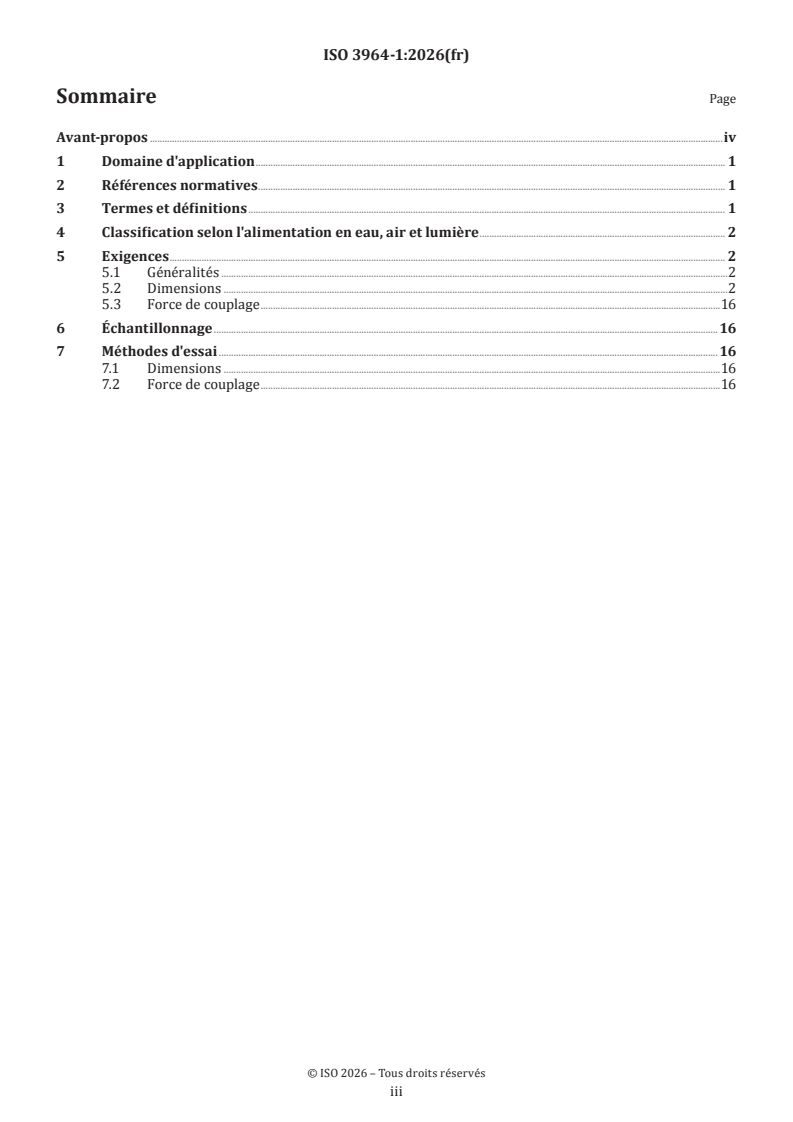
Contents Page
Foreword .iv
1 Scope . 1
2 Normative references . 1
3 Terms and definitions . 1
4 Classification according to the supply of water, air and light . 2
5 Requirements . 2
5.1 General .2
5.2 Dimensions .2
5.3 Coupling force . .16
6 Sampling . 16
7 Test methods .16
7.1 Dimensions .16
7.2 Coupling force .16
iii
Foreword
ISO (the International Organization for Standardization) is a worldwide federation of national standards
bodies (ISO member bodies). The work of preparing International Standards is normally carried out through
ISO technical committees. Each member body interested in a subject for which a technical committee
has been established has the right to be represented on that committee. International organizations,
governmental and non-governmental, in liaison with ISO, also take part in the work. ISO collaborates closely
with the International Electrotechnical Commission (IEC) on all matters of electrotechnical standardization.
The procedures used to develop this document and those intended for its further maintenance are described
in the ISO/IEC Directives, Part 1. In particular, the different approval criteria needed for the different types
of ISO document should be noted. This document was drafted in accordance with the editorial rules of the
ISO/IEC Directives, Part 2 (see www.iso.org/directives).
ISO draws attention to the possibility that the implementation of this document may involve the use of (a)
patent(s). ISO takes no position concerning the evidence, validity or applicability of any claimed patent
rights in respect thereof. As of the date of publication of this document, ISO had not received notice of (a)
patent(s) which may be required to implement this document. However, implementers are cautioned that
this may not represent the latest information, which may be obtained from the patent database available at
www.iso.org/patents. ISO shall not be held responsible for identifying any or all such patent rights.
Any trade name used in this document is information given for the convenience of users and does not
constitute an endorsement.
For an explanation of the voluntary nature of standards, the meaning of ISO specific terms and expressions
related to conformity assessment, as well as information about ISO's adherence to the World Trade
Organization (WTO) principles in the Technical Barriers to Trade (TBT), see www.iso.org/iso/foreword.html.
This document was prepared by Technical Committee ISO/TC 106, Dentistry, Subcommittee SC 4, Dental
instruments, in collaboration with the European Committee for Standardization (CEN) Technical Committee
CEN/TC 55, Dentistry, in accordance with the Agreement on technical cooperation between ISO and CEN
(Vienna Agreement).
This first edition cancels and replaces ISO 3964:2016, which has been technically revised. It also incorporates
the Amendment ISO 3964:2016/Amd 1:2018.
The main changes are as follows:
— the technical drawings have been improved;
— new dimensions and optional figures have been added.
A list of all parts in the ISO 3964 series can be found on the ISO website.
Any feedback or questions on this document should be directed to the user’s national standards body. A
complete listing of these bodies can be found at www.iso.org/members.html.
iv
International Standard ISO 3964-1:2026(en)
Dentistry — Coupling dimensions for handpiece
connectors —
Part 1:
Mechanical properties
1 Scope
This document specifies coupling between handpieces and motors that are connected to dental units. For
the purposes of this document, the couplings described in this document are not equipped with electronic
terminal(s).
This document specifies the nominal dimensions, tolerances and extraction force of coupling systems for use
between handpieces and motor which supply the handpiece with water, air and light and rotation energy.
2 Normative references
The following documents, in whole or in part, are normatively referenced in this document and are
indispensable for its application. For dated references, only the edition cited applies. For undated references,
the latest edition of the referenced document (including any amendments) applies.
ISO 1942, Dentistry — Vocabulary
ISO 2768-1, General tolerances — Part 1: Tolerances for linear and angular dimensions without individual
tolerance indications
ISO 22081, Geometrical product specifications (GPS) — Geometrical tolerancing — General geometrical
specifications and general size specifications
ISO 14457, Dentistry — Handpieces and motors
3 Terms and definitions
For the purposes of this document, the terms and definitions given in ISO 1942, ISO 14457 and the following
apply.
ISO and IEC maintain terminology databases for use in standardization at the following addresses:
— ISO Online browsing platform: available at https:// www .iso .org/ obp
— IEC Electropedia: available at https:// www .electropedia .org/
3.1
coupling dimension
description of the dimensions of connectors between air and electrical motors and straight and angled
handpieces, used to connect and supply the handpiece system
3.2
coupling system
combination of connector parts between air and electrical motors and straight and angled handpieces, used
to connect and supply the handpiece system
4 Classification according to the supply of water, air and light
For the purpose of this document, coupling systems are classified into the following types:
— Type 1: Coupling system for straight and angled handpieces and motors without internal spray supply
and without light supply;
— Type 2: Coupling system for straight and angled handpieces and motors with internal spray supply and
without light supply;
— Type 3: Coupling system for straight and angled handpieces and motors with internal spray supply and
with light supply;
— Type 4: Coupling system for straight and angled handpieces and motors without internal spray supply
and with light supply.
5 Requirements
5.1 General
Types of coupling for handpieces and motors are specific parts of dental handpieces. Requirements for
dental handpieces are specified in ISO 14457.
5.2 Dimensions
The dimensions and the configuration of handpiece-sides and motor-sides shall be as specified in Figure 1,
Figure 2, Figure 3, Figure 4, Figure 5, Figure 6, Figure 7 and Figure 8. The coupling dimensions X and X are
1 2
specified in Table 1.
Table 1 — Coupling dimensions X and X
1 2
Coupling Dimension Long Middle Short Extra short
Motor
...
Norme
internationale
ISO 3964-1
Première édition
Médecine bucco-dentaire —
2026-06
Dimensions d'accouplement pour
pièces à main dentaires —
Partie 1:
Propriétés mécaniques
Dentistry — Coupling dimensions for handpiece connectors —
Part 1: Mechanical properties
Numéro de référence
DOCUMENT PROTÉGÉ PAR COPYRIGHT
© ISO 2026
Tous droits réservés. Sauf prescription différente ou nécessité dans le contexte de sa mise en œuvre, aucune partie de cette
publication ne peut être reproduite ni utilisée sous quelque forme que ce soit et par aucun procédé, électronique ou mécanique,
y compris la photocopie, ou la diffusion sur l’internet ou sur un intranet, sans autorisation écrite préalable. Une autorisation peut
être demandée à l’ISO à l’adresse ci-après ou au comité membre de l’ISO dans le pays du demandeur.
ISO copyright office
Case postale 401 • Ch. de Blandonnet 8
CH-1214 Vernier, Genève
Tél.: +41 22 749 01 11
E-mail: copyright@iso.org
Web: www.iso.org
Publié en Suisse
ii
Sommaire Page
Avant-propos .iv
1 Domaine d'application . 1
2 Références normatives . 1
3 Termes et définitions . 1
4 Classification selon l'alimentation en eau, air et lumière . 2
5 Exigences . 2
5.1 Généralités .2
5.2 Dimensions .2
5.3 Force de couplage .16
6 Échantillonnage .16
7 Méthodes d'essai . 16
7.1 Dimensions .16
7.2 Force de couplage .16
iii
Avant-propos
L'ISO (Organisation internationale de normalisation) est une fédération mondiale d'organismes nationaux
de normalisation (comités membres de l'ISO). Le travail d'élaboration des Normes internationales est
normalement effectué par l'intermédiaire des comités d'études de l'ISO. Chaque comité membre intéressé
par un sujet pour lequel un comité technique a été créé a le droit d'être représenté au sein de ce comité. Des
organisations internationales, gouvernementales et non gouvernementales, en liaison avec l'ISO, participent
également aux travaux. L'ISO collabore étroitement avec la Commission électrotechnique internationale
(CEI) sur toutes les questions de normalisation électrotechnique.
Les procédures utilisées pour élaborer le présent document et celles destinées à sa mise à jour sont décrites
dans les directives ISO/IEC, Partie 1. En particulier, il convient de noter les différents critères d'approbation
nécessaires pour les différents types de documents ISO. Le présent document a été rédigé conformément
aux règles de rédaction des directives ISO/IEC, Partie 2 (voir www.iso.org/directives).
L'ISO attire l'attention sur le fait que la mise en œuvre du présent document peut impliquer l'utilisation
d'un ou de plusieurs brevets. L'ISO ne prend pas position quant à la preuve, à la validité ou à l'applicabilité
des droits de propriété revendiqués à cet égard. À la date de publication du présent document, l'ISO n'avait
pas reçu notification d'un ou de plusieurs brevets qui pourraient être nécessaires à sa mise en application.
Toutefois, les responsables de la mise en œuvre sont avertis que cela peut ne pas représenter les informations
les plus récentes, qui peuvent être obtenues à partir de la base de données sur les brevets disponible à
l'adresse www.iso.org/patents. L'ISO ne saurait être tenue pour responsable d'avoir identifié tout ou partie
de tels droits de propriété.
Toute appellation commerciale utilisée dans le présent document est donnée par souci de commodité à
l'intention des utilisateurs et ne saurait constituer un engagement.
Pour une explication de la nature volontaire des normes, la signification des termes et expressions
spécifiques de l'ISO liés à l'évaluation de la conformité, ou pour toute information au sujet de l'adhésion de
l'ISO aux principes de l'Organisation mondiale du commerce (OMC) concernant les obstacles techniques au
commerce (OTC), voir le site www.iso.org/iso/foreword.html.
Le présent document a été élaboré par le comité technique ISO/TC 106, Médecine bucco-dentaire, sous-comité
SC 4, Instruments dentaires, en collaboration avec le comité technique CEN/TC 55, Médecine bucco-dentaire,
du Comité européen de normalisation (CEN), conformément à l'Accord de coopération technique entre l'ISO
et le CEN (Accord de Vienne).
Cette première édition annule et remplace l'ISO 3964:2016, qui a fait l'objet d'une révision technique. Elle
intègre également l'Amendement ISO 3964:2016/Amd 1:2018.
Les principales modifications sont les suivantes:
— les dessins techniques ont été améliorés;
— de nouvelles dimensions et des figures facultatives ont été ajoutées.
Une liste de toutes les parties de la série ISO 3964 est disponible sur le site web de l'ISO.
Il convient que tout retour d'information ou toute question concernant le présent document soit adressé
à l'organisme national de normalisation de l'utilisateur. Une liste complète de ces organismes peut être
consultée à l'adresse www.iso.org/members.html.
iv
Norme internationale ISO 3964-1:2026(fr)
Médecine bucco-dentaire — Dimensions d'accouplement
pour pièces à main dentaires —
Partie 1:
Propriétés mécaniques
1 Domaine d'application
Le présent document spécifie le couplage entre les pièces à main et les moteurs qui sont raccordés aux units
dentaires. Pour les besoins du présent document, les couplages décrits dans le présent document ne sont pas
équipés de borne(s) électronique(s).
Le présent document spécifie les dimensions nominales, les tolérances et la force d’extraction des systèmes
d’accouplement utilisés entre les pièces à main et le moteur qui alimentent la pièce à main en eau, air et
lumière et en énergie de rotation.
2 Références normatives
Les documents suivants, dans leur intégralité ou en partie, sont des références normatives indispensables
à l'application du présent document. Pour les références datées, seule l'édition citée s'applique. Pour les
références non datées, la dernière édition du document de référence s'applique (y compris les éventuels
amendements).
ISO 1942, Médecine bucco-dentaire — Vocabulaire
ISO 2768-1, Tolérances générales — Partie 1: Tolérances pour dimensions linéaires et angulaires non affectées
de tolérances individuelles
ISO 22081, Spécification géométrique des produits (GPS) — Tolérancement géométrique — Spécifications
géométriques générales et spécifications de taille générales
ISO 14457, Médecine bucco-dentaire — Pièces à main et moteurs
3 Termes et définitions
Pour les besoins du présent document, les termes et définitions donnés dans l'ISO 1942, l'ISO 14457 ainsi
que les suivants s'appliquent.
L'ISO et l'IEC tiennent à jour des bases de données terminologiques destinées à être utilisées en normalisation
aux adresses suivantes:
— ISO Online browsing platform: disponible à l'adresse https:// www .iso .org/ obp
— IEC Electropedia: disponible à l'adresse https:// www .electropedia .org/
3.1
dimension de couplage
description des dimensions des connecteurs entre les moteurs pneumatiques et électriques et les pièces à
main droites et coudées, utilisés pour raccorder et alimenter le système de pièces à main
3.2
système de couplage
combinaison de parties de connecteur entre les moteurs à air et électriques et les pièces à main droites et
coudées, utilisée pour connecter et alimenter le système de pièces à main
4 Classification selon l'alimentation en eau, air et lumière
Pour les besoins du présent document, les systèmes d'accouplement sont classés selon les types suivants:
— Type 1: Système d’accouplement pour pièces à main et moteurs droits et coudés sans source de
pulvérisation interne et sans source de lumière;
— Type 2: Système d’accouplement pour pièces à main et moteurs droits et coudés avec alimentation interne
en spray et sans alimentation en lumière;
— Type 3: Système d’accouplement pour pièces à main et moteurs droits et coudés avec alimentation interne
en spray et alimentation en lumière;
— Type 4: Système d’accouplement pour pièces à main et moteurs droits et coudés sans alimentation interne
en spray et avec alimentation en lumière.
5 Exigences
5.1 Généralités
Les types de raccords pour pièces à main et moteurs sont des parties spécifiques des pièces à main dentaires.
Les exigences relatives aux pièces à main dentaires sont spécifiées dans l’ISO 14457.
5.2 Dimensions
Les dimensions et la configuration des côtés de la pièce à main et des côtés du moteur doivent être telles que
spécifiées à la Figure 1, à la Figure 2, à la Figure 3, à la Figure 4, à la Figure 5, à la Figure 6, à la Figure 7 et à
la Figure 8. Les dimensions d'accouplement X et X sont spécifiées dans le Tableau 1.
...