


ISO PAS 15118-23:2026 Sets New Benchmark for EV Communication Testing – May 2026 Release
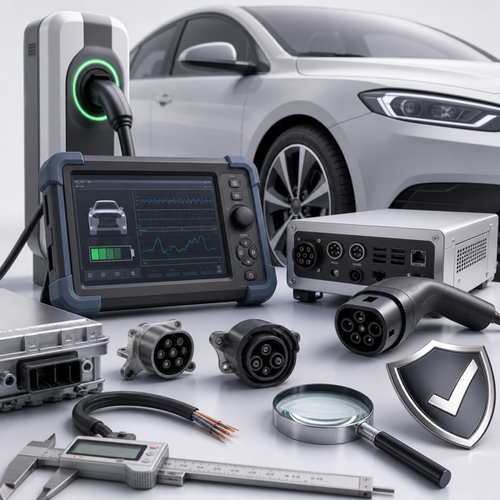
The Automotive and Road Vehicles sector welcomes a pivotal update with the publication of ISO PAS 15118-23:2026 in May 2026. This standard introduces rigorous conformance testing protocols for electric vehicle (EV) communication controllers, specifically addressing direct current (DC) charging requirements. With electric mobility accelerating worldwide, this single but highly influential standard is set to define the next era of interoperability, safety, and compliance across EV charging infrastructure. Here, we explore what’s new, what it means for industry stakeholders, and how organizations can proactively align with the evolving landscape.
Overview / Introduction
The automotive landscape is rapidly evolving as electric vehicles and next-generation charging systems reshape how energy is transferred between vehicles and the grid. In this dynamic ecosystem, robust standards for vehicle-to-grid (V2G) communication are essential to ensure interoperability, safety, and efficiency in every market.
ISO PAS 15118-23:2026 introduces a conformance test plan targeting DC charging communications per the latest protocols of the ISO 15118-20 series. As automotive supply chains, charging station manufacturers, and software solution providers respond to increasing technical and regulatory demands, this standard represents a crucial step in unifying the way EVs and supply equipment interact.
In this article, you’ll learn:
- The scope, structure, and impacts of ISO PAS 15118-23:2026
- Detailed test requirements and expected technical outcomes
- Compliance and certification implications for all stakeholders
- Best practices for early adoption and implementation
Detailed Standards Coverage
ISO PAS 15118-23:2026 – V2G Communication Conformance Tests for DC Charging
Road vehicles – Vehicle to grid communication interface – Part 23: Second generation network layer and application layer requirements conformance test plan for DC charging
ISO PAS 15118-23:2026 establishes a robust conformance test suite for systems implementing an Electric Vehicle Communication Controller (EVCC) or a Supply Equipment Communication Controller (SECC). The focus is on all DC-specific requirements set forth in ISO 15118-20 and incorporates network through application layer (ISO/OSI Layers 3-7) test cases to ensure end-to-end protocol fidelity.
What this standard covers and its scope
- Specifies an abstract test suite (ATS) for verifying that device implementations meet both the static (capabilities-based) and dynamic (behavioral) conformance requirements referenced in ISO 15118-20 for DC charging protocols.
- Targets the communication interfaces between EVs and charging stations, providing test scenarios for both forward (EV to grid) and bidirectional (vehicle-to-grid) operations.
- Utilizes a black-box testing methodology to simulate real-world protocol exchanges, focusing on the observed communication behaviors rather than system internals.
- Establishes the foundation for interoperability by ensuring all implementations meet a harmonized, internationally agreed test protocol.
Key requirements and specifications
- Defines system adapters and test platform configurations for simulating network and application layer interactions, leveraging complementary standards such as ISO 15118-21.
- Includes technical requirements for correct handling of network messages, test system timers, and error conditions—such as response to invalid protocol headers or unexpected session states.
- Outlines procedure for verifying responses to session setup, cable checks, charge parameter discovery, precharge, charge loop, and session stop sequences as specified in DC charging use cases.
- Details specific verdict criteria for passing, inconclusive, or failing conformance tests, including correct management of session IDs, protocol versions, header payloads, and communication timeouts.
- Limits scope to protocol conformance (excluding physical performance, reliability, or robustness evaluation).
Who needs to comply
- EV manufacturers and suppliers integrating EVCC modules
- Charging station manufacturers (DC fast chargers, infrastructure providers)
- System integrators offering V2G solutions
- Certification bodies and test labs specializing in EV supply equipment (EVSE) protocol validation
- Automotive OEMs and Tier-1 suppliers involved in DC charging and V2G deployments
Practical implications for implementation
- Enables test labs and manufacturers to develop or update their conformance testing platforms for rapid, reliable certification of new products
- Provides a readily auditable, unified set of conformance criteria—reducing risks associated with proprietary or ad hoc testing
- Streamlines troubleshooting, debugging, and interoperability verification for multi-vendor environments
- Ensures faster time-to-market for compliant products, helping organizations meet evolving regulatory and market requirements
Notable changes and innovations
- First international specification fully harmonized with second-generation network layer and application layer V2G protocols
- Abstract, maintainable test case definitions covering the latest DC-specific communication requirements
- Clarity on management of protocol errors, session handling, and timed responses via detailed test case design
Key highlights:
- Universal, structured protocol test plan for DC charging communication
- Focus on dynamic and static conformance with ISO 15118-20
- Foundation for widespread V2G interoperability and certification
Access the full standard:View ISO PAS 15118-23:2026 on iTeh Standards
Industry Impact & Compliance
Adoption of ISO PAS 15118-23:2026 is expected to transform stakeholder operations throughout the automotive and e-mobility value chains:
- Businesses integrating DC charging stations and V2G solutions must ensure their products pass the conformance tests as outlined, paving the way for easier certification and reduced technical risk in deployments.
- Regulatory requirements across jurisdictions increasingly reference harmonized international standards like ISO 15118-20 and its associated test plans as prerequisites for product acceptance.
- Quality assurance teams benefit from clear, objective criteria for verifying conformance, minimizing ambiguity or subjectivity in protocol compliance assessments.
- Time-to-market and global acceptance improve as suppliers can demonstrate compliance with recognized, up-to-date standards during tendering, procurement, and homologation.
Compliance considerations and timelines
- Early alignment is essential, as regulatory and market-driven requirements are quickly converging around ISO 15118-20/23 protocols
- Suppliers will need to integrate test plan requirements into their design, software, and validation processes
- Certification bodies will benchmark assessments against the conformance suite to determine protocol compliance and readiness for real-world interoperability testing
Benefits of adoption
- Guarantees compatibility between diverse charging stations and electric vehicles
- Reduces costly interoperability issues during product roll-out
- Supports consistent, repeatable, and transparent testing outcomes internationally
Risks of non-compliance
- Increased risk of interoperability failures and market access delays
- Greater exposure to warranty claims, recalls, or regulatory penalties
- Limited participation in public and private infrastructure deployment programs
Technical Insights
Technical requirements and shared patterns
Implementing ISO PAS 15118-23:2026 requires a robust understanding of:
- Adaptable test architectures: Leveraging modular adapters (for SECC/EVCC) and standardized message formats for comprehensive coverage
- Stringent communication protocols: Including correct versioning, header structure, and error response management
- Deterministic timing systems: Ensuring all communications, timeouts, and session changes are handled with precision
Implementation best practices
- Integrate protocol conformance testing early in the product development lifecycle—ideally during initial controller firmware iterations
- Automate test case execution and reporting using approved adapters and simulators specified in the standard
- Continuously monitor for protocol updates and interoperability test results from other market players
- Engage with accredited test labs and certification organizations to validate current and future releases
Testing and certification considerations
- Certification is likely to require demonstration of conformance across all mandatory test cases, not just selective scenarios
- Testing platforms must replicate the message timing, scenario sequencing, and error handling defined in the Abstract Test Suite
- Documentation such as PICS (Protocol Implementation Conformance Statement) and PIXIT (Protocol Implementation Extra Information for Testing) will be required to support test planning and evidence gathering for each system implementation
Conclusion / Next Steps
The publication of ISO PAS 15118-23:2026 represents a strategic leap forward for anyone involved in the design, supply, certification, or deployment of DC charging and V2G solutions. Now is the time for organizations across the Automotive and Road Vehicles sector to:
- Review and download the new standard through authoritative platforms such as iTeh Standards
- Update internal processes, product roadmaps, and technical documentation to reflect the latest requirements
- Coordinate with supply chain partners and certification bodies to plan for seamless compliance and certification
- Monitor future developments in the ISO 15118 family to stay ahead of regulatory and interoperability trends
Professionals, quality managers, and engineers are encouraged to explore the full text and supplementary resources for ISO PAS 15118-23:2026:
Access the full standard:View ISO PAS 15118-23:2026 on iTeh Standards
Stay informed, stay compliant, and lead your organization into the future of electric mobility with confidence.
Categories
- Latest News
- New Arrivals
- Generalities
- Services and Management
- Natural Sciences
- Health Care
- Environment
- Metrology and Measurement
- Testing
- Mechanical Systems
- Fluid Systems
- Manufacturing
- Energy and Heat
- Electrical Engineering
- Electronics
- Telecommunications
- Information Technology
- Image Technology
- Precision Mechanics
- Road Vehicles
- Railway Engineering
- Shipbuilding
- Aircraft and Space
- Materials Handling
- Packaging
- Textile and Leather
- Clothing
- Agriculture
- Food technology
- Chemical Technology
- Mining and Minerals
- Petroleum
- Metallurgy
- Wood technology
- Glass and Ceramics
- Rubber and Plastics
- Paper Technology
- Paint Industries
- Construction
- Civil Engineering
- Military Engineering
- Entertainment