

ISO PAS 15118-23:2026
(Main)Road vehicles - Vehicle to grid communication interface - Part 23: Second generation network layer and application layer requirements conformance test plan for DC charging
- Abstract
ISO PAS 15118-23:2026 This document specifies conformance tests in the form of an abstract test suite (ATS) for a system under test (SUT) that implements an electric-vehicle communication controller (EVCC) or a supply-equipment communication controller (SECC) for all direct current (DC)-specific requirements specified in ISO 15118-20 that are associated to the DC charging type. These conformance tests specify the testing of capabilities and behaviours of an SUT, as well as checking what is observed against the conformance requirements specified in ISO 15118-20 and against what the implementer states the SUT implementation's capabilities are.
The capability tests within the ATS check that the observable capabilities of the SUT are in accordance with the static conformance requirements defined in ISO 15118-20. The behaviour tests of the ATS examine an implementation as thoroughly as practical over the full range of dynamic conformance requirements defined in ISO 15118-20 and within the capabilities of the SUT.
The test architecture for this document is inherited from the test architecture specified in ISO 15118-21. If further aspects for DC-specific requirements are necessary, they extend this architecture and are specified in this document. The abstract test cases in this document are described leveraging this test architecture and are specified in descriptive tabular format covering the ISO/OSI layer 3 to 7 (network to application layers).
In terms of coverage, this document only covers normative sections and requirements in ISO 15118-20. This document can additionally refer to specific tests for requirements on referenced standards (e.g. IETF RFCs, W3C Recommendation, etc.) if they are relevant in terms of conformance for implementations according to ISO 15118-20. However, it is explicitly not intended to widen the scope of this conformance specification to such external standards, if it is not technically necessary for the purpose of conformance testing for ISO 15118-20. Furthermore, the conformance tests specified in this document do not include the assessment of performance nor robustness or reliability of an implementation. They cannot provide judgments on the physical realization of abstract service primitives, how a system is implemented, how it provides any requested service, nor the environment of the protocol implementation. Furthermore, the abstract test cases defined in this document only consider the communication protocol and the system's behaviour defined ISO 15118-20. Power flow between the EVSE and the EV is not a prerequisite for the test cases specified in this document.
- Status
- Published
- Publication Date
- 28-May-2026
- Current Stage
- PPUB - Publication issued
- Start Date
- 29-May-2026
- Completion Date
- 09-Jul-2026
Buy Documents

ISO PAS 15118-23:2026 - Road vehicles - Vehicle to grid communication interface - Part 23: Second generation network layer and application layer requirements conformance test plan for DC charging
ISO/PAS 15118-23:2026 is a publicly available specification in the ISO/IEC 15118 series for road vehicles and vehicle-to-grid communication. It specifies an abstract test suite for conformance testing of the second-generation network layer and application layer requirements for DC charging, aimed at implementations that act as an electric-vehicle communication controller (EVCC) or a supply-equipment communication controller (SECC).
The document is used to check whether an implementation behaves as declared and as required by ISO 15118-20, using black-box conformance tests rather than performance or interoperability assessment.
What does ISO/PAS 15118-23:2026 specify?
ISO/PAS 15118-23:2026 specifies conformance tests for DC-specific requirements in ISO 15118-20, expressed as an abstract test suite (ATS) for a system under test (SUT). The tests cover observable capabilities and behaviour for EVCC and SECC implementations, and compare the observed results against both ISO 15118-20 requirements and the implementation’s declared capabilities.
The document focuses on ISO/OSI layers 3 to 7, and it uses a descriptive tabular format for the abstract test cases. It also keeps the scope on communication protocol behaviour only: it does not assess performance, robustness, reliability, the physical realization of service primitives, implementation architecture, or the environment of the protocol implementation.
The document structure is:
- Clause 1 - Scope
- Clause 2 - Normative references
- Clause 3 - Terms and definitions
- Clause 4 - Abbreviated terms
- Clause 5 - Conventions
- Clause 6 - Test architecture reference model
- Clause 7 - Test suite conventions
- Clause 8 - Test case specification for DC charging ISO 15118-20 requirements
- Annex A - Informative test suite coverage
- Bibliography
What are the key requirements of ISO/PAS 15118-23:2026?
Test architecture and test system setup
ISO/PAS 15118-23:2026 builds on the test architecture from ISO 15118-21, and adds DC-specific aspects where needed. Clause 6 keeps the common structure for the platform adapter, SUT adapters, codecs, and timer handling, so a test system can be built on the same reference model used across the ISO 15118 conformance test series.
Table 1 adds the DC-specific observation timer SECC_StopEnergyTransfer_Observation_Timer, and Table 2 adds the timeout SECC_StopEnergyTransfer_Timeout. In practice, this means a test system must watch for the end of energy transfer and must give the EVCC a defined time to react to a user-initiated stop.
TTCN-3 is used for describing the test system architecture and conventions where applicable, but it is not mandatory for implementation of a conformance test system. Requirement [V2G23-001] says implementers shall verify that executable test cases match the abstract test cases in the document.
Test selection, profiles, and conformance data
Clause 7 defines how the test suite is organized and selected. Test control shall execute all applicable test cases in Clause 8 for the SUT, taking the relevant PICS and PIXIT into account. That matters in practice because the same implementation may support only a subset of the charging modes and therefore only a subset of the test cases.
Table 3 defines four test configurations:
| Configuration | What it covers |
|---|---|
| CF_21_001 | SECC with ISO 15118-20 and ISO 15118-3 support, tested with an EVCC MTC and IEC 61851-1 signalling |
| CF_21_002 | EVCC with ISO 15118-20 and ISO 15118-3 support, tested with an SECC MTC and IEC 61851-1 signalling |
| CF_21_003 | SECC with ISO 15118-20 and ISO 15118-8 WLAN support, tested with an EVCC MTC and IEC 61851-1 signalling |
| CF_21_004 | EVCC with ISO 15118-20 and ISO 15118-8 WLAN support, tested with an SECC MTC and IEC 61851-1 signalling |
Table 4 adds a DC-specific EVCC PICS parameter, PICS_EVCC_EVV2XEnergyRequest. This parameter controls whether EVMaximumV2XEnergyRequest and EVMinimumV2XEnergyRequest are included in DC_ChargeLoopReq. In practice, the tester must configure the test case according to whether the EVCC supports a preferred operational V2X range.
SECC conformance checks
Clause 8.2 covers the SECC test cases. The SECC side checks header handling, message sequencing, timeout behaviour, CP signalling, and DC-specific parameter handling.
Key points include:
- V2GTP header checks for DC messages, including protocol version, inverse protocol version, payload type, and payload length.
- SessionSetup, ServiceDetail, ScheduleExchange, SessionStop, ChargeParameterDiscovery, CableCheck, PreCharge, ChargeLoop, and WeldingDetection message flows.
- Correct responses to invalid SessionID values, wrong message order, and
FAILED_SequenceErrorcases. - CP duty cycle handling in the digital communication range of 3 to 7 % during a V2G communication session.
- DC charging parameter checks in
ChargeLoop, including whether SECC limits are consistent with the values announced earlier inChargeParameterDiscovery.
The SECC test cases also distinguish between EVSEProcessing = Ongoing and EVSEProcessing = Finished, which is important because many charging exchanges are multi-step loops. The tester must therefore monitor whether the SUT keeps looping correctly until the finished state is reached or a timeout occurs.
EVCC conformance checks
Clause 8.3 mirrors the SECC tests for EVCC behaviour. It checks whether the EVCC sends the right requests at the right time and reacts correctly to SECC responses.
The main EVCC checks include:
- Sending
SupportedAppProtocolReqafter TLS connection establishment for DC. - Sending
AuthorizationSetupReqafterSessionSetupRes. - Sending
PowerDeliveryReqafterDC_PreChargeReswithResponseCode = OK. - Sending
SessionStopReqafterDC_WeldingDetectionReswithResponseCode = OK. - Sending
DC_CableCheckReq,DC_PreChargeReq,DC_ChargeLoopReq, andDC_WeldingDetectionReqin the correct sequence. - Signalling CP State C or D before
DC_CableCheckReq, and CP State B before welding detection or disconnect-related actions. - Handling timeout and failure responses correctly, including
FAILEDandFAILED_SequenceError.
The EVCC charge loop tests also cover bidirectional power transfer (BPT) and dynamic or scheduled control mode cases. That is where the EVCC must keep the requested energy values within the logical limits defined by the test conditions.
Coverage mapping
Annex A maps ISO 15118-20 requirements to the test cases in Clauses 8.2 and 8.3. For implementers and test labs, this is the quickest way to see which requirements are exercised by which abstract test cases and which parts of the protocol receive direct conformance coverage.
What terms does ISO/PAS 15118-23:2026 define?
- Abstract test suite (ATS) - A structured set of abstract test cases used to verify protocol conformance without prescribing a specific implementation.
- System under test (SUT) - The EVCC or SECC implementation being tested.
- Electric-vehicle communication controller (EVCC) - The communication controller on the vehicle side.
- Supply-equipment communication controller (SECC) - The communication controller on the charging infrastructure side.
- Protocol implementation conformance statement (PICS) - A declaration of which features and options the implementation supports.
- Protocol implementation extra information for testing (PIXIT) - Additional test information needed to run the selected test cases.
- TTCN-3 - Testing and Test Control Notation version 3, used for test specification and control descriptions.
- Vehicle-to-grid (V2G) - The communication domain covered by the ISO 15118 series.
Who uses ISO/PAS 15118-23:2026?
ISO/PAS 15118-23:2026 is used by conformance test laboratories, certification bodies, EV and EVSE manufacturers, protocol implementers, and quality teams working on DC charging communication.
It is especially relevant when a team needs to:
- build executable conformance tests from abstract test cases
- select the applicable test set from PICS and PIXIT information
- verify EVCC or SECC message sequencing
- check DC-specific header handling and timeout behaviour
- confirm charging-session state handling at the protocol level
- map ISO 15118-20 requirements to test outcomes
What changed in ISO/PAS 15118-23:2026 from the previous edition?
ISO/PAS 15118-23:2026 is the first edition of this part.
Which standards are used with ISO/PAS 15118-23:2026?
ISO/PAS 15118-23:2026 is defined together with these normative references:
- ISO 15118-1 - provides the general information and use-case definitions for the series.
- ISO 15118-20:2022 - provides the second-generation network layer and application layer requirements that this test plan verifies.
- ISO 15118-21:2025 - provides the common second-generation conformance test plan and the inherited test architecture, timers, and conventions.
The document also depends on related standards and references in its test setup and bibliography, including ISO 15118-3, ISO 15118-8, IEC 61851-1, IEC 61851-23, and the TTCN-3 runtime and control interfaces in ETSI ES 201 873-5 and ETSI ES 201 873-6.
What does the ISO/PAS 15118-23:2026 document contain?
ISO/PAS 15118-23:2026 contains a table-driven abstract test suite for DC charging conformance, with separate test groups for SECC and EVCC behaviour. It includes message-level tests for V2GTP headers, common message flows, DC message flows, and timer-based termination scenarios.
The document also contains:
- test architecture references and adapter descriptions
- timer and timeout tables specific to this part
- test configuration tables for EVCC and SECC setups
- PICS and PIXIT-related test selection data
- detailed test case tables in Clause 8
- an informative coverage matrix in Annex A that maps ISO 15118-20 requirements to test case IDs
For practical use, the tables tell a test engineer what to send, what to observe, which timers to start, and which verdict conditions apply.
Buy Documents
ISO PAS 15118-23:2026 - Road vehicles - Vehicle to grid communication interface - Part 23: Second generation network layer and application layer requirements conformance test plan for DC charging
Get Certified
Connect with accredited certification bodies for this standard

TÜV Rheinland
TÜV Rheinland is a leading international provider of technical services.

TÜV SÜD
TÜV SÜD is a trusted partner of choice for safety, security and sustainability solutions.

DEKRA Certification Inc.
DEKRA US certification services.
Sponsored listings
Frequently Asked Questions
ISO PAS 15118-23:2026 is a technical specification published by the International Electrotechnical Commission (IEC). Its full title is "Road vehicles - Vehicle to grid communication interface - Part 23: Second generation network layer and application layer requirements conformance test plan for DC charging". This standard covers: ISO PAS 15118-23:2026 This document specifies conformance tests in the form of an abstract test suite (ATS) for a system under test (SUT) that implements an electric-vehicle communication controller (EVCC) or a supply-equipment communication controller (SECC) for all direct current (DC)-specific requirements specified in ISO 15118-20 that are associated to the DC charging type. These conformance tests specify the testing of capabilities and behaviours of an SUT, as well as checking what is observed against the conformance requirements specified in ISO 15118-20 and against what the implementer states the SUT implementation's capabilities are. The capability tests within the ATS check that the observable capabilities of the SUT are in accordance with the static conformance requirements defined in ISO 15118-20. The behaviour tests of the ATS examine an implementation as thoroughly as practical over the full range of dynamic conformance requirements defined in ISO 15118-20 and within the capabilities of the SUT. The test architecture for this document is inherited from the test architecture specified in ISO 15118-21. If further aspects for DC-specific requirements are necessary, they extend this architecture and are specified in this document. The abstract test cases in this document are described leveraging this test architecture and are specified in descriptive tabular format covering the ISO/OSI layer 3 to 7 (network to application layers). In terms of coverage, this document only covers normative sections and requirements in ISO 15118-20. This document can additionally refer to specific tests for requirements on referenced standards (e.g. IETF RFCs, W3C Recommendation, etc.) if they are relevant in terms of conformance for implementations according to ISO 15118-20. However, it is explicitly not intended to widen the scope of this conformance specification to such external standards, if it is not technically necessary for the purpose of conformance testing for ISO 15118-20. Furthermore, the conformance tests specified in this document do not include the assessment of performance nor robustness or reliability of an implementation. They cannot provide judgments on the physical realization of abstract service primitives, how a system is implemented, how it provides any requested service, nor the environment of the protocol implementation. Furthermore, the abstract test cases defined in this document only consider the communication protocol and the system's behaviour defined ISO 15118-20. Power flow between the EVSE and the EV is not a prerequisite for the test cases specified in this document.
ISO PAS 15118-23:2026 This document specifies conformance tests in the form of an abstract test suite (ATS) for a system under test (SUT) that implements an electric-vehicle communication controller (EVCC) or a supply-equipment communication controller (SECC) for all direct current (DC)-specific requirements specified in ISO 15118-20 that are associated to the DC charging type. These conformance tests specify the testing of capabilities and behaviours of an SUT, as well as checking what is observed against the conformance requirements specified in ISO 15118-20 and against what the implementer states the SUT implementation's capabilities are. The capability tests within the ATS check that the observable capabilities of the SUT are in accordance with the static conformance requirements defined in ISO 15118-20. The behaviour tests of the ATS examine an implementation as thoroughly as practical over the full range of dynamic conformance requirements defined in ISO 15118-20 and within the capabilities of the SUT. The test architecture for this document is inherited from the test architecture specified in ISO 15118-21. If further aspects for DC-specific requirements are necessary, they extend this architecture and are specified in this document. The abstract test cases in this document are described leveraging this test architecture and are specified in descriptive tabular format covering the ISO/OSI layer 3 to 7 (network to application layers). In terms of coverage, this document only covers normative sections and requirements in ISO 15118-20. This document can additionally refer to specific tests for requirements on referenced standards (e.g. IETF RFCs, W3C Recommendation, etc.) if they are relevant in terms of conformance for implementations according to ISO 15118-20. However, it is explicitly not intended to widen the scope of this conformance specification to such external standards, if it is not technically necessary for the purpose of conformance testing for ISO 15118-20. Furthermore, the conformance tests specified in this document do not include the assessment of performance nor robustness or reliability of an implementation. They cannot provide judgments on the physical realization of abstract service primitives, how a system is implemented, how it provides any requested service, nor the environment of the protocol implementation. Furthermore, the abstract test cases defined in this document only consider the communication protocol and the system's behaviour defined ISO 15118-20. Power flow between the EVSE and the EV is not a prerequisite for the test cases specified in this document.
ISO PAS 15118-23:2026 is classified under the following ICS (International Classification for Standards) categories: 43.120 - Electric road vehicles. The ICS classification helps identify the subject area and facilitates finding related standards.
ISO PAS 15118-23:2026 is available in PDF format for immediate download after purchase. The document can be added to your cart and obtained through the secure checkout process. Digital delivery ensures instant access to the complete standard document.
Standards Content (Sample)
Publicly
Available
Specification
ISO/PAS 15118-23
First edition
Road vehicles — Vehicle to grid
2026-04
communication interface —
Part 23:
Second generation network layer
and application layer requirements
conformance test plan for DC
charging
Véhicules routiers — Interface de communication entre véhicule
et réseau électrique —
Partie 23: Plan de test de conformité aux exigences de la couche
réseau et de la couche application de deuxième génération pour
la charge en courant continu
Reference number
ISO/PAS 15118-23:2026(en) © ISO 2026
ISO/PAS 15118-23:2026(en)
© ISO 2026
All rights reserved. Unless otherwise specified, or required in the context of its implementation, no part of this publication may
be reproduced or utilized otherwise in any form or by any means, electronic or mechanical, including photocopying, or posting on
the internet or an intranet, without prior written permission. Permission can be requested from either ISO at the address below
or ISO’s member body in the country of the requester.
ISO copyright office
CP 401 • Ch. de Blandonnet 8
CH-1214 Vernier, Geneva
Phone: +41 22 749 01 11
Email: copyright@iso.org
Website: www.iso.org
Published in Switzerland
ii
ISO/PAS 15118-23:2026(en)
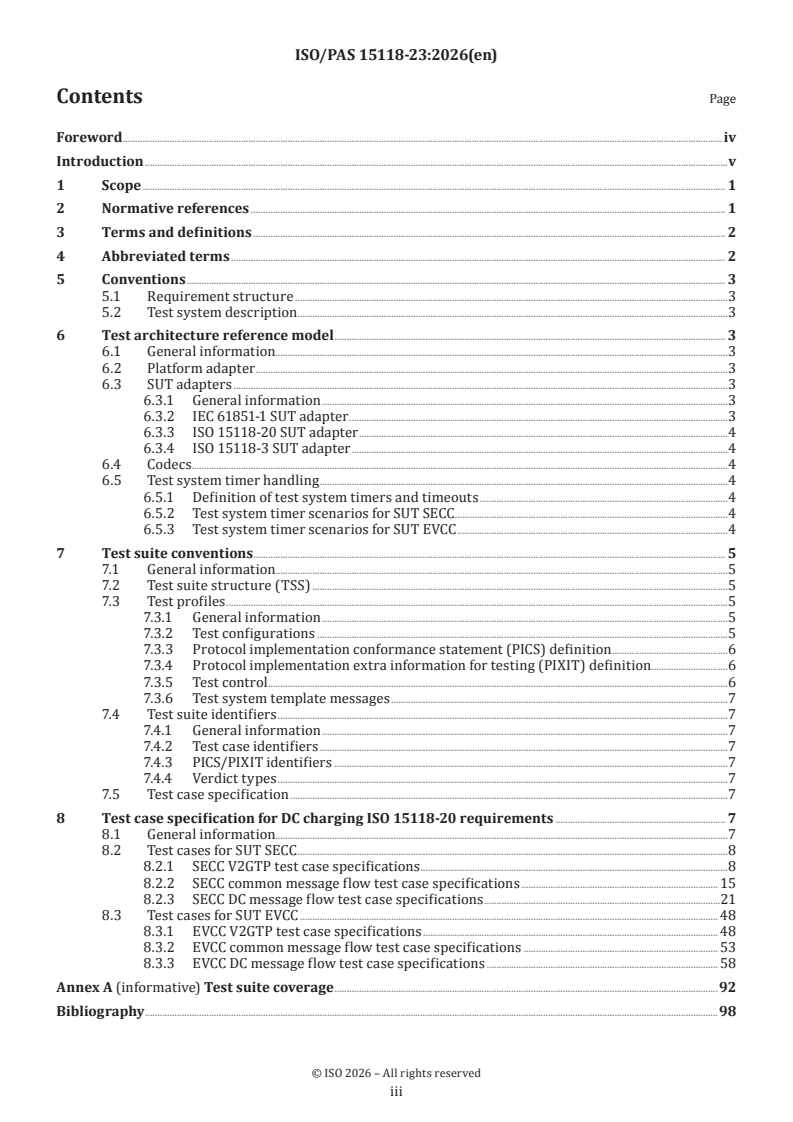
Contents Page
Foreword .iv
Introduction .v
1 Scope . 1
2 Normative references . 1
3 Terms and definitions . 2
4 Abbreviated terms . 2
5 Conventions . 3
5.1 Requirement structure .3
5.2 Test system description . .3
6 Test architecture reference model . 3
6.1 General information.3
6.2 Platform adapter .3
6.3 SUT adapters .3
6.3.1 General information .3
6.3.2 IEC 61851-1 SUT adapter .3
6.3.3 ISO 15118-20 SUT adapter .4
6.3.4 ISO 15118-3 SUT adapter .4
6.4 Codecs . .4
6.5 Test system timer handling .4
6.5.1 Definition of test system timers and timeouts .4
6.5.2 Test system timer scenarios for SUT SECC .4
6.5.3 Test system timer scenarios for SUT EVCC .4
7 Test suite conventions. 5
7.1 General information.5
7.2 Test suite structure (TSS) .5
7.3 Test profiles .5
7.3.1 General information .5
7.3.2 Test configurations .5
7.3.3 Protocol implementation conformance statement (PICS) definition .6
7.3.4 Protocol implementation extra information for testing (PIXIT) definition .6
7.3.5 Test control .6
7.3.6 Test system template messages .7
7.4 Test suite identifiers .7
7.4.1 General information .7
7.4.2 Test case identifiers .7
7.4.3 PICS/PIXIT identifiers .7
7.4.4 Verdict types .7
7.5 Test case specification .7
8 Test case specification for DC charging ISO 15118-20 requirements . 7
8.1 General information.7
8.2 Test cases for SUT SECC .8
8.2.1 SECC V2GTP test case specifications .8
8.2.2 SECC common message flow test case specifications . 15
8.2.3 SECC DC message flow test case specifications .21
8.3 Test cases for SUT EVCC . 48
8.3.1 EVCC V2GTP test case specifications . 48
8.3.2 EVCC common message flow test case specifications . 53
8.3.3 EVCC DC message flow test case specifications . 58
Annex A (informative) Test suite coverage .92
Bibliography .98
iii
ISO/PAS 15118-23:2026(en)
Foreword
ISO (the International Organization for Standardization) and IEC (the International Electrotechnical
Commission) form the specialized system for worldwide standardization. National bodies that are
members of ISO or IEC participate in the development of International Standards through technical
committees established by the respective organization to deal with particular fields of technical activity.
ISO and IEC technical committees collaborate in fields of mutual interest. Other international organizations,
governmental and non-governmental, in liaison with ISO and IEC, also take part in the work.
The procedures used to develop this document and those intended for its further maintenance are described
in the ISO/IEC Directives, Part 1. In particular, the different approval criteria needed for the different types
of document should be noted. This document was drafted in accordance with the editorial rules of the ISO/
IEC Directives, Part 2 (see www.iso.org/directives or www.iec.ch/members_experts/refdocs).
ISO and IEC draw attention to the possibility that the implementation of this document may involve the
use of (a) patent(s). ISO and IEC take no position concerning the evidence, validity or applicability of any
claimed patent rights in respect thereof. As of the date of publication of this document, ISO and IEC had not
received notice of (a) patent(s) which may be required to implement this document. However, implementers
are cautioned that this may not represent the latest information, which may be obtained from the patent
database available at www.iso.org/patents and https://patents.iec.ch. ISO and IEC shall not be held
responsible for identifying any or all such patent rights.
Any trade name used in this document is information given for the convenience of users and does not
constitute an endorsement.
For an explanation of the voluntary nature of standards, the meaning of ISO specific terms and expressions
related to conformity assessment, as well as information about ISO's adherence to the World Trade
Organization (WTO) principles in the Technical Barriers to Trade (TBT) see www.iso.org/iso/foreword.html.
In the IEC, see www.iec.ch/understanding-standards.
This document was prepared jointly by Technical Committee ISO/TC 22, Road vehicles, Subcommittee SC
31, Data communication, and Technical Committee IEC/TC 69, Electrical power/energy transfer systems for
electrically propelled road vehicles and industrial trucks.
A list of all parts in the ISO 15118 series can be found on the ISO and IEC websites.
Any feedback or questions on this document should be directed to the user’s national standards
body. A complete listing of these bodies can be found at www.iso.org/members.html and
www.iec.ch/national-committees.
iv
ISO/PAS 15118-23:2026(en)
Introduction
Resulting from the 2nd generation network layer and application layer requirements defined in ISO 15118-20,
a corresponding set of abstract test cases is necessary to verify the conformance of implementations.
This document, therefore, defines a conformance test suite for the 2nd generation network layer and
application layer protocols to derive a common basis for conformance tests. The resulting test suite is a
prerequisite for downstream interoperability tests. Since interoperability tests furthermore involve the
actual application logic of an implementation, such tests are beyond the scope of this document (see NOTE
1 in the Introduction). Therefore, this document focuses on the communication interface aspects and the
corresponding requirements given in ISO 15118-20 only.
The layered structure of the conformance test documents for ISO 15118-20 is shown in Figure 1. The
complete set of relevant conformance test documents per charging type is composed of all documents within
its column according to Figure 1.
Figure 1 — Overview of mandatory set of conformance test plan documents per charging type
EXAMPLE For a SUT supporting DC-charging the following conformance test plan documents apply:
— test plan for common network & application layer requirements;
— test plan for common security requirements;
— test plan for AC-/DC-specific network and application layer requirements (only DC-specific subset applies, this
document).
NOTE 1 Practical limitations make it impossible to define an exhaustive test suite, and economic considerations
can restrict testing even further. Hence, the purpose of this document is to increase the probability that different
implementations are able to interwork. This is achieved by verifying them by means of a protocol test suite, thereby
increasing the confidence that each implementation conforms to the protocol specification. However, the specified
protocol test suite cannot guarantee conformance to the specification since it detects errors rather than their
absence. Thus, conformance to a test suite alone cannot guarantee interworking. Instead, it gives confidence that an
implementation has the required capabilities and that its behaviour conforms consistently in representative instances
of communication.
NOTE 2 This document generally refers to SUT instead of implementation under test (IUT), due to the black box
testing paradigm adopted in this document and related certification processes.
v
Publicly Available Specification ISO/PAS 15118-23:2026(en)
Road vehicles — Vehicle to grid communication interface —
Part 23:
Second generation network layer and application layer
requirements conformance test plan for DC charging
1 Scope
This document specifies conformance tests in the form of an abstract test suite (ATS) for a system under
test (SUT) that implements an electric-vehicle communication controller (EVCC) or a supply-equipment
communication controller (SECC) for all direct current (DC)-specific requirements specified in ISO 15118-20
that are associated to the DC charging type. These conformance tests specify the testing of capabilities and
behaviours of an SUT, as well as checking what is observed against the conformance requirements specified
in ISO 15118-20 and against what the implementer states the SUT implementation's capabilities are.
The capability tests within the ATS check that the observable capabilities of the SUT are in accordance with
the static conformance requirements defined in ISO 15118-20. The behaviour tests of the ATS examine an
implementation as thoroughly as practical over the full range of dynamic conformance requirements defined
in ISO 15118-20 and within the capabilities of the SUT.
The test architecture for this document is inherited from the test architecture specified in ISO 15118-21. If
further aspects for DC-specific requirements are necessary, they extend this architecture and are specified
in this document. The abstract test cases in this document are described leveraging this test architecture
and are specified in descriptive tabular format covering the ISO/OSI layer 3 to 7 (network to application
layers).
In terms of coverage, this document only covers normative sections and requirements in ISO 15118-20. This
document can additionally refer to specific tests for requirements on referenced standards (e.g. IETF RFCs,
W3C Recommendation, etc.) if they are relevant in terms of conformance for implementations according to
ISO 15118-20. However, it is explicitly not intended to widen the scope of this conformance specification
to such external standards, if it is not technically necessary for the purpose of conformance testing for
ISO 15118-20. Furthermore, the conformance tests specified in this document do not include the assessment
of performance nor robustness or reliability of an implementation. They cannot provide judgments on
the physical realization of abstract service primitives, how a system is implemented, how it provides any
requested service, nor the environment of the protocol implementation. Furthermore, the abstract test cases
defined in this document only consider the communication protocol and the system's behaviour defined
ISO 15118-20. Power flow between the EVSE and the EV is not a prerequisite for the test cases specified in
this document.
2 Normative references
The following documents are referred to in the text in such a way that some or all of their content constitutes
requirements of this document. For dated references, only the edition cited applies. For undated references,
the latest edition of the referenced document (including any amendments) applies.
ISO 15118-1, Road vehicles — Vehicle to grid communication interface — Part 1: General information and use-
case definition
ISO 15118-20:2022, Road vehicles — Vehicle to grid communication interface — Part 20: 2nd generation
network layer and application layer requirements
ISO/PAS 15118-23:2026(en)
ISO 15118-21:2025, Road vehicles — Vehicle to grid communication interface — Part 21: Common 2nd
generation network layer and application layer requirements conformance test plan
3 Terms and definitions
For the purposes of this document, the terms and definitions given in ISO 15118-1, ISO 15118-20 and
ISO 15118-21 apply.
ISO and IEC maintain terminology databases for use in standardization at the following addresses:
— ISO Online browsing platform: available at https:// www .iso .org/ obp
— IEC Electropedia: available at https:// www .electropedia .org/
4 Abbreviated terms
For the purposes of this document, the following abbreviated terms apply:
ATS abstract test suite
CP control pilot
ETT energy transfer types
EV electric vehicle
EVCC electric vehicle communication controller
EVSE electric vehicle supply equipment
IUT implementation under test
MTC maint test component
PICS protocol implementation conformance statement
PIXIT protocol implementation extra information for testing
PLC powerline communication
PTC parallel test component
SECC supply equipment communication controller
SUT system under test
TC test case
TCP transport control protocol
TS test system
TSS test suite structure
TTCN-3 testing and test control notation version 3
V2G vehicle-to-grid
ISO/PAS 15118-23:2026(en)
5 Conventions
5.1 Requirement structure
For the purposes of this document, the following abbreviated terms apply:
This document uses unique number identifiers for each individual requirement. This requirement structure
allows for easier requirement tracking and management. The following format is used throughout this
document:
'[V2G'Y'-'XXX']' requirement text
Where:
— 'V2G' represents the ISO 15118 series;
— Y represents the document part of the ISO 15118 series, for this document Y = 23;
— XXX represents the individual requirement number; and
— 'requirement text' includes the actual text of the requirement.
5.2 Test system description
TTCN-3 is used in this document to define/specify the test system architecture and test suite conventions,
where applicable. TTCN-3 is, however, not mandatory for the implementation of a conformance test system
according to this document.
[V2G23-001] The implementers of conformance tests shall verify that the test purposes implemented in
their executable test cases are identical to the abstract test cases described in this document.
NOTE In this document, test cases are not programmatically specified in TTNC-3 core language.
6 Test architecture reference model
6.1 General information
ISO 15118-21:2025, 6.1 is applicable.
6.2 Platform adapter
ISO 15118-21:2025, 6.2 is applicable.
6.3 SUT adapters
6.3.1 General information
ISO 15118-21:2025, 6.3.1 is applicable.
6.3.2 IEC 61851-1 SUT adapter
ISO 15118-21:2025, 6.3.2 is applicable.
6.3.2.1 Requirements of IEC 61851-1 SUT adapter for SECC or EVCC testing
ISO 15118-21:2025, 6.3.2.1 is applicable.
ISO/PAS 15118-23:2026(en)
6.3.2.2 Requirements of IEC 61851-1 SUT adapter for SECC testing
ISO 15118-21:2025, 6.3.2.2 is applicable.
6.3.2.3 Requirements of IEC 61851-1 SUT adapter for EVCC testing
ISO 15118-21:2025, 6.3.2.3 is applicable.
6.3.3 ISO 15118-20 SUT adapter
ISO 15118-21:2025, 6.3.3 is applicable.
6.3.4 ISO 15118-3 SUT adapter
ISO 15118-21:2025, 6.3.4 is applicable.
6.4 Codecs
ISO 15118-21:2025, 6.4 is applicable.
6.5 Test system timer handling
ISO 15118-21:2025, 6.5 is applicable.
6.5.1 Definition of test system timers and timeouts
ISO 15118-21:2025, 6.5.1 is applicable.
Besides that, Table 1 lists all additional test system specific observation and termination timers in this
document.
Table 1 — ISO/PAS 15118-23 Test system timers
Time/Timeout Description
SECC_StopEnergyTransfer_Observation_Timer
Energy transfer stop observation timer in the
SECC
Table 2 lists all additional test system specific timeouts in this document.
Table 2 — ISO 15118-23 Test system timings and timeouts
Value in
Time/Timeout Description
sec
SECC_StopEnergyTransfer_Timeout
Timeout for EVCC reaction to user initiated stop of ener-
gy transfer
6.5.2 Test system timer scenarios for SUT SECC
ISO 15118-21:2025, 6.5.2 is applicable.
6.5.3 Test system timer scenarios for SUT EVCC
ISO 15118-21:2025, 6.5.3 is applicable. In addition, the following test system timer scenarios are specified.
Figure 2 shows the TS timer handling for multi-message sequence termination scenarios for EVCC (e.g.
involving ongoing message loops).
ISO/PAS 15118-23:2026(en)
Figure 2 — Test system timer handling for multi-message sequence termination scenarios for EVCC
7 Test suite conventions
7.1 General information
ISO 15118-21:2025, 7.1 is applicable.
7.2 Test suite structure (TSS)
ISO 15118-21:2025, 7.2 is applicable.
7.3 Test profiles
ISO 15118-21:2025, 7.3 is applicable.
7.3.1 General information
ISO 15118-21:2025, 7.3.1 is applicable.
7.3.2 Test configurations
ISO 15118-21:2025, 7.3.2 is applicable, except as follows:
ISO/PAS 15118-23:2026(en)
Replace “Table 4 – Test configurations” in ISO 15118-21:2025, 7.3.2 with Table 3 in this document.
Table 3 — Test configurations
CF_ID SUT MTC PTC
CF_21_001 SECC with ISO 15118-20 EVCC with PTC with
protocol support and ISO ISO 15118-20 SUT adapter IEC 61851-1 SUT adapter
15118-3 HPGP PLC commu- ISO 15118-3 SUT adapter (HPGP) (CP, PP)
nication interface and IEC
61851-1 signalling
CF_21_002 EVCC with ISO 15118-20 SECC with PTC with
protocol support and ISO ISO 15118-20 SUT adapter ISO IEC 61851-1 SUT adapter
15118-3 HPGP PLC commu- 15118-3 SUT adapter (HPGP) (CP, PP)
nication interface and IEC
61851-1 signalling
CF_21_003 SECC with ISO 15118-20 EVCC with PTC with
protocol support and ISO ISO 15118-20 SUT adapter IEC 61851-1 SUT adapter
15118-8 WLAN commu- ISO 15118-8 SUT adapter (CP, PP)
nication interface and IEC (WLAN)
61851-1 signalling
CF_21_004 EVCC with ISO 15118-20 SECC with PTC with
protocol support and ISO ISO 15118-20 SUT adapter IEC 61851-1 SUT adapter
15118-8 WLAN commu- ISO 15118-8 SUT adapter (CP, PP)
nication interface and IEC (WLAN)
61851-1 signalling
7.3.3 Protocol implementation conformance statement (PICS) definition
ISO 15118-21:2025, 7.3.3 is applicable.
Besides that, Table 4 lists all additional PICS parameter for EVCC tests in this document.
Table 4 — PICS for test system configuration CF_21_002 (SUT equals EVCC)
PICS Capability description Test parameter
PICS_EVCC_EVV2XEnergyRequest
Specifies whether a preferred oper- Parameter evv2xenergyrequest_value
ational V2X range is supported by the indicates if the parameters EVMaximum-
SUT. The corresponding feature is V2XEnergyRequest and EVMinimumV2XEn-
enabled by usage of the parameters ergyRequest are included in DC_ChargeLoo-
EVMaximumV2XEnergyRequest and EVMin- pReq message. One of the following values
imumV2XEnergyRequest. Possible values can be assigned to evv2xenergyrequest_
to choose from are: value:
— True or False — True
— True — False
— False
7.3.4 Protocol implementation extra information for testing (PIXIT) definition
ISO 15118-21:2025, 7.3.4 is applicable.
7.3.5 Test control
For test control, the following requirements or recommendations apply for this document:
Test case description for test control shall execute all applicable test cases listed in 8.2 for SUT SECC under
consideration of all PICS and PIXIT for that particular SUT.
ISO/PAS 15118-23:2026(en)
[V2G23-002] Test control shall execute all applicable test cases listed in 8.2 for SUT SECC under consid-
eration of all PICS and PIXIT for that particular SUT.
[V2G23-003] Test control shall execute all applicable test cases listed in 8.3 for SUT EVCC under consid-
eration of all PICS and PIXIT for that particular SUT.
[V2G23-004] Test control shall implement the test parameters derived from all PICS and PIXIT parameters
as specified in 7.3.3 and 7.3.4.
7.3.6 Test system template messages
ISO 15118-21:2025, 7.3.6 is applicable.
7.4 Test suite identifiers
ISO 15118-21:2025, 7.4 is applicable.
7.4.1 General information
ISO 15118-21:2025, 7.4.1 is applicable.
7.4.2 Test case identifiers
ISO 15118-21:2025, 7.4.2 is applicable.
7.4.3 PICS/PIXIT identifiers
ISO 15118-21:2025, 7.4.3 is applicable.
7.4.4 Verdict types
ISO 15118-21:2025, 7.4.4 is applicable.
7.5 Test case specification
Apply ISO 15118-21:2025, 7.5 is applicable.
8 Test case specification for DC charging ISO 15118-20 requirements
8.1 General information
Subclause 8.2 covers all test cases (Tables 5 to 42) for SECC according to ISO 15118-20 while subclause 8.3
covers all test cases (Tables 43 to 90) for EVCC according to ISO 15118-20. (Table A.1 shows how the
requirements in ISO 15118-20 are mapped against the test cases specified in 8.2 and 8.3.)
ISO/PAS 15118-23:2026(en)
8.2 Test cases for SUT SECC
8.2.1 SECC V2GTP test case specifications
8.2.1.1 SECC V2GTP test case specifications with DC V2G message payload
Table 5 — Test case description for TC23_SECC_V2GTPDCMessages_001
TC Id TC23_SECC_V2GTPDCMessages_001
Test purpose In case the SUT supports DC or ACDP (PICS_CMN_ETT), this TC observes whether the SUT
sends a DC_CableCheckRes message with V2GTP header information ProtocolVersion set
to '01'H, InvProtocolVersion set to 'FE'H and PayloadType set to '8004'H after receiving a
DC_CableCheckReq message from the test system.
Pre-condition The SUT and TS are initialized to a state where the data link and TLS connection are
successfully established and the V2G message sequence is succeeded until the ScheduleEx-
changeRes message with EVSEProcessing set to ‘Finished’ (ett_value := DC) or the ACDP_
ConnectRes message with EVSEProcessing set to ‘Finished’ (ett_value := ACDP) is received.
Test behaviour The test system starts the V2G_EVCC_Msg_Observation_Timer when sending a DC_Cable-
CheckReq message and the corresponding V2GTP header with all elements and values from
default parameter set according to ISO 15118-21:2025, Annex C.
For verdict ‘pass’ the test system then checks whether a DC_CableCheckRes message with
V2GTP header is received within V2G_EVCC_Msg_Timeout according to ISO 15118-20:2022,
Table 215 and the test system timer handling as specified in ISO 15118-21:2025, 6.5 with
the following format:
V2GTP := {
Header := {
ProtocolVersion := '01'H
InvProtocolVersion := 'FE'H
PayloadType := '8004'H
PayloadLength := ?
}
Payload :=
DC_CableCheckRes := ?
}
}
Document reference ISO 15118-20:2022, 7.8.3.1
Referenced require- [V2G20-2307]
ment(s)
Config Id CF_21_001, CF_21_003
PICS PICS_CMN_ETT contains (ett_value = DC|ACDP)
PIXIT -
ISO/PAS 15118-23:2026(en)
Table 6 — Test case description for TC23_SECC_V2GTPDCMessages_002
TC Id TC23_SECC_V2GTPDCMessages_002
Test purpose In case the SUT supports DC or ACDP (PICS_CMN_ETT), this TC observes whether the SUT
sends a DC_CableCheckRes message whose TCP destination port number is in range of V2G_
DST_TCP_DATA after receiving a DC_CableCheckReq message from the test system.
Pre-condition The SUT and TS are initialized to a state where the data link and TLS connection are
successfully established and the V2G message sequence is succeeded until the ScheduleEx-
changeRes message with EVSEProcessing set to ‘Finished’ (ett_value := DC) or the ACDP_
ConnectRes message with EVSEProcessing set to ‘Finished’ (ett_value := ACDP) is received.
Test behaviour The test system starts the V2G_EVCC_Msg_Observation_Timer when sending a DC_CableCh-
eckReq message with all elements and values from default parameter set according to ISO
15118-21:2025, Annex C.
For verdict ‘pass’ the test system then checks whether the used TCP destination port num-
ber of DC_CableCheckRes message is in the range of Dynamic Ports (49152-65535).
Document reference ISO 15118-20:2022, 7.8.2
Referenced require- [V2G20-078], [V2G20-080]
ment(s)
Config Id CF_21_001, CF_21_003
PICS PICS_CMN_ETT contains (ett_value = DC|ACDP)
PIXIT -
Table 7 — Test case description for TC23_SECC_V2GTPDCMessages_003
TC Id TC23_SECC_V2GTPDCMessages_003
Test purpose In case the SUT supports DC or ACDP (PICS_CMN_ETT), this TC observes whether the SUT
ignores a DC_CableCheckReq message with invalid V2GTP header information ProtocolVer-
sion set to 'FF'H.
Pre-condition The SUT and TS are initialized to a state where the data link and TLS connection are
successfully established and the V2G message sequence is succeeded until the ScheduleEx-
changeRes message with EVSEProcessing set to ‘Finished’ (ett_value := DC) or the ACDP_
ConnectRes message with EVSEProcessing set to ‘Finished’ (ett_value := ACDP) is received.
Test behaviour The test system starts the V2G_SECC_Sequence_Observation_Timer upon receiving a
ScheduleExchangeRes message with EVSEProcessing set to ‘Finished’ (ett_value := DC) or
ACDP_ConnectRes message with EVSEProcessing set to ‘Finished’ (ett_value := ACDP) and
the V2G_EVCC_Msg_Observation_Timer when sending a DC_CableCheckReq message and
the corresponding V2GTP header with all elements and values from default parameter set
according to ISO 15118-21:2025, Annex C with consideration of the following parameter
adjustment:
ProtocolVersion := 'FF'H
For verdict ‘pass’ the test system then checks whether the SUT does not respond to a
DC_CableCheckReq message with invalid V2GTP header within V2G_EVCC_Msg_Timeout
according to ISO 15118-20:2022, Table 215 and the test system timer handling as specified
in ISO 15118-21:2025, 6.5. Furthermore, the test system checks whether the SUT does not
terminate the TLS connection within V2G_SECC_Sequence_Timeout according to ISO 15118-
20:2022, Table 215, and the test system timer handling as specified in ISO 15118-21:2025,
6.5.
Document reference ISO 15118-20:2022, 8.6.4.6.3.1
Referenced require- [V2G20-800]
ment(s)
Config Id CF_21_001, CF_21_003
PICS PICS_CMN_ETT contains (ett_value = DC|ACDP)
PIXIT -
ISO/PAS 15118-23:2026(en)
Table 8 — Test case description for TC23_SECC_V2GTPDCMessages_004
TC Id TC23_SECC_V2GTPDCMessages_004
Test purpose In case the SUT supports DC or ACDP (PICS_CMN_ETT), this TC observes whether the SUT
ignores a DC_CableCheckReq message with invalid V2GTP header information InvProto-
colVersion set to 'FF'H.
Pre-condition The SUT and TS are initialized to a state where the data link and TLS connection are
successfully established and the V2G message sequence is succeeded until the Schedu-
leExchangeRes message with EVSEProcessing set to ‘Finished’ (ett_value := DC) or the
ACDP_ConnectRes message with EVSEProcessing is set to ‘Finished’ (ett_value := ACDP) is
received.
Test behaviour The test system starts the V2G_SECC_Sequence_Observation_Timer upon receiving a
ScheduleExchangeRes message with EVSEProcessing set to ‘Finished’ (ett_value := DC) or
ACDP_ConnectRes message with EVSEProcessing set to ‘Finished’ (ett_value := ACDP) and
the V2G_EVCC_Msg_Observation_Timer when sending a DC_CableCheckReq message and
the corresponding V2GTP header with all elements and values from default parameter set
according to ISO 15118-21:2025, Annex C with consideration of the following parameter
adjustment:
InvProtocolVersion := 'FF'H
For verdict ‘pass’ the test system then checks whether the SUT does not respond to a
DC_CableCheckReq message with invalid V2GTP header within V2G_EVCC_Msg_Timeout
according to ISO 15118-20:2022, Table 215 and the test system timer handling as specified
in ISO 15118-21:2025, 6.5. Furthermore, the test system checks whether the SUT does not
terminate the TLS connection within V2G_SECC_Sequence_Timeout according to ISO 15118-
20:2022, Table 215, and the test system timer handling as specified in ISO 15118-21:2025,
6.5
Document reference ISO 15118-20:2022, 8.6.4.6.3.1
Referenced require- [V2G20-800]
ment(s)
Config Id CF_21_001, CF_21_003
PICS PICS_CMN_ETT contains (ett_value = DC|ACDP)
PIXIT -
ISO/PAS 15118-23:2026(en)
Table 9 — Test case description for TC23_SECC_V2GTPDCMessages_005
TC Id TC23_SECC_V2GTPDCMessages_005
Test purpose In case the SUT supports DC or ACDP (PICS_CMN_ETT), this TC observes whether the SUT
ignores a DC_CableCheckReq message with invalid V2GTP header information PayloadType
set to '7001'H.
Pre-condition The SUT and TS are initialized to a state where the data link and TLS connection are
successfully established and the V2G message sequence is succeeded until the ScheduleEx-
changeRes message with EVSEProcessing set to ‘Finished’ (ett_value := DC) or the ACDP_
ConnectRes message with EVSEProcessing set to ‘Finished’ (ett_value := ACDP) is received.
Test behaviour The test system starts the V2G_SECC_Sequence_Observation_Timer upon receiving a
ScheduleExchangeRes message with EVSEProcessing set to ‘Finished’ (ett_value := DC) or
ACDP_ConnectRes message with EVSEProcessing set to ‘Finished’ (ett_value := ACDP) and
the V2G_EVCC_Msg_Observation_Timer when sending a DC_CableCheckReq message and
the corresponding V2GTP header with all elements and values from default parameter set
according to ISO 15118-21:2025, Annex C with consideration of the following parameter
adjustment:
PayloadType := ‘7001’H
For verdict ‘pass’ the test system then checks whether the SUT does not respond to a
DC_CableCheckReq message with invalid V2GTP header within V2G_EVCC_Msg_Timeout
according to ISO 15118-20:2022, Table 215 and the test system timer handling as specified
in ISO 15118-21:2025, 6.5. Furthermore, the test system checks whether the SUT does not
terminate the TLS connection within V2G_SECC_Sequence_Timeout according to ISO 15118-
20:2022, Table 215, and the test system timer handling as specified in ISO 15118-21:2025,
6.5.
Document reference ISO 15118-20:2022, 8.6.4.6.3.1
Referenced require- [V2G20-800]
ment(s)
Config Id CF_21_001, CF_21_003
PICS PICS_CMN_ETT contains (ett_value = DC|ACDP)
PIXIT -
ISO/PAS 15118-23:2026(en)
Table 10 — Test case description for TC23_SECC_V2GTPDCMessages_006
TC Id TC23_SECC_V2GTPDCMessages_006
Test purpose In case the SUT supports DC or ACDP (PICS_CMN_ETT), this TC observes whether the
SUT ignores a DC_CableCheckReq message with invalid V2GTP header information Pay-
loadLength set to ‘00000000’H.
Pre-condition The SUT and TS are initialized to a state where the data link and TLS connection are
successfully established and the V2G message sequence is succeeded until the ScheduleEx-
changeRes message with EVSEProcessing set to ‘Finished’ (ett_value := DC) or the ACDP_
ConnectRes message with EVSEProcessing set to ‘Finished’ (ett_value := ACDP) is received.
Test behaviour The test system starts the V2G_SECC_Sequence_Observation_Timer upon receiving a
ScheduleExchangeRes message with EVSEProcessing set to ‘Finished’ (ett_value := DC) or
ACDP_ConnectRes message with EVSEProcessing set to ‘Finished’ (ett_value := ACDP) and
the V2G_EVCC_Msg_Observation_Timer when sending a DC_CableCheckReq message and
the corresponding V2GTP header with all elements and values from default parameter set
according to ISO 15118-21:2025, Annex C with consideration of the following parameter
adjustment:
PayloadLength := '00000000'H
For verdict ‘pass’ the test system then checks whether the SUT does not respond to a
DC_CableCheckReq message with invalid V2GTP header within V2G_EVCC_Msg_Timeout
according to ISO 15118-20:2022, Table 215 and the test system timer handling as specified
in ISO 15118-21:2025, 6.5. Furthermore, the test system checks whether the SUT does not
terminate the TLS connection within V2G_SECC_Sequence_Timeout according to ISO 15118-
20:2022, Table 215, and the test system timer handling as specified in ISO 15118-21:2025,
6.5.
Document reference ISO 15118-20:2022, 8.6.4.6.3.1
Referenced require- [V2G20-800]
ment(s)
Config Id CF_21_001, CF_21_003
PICS PICS_CMN_ETT contains (ett_value = DC|ACDP)
PIXIT -
ISO/PAS 15118-23:2026(en)
Table 11 — Test case description for TC23_SECC_V2GTPDCMessages_007
TC Id TC23_SECC_V2GTPDCMessages_007
Test purpose In case the SUT supports DC or ACDP (PICS_CMN_ETT), this TC observes whether the
SUT ignores a DC_CableCheckReq message with invalid V2GTP header information Pay-
loadLength set to the result of function ‘setSmallerV2GTPPayloadLength(payload_value)’.
Pre-condition The SUT and TS are initialized to a state where the data link and TLS connection are
successfully established and the V2G message sequence is succeeded until the Schedu-
leExchangeRes message with EVSEProcessing set to ‘Finished’ (ett_value := DC) or the
ACDP_ConnectRes message with EVSEProcessing is set to ‘Finished’ (ett_value := ACDP) is
received.
Test behaviour The test system starts the V2G_SECC_Sequence_Observation_Timer upon receiving a
ScheduleExchangeRes message with EVSEProcessing set to ‘Finished’ (ett_value := DC) or
ACDP_ConnectRes message with EVSEProcessing set to ‘Finished’ (ett_value := ACDP) and
the V2G_EVCC_Msg_Observation_Timer when sending a DC_CableCheckReq message and
the corresponding V2GTP header with all elements and values from default parameter set
according to ISO 15118-21:2025, Annex C with consideration of the following parameter
adjustment:
PayloadLength := setSmallerV2GTPPayloadLength(payload_value)
For verdict ‘pass’ the test system then checks whether the SUT does not respond to a
DC_CableCheckReq message with invalid V2GTP header within V2G_EVCC_Msg_Timeout
according to ISO 15118-20:2022, Table 215 and the test system timer handling as specified
in ISO 15118-21:2025, 6.5. Furthermore, the test system checks whether the SUT does not
terminate the TLS connection within V2G_SECC_Sequence_Timeout according to ISO 15118-
20:2022, Table 215, and the test system timer handling as specified in ISO 15118-21:2025,
6.5.
Document reference ISO 15118-20:2022, 8.6.4.6.3.1
Referenced require- [V2G20-800]
ment(s)
Config Id CF_21_001, CF_21_003
PICS PICS_CMN_ETT contains (ett_value = DC|ACDP)
PIXIT -
ISO/PAS 15118-23:2026(en)
Table 12 — Test case description for TC23_SECC_V2GTPDCMessages_008
TC Id TC23_SECC_V2GTPDCMessages_008
Test purpose In case the SUT supports DC or ACDP (PICS_CMN_ETT), this TC observes whether the
SUT ignores a DC_CableCheckReq message with invalid V2GTP header information Pay-
loadLength set to the result of function ‘setLargerV2GTPPayloadLength(payload_value)’.
Pre-condition The SUT and TS are initialized to a state where the data link and TLS connection are
successfully established and the V2G message sequence is succeeded until the ScheduleEx-
changeRes message with EVSEProcessing set to ‘Finished’ (ett_value := DC) or the ACDP_
ConnectRes message with EVSEProcessing set to ‘Finished’ (ett_value := ACDP) is received.
Test behaviour The test system starts the V2G_SECC_Sequence_Observation_Timer upon receiving a
ScheduleExchangeRes message with EVSEProcessing set to ‘Finished’ (ett_value := DC) or
ACDP_ConnectRes message with EVSEProcessing set to ‘Finished’ (ett_value := ACDP) and
the V2G_EVCC_Msg_Observation_Timer when sending a DC_CableCheckReq message and
the corresponding V2GTP header with all elements and values from default parameter set
according to ISO 15118-21:2025, Annex C with consideration of the following parameter
adjustment:
PayloadLength := setLargerV2GTPPayloadLength(payload_value)
For verdict ‘pass’ the test system then checks whether the SUT does not respond to a
DC_CableCheckReq message with invalid V
...