


Manufacturing Engineering Standards Update: May 2026 Brings New Data Quality, Safety, and Welding Guidelines
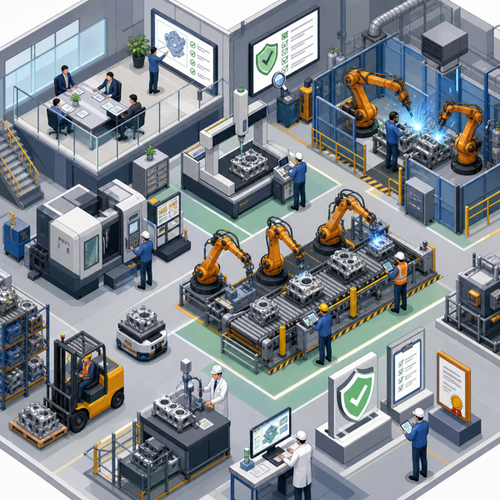
Manufacturing professionals are set to benefit from a transformative wave of standards published in May 2026, addressing key areas ranging from data interoperability and quality management to machinery safety and welding performance. Part 1 of this update delivers in-depth coverage of five newly published international standards, equipping engineers, compliance officers, and industry leaders with the latest requirements and recommendations vital for maintaining quality, efficiency, and safety in modern manufacturing.
Overview / Introduction
Manufacturing engineering stands at the intersection of technological innovation, rigorous quality control, and operational safety. International standards are essential tools that establish a common language, drive interoperability, reduce risk, and ensure that products and processes meet the complex demands of global supply chains.
In May 2026, new and updated standards were introduced covering:
- Data models enabling cross-domain interoperability
- Safety frameworks for metalworking machine tools
- Sensor data cleansing for trustworthy industrial analytics
- Advanced flaw detection in metal additive manufacturing
- Classification systems for welding consumables in high-strength fabrication
This article presents a comprehensive review of each newly published standard, detailing their scope, critical requirements, intended stakeholders, and real-world application guidance. Whether you are an engineer, quality manager, compliance specialist, or procurement lead, you’ll find actionable insights to support your organization’s continued excellence in manufacturing engineering.
Detailed Standards Coverage
EN IEC 61360-7:2026 - Data Dictionary of Cross-Domain Concepts
Standard data element types with associated classification scheme – Part 7: Data dictionary of cross-domain concepts
This standard, developed by CLC, delivers a crucial extension to the international data dictionary (IEC 61360-7), introducing a suite of generic, cross-domain concepts intended to facilitate seamless digital integration across varied engineering domains. The "IEC 61360-7 – General items" domain is designed to support the growing need for interoperability among disparate industry systems by compiling standard classes and properties usable from design to operations.
Relevant for organizations engaged in:
- Product lifecycle management (PLM)
- Digital thread and digital twin initiatives
- Industrial automation and integration
Key requirements and specifications:
- Introduction of a standardized library of data element types (DET) and associated classification schemes covering general (not sector-specific) items
- Classes and properties suitable for cross-domain use in electrical, mechanical, and electromechanical systems
- Tables specifying generic structures and comprehensive property attributes for industrial data modeling
- Provisions for ongoing extension and maintenance of the dictionary, fostering evolving interoperability
Who needs to comply? Manufacturers, integrators, software developers, and data architects implementing digital engineering workflows, particularly those leveraging PLM or automated data exchange platforms.
Practical implications:
- Accelerates system integration and reduces translation errors in multi-disciplinary projects
- Enhances supply chain communication and traceability
- Supports Industry 4.0, IIoT (Industrial Internet of Things), and digital transformation goals
Key highlights:
- Comprehensive cross-domain data element definitions
- Improved machine-readability for multi-industry digital communications
- Structures supporting future expansion for advanced manufacturing needs
Access the full standard:View EN IEC 61360-7:2026 on iTeh Standards
ISO 6909:2026 - Safety for Press Brakes
Machine tools — Safety — Press brakes
ISO’s newly published standard offers a comprehensive framework for safeguarding press brake operations—covering hydraulic, hydraulic servo-drive, screw servo-drive, and belt-spring servo-drive press brakes. With its broad technical scope, ISO 6909:2026 addresses hazards from equipment design through operation, targeting not only manufacturers but also users integrating these machines into production lines.
Key requirements and specifications:
- Technical safety requirements and prescriptive measures for design, manufacture, and supply of press brakes
- Identification and mapping of all significant hazards, including machine access, control failure, mechanical and non-mechanical dangers
- Safeguards for operating personnel and nearby individuals throughout all lifecycle phases
- Detailed provisions for safety-related control systems, energy isolation, ergonomics, and special cases (e.g., side safeguarding, marking, and information for use)
- Excludes pneumatic/mechanical clutch types and machines with combined energy transmission technologies
Who needs to comply?
- Machine tool manufacturers
- Integrators of press brakes in automated or semi-automated production systems
- Health and safety managers in fabrication and sheet metal processing plants
Practical implications:
- Safer machine operation and maintenance
- Systematic risk reduction through enforced engineering controls
- Facilitation of compliance with statutory and regulatory requirements on occupational health and safety
- Up-to-date guidance for future-proofing equipment investment
Key highlights:
- Extensively updated hazard identification and risk mitigation measures
- Prescriptive design and user information requirements aligned with global best practices
- Applicability to integration of press brakes into larger manufacturing systems
Access the full standard:View ISO 6909:2026 on iTeh Standards
ISO/TS 8000-230:2026 - Sensor Data Cleansing Guidelines
Data quality — Part 230: Sensor data — Guidelines for data cleansing
Data-driven decision making is only as reliable as the integrity of input data. ISO/TS 8000-230:2026 recognizes this reality, providing specific, actionable guidelines for cleansing sensor data—essential for digital manufacturing, IoT, and advanced analytics. While the specification excludes detailed detection algorithms and real-time processing steps, it provides a functional process for detecting and repairing data anomalies that can compromise operational insight.
Key requirements and specifications:
- Principles and structured process for cleansing sensor data sets
- Guidance on preparing measurement plans, measuring data quality, and improving data through systematic cleansing
- List of anomaly detection and repair techniques (informative), with real-world examples in annexes
- Implementation requirements ensuring practical adoption in industrial contexts
Who needs to comply?
- Operations managers, plant engineers, and data scientists handling sensor-rich environments (including IIoT networks)
- Quality assurance teams aiming to ensure trusted data for analytics and control
Practical implications:
- Enhanced operational decisions through cleaner, more accurate sensor data
- Facilitates compliance with quality management principles and digital transformation mandates
- Reduces maintenance costs and false positives in automated monitoring systems
- Strengthens confidence in data-driven reporting and regulatory submissions
Key highlights:
- Clear process for sensor data cleansing to boost confidence in analytics
- Applicable to both legacy and new sensor networks
- Improved interoperability between information systems and supply chain partners
Access the full standard:View ISO/TS 8000-230:2026 on iTeh Standards
ISO/ASTM TR 52958:2026 - Flaw Detection in Additive Manufacturing
Additive manufacturing of metals — Powder bed fusion (PBF) — In-situ coaxial photodiode monitoring for lack of fusion flaw detection in PBF-LB
This technical report provides much-needed guidance for quality assurance in powder bed fusion-laser-based (PBF-LB) additive manufacturing of metals. It describes workflows combining experimental procedures, the use of in-situ coaxial photodiode monitoring, and advanced statistical and clustering machine learning algorithms to detect the crucial "lack of fusion" flaws that can impact part integrity.
Key requirements and specifications:
- Validated workflow for customizing and calibrating flaw detection algorithms using intentionally seeded flaws in test coupons
- Protocols for statistical and machine learning-based detection utilizing photodiode data streams
- Guidelines for threshold setting, cluster sizing, and integration with computed tomography (CT) validation
- Hardware performance considerations, such as photodiode frequency (≥60 kHz) and detection limits (down to 100 µm)
Who needs to comply?
- Quality control managers and engineers in additive manufacturing operations
- Machine manufacturers supplying PBF-LB systems
- R&D teams advancing monitoring and non-destructive testing for advanced manufacturing
Practical implications:
- Improved detection of internal flaws supports risk mitigation and certificate of conformance
- Enables adoption of machine learning and data-driven QA in AM environments
- Addresses multi-laser hardware considerations for scaling production
Key highlights:
- In-situ, real-time flaw detection optimizes process reliability
- Systematic methodology integrates seamlessly with digital QA systems
- Validation using CT scanning bridges digital and physical quality assurance
Access the full standard:View ISO/ASTM TR 52958:2026 on iTeh Standards
EN ISO 18275:2026 - Welding Consumables for High-Strength Steels
Welding consumables – Covered electrodes for manual metal arc welding of high-strength steels – Classification (ISO 18275:2026)
EN ISO 18275:2026 offers a dual-system, comprehensive classification for covered electrodes and deposited metals used in welding high-strength steels. The standard provides global manufacturers, specifiers, and welders with clear symbols and criteria for selection and quality assurance, covering both as-welded and post-weld heat-treated conditions.
Key requirements and specifications:
- Classification by minimum yield strength (>500 MPa) with 47 J impact energy (System A) and minimum tensile strength (>570 MPa) with 27 J impact energy (System B)
- Specification of product/process identifiers, mechanical property symbols, electrode covering types, welding position, and diffusible hydrogen content
- Explicit requirements for mechanical property tests, chemical analyses, and technical delivery conditions
Who needs to comply?
- Welding consumable manufacturers
- Fabricators and welders engaged in high-strength steel construction (e.g., automotive, pressure vessels, structural steel)
- Procurement and quality control units responsible for specification compliance
Practical implications:
- Uniformity in weld quality and documentation across facilities and borders
- Improved mechanical performance and reliability for high-demand applications
- Clarity in procurement and supply chain activities involving critical welding consumables
Key highlights:
- Two-tier classification system to suit diverse market and regulatory needs
- Explicit hydrogen control for enhanced weld integrity
- Detailed designation examples for accurate adoption and traceability
Access the full standard:View EN ISO 18275:2026 on iTeh Standards
Industry Impact & Compliance
Adoption of these five new standards will have far-reaching influence across modern manufacturing supply chains. Organizations implementing the new requirements can anticipate:
- Elevated product and process quality, enhancing market reputation and customer confidence
- Streamlined digital transformation, especially in data interoperability and automation
- Greater assurance of workplace and operator safety, minimizing legal and operational risks
- Simplified procurement, specification, and conformity assessment through harmonized classification
- Proactive risk management in the adoption of emerging technologies, such as additive manufacturing and IIoT
Compliance considerations:
- Early adoption is critical for organizations seeking to maintain certifications or win global business
- Compliance may require process updates, staff training, equipment validation, and updated documentation
- Non-compliance risks include operational downtime, product recalls, or loss of certification/accreditation
Technical Insights
Across these standards, several technical themes emerge:
- Data quality and modeling: Common requirements for structured data dictionaries and cleansing procedures promote strong digital foundations and reliable digital engineering.
- Safety and risk management: Rigorous hazard identification and prescriptive engineering controls ensure machinery and processes meet international best practice benchmarks.
- Testing and validation: Standards call for robust mechanical, chemical, and non-destructive tests to verify compliance, supported in some cases by in-situ monitoring and advanced analytics.
- Certification: For companies aiming for global reach, certification to these requirements will facilitate participation in international supply chains and regulatory acceptance.
Best practices for implementation:
- Conduct gap assessments to benchmark against new requirements
- Update internal processes, work instructions, and procurement specifications as needed
- Invest in staff training focused on new standards and compliance procedures
- Collaborate with suppliers to ensure harmonized adoption across the value chain
- Utilize third-party audit or certification services for added confidence and market advantage
Conclusion / Next Steps
May 2026 marks a significant evolution in manufacturing engineering standards, with newly published documents addressing the complexities of digital data management, machine safety, advanced manufacturing, and welding for critical materials.
Key takeaways:
- Five new standards set benchmarks for data interoperability, safety, quality assurance, and material performance.
- Early adoption and diligent compliance enable organizations to excel in efficiency, reliability, and competitiveness.
- Investment in training and proactive process alignment is vital to unlocking the full benefits of these updates.
Recommendations for organizations:
- Review your current practices and identify areas impacted by new standards
- Engage with quality and compliance teams to develop adoption plans
- Explore the full texts on iTeh Standards and stay attuned for Part 2 of this series, which will cover additional standards released in May 2026
Explore all manufacturing engineering standards and stay ahead of regulatory and technical developments at iTeh Standards.
Categories
- Latest News
- New Arrivals
- Generalities
- Services and Management
- Natural Sciences
- Health Care
- Environment
- Metrology and Measurement
- Testing
- Mechanical Systems
- Fluid Systems
- Manufacturing
- Energy and Heat
- Electrical Engineering
- Electronics
- Telecommunications
- Information Technology
- Image Technology
- Precision Mechanics
- Road Vehicles
- Railway Engineering
- Shipbuilding
- Aircraft and Space
- Materials Handling
- Packaging
- Textile and Leather
- Clothing
- Agriculture
- Food technology
- Chemical Technology
- Mining and Minerals
- Petroleum
- Metallurgy
- Wood technology
- Glass and Ceramics
- Rubber and Plastics
- Paper Technology
- Paint Industries
- Construction
- Civil Engineering
- Military Engineering
- Entertainment