


Industrial Process Measurement and Control: Key Standards, Benefits, and Implementation for Modern Manufacturing
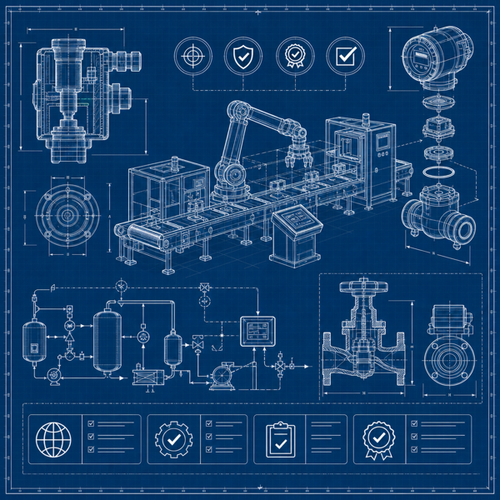
Industrial process measurement and control has become the cornerstone of efficient, safe, and scalable operations within the modern manufacturing sector. As automation grows and digital transformation accelerates, adherence to globally recognized standards is no longer optional—the pressures of productivity, cybersecurity, compliance, and growth demand it. This comprehensive guide covers four pivotal international standards shaping today's process control landscape: IEC 61298-3:2026, IEC 61514:2026, IEC 62828-1:2026, and ISO 15926-100:2026. Whether you’re aiming to improve plant reliability, minimize downtime, or ensure the interoperability of your systems, these standards provide the proven frameworks to drive manufacturing excellence.
Overview / Introduction
Industrial process measurement and control describes the technologies, devices, and strategies that enable manufacturers to monitor, regulate, and optimize processes—ensuring products are consistently high-quality, operations remain safe, and resources are used efficiently. In a world where competitiveness relies on responsive automation, intelligent data, and seamless system integration, the adoption of robust standards has moved from best practice to business necessity.
What will you learn here? This guide offers:
- A plain-language summary of the core principles in four key international standards
- The main requirements and specifications outlined by each standard
- Practical implementation advice
- A clear look at how compliance strengthens productivity, security, and scalability
By embedding high-ranking keywords such as “industrial process measurement standards,” “process control compliance,” “manufacturing automation,” and “industrial data integration,” this article ensures relevance for both professionals and those new to industrial standards.
Detailed Standards Coverage
IEC 61298-3:2026 – Evaluating Performance of Process Measurement & Control Devices
Process measurement and control devices – General methods and procedures for evaluating performance – Part 3: Tests for the effects of influence quantities
The IEC 61298-3:2026 standard provides comprehensive, uniform methods for testing and reporting the performance of process measurement and control devices—excluding process measurement transmitters (PMTs). This standard applies to both analogue and digital devices, setting procedures for determining how specific environmental factors (called ".influence quantities") affect device performance.
Scope and Key Requirements:
- Covers devices characterized by specific input/output variables and measurable transfer functions
- Prescribes tests for effects like ambient temperature, humidity, vibration, mechanical shocks, mounting position, and electrical power supply variations
- Applies to control and measurement devices except those standardized under the IEC 62828 PMT series
- Includes references to relevant IEC standards rather than duplicating requirements for EMC (Electromagnetic Compatibility) and electrical safety
Who Needs to Comply? Manufacturers, testing bodies, and users of process measurement and control instruments—across industries such as chemicals, food processing, water treatment, mining, and pharmaceuticals—that expect consistent device performance under varying operational conditions.
Implementation and Practical Features:
- Establishes slow, controlled variation of each influence quantity to evaluate performance drift
- Recommends a thorough documentation process for each test, ensuring traceability and reproducibility
- Allows conjunction with product-specific standards for specialized devices
Key highlights:
- Tests for temperature, humidity, electrical disruptions, and mechanical influence
- Covers both analogue and digital devices, excluding PMTs
- Emphasizes repeatability and reporting to support audits and certification
Access the full standard:View IEC 61298-3:2026 on iTeh Standards
IEC 61514:2026 – Performance Evaluation of Pneumatic Valve Positioners
Industrial-process control systems – Methods of evaluating the performance of valve positioners with pneumatic outputs
The IEC 61514:2026 standard lays out test methods for single- and double-acting analogue positioners with pneumatic outputs. Pneumatic valve positioners are essential in automated process control—ensuring that valves respond accurately and reproducibly to control signals.
Scope and Key Requirements:
- Applies to positioners that receive analogue input signals and output pneumatic signals
- Excludes positioners with digital or pulsed input/output signals
- Specifies tests for static and dynamic performance, air consumption, error behavior, influence of environmental factors (temperature, vibration, magnetic fields), and joint operation with actuators
Who Needs to Comply? Manufacturers of valve positioners, end-users in industries like oil & gas, chemical processing, water treatment, energy, and all who depend on pneumatic actuation for process safety and efficiency.
Implementation and Practical Features:
- Tests can be conducted on positioners alone or paired with designated actuators
- Mandates close collaboration between the evaluating body and manufacturer during testing
- Offers flexibility: a reduced set of tests may be used for devices only exposed to limited operational stresses
Notable Features and Updates:
- Redefinition of magnetic field requirements for fatigue testing
- Improved clarity in dynamic response test protocols
- Updated documentation and reporting requirements
Key highlights:
- Uniform and transparent assessment of positioner performance
- Clearly defined error calculations and repeatability requirements
- Optional reduced test sets for less demanding environments
Access the full standard:View IEC 61514:2026 on iTeh Standards
IEC 62828-1:2026 – Testing Industrial and Process Measurement Transmitters
Reference conditions and procedures for testing industrial and process measurement transmitters – Part 1: General procedures for all types of transmitters
IEC 62828-1:2026 sets the baseline for assessing all types of process measurement transmitters (PMTs) used in process automation—whether these transmitters provide analogue current or voltage signals, only digital outputs, or a combination of analogue and digital outputs.
Scope and Key Requirements:
- Defines reference environmental, electrical, and mechanical conditions for testing transmitters
- Describes standardized procedures for accuracy, uncertainty, static/dynamic behavior, and environmental influences
- Distinguishes between analogue PMTs and digital/hybrid PMTs
- Serves as the foundational reference for further test methods developed in the IEC 62828 series
- Excludes sensing devices covered under IEC 60947
Who Needs to Comply? Device manufacturers, system integrators, automation engineers, and end-users in process industries—especially where reliable measurement is critical for automated control, safety, and reporting.
Implementation and Practical Features:
- Comprehensive terminology for accuracy and uncertainty, harmonized across the series
- Detailed reporting frameworks for measurement errors, drift, and environmental sensitivity
- Example parameter settings for common test currents (e.g., 4–20 mA signalling)
Recent Technical Changes:
- Detailed examples for signal currents moved into this edition for clarity
- Unified definitions of critical measurement parameters (warm-up time, settling, accuracy)
- Reworked test reporting procedures for consistency
Key highlights:
- Universal procedures for all PMTs, ensuring process data integrity
- Standardizes terminology and methodology across product lines
- Provides templates for test reports usable in audits and certifications
Access the full standard:View IEC 62828-1:2026 on iTeh Standards
ISO 15926-100:2026 – Vocabulary for Integration of Life-Cycle Data
Industrial automation systems and integration — Integration of life-cycle data for process plants including oil and gas production facilities — Part 100: Vocabulary
The ISO 15926-100:2026 standard establishes the vocabulary for integrating life-cycle data in process plant environments. In our digital era, standardizing concepts and information models is vital for effective data exchange, plant lifecycle management, and interoperability across systems.
Scope and Key Requirements:
- Defines fundamental and advanced terms for describing data integration, plant entities, life-cycle activities, and process plant automation
- Covers concepts from data and metadata through to asset, entity, class, ontology, part, role, and requirements
- Does not directly specify reference libraries or underlying data model entities (these are covered in other ISO 15926 series parts)
Who Needs to Comply? Plant owners/operators, engineering firms, equipment vendors, and software developers who design, operate, or maintain digital twins and integrated systems for process plants—especially in oil & gas, chemicals, and large-scale manufacturing.
Implementation and Practical Features:
- Provides a common semantics backbone supporting data handover across project phases, suppliers, and lifecycle events
- Enables unambiguous communication and reduces integration errors in multi-vendor, multi-system environments
- Facilitates implementation of digital plant platforms, exchange formats, and connected enterprise initiatives
Key highlights:
- Centralized, harmonized vocabulary for process plant data integration
- Supports global collaborative engineering, digital twin, and asset management projects
- Reduces ambiguity and boosts efficiency in data-driven manufacturing
Access the full standard:View ISO 15926-100:2026 on iTeh Standards
Industry Impact & Compliance
Modern manufacturing operations demand consistency, reliability, and traceability—qualities that stem directly from strong process measurement and control standards. The implementation of these international guidelines not only assures compliance with legal and customer mandates but reinforces your organization’s market credibility.
Key compliance considerations include:
- Meeting regulatory obligations for quality, safety, and environmental controls
- Supporting third-party audits, certifications, and customer quality requirements
- Enabling seamless data interchange and integration with supply chain partners
- Reducing non-conformance risks that lead to costly downtime, recalls, or legal exposure
Benefits of Adopting These Standards:
- Increased Productivity – Accurate process control minimizes rework and optimizes output.
- Enhanced Security and Robustness – Standardized methods address vulnerabilities from electromagnetic interference, power fluctuations, and environmental extremes.
- Scalability and Future-Proofing – Uniform approaches and vocabulary enable scaling from local plants to global operations, and incorporate new automation technologies with minimal friction.
- Efficient Troubleshooting and Maintenance – Consistent measurement, reporting, and test documentation streamline diagnostics, predictive maintenance, and root cause analysis.
- Supply Chain and Partner Interoperability – Common terminology and reporting facilitate collaboration with OEMs, integrators, and digital technology providers.
Risks of Non-Compliance:
- Regulatory penalties or restrictions
- Poor process data integrity and increased risk of quality incidents
- Integration difficulties in future modernization or expansion
- Loss of market or customer trust
Implementation Guidance
Switching to or upgrading existing processes to fully comply with these standards requires a systematic approach. Key implementation strategies include:
- Assessment: Review your existing devices, positioners, and data integration methods for alignment with these standards.
- Training: Educate your engineering, maintenance, and quality teams on the new procedures, vocabulary, and reporting requirements.
- Supplier and OEM Engagement: Collaborate with your device and system suppliers to ensure their equipment is certified or tested per the relevant IEC/ISO standard.
- Testing and Validation: Establish or contract out testing protocols to periodically assess device and system compliance (using the procedures detailed in these standards).
- Documentation: Maintain clear, updated test records, maintenance logs, and compliance certificates—facilitating audits and continuous improvement.
- Continuous Improvement: Integrate lessons learned from test outcomes, non-conformance events, and plant upgrades into your process improvement cycles.
- Resource Libraries: Leverage tools and open-access resources, such as online standard vocabularies, best-practice guides, and template test reports, provided by organizations like ISO and IEC.
Best practice tips:
- Choose partners and technology providers who demonstrate commitment to up-to-date standards
- Establish a governance process for periodically reviewing, auditing, and updating your standards compliance
- Use digital platforms to automate test recording, version control, and document management
Conclusion / Next Steps
Industrial process measurement and control standards—such as IEC 61298-3:2026, IEC 61514:2026, IEC 62828-1:2026, and ISO 15926-100:2026—are not only about regulatory compliance. They are strategic tools for achieving operational excellence, maintaining a competitive edge, and unlocking innovation in modern manufacturing environments.
Key takeaways:
- Adopting these standards brings measurable benefits: higher productivity, stronger security, and true scalability
- Compliance is key for regulatory approval, market access, and robust risk management
- The standards provide harmonized vocabularies, test procedures, and requirements—supporting smooth integration, automation, and data-driven decision making
What should your organization do next?
- Audit your current systems and practices for alignment with these standards
- Train and empower your staff for the coming digital industrial era
- Explore the full text and supporting materials for each standard through platforms like iTeh Standards
- Stay informed—these standards are living documents, evolving to meet new technological and regulatory challenges
Embracing and implementing international process measurement and control standards today will ensure your business is ready for tomorrow’s competitive, connected, and ever-changing industrial landscape.
Categories
- Latest News
- New Arrivals
- Generalities
- Services and Management
- Natural Sciences
- Health Care
- Environment
- Metrology and Measurement
- Testing
- Mechanical Systems
- Fluid Systems
- Manufacturing
- Energy and Heat
- Electrical Engineering
- Electronics
- Telecommunications
- Information Technology
- Image Technology
- Precision Mechanics
- Road Vehicles
- Railway Engineering
- Shipbuilding
- Aircraft and Space
- Materials Handling
- Packaging
- Textile and Leather
- Clothing
- Agriculture
- Food technology
- Chemical Technology
- Mining and Minerals
- Petroleum
- Metallurgy
- Wood technology
- Glass and Ceramics
- Rubber and Plastics
- Paper Technology
- Paint Industries
- Construction
- Civil Engineering
- Military Engineering
- Entertainment