

IEC 61514:2026
(Main)Industrial-process control systems - Methods of evaluating the performance of valve positioners with pneumatic outputs
- Abstract
IEC 61514:2026 specifies tests designed to determine the static and dynamic performance of single-acting or double-acting analogue positioners. The tests apply to positioners which receive standard analogue input signals (as specified in IEC 60381-1, IEC 60381-2 and IEC 60382) and have a pneumatic output. Positioners with pulsed or digital input signals, positioners with digital controllers and positioners with pulsed outputs are outside the scope of this document. Testing is conducted either on a positioner alone, independently of an actuator, or on a positioner mounted and connected to a specific actuator, as a combined unit. The text makes clear where different approaches are required. The methods of evaluation given in this document are intended for use by manufacturers to determine the performance of their products, and by users, or independent testing establishments, to verify manufacturers' performance specifications. The closest liaison between the evaluating body and the manufacturer is indispensable during the tests, including the possibility for the manufacturer to influence the test programme based on the manufacturer's specifications for the instrument and comment on both the test programme and the results. This document is intended to provide definitions of positioner elements, actions, and characteristics, to specify uniform methods of measuring performance errors and effects of influence quantities on those characteristics, and to describe methods of reporting and evaluating the results of the measurement data obtained. The test conditions described in this publication (for example range of ambient temperatures and power supply) relate to conditions which commonly arise in use. Consequently, the values specified are used where no other values are specified by the manufacturer or user. If other values are used, they will be stated. It is recognized that the manufacturer's specifications and instructions for installation and operation apply during all steps. The tests specified in this document are not necessarily sufficient for instruments specifically designed for unusually arduous conditions. Conversely, a reduced series of tests can serve adequately for instruments designed to perform within a more limited range of conditions. When a full evaluation, in accordance with this document, is not required or possible, only the tests which are required are performed and the results reported in accordance with the relevant parts of this document. In such cases, the test report will state that it does not cover the full number of tests specified herein. This second edition cancels and replaces the first edition published in 2000. This edition constitutes a technical revision.
This edition includes the following significant technical changes with respect to the previous edition:
a) in 6.6.8 and Table 5, the magnetic field has been changed from 100 A/m to of 30 A/m (Mean Root Square);
b) 6.10.4 and Figure 9 have been modified for better understandability;
c) in 7.4, the reference to IEC 61187 has been deleted and replaced with a new Table 4: Document information.
- Status
- Published
- Publication Date
- 08-Jun-2026
- Technical Committee
- SC 65B - Measurement and control devices
- Drafting Committee
- WG 6 - TC 65/SC 65B/WG 6
- Current Stage
- PPUB - Publication issued
- Start Date
- 09-Jun-2026
- Completion Date
- 26-Jun-2026
Buy Documents
REDLINE IEC 61514:2026 RLV - Industrial-process control systems - Methods of evaluating the performance of valve positioners with pneumatic outputs
iec61514{ed2.0}en - Industrial-process control systems - Methods of evaluating the performance of valve positioners with pneumatic outputs
iec61514{ed2.0}fr - Systemes de commande des processus industriels - Méthodes d'évaluation des performances des positionneurs de vannes a sorties pneumatiques
IEC 61514:2026 is an IEC International Standard from the International Electrotechnical Commission for industrial-process control systems. It specifies methods for evaluating the static and dynamic performance of valve positioners with pneumatic outputs.
IEC 61514:2026 is written for manufacturers, users, and independent testing establishments that need to measure performance, verify stated specifications, and report results in a uniform way. It also defines the key positioner terms, test conditions, and test report content used in practice.
What does IEC 61514:2026 specify?
IEC 61514:2026 specifies test methods for single-acting and double-acting analogue positioners with pneumatic output. The document focuses on positioners that receive standard analogue input signals and it leaves out positioners with pulsed or digital inputs, digital controllers, and pulsed outputs.
IEC 61514:2026 is organized into 8 clauses:
- Clause 1 - scope and application
- Clause 2 - normative references
- Clause 3 - terms and definitions
- Clause 4 - general test conditions
- Clause 5 - general test procedures
- Clause 6 - test procedures
- Clause 7 - other factors to consider
- Clause 8 - test report and documentation
The standard covers both bench testing of the positioner alone and combined testing of a positioner mounted on a specific actuator. That matters because the first method isolates the positioner, while the second shows how the assembled unit behaves in service.
What are the key requirements of IEC 61514:2026?
IEC 61514:2026 requires tests to be run under controlled ambient and supply conditions, with manufacturer instructions taking precedence when they give different values. In practice, this means the test setup, stabilization time, and supply quality have to be controlled before results can be compared.
Setting up the test correctly
Clause 5 requires the device to stabilize before readings are taken, and it calls for repeated traverses of the operating range before the measurements are recorded. The measurement points should be spread across the full range, so the result reflects the whole operating band and not just one favorable point.
Clause 5 also separates positioner-only tests from positioner-plus-actuator tests. That distinction matters because the combined unit can be affected by actuator friction, inertia, spring action, and load, while the separate test is the way to compare positioners on their own.
Measuring the main performance characteristics
Clause 6 measures gain, course characteristic, precision terms, dead band, air-flow data, and dynamic response. In practice, this gives a buyer or engineer a full picture of how well the positioner follows its input and how stable and repeatable that behavior is.
Clause 6 defines how to measure gain and the proportional gain factor K, including checks for direct and reverse action and for the effect of supply pressure. That matters because gain changes can affect controllability and tuning in the installed loop.
Clause 6 also requires evaluation of the course characteristic and the main error terms - measured error, conformity or linearity error, hysteresis, and repeatability error. These results show whether the positioner tracks the intended position consistently in both directions.
Checking influence quantities and robustness
Clause 6 requires testing the effect of influence quantities such as supply pressure, ambient temperature, humidity, mounting position, shock, vibration, magnetic field, electromagnetic radiation, electrical fast transients, surge, and series-mode interference. For the user, this shows how much the positioner output or course can shift when the environment changes.
The document also includes an input-overrange test, start-up drift, long-term drift, and accelerated life testing. These checks matter because they reveal whether the positioner stays stable after overload, after power-up, and over extended operation.
Evaluating dynamic response and documenting the result
Clause 6 includes both frequency-response testing and step-response testing. These methods are important when the positioner has to follow fast control signals or when the combined positioner/actuator response is critical to process stability.
Clause 8 requires a full test report in the format of IEC 61298-4, together with the test results listed in the document. In practice, the report has to show what was tested, how it was mounted, what actuator or valve was used, and which tests were omitted if the evaluation was partial.
What terms does IEC 61514:2026 define?
- Positioner - A control device connected to the moving part of the final control element or its actuator that adjusts output signal Y to maintain the desired course signal X.
- Single-acting positioner - A positioner with one output signal Y acting on one side of the actuator.
- Double-acting positioner - A positioner with two output signals Y and Y acting on opposite sides of the actuator.
- Signal d'entrée W - The reference input signal that represents the desired position of the associated control element.
- Signal de course X - The signal produced by the movement of the final control element or its actuator.
- Signal de sortie Y - The air pressure supplied to the actuator of the final control element.
- Action directe / action inversée - Direct action means Y rises when W rises, while reverse action means Y falls when W rises.
- Fractionnement de la plage - A special setting that uses only part of the input range to obtain full actuator travel.
- Facteur de gain proportionnel K - The gain over the full actuator range.
- Zone d'insensibilité - The range of input or course change that produces no detectable output change.
Who uses IEC 61514:2026?
IEC 61514:2026 is used by positioner manufacturers, industrial users, and independent test laboratories. Manufacturers use it to characterize their products and support performance claims, while users and test houses use it to verify those claims in a consistent way.
It is relevant in industrial process control and valve automation, especially where pneumatic positioners are part of a control loop. Quality teams and buyers can use it to compare devices on the same test basis and to check that test reports include the information needed for acceptance or audit.
What changed in IEC 61514:2026 from the previous edition?
IEC 61514:2026 is the second edition and it cancels and replaces the 2000 edition as a technical revision. The stated technical changes are:
- the magnetic-field test severity in Clause 6.6.8 and Table 5 was reduced
- Clause 6.10.4 and Figure 9 were revised for clarity
- Clause 7.4 now uses a new document-information table instead of the former reference to IEC 61187
Which standards are used with IEC 61514:2026?
IEC 61514:2026 relies on several referenced standards for signals, test conditions, EMC, safety, and reporting.
| Standard | What it contributes |
|---|---|
| IEC 60050-311 | Vocabulary for electrical measurements |
| IEC 60050-351 | Vocabulary for control and regulation technology |
| IEC 60068-2-1, IEC 60068-2-2, IEC 60068-2-6, IEC 60068-2-31, IEC 60068-2-78 | Environmental test methods for cold, dry heat, vibration, shock, and damp heat |
| IEC 60381-1, IEC 60381-2, IEC 60382 | Standard analogue input signals used by the positioners in scope |
| IEC 60529 | Degree of protection provided by enclosures |
| IEC 60654 and IEC 60721-3 | Operating and environmental condition classifications |
| IEC 61010-1 | Safety requirements for electrical measuring and control equipment |
| IEC 61032 | Test probes for verifying protection by enclosures |
| IEC 61298-4 | Required structure of the performance-evaluation report |
| IEC 61326-1 | EMC test requirements used for immunity checks |
What does the IEC 61514:2026 document contain?
IEC 61514:2026 contains test conditions, general procedures, specific measurement methods, and reporting rules, supported by figures and tables. The tables cover environmental conditions, typical error terms, vibration levels, document information, and the results that must appear in the report.
The figures show typical positioner/actuator arrangements, gain and error curves, the air-flow test setup, a dynamic-response setup, and example frequency- and step-response plots. These elements are used for performance testing, verification, and reporting rather than for installation instructions alone.
Clause 6 provides the core measurement procedures for gain, course characteristic, dead band, air flow, influence quantities, overrange, drift, life testing, and dynamic response. Clause 7 then adds checks on safety, enclosure protection, installation, maintenance, repair, protective treatments, design features, variants, and required tools.
Relations
- Effective Date
- 05-Sep-2023
Buy Documents
REDLINE IEC 61514:2026 RLV - Industrial-process control systems - Methods of evaluating the performance of valve positioners with pneumatic outputs
iec61514{ed2.0}en - Industrial-process control systems - Methods of evaluating the performance of valve positioners with pneumatic outputs
iec61514{ed2.0}fr - Systemes de commande des processus industriels - Méthodes d'évaluation des performances des positionneurs de vannes a sorties pneumatiques
Get Certified
Connect with accredited certification bodies for this standard

DVS-ZERT GmbH
German welding certification society.
Institut za varilstvo d.o.o. (Welding Institute)
Slovenia's leading welding institute since 1952. ISO 3834, EN 1090, pressure equipment certification, NDT personnel, welder qualification. Only IIW Au
CARES (UK Certification Authority for Reinforcing Steels)
UK certification for reinforcing steels and construction.
Sponsored listings
Frequently Asked Questions
IEC 61514:2026 is a standard published by the International Electrotechnical Commission (IEC). Its full title is "Industrial-process control systems - Methods of evaluating the performance of valve positioners with pneumatic outputs". This standard covers: IEC 61514:2026 specifies tests designed to determine the static and dynamic performance of single-acting or double-acting analogue positioners. The tests apply to positioners which receive standard analogue input signals (as specified in IEC 60381-1, IEC 60381-2 and IEC 60382) and have a pneumatic output. Positioners with pulsed or digital input signals, positioners with digital controllers and positioners with pulsed outputs are outside the scope of this document. Testing is conducted either on a positioner alone, independently of an actuator, or on a positioner mounted and connected to a specific actuator, as a combined unit. The text makes clear where different approaches are required. The methods of evaluation given in this document are intended for use by manufacturers to determine the performance of their products, and by users, or independent testing establishments, to verify manufacturers' performance specifications. The closest liaison between the evaluating body and the manufacturer is indispensable during the tests, including the possibility for the manufacturer to influence the test programme based on the manufacturer's specifications for the instrument and comment on both the test programme and the results. This document is intended to provide definitions of positioner elements, actions, and characteristics, to specify uniform methods of measuring performance errors and effects of influence quantities on those characteristics, and to describe methods of reporting and evaluating the results of the measurement data obtained. The test conditions described in this publication (for example range of ambient temperatures and power supply) relate to conditions which commonly arise in use. Consequently, the values specified are used where no other values are specified by the manufacturer or user. If other values are used, they will be stated. It is recognized that the manufacturer's specifications and instructions for installation and operation apply during all steps. The tests specified in this document are not necessarily sufficient for instruments specifically designed for unusually arduous conditions. Conversely, a reduced series of tests can serve adequately for instruments designed to perform within a more limited range of conditions. When a full evaluation, in accordance with this document, is not required or possible, only the tests which are required are performed and the results reported in accordance with the relevant parts of this document. In such cases, the test report will state that it does not cover the full number of tests specified herein. This second edition cancels and replaces the first edition published in 2000. This edition constitutes a technical revision. This edition includes the following significant technical changes with respect to the previous edition: a) in 6.6.8 and Table 5, the magnetic field has been changed from 100 A/m to of 30 A/m (Mean Root Square); b) 6.10.4 and Figure 9 have been modified for better understandability; c) in 7.4, the reference to IEC 61187 has been deleted and replaced with a new Table 4: Document information.
IEC 61514:2026 specifies tests designed to determine the static and dynamic performance of single-acting or double-acting analogue positioners. The tests apply to positioners which receive standard analogue input signals (as specified in IEC 60381-1, IEC 60381-2 and IEC 60382) and have a pneumatic output. Positioners with pulsed or digital input signals, positioners with digital controllers and positioners with pulsed outputs are outside the scope of this document. Testing is conducted either on a positioner alone, independently of an actuator, or on a positioner mounted and connected to a specific actuator, as a combined unit. The text makes clear where different approaches are required. The methods of evaluation given in this document are intended for use by manufacturers to determine the performance of their products, and by users, or independent testing establishments, to verify manufacturers' performance specifications. The closest liaison between the evaluating body and the manufacturer is indispensable during the tests, including the possibility for the manufacturer to influence the test programme based on the manufacturer's specifications for the instrument and comment on both the test programme and the results. This document is intended to provide definitions of positioner elements, actions, and characteristics, to specify uniform methods of measuring performance errors and effects of influence quantities on those characteristics, and to describe methods of reporting and evaluating the results of the measurement data obtained. The test conditions described in this publication (for example range of ambient temperatures and power supply) relate to conditions which commonly arise in use. Consequently, the values specified are used where no other values are specified by the manufacturer or user. If other values are used, they will be stated. It is recognized that the manufacturer's specifications and instructions for installation and operation apply during all steps. The tests specified in this document are not necessarily sufficient for instruments specifically designed for unusually arduous conditions. Conversely, a reduced series of tests can serve adequately for instruments designed to perform within a more limited range of conditions. When a full evaluation, in accordance with this document, is not required or possible, only the tests which are required are performed and the results reported in accordance with the relevant parts of this document. In such cases, the test report will state that it does not cover the full number of tests specified herein. This second edition cancels and replaces the first edition published in 2000. This edition constitutes a technical revision. This edition includes the following significant technical changes with respect to the previous edition: a) in 6.6.8 and Table 5, the magnetic field has been changed from 100 A/m to of 30 A/m (Mean Root Square); b) 6.10.4 and Figure 9 have been modified for better understandability; c) in 7.4, the reference to IEC 61187 has been deleted and replaced with a new Table 4: Document information.
IEC 61514:2026 is classified under the following ICS (International Classification for Standards) categories: 23.060.99 - Other valves; 25.040.40 - Industrial process measurement and control. The ICS classification helps identify the subject area and facilitates finding related standards.
IEC 61514:2026 has the following relationships with other standards: It is inter standard links to IEC 61514:2000. Understanding these relationships helps ensure you are using the most current and applicable version of the standard.
IEC 61514:2026 is available in PDF format for immediate download after purchase. The document can be added to your cart and obtained through the secure checkout process. Digital delivery ensures instant access to the complete standard document.
Standards Content (Sample)
IEC 61514 ®
Edition 2.0 2026-06
INTERNATIONAL
STANDARD
REDLINE VERSION
Industrial-process control systems - Methods of evaluating the performance of
valve positioners with pneumatic outputs
ICS 23.060.99; 25.040.40 ISBN 978-2-8327-1324-2
All rights reserved. Unless otherwise specified, no part of this publication may be reproduced or utilized in any form or
by any means, electronic or mechanical, including photocopying and microfilm, without permission in writing from either
IEC or IEC's member National Committee in the country of the requester. If you have any questions about IEC copyright
or have an enquiry about obtaining additional rights to this publication, please contact the address below or your local
IEC member National Committee for further information.
IEC Secretariat Tel.: +41 22 919 02 11
3, rue de Varembé info@iec.ch
CH-1211 Geneva 20 www.iec.ch
Switzerland
About the IEC
The International Electrotechnical Commission (IEC) is the leading global organization that prepares and publishes
International Standards for all electrical, electronic and related technologies.
About IEC publications
The technical content of IEC publications is kept under constant review by the IEC. Please make sure that you have the
latest edition, a corrigendum or an amendment might have been published.
IEC publications search - IEC Products & Services Portal - products.iec.ch
webstore.iec.ch/advsearchform Discover our powerful search engine and read freely all the
The advanced search enables to find IEC publications by a publications previews, graphical symbols and the glossary.
variety of criteria (reference number, text, technical With a subscription you will always have access to up to date
committee, …). It also gives information on projects, content tailored to your needs.
replaced and withdrawn publications.
Electropedia - www.electropedia.org
The world's leading online dictionary on electrotechnology,
IEC Just Published - webstore.iec.ch/justpublished
Stay up to date on all new IEC publications. Just Published containing more than 22 500 terminological entries in English
details all new publications released. Available online and and French, with equivalent terms in 25 additional languages.
once a month by email. Also known as the International Electrotechnical Vocabulary
(IEV) online.
IEC Customer Service Centre - webstore.iec.ch/csc
If you wish to give us your feedback on this publication or
need further assistance, please contact the Customer
Service Centre: sales@iec.ch.
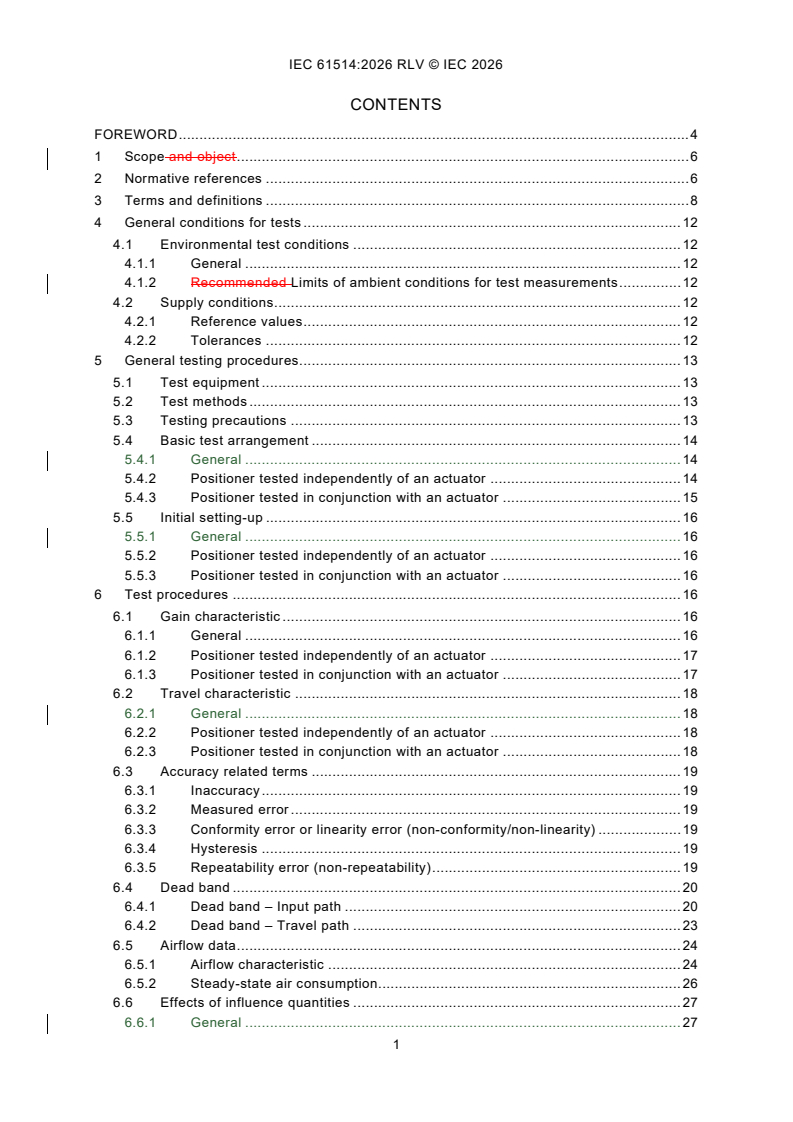
CONTENTS
FOREWORD . 4
1 Scope and object . 6
2 Normative references . 6
3 Terms and definitions . 8
4 General conditions for tests . 12
4.1 Environmental test conditions . 12
4.1.1 General . 12
4.1.2 Recommended Limits of ambient conditions for test measurements . 12
4.2 Supply conditions . 12
4.2.1 Reference values . 12
4.2.2 Tolerances . 12
5 General testing procedures. 13
5.1 Test equipment . 13
5.2 Test methods . 13
5.3 Testing precautions . 13
5.4 Basic test arrangement . 14
5.4.1 General . 14
5.4.2 Positioner tested independently of an actuator . 14
5.4.3 Positioner tested in conjunction with an actuator . 15
5.5 Initial setting-up . 16
5.5.1 General . 16
5.5.2 Positioner tested independently of an actuator . 16
5.5.3 Positioner tested in conjunction with an actuator . 16
6 Test procedures . 16
6.1 Gain characteristic . 16
6.1.1 General . 16
6.1.2 Positioner tested independently of an actuator . 17
6.1.3 Positioner tested in conjunction with an actuator . 17
6.2 Travel characteristic . 18
6.2.1 General . 18
6.2.2 Positioner tested independently of an actuator . 18
6.2.3 Positioner tested in conjunction with an actuator . 18
6.3 Accuracy related terms . 19
6.3.1 Inaccuracy . 19
6.3.2 Measured error . 19
6.3.3 Conformity error or linearity error (non-conformity/non-linearity) . 19
6.3.4 Hysteresis . 19
6.3.5 Repeatability error (non-repeatability) . 19
6.4 Dead band . 20
6.4.1 Dead band – Input path . 20
6.4.2 Dead band – Travel path . 23
6.5 Airflow data . 24
6.5.1 Airflow characteristic . 24
6.5.2 Steady-state air consumption. 26
6.6 Effects of influence quantities . 27
6.6.1 General . 27
6.6.2 Supply pressure. 28
6.6.3 Ambient temperature . 28
6.6.4 Relative humidity . 29
6.6.5 Mounting position . 30
6.6.6 Mechanical shock . 30
6.6.7 Vibration . 31
6.6.8 Power-frequency magnetic field . 32
6.6.9 Radiated electromagnetic field interference . 33
6.6.10 Electrical fast transients (burst) . 33
6.6.11 Surge voltage immunity . 34
6.6.12 Series mode interference . 35
6.7 Input over-range . 36
6.7.1 General . 36
6.7.2 Positioner tested independently of an actuator . 36
6.7.3 Positioner tested in conjunction with an actuator . 36
6.7.4 Common text for positioners tested independently of an actuator/with an
actuator . 36
6.8 Drift . 36
6.8.1 General . 36
6.8.2 Start-up drift . 36
6.8.3 Long-term drift . 37
6.9 Accelerated life test . 37
6.9.1 Positioner tested independently of an actuator . 37
6.9.2 Positioner tested in conjunction with an actuator . 38
6.9.3 Common text for positioners tested in conjunction with/independently of
an actuator . 38
6.10 Dynamic response . 38
6.10.1 General . 38
6.10.2 General considerations . 38
6.10.3 Basic test arrangement . 38
6.10.4 Frequency response . 39
6.10.5 Step response . 40
7 Other considerations . 42
7.1 General . 42
7.2 Safety . 43
7.3 Degree of protection provided by enclosures . 43
7.4 Documentary information . 43
7.5 Installation . 44
7.6 Routine maintenance and adjustment . 44
7.7 Repair . 44
7.8 Protective finishes . 45
7.9 Design features . 45
7.10 Variants . 45
7.11 Tools and equipment . 45
8 Test report and documentation . 45
Bibliography . 48
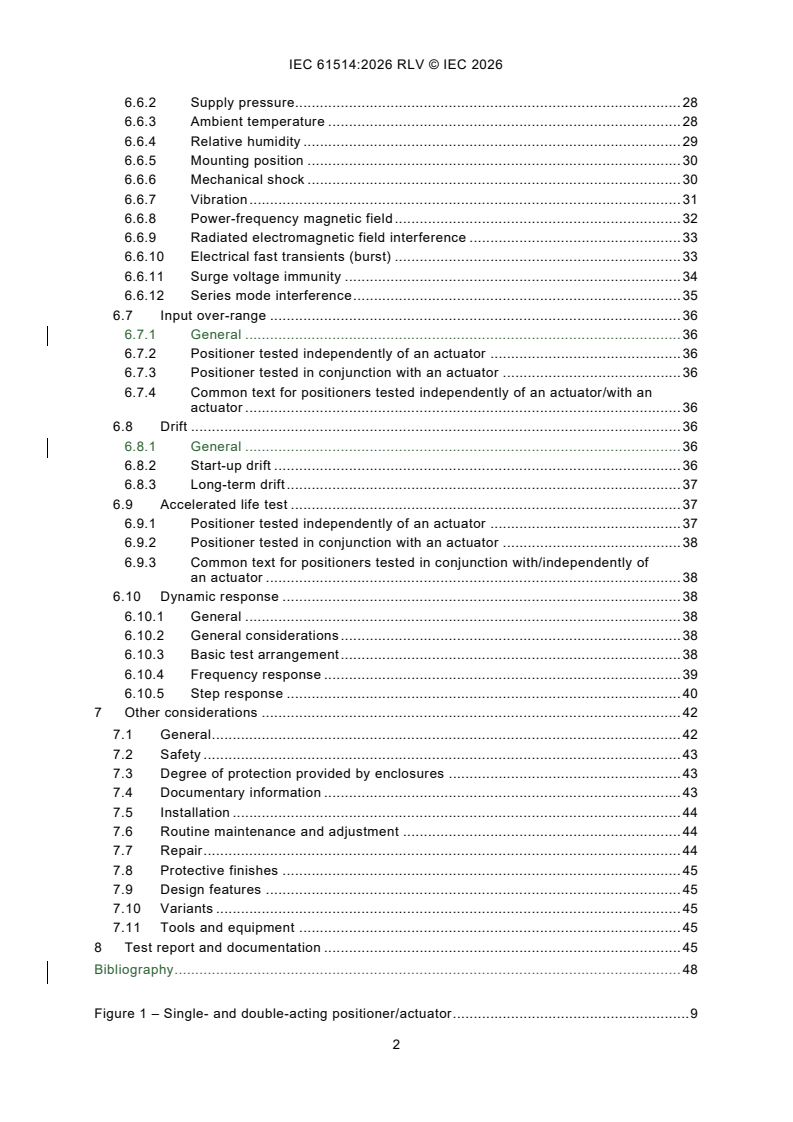
Figure 1 – Single- and double-acting positioner/actuator . 9
Figure 2 – Gain characteristic . 11
Figure 3 – Basic test arrangement . 15
Figure 4 – Typical error plot . 23
Figure 5 – Test arrangement for measurement of airflow characteristic . 25
Figure 6 – Typical air flow characteristic . 26
Figure 7 – Series mode interference . 35
Figure 8 – Simple dynamic response test arrangement . 39
Figure 9 – Two examples of frequency response tests . 40
Figure 10 – Two examples of responses to a step input . 42
Table 1 – Environmental conditions . 12
Table 2 – Typical table of errors . 21
Table 3 – Vibration test levels . 31
Table 4 – Document information . 43
Table 5 – Test results to be reported . 46
INTERNATIONAL ELECTROTECHNICAL COMMISSION
____________
Industrial-process control systems -
Methods of evaluating the performance
of valve positioners with pneumatic outputs
FOREWORD
1) The International Electrotechnical Commission (IEC) is a worldwide organization for standardization comprising
all national electrotechnical committees (IEC National Committees). The object of IEC is to promote international
co-operation on all questions concerning standardization in the electrical and electronic fields. To this end and
in addition to other activities, IEC publishes International Standards, Technical Specifications, Technical Reports,
Publicly Available Specifications (PAS) and Guides (hereafter referred to as “IEC Publication(s)”). Their
preparation is entrusted to technical committees; any IEC National Committee interested in the subject dealt with
may participate in this preparatory work. International, governmental and non-governmental organizations liaising
with the IEC also participate in this preparation. IEC collaborates closely with the International Organization for
Standardization (ISO) in accordance with conditions determined by agreement between the two organizations.
2) The formal decisions or agreements of IEC on technical matters express, as nearly as possible, an international
consensus of opinion on the relevant subjects since each technical committee has representation from all
interested IEC National Committees.
3) IEC Publications have the form of recommendations for international use and are accepted by IEC National
Committees in that sense. While all reasonable efforts are made to ensure that the technical content of IEC
Publications is accurate, IEC cannot be held responsible for the way in which they are used or for any
misinterpretation by any end user.
4) In order to promote international uniformity, IEC National Committees undertake to apply IEC Publications
transparently to the maximum extent possible in their national and regional publications. Any divergence between
any IEC Publication and the corresponding national or regional publication shall be clearly indicated in the latter.
5) IEC itself does not provide any attestation of conformity. Independent certification bodies provide conformity
assessment services and, in some areas, access to IEC marks of conformity. IEC is not responsible for any
services carried out by independent certification bodies.
6) All users should ensure that they have the latest edition of this publication.
7) No liability shall attach to IEC or its directors, employees, servants or agents including individual experts and
members of its technical committees and IEC National Committees for any personal injury, property damage or
other damage of any nature whatsoever, whether direct or indirect, or for costs (including legal fees) and
expenses arising out of the publication, use of, or reliance upon, this IEC Publication or any other IEC
Publications.
8) Attention is drawn to the Normative references cited in this publication. Use of the referenced publications is
indispensable for the correct application of this publication.
9) IEC draws attention to the possibility that the implementation of this document may involve the use of (a)
patent(s). IEC takes no position concerning the evidence, validity or applicability of any claimed patent rights in
respect thereof. As of the date of publication of this document, IEC had not received notice of (a) patent(s), which
may be required to implement this document. However, implementers are cautioned that this may not represent
the latest information, which may be obtained from the patent database available at https://patents.iec.ch. IEC
shall not be held responsible for identifying any or all such patent rights.
This redline version of the official IEC Standard allows the user to identify the changes made
to the previous edition IEC 61514:2000. A vertical bar appears in the margin wherever a change
has been made. Additions are in green text, deletions are in strikethrough red text.
IEC 61514 has been prepared by subcommittee 65B: Devices, of IEC technical
committee 65: Industrial-process measurement and control. It is an International Standard.
This second edition cancels and replaces the first edition published in 2000. This edition
constitutes a technical revision.
This edition includes the following significant technical changes with respect to the previous
edition:
a) in 6.6.8 and Table 5, the magnetic field has been changed from 100 A/m to of 30 A/m (Mean
Root Square);
b) 6.10.4 and Figure 9 have been modified for better understandability;
c) in 7.4, the reference to IEC 61187 has been deleted and replaced with a new Table 4:
Document information.
The text of this International Standard is based on the following documents:
Draft Report on voting
65B/1309/FDIS 65B/1321/RVD
Full information on the voting for its approval can be found in the report on voting indicated in
the above table.
The language used for the development of this International Standard is English.
This document was drafted in accordance with ISO/IEC Directives, Part 2, and developed in
accordance with ISO/IEC Directives, Part 1 and ISO/IEC Directives, IEC Supplement, available
at www.iec.ch/members_experts/refdocs. The main document types developed by IEC are
described in greater detail at www.iec.ch/publications.
The committee has decided that the contents of this document will remain unchanged until the
stability date indicated on the IEC website under webstore.iec.ch in the data related to the
specific document. At this date, the document will be
– reconfirmed,
– withdrawn, or
– revised.
1 Scope and object
This International Standard specifies tests designed to determine the static and dynamic
performance of single-acting or double-acting analogue positioners. The tests may be applied
apply to positioners which receive standard analogue input signals (as specified in
IEC 60381-1, IEC 60381-2 and IEC 60382) and have a pneumatic output.
NOTE For Positioners with pulsed or digital input signals, equivalent criteria may be applied.
The methods described may not fully apply to positioners with digital controllers or and
positioners with pulsed outputs are outside the scope of this document.
Testing may be is conducted either on a positioner alone, independently of an actuator, or on
a positioner mounted and connected to a specific actuator, as a combined unit. The text makes
clear where different approaches are required.
The methods of evaluation given in this document are intended for use by manufacturers to
determine the performance of their products, and by users, or independent testing
establishments, to verify manufacturers' performance specifications.
The closest liaison should be maintained between the evaluating body and the manufacturer.
Note should be taken of the manufacturer's specifications for the instrument when the test
programme is being decided, and the manufacturer should be invited to comment on both the
test programme and the results. His comments on the results should be included in any report
produced by the testing organization.
The closest liaison between the evaluating body and the manufacturer is indispensable during
the tests, including the possibility for the manufacturer to influence the test programme based
on the manufacturer's specifications for the instrument and comment on both the test
programme and the results.
This document is intended to provide definitions of positioner elements, actions, and
characteristics, to specify uniform methods of measuring performance errors and effects of
influence quantities on those characteristics, and to describe methods of reporting and
evaluating the results of the measurement data obtained.
The test conditions described in this publication (for example range of ambient temperatures
and power supply) relate to conditions which commonly arise in use. Consequently, the values
specified shall be are used where no other values are specified by the manufacturer or user. If
other values are used, they should will be stated. It is recognized that the manufacturer's
specifications and instructions for installation and operation should apply during all steps.
The tests specified in this document are not necessarily sufficient for instruments specifically
designed for unusually arduous conditions. Conversely, a reduced series of tests may can serve
adequately for instruments designed to perform within a more limited range of conditions.
When a full evaluation, in accordance with this document, is not required or possible, those
only the tests which are required should be are performed and the results reported in
accordance with the relevant parts of this document. In such cases, the test report should will
state that it does not cover the full number of tests specified herein.
2 Normative references
The following documents are referred to in the text in such a way that some or all of their content
constitutes requirements of this document. For dated references, only the edition cited applies.
For undated references, the latest edition of the referenced document (including any
amendments) applies.
IEC 60050(161):1990, International Electrotechnical Vocabulary (IEV) – Chapter 161: Electro-
magnetic compatibility
IEC 60050-311, International electrotechnical vocabulary - Electrical and electronic
measurements - Part 311: General terms relating to electrical measurements
IEC 60050-351, International electrotechnical vocabulary - Part 351: Control technology
IEC 60068-2-1:1990, Environmental testing - Part 2-1: Tests - Test A: Cold
IEC 60068-2-2:1974, Environmental testing - Part 2-2: Tests - Test B: Dry heat
IEC 60068-2-6:1995, Environmental testing - Part 2-6: Tests - Test Fc: Vibration (sinusoidal)
IEC 60068-2-31:1969, Environmental testing - Part 2-31: Tests - Test Ec: Drop and topple
Rough handling shocks, primarily for equipment-type specimens
IEC 60068-2-56:1988, Environmental testing – Part 2: Tests. Test Cb: Damp heat, steady state,
primarily for equipment
IEC 60068-2-78, Environmental testing - Part 2-78: Tests - Test Cab: Damp heat, steady state
IEC 60381-1:1982, Analogue signals for process control systems - Part 1: Direct current signals
IEC 60381-2, Analogue signals for process control systems - Part 2: Direct voltage signals
IEC 60382:1991, Analogue pneumatic signal for process control systems
IEC 60529:1989, DegreeS of protection provided by enclosures (IP Code)
IEC 60654 (all parts), Industrial-process measurement and control equipment - Operating
conditions
IEC 60721-3 (all parts), Classification of environmental conditions - Part 3 Classification of
groups of environmental parameters and their severities
IEC 60902:1987, Industrial-process measurement and control – Terms and definitions
IEC 61000-4-3:1995, Electromagnetic compatibility (EMC) – Part 4: Testing and measurement
techniques – Section 3: Radiated, radio-frequency electromagnetic field immunity test
IEC 61000-4-4:1995, Electromagnetic compatibility (EMC) – Part 4: Testing and measurement
techniques – Section 4: Electrical fast transient/burst immunity test
IEC 61000-4-5:1995, Electromagnetic compatibility (EMC) – Part 4: Testing and measurement
techniques – Section 5: Surge immunity test
IEC 61000-4-8:1993, Electromagnetic compatibility (EMC) – Part 4: Testing and measurement
techniques – Section 8: Power frequency magnetic field immunity test
IEC 61010-1:1990, Safety requirements for electrical equipment for measurement, control, and
laboratory use - Part 1: General requirements
IEC 61032:1997, Protection of persons and equipment by enclosures - Probes for verification
IEC 61187:1993, Electrical and electronic measuring equipment – Documentation
IEC 61298-4:1995, Process measurement and control devices - General methods and
procedures for evaluating performance - Part 4: Evaluation report content
IEC 61326-1, Electrical equipment for measurement, control and laboratory use - EMC
requirements - Part 1: General requirements
3 Terms and definitions
For the purpose of this standard, the definitions given in IEC 60902 and IEC 60050(161) shall
be applied, in addition to the following definitions.
For the purposes of this document, the terms and definitions given in IEC 60050-311 and
IEC 60050- 351 and the following apply.
ISO and IEC maintain terminology databases for use in standardization at the following
addresses:
– IEC Electropedia: available at https://www.electropedia.org/
– ISO Online browsing platform: available at https://www.iso.org/obp
3.1
positioner
position controller connected to the moving part of a final control element or its actuator;
automatically adjusts its output signal Y to the actuator in order to maintain a desired travel
signal X that bears a predetermined relationship to the input signal W
Note 1 to entry: In this document, only positioners with pneumatic output signals Y are considered. The input signal
W may be an air pressure (pneumatic positioner), or an electric current or voltage (electro-pneumatic positioner, or
a pulse or digital signal).
3.1.1
single-acting positioner
positioner having one output signal Y which acts on one side of the actuator
SEE: Figure 1 a).
Note 1 to entry: The returning force for the actuator is usually provided by springs.
3.1.2
double-acting positioner
positioner providing two output signals Y and Y connected to opposite sides of the actuator
D R
diaphragm or piston
SEE: Figure 1 b).
a) Single-acting positioner/actuator
b) Double-acting positioner/actuator
Figure 1 – Single- and double-acting positioner/actuator
3.2
input signal W
reference input signal which represents the desired position of the associated control element
3.3
travel signal X
signal which results from the linear or angular travel caused by movement of the final control
element or its actuator
3.4
output signal Y
air pressure delivered to the actuator of the final control element
3.5
supply pressure P
s
air pressure at the supply connector of the positioner
3.6
action
action is direct when the output signal Y increases as the value of the input signal W increases.
The action is reverse when the output signal Y decreases as the value of the input signal W
increases
direction of the output signal Y in relation to the direction of the input signal W
3.6.1
direct action
output signal Y increases as the value of the input signal W increases
3.6.2
reverse action
output signal Y decreases as the value of the input signal W increases
3.7
split ranging
special adjustment in which the full travel of the actuator is achieved from only part of the whole
input range (for example 0 % to 50 % or 50 % to 100 %)
3.8
gain characteristic
relationship between input signal W and output signal Y with travel signal X kept constant
(i.e. locked stem)
SEE: Figure 2.
Note 1 to entry: Incremental gain ΔY/ΔW varies with pressure and the related pressure shall be stated.
3.9
proportional (average) gain factor K
p
gain over the full range of the actuator
Note 1 to entry: The proportional gain factor for a single-acting positioner may can be derived from the gain
characteristic (Figure 2 a)):
ΔY
max
K =
p
ΔW
max
where ΔW is the change of input signal W as a percentage of span required to change the output signal over the
max
whole range (ΔY for 100 %). In this case ΔW (%) corresponds to the proportional band X (%). The output
max max p
signal range ΔY is taken to be the nominal range stated by the manufacturer.
max
For a double-acting positioner, a proportional gain factor for each output may be derived separately (see Figure 2 b):
ΔY ΔY
max max
K = K =
pD pR
ΔW ΔW
Dmax Rmax
The proportional gain factor K for a double-acting positioner may can then be calculated as the summation of the
p
two individual gain factors, i.e.:
KK+ K
ppDRp
or derived from the differential pressure characteristic (Y – Y ); see Figure 2 b.
D R
The balance pressure Y is the cross-over point of the direct Y and reverse Y characteristics. Generally, this value
B D R
depends on the supply pressure applied to the positioner.
=
a) Single-acting positioner b) Double-acting positioner
Figure 2 – Gain characteristic
3.10
proportional band X
p
is defined as
100 %
X (%)=
p
K
p
local gain factor K
l
slope of the gain characteristic at a specific input value
3.11
travel characteristic
closed-loop relationship of a positioner/actuator between the input signal W and the travel signal
X
Note 1 to entry: The intended relationship between input signal W and travel signal X (for example linear or equal
percentage) determines the ideal characteristic.
3.13
travel factor U
ratio between the travel span and the corresponding input span. This may be adjustable.
3.12
maximum measured error
largest positive or negative value of error of the average up-scale or down-scale value at each
point of measurement
4 General conditions for tests
4.1 Environmental test conditions
4.1.1 General
The tests shall be performed under the ambient test conditions recommended below:
Table 1 – Environmental conditions
Atmospheric test conditions Temperature Relative humidity Atmospheric pressure
°C % kPa
Standard reference atmosphere 20 65 101,3
Recommended limits 15 to 25 45 to 75 86 to 106
Referee measurements a: 20 ± 2 65 ± 5 86 to 106
b: 23 ± 2 50 ± 5 86 to 106
The test values shall be corrected back to the standard reference atmosphere conditions listed
above. The standard reference atmosphere is equivalent to the normal reference operating
conditions commonly identified by the manufacturer.
It is recognized that there may not cannot be a factor to correct for humidity. When
measurements within the recommended range of ambient conditions are unsatisfactory, and
the correction factors to adjust parameters to the standard atmosphere are unknown, repeat
measurements (referee measurements) may be conducted under the conditions listed in
Table 1, a or b, or other reference operating conditions identified by the manufacturer.
NOTE Special equipment may can be required to maintain the basic test conditions within the
limits specified.
4.1.2 Recommended Limits of ambient conditions for test measurements
Electromagnetic field: value to shall be stated, if relevant.
Maximum rate of change of ambient temperature permissible during any test: 1 °C in 10 min,
but not more than 3 °C/h.
4.2 Supply conditions
4.2.1 Reference values
Electrical supply: the values specified by the manufacturer.
Pneumatic supply: the values specified by the manufacturer, or a supply pressure of 4,0 bar
(400 kPa).
4.2.2 Tolerances
The tolerances given below apply, unless closer tolerances are agreed between user and
manufacturer.
a) Electrical supply
1) Rated voltage: ±1 %.
2) Rated frequency: ±1 %.
3) Harmonic distortion (AC supply): less than 5 %.
4) Ripple (DC supply): less than 0,1 %.
b) Pneumatic supply
1) Rated pressure: ±3 %;
2) Supply air temperature: ambient temperature ±2 °C.
3) Supply air humidity: dew-point at least 10 °C below device body
temperature.
4) Oil and dust content
–6
i) oil: less than 10 by weight;
ii) dust: absence of particles greater than 3 µm in diameter.
5 General testing procedures
5.1 Test equipment
When the accuracy rating of the reference measuring means is one-tenth or less than that of
the device under test, the accuracy rating of the reference measuring means may be ignored in
calculations, but shall be reported. When the accuracy rating of the reference measuring means
is one-third or less, but greater than one-tenth of that of the device under test, the accuracy
rating of the reference measuring means shall be stated in the report.
5.2 Test methods
Specific test methods and test configurations are described separately in Clause 6.
5.3 Testing precautions
Unless affecting the influence condition being tested, the following conditions shall apply.
An adequate time, as specified by the manufacturer, shall be allowed after switching on the
power supply in order to allow stabilization of the positioner and/or associated test equipment.
In the absence of a manufacturer specification, a period of at least 15 min shall be allowed (at
least 30 min for electrical supplies).
Prior to recording observations, the device under test shall be exercised by three or more full
range traverses in each direction.
The measurement points used to determine the relevant performance characteristic should be
distributed over the range. They should include points at or near (within 10 %) the lower- and
upper-range values. There should be at least six measurement points, and preferably more.
The number and location of these measurement points should be consistent with the degree of
precision required and the characteristic being evaluated. Each measurement point should be
reached avoiding any overshoot of the input signal.
At each point being observed, the recording shall be made after the device becomes stabilized
at its apparent steady-state value.
Tapping or vibrating the device under test is not allowed unless the performance characteristic
under study requires such action.
All testing should be conducted with positioner covers in place.
Any mechanical stops should be adjusted so that they do not interfere with the measurements.
All tests shall be conducted with the device in (an) agreed mounting position(s), which shall be
stated in the report.
Characteristics and data which are dependent on the supply pressure value (for example air
consumption, flow capacity, etc.) should be measured at minimum and maximum values of the
specified supply pressure range.
Positioners fitted with a cam shall be tested with input to travel characteristics which are
normally linear.
5.4 Basic test arrangement
5.4.1 General
The basic test arrangements are shown in Figure 3 a) and 3 b).
5.4.2 Positioner tested independently of an actuator
Tests carried out on a positioner, tested independently of an actuator, are conducted with the
output Y of the positioner connected only to a dummy load (sometimes referred to as "open-
loop" operation).
Unless otherwise agreed, a 1 000 cm volume shall be connected to the output. In this way, the
performance of the positioner is not affected by the performance of the actuator.
This is the only test method which provides positioner data independent of an actuator, and
may can be useful in comparing the performance of one positioner with another, or in checking
a manufacturer's specification for a positioner.
The travel adjustment can be made manually or by using an actuator (manually controlled).
The input signal W can be manually adjusted to obtain the required re-balance of output signal
Y, or a loop between output signal Y and input signal W can be arranged if desired, i.e. automatic
re-balance.
a)
b)
Figure 3 – Basic test arrangement
NOTE 1 With positioners possessing an additional integral mode (i.e. PIP+I control action), it is
necessary to use an automatic re-balance loop to achieve stable measurements. In this case,
the output Y of the positioner is connected to the input (+) of the pneumatic rebalance device
(for example summing relay or PIP+I controller), whose output is fed back to the input W of the
positioner. In cases where the input W is an electrical signal, a pressure/electrical convertor
must be included in the circuit, after the re-balance device. The arrangement for this additional
test is shown in Figure 3 b).
NOTE 2 The input signal W can be a pressure or an electrical signal. The output signal Y is a
pressure. The normal test procedure will be to set the travel input signal X to some desired
position and then to adjust the input signal W sufficiently to balance a change in output signal
Y.
5.4.3 Positioner tested in conjunction with an actuator
Tests carried out in conjunction with an actuator are conducted on a positioner when it is
mounted on and connected to an actuator, as a complete positioner/actuator assembly.
The positioner may be fitted to any commercially available actuator with which it is compatible.
The selected actuator is the choice of the user or the manufacturer. Generally, the results of
tests may can be affected by performance of the actuator used for the test. Therefore,
supporting information about the actuator used (such as friction, inertia, type of packing
material, etc.) should be included in the presentation of the test report (see Clause 8).
NOTE 1 The input signal W can be a pressure or an electrical signal. Some means of accurately
measuring the travel X is necessary. The normal test procedure will be to set the input signal
W to some desired value and then to read the corresponding value of the travel signal X.
NOTE 2 Since the output pressure signals Y (or Y and Y for a double-acting positioner) are
D R
connected to the actuator (sometimes referred to as "closed-loop" operation) and since their
actual values are only an internal signal, they need shall be measured only if specifically
required.
5.5 Initial setting-up
5.5.1 General
The positioner shall be adjusted in accordance with the manufacturer's instructions.
5.5.2 Positioner tested independently of an actuator
Where the gain of the positioner can be altered, it should be set at a value K = 50 or at a
p
proportional band X = 2 %. If this is not convenient, another value recommended by the
p
manufacturer may be used.
If required, some characteristics and data may be measured at minimum or maximum K (X )
p p
values.
Adjust the travel span and input range as required. When a positioner can be set for a travel
span of 25 mm or 90° for a rotary-actuating positioner, this is preferred.
The output pressure range for a single-acting positioner will be 0,2 bar to 1 bar. For a double-
acting positioner, it will be ±0,4 bar from the balance pressure Y . Other values may be specified
B
by the manufacturer.
With the normal characteristics (i.e. without splitting) the lower range point is determined by
0 % input and 0 % travel, the upper range point is determined by 100 % input and 100 % travel.
5.5.3 Positioner tested in conjunction with an actuator
With a single range (i.e. not split) the lower range point is determined by 0 % input and 0 %
travel, and the upper range point is determined by 100 % input and 100 % travel.
Normally, The gain of the positioner should shall be set as high as possible in order to minimize
the deviations, but otherwise the gain shall be kept low enough to avoid "hunting" in the closed
loop "hunting" (permanent movements of the actuator at constant input signal) must be avoided.
If a positioner with a fixed gain is under test, some other means of damping may be used to
avoid "hunting". If the positioner provides additional adjustment means (for example integral
control action), this should be adjusted as specified by the manufacturer. The set values of the
gain and/or other adjustment means should be reported.
6 Test procedures
6.1 Gain characteristic
6.1.1 General
Adjust the positioner input signal W to bring the output signal Y to 0 % of its range. Then slowly
vary the input signal W so that the output signal Y will successively assume values of 20 %,
40 %, 60 %, 80 %, and 100 % (or other sufficiently small increments) and back to 0 %.
At each setting, measure the input signal W and the output signal Y (or outputs Y and Y in the
D R
case of a double-acting positioner).
...
IEC 61514 ®
Edition 2.0 2026-06
INTERNATIONAL
STANDARD
Industrial-process control systems - Methods of evaluating the performance of
valve positioners with pneumatic outputs
ICS 23.060.99; 25.040.40 ISBN 978-2-8327-1288-7
All rights reserved. Unless otherwise specified, no part of this publication may be reproduced or utilized in any form or
by any means, electronic or mechanical, including photocopying and microfilm, without permission in writing from either
IEC or IEC's member National Committee in the country of the requester. If you have any questions about IEC copyright
or have an enquiry about obtaining additional rights to this publication, please contact the address below or your local
IEC member National Committee for further information.
IEC Secretariat Tel.: +41 22 919 02 11
3, rue de Varembé info@iec.ch
CH-1211 Geneva 20 www.iec.ch
Switzerland
About the IEC
The International Electrotechnical Commission (IEC) is the leading global organization that prepares and publishes
International Standards for all electrical, electronic and related technologies.
About IEC publications
The technical content of IEC publications is kept under constant review by the IEC. Please make sure that you have the
latest edition, a corrigendum or an amendment might have been published.
IEC publications search - IEC Products & Services Portal - products.iec.ch
webstore.iec.ch/advsearchform Discover our powerful search engine and read freely all the
The advanced search enables to find IEC publications by a publications previews, graphical symbols and the glossary.
variety of criteria (reference number, text, technical With a subscription you will always have access to up to date
committee, …). It also gives information on projects, content tailored to your needs.
replaced and withdrawn publications.
Electropedia - www.electropedia.org
The world's leading online dictionary on electrotechnology,
IEC Just Published - webstore.iec.ch/justpublished
Stay up to date on all new IEC publications. Just Published containing more than 22 500 terminological entries in English
details all new publications released. Available online and and French, with equivalent terms in 25 additional languages.
once a month by email. Also known as the International Electrotechnical Vocabulary
(IEV) online.
IEC Customer Service Centre - webstore.iec.ch/csc
If you wish to give us your feedback on this publication or
need further assistance, please contact the Customer
Service Centre: sales@iec.ch.
CONTENTS
FOREWORD . 4
1 Scope . 6
2 Normative references . 6
3 Terms and definitions . 7
4 General conditions for tests . 11
4.1 Environmental test conditions . 11
4.1.1 General . 11
4.1.2 Limits of ambient conditions for test measurements . 11
4.2 Supply conditions . 11
4.2.1 Reference values . 11
4.2.2 Tolerances . 11
5 General testing procedures. 12
5.1 Test equipment . 12
5.2 Test methods . 12
5.3 Testing precautions . 12
5.4 Basic test arrangement . 13
5.4.1 General . 13
5.4.2 Positioner tested independently of an actuator . 13
5.4.3 Positioner tested in conjunction with an actuator . 14
5.5 Initial setting-up . 15
5.5.1 General . 15
5.5.2 Positioner tested independently of an actuator . 15
5.5.3 Positioner tested in conjunction with an actuator . 15
6 Test procedures . 15
6.1 Gain characteristic . 15
6.1.1 General . 15
6.1.2 Positioner tested independently of an actuator . 16
6.1.3 Positioner tested in conjunction with an actuator . 16
6.2 Travel characteristic . 17
6.2.1 General . 17
6.2.2 Positioner tested independently of an actuator . 17
6.2.3 Positioner tested in conjunction with an actuator . 17
6.3 Accuracy related terms . 18
6.3.1 Inaccuracy . 18
6.3.2 Measured error . 18
6.3.3 Conformity error or linearity error (non-conformity/non-linearity) . 18
6.3.4 Hysteresis . 18
6.3.5 Repeatability error (non-repeatability) . 18
6.4 Dead band . 19
6.4.1 Dead band – Input path . 19
6.4.2 Dead band – Travel path . 20
6.5 Airflow data . 21
6.5.1 Airflow characteristic . 21
6.5.2 Steady-state air consumption. 23
6.6 Effects of influence quantities . 24
6.6.1 General . 24
6.6.2 Supply pressure. 25
6.6.3 Ambient temperature . 25
6.6.4 Relative humidity . 26
6.6.5 Mounting position . 27
6.6.6 Mechanical shock . 27
6.6.7 Vibration . 28
6.6.8 Power-frequency magnetic field . 29
6.6.9 Radiated electromagnetic field interference . 30
6.6.10 Electrical fast transients (burst) . 30
6.6.11 Surge voltage immunity . 31
6.6.12 Series mode interference . 32
6.7 Input over-range . 32
6.7.1 General . 32
6.7.2 Positioner tested independently of an actuator . 33
6.7.3 Positioner tested in conjunction with an actuator . 33
6.7.4 Common text for positioners tested independently of an actuator/with an
actuator . 33
6.8 Drift . 33
6.8.1 General . 33
6.8.2 Start-up drift . 33
6.8.3 Long-term drift . 34
6.9 Accelerated life test . 34
6.9.1 Positioner tested independently of an actuator . 34
6.9.2 Positioner tested in conjunction with an actuator . 34
6.9.3 Common text for positioners tested in conjunction with/independently of
an actuator . 35
6.10 Dynamic response . 35
6.10.1 General . 35
6.10.2 General considerations . 35
6.10.3 Basic test arrangement . 35
6.10.4 Frequency response . 36
6.10.5 Step response . 37
7 Other considerations . 39
7.1 General . 39
7.2 Safety . 40
7.3 Degree of protection provided by enclosures . 40
7.4 Documentary information . 40
7.5 Installation . 41
7.6 Routine maintenance and adjustment . 41
7.7 Repair . 41
7.8 Protective finishes . 41
7.9 Design features . 41
7.10 Variants . 41
7.11 Tools and equipment . 41
8 Test report and documentation . 42
Bibliography . 44
Figure 1 – Single- and double-acting positioner/actuator . 8
Figure 2 – Gain characteristic . 10
Figure 3 – Basic test arrangement . 14
Figure 4 – Typical error plot . 20
Figure 5 – Test arrangement for measurement of airflow characteristic . 22
Figure 6 – Typical air flow characteristic . 23
Figure 7 – Series mode interference . 32
Figure 8 – Simple dynamic response test arrangement . 36
Figure 9 – Two examples of frequency response tests . 37
Figure 10 – Two examples of responses to a step input . 39
Table 1 – Environmental conditions . 11
Table 2 – Typical table of errors . 19
Table 3 – Vibration test levels . 28
Table 4 – Document information . 40
Table 5 – Test results to be reported . 42
INTERNATIONAL ELECTROTECHNICAL COMMISSION
____________
Industrial-process control systems -
Methods of evaluating the performance
of valve positioners with pneumatic outputs
FOREWORD
1) The International Electrotechnical Commission (IEC) is a worldwide organization for standardization comprising
all national electrotechnical committees (IEC National Committees). The object of IEC is to promote international
co-operation on all questions concerning standardization in the electrical and electronic fields. To this end and
in addition to other activities, IEC publishes International Standards, Technical Specifications, Technical Reports,
Publicly Available Specifications (PAS) and Guides (hereafter referred to as “IEC Publication(s)”). Their
preparation is entrusted to technical committees; any IEC National Committee interested in the subject dealt with
may participate in this preparatory work. International, governmental and non-governmental organizations liaising
with the IEC also participate in this preparation. IEC collaborates closely with the International Organization for
Standardization (ISO) in accordance with conditions determined by agreement between the two organizations.
2) The formal decisions or agreements of IEC on technical matters express, as nearly as possible, an international
consensus of opinion on the relevant subjects since each technical committee has representation from all
interested IEC National Committees.
3) IEC Publications have the form of recommendations for international use and are accepted by IEC National
Committees in that sense. While all reasonable efforts are made to ensure that the technical content of IEC
Publications is accurate, IEC cannot be held responsible for the way in which they are used or for any
misinterpretation by any end user.
4) In order to promote international uniformity, IEC National Committees undertake to apply IEC Publications
transparently to the maximum extent possible in their national and regional publications. Any divergence between
any IEC Publication and the corresponding national or regional publication shall be clearly indicated in the latter.
5) IEC itself does not provide any attestation of conformity. Independent certification bodies provide conformity
assessment services and, in some areas, access to IEC marks of conformity. IEC is not responsible for any
services carried out by independent certification bodies.
6) All users should ensure that they have the latest edition of this publication.
7) No liability shall attach to IEC or its directors, employees, servants or agents including individual experts and
members of its technical committees and IEC National Committees for any personal injury, property damage or
other damage of any nature whatsoever, whether direct or indirect, or for costs (including legal fees) and
expenses arising out of the publication, use of, or reliance upon, this IEC Publication or any other IEC
Publications.
8) Attention is drawn to the Normative references cited in this publication. Use of the referenced publications is
indispensable for the correct application of this publication.
9) IEC draws attention to the possibility that the implementation of this document may involve the use of (a)
patent(s). IEC takes no position concerning the evidence, validity or applicability of any claimed patent rights in
respect thereof. As of the date of publication of this document, IEC had not received notice of (a) patent(s), which
may be required to implement this document. However, implementers are cautioned that this may not represent
the latest information, which may be obtained from the patent database available at https://patents.iec.ch. IEC
shall not be held responsible for identifying any or all such patent rights.
IEC 61514 has been prepared by subcommittee 65B: Devices, of IEC technical committee
65: Industrial-process measurement and control. It is an International Standard.
This second edition cancels and replaces the first edition published in 2000. This edition
constitutes a technical revision.
This edition includes the following significant technical changes with respect to the previous
edition:
a) in 6.6.8 and Table 5, the magnetic field has been changed from 100 A/m to of 30 A/m (Mean
Root Square);
b) 6.10.4 and Figure 9 have been modified for better understandability;
c) in 7.4, the reference to IEC 61187 has been deleted and replaced with a new Table 4:
Document information.
The text of this International Standard is based on the following documents:
Draft Report on voting
65B/1309/FDIS 65B/1321/RVD
Full information on the voting for its approval can be found in the report on voting indicated in
the above table.
The language used for the development of this International Standard is English.
This document was drafted in accordance with ISO/IEC Directives, Part 2, and developed in
accordance with ISO/IEC Directives, Part 1 and ISO/IEC Directives, IEC Supplement, available
at www.iec.ch/members_experts/refdocs. The main document types developed by IEC are
described in greater detail at www.iec.ch/publications.
The committee has decided that the contents of this document will remain unchanged until the
stability date indicated on the IEC website under webstore.iec.ch in the data related to the
specific document. At this date, the document will be
– reconfirmed,
– withdrawn, or
– revised.
1 Scope
This International Standard specifies tests designed to determine the static and dynamic
performance of single-acting or double-acting analogue positioners. The tests apply to
positioners which receive standard analogue input signals (as specified in IEC 60381-1,
IEC 60381-2 and IEC 60382) and have a pneumatic output.
Positioners with pulsed or digital input signals, positioners with digital controllers and
positioners with pulsed outputs are outside the scope of this document.
Testing is conducted either on a positioner alone, independently of an actuator, or on a
positioner mounted and connected to a specific actuator, as a combined unit. The text makes
clear where different approaches are required.
The methods of evaluation given in this document are intended for use by manufacturers to
determine the performance of their products, and by users, or independent testing
establishments, to verify manufacturers' performance specifications.
The closest liaison between the evaluating body and the manufacturer is indispensable during
the tests, including the possibility for the manufacturer to influence the test programme based
on the manufacturer's specifications for the instrument and comment on both the test
programme and the results.
This document is intended to provide definitions of positioner elements, actions, and
characteristics, to specify uniform methods of measuring performance errors and effects of
influence quantities on those characteristics, and to describe methods of reporting and
evaluating the results of the measurement data obtained.
The test conditions described in this publication (for example range of ambient temperatures
and power supply) relate to conditions which commonly arise in use. Consequently, the values
specified are used where no other values are specified by the manufacturer or user. If other
values are used, they will be stated. It is recognized that the manufacturer's specifications and
instructions for installation and operation apply during all steps.
The tests specified in this document are not necessarily sufficient for instruments specifically
designed for unusually arduous conditions. Conversely, a reduced series of tests can serve
adequately for instruments designed to perform within a more limited range of conditions.
When a full evaluation, in accordance with this document, is not required or possible, only the
tests which are required are performed and the results reported in accordance with the relevant
parts of this document. In such cases, the test report will state that it does not cover the full
number of tests specified herein.
2 Normative references
The following documents are referred to in the text in such a way that some or all of their content
constitutes requirements of this document. For dated references, only the edition cited applies.
For undated references, the latest edition of the referenced document (including any
amendments) applies.
IEC 60050-311, International electrotechnical vocabulary - Electrical and electronic
measurements - Part 311: General terms relating to electrical measurements
IEC 60050-351, International electrotechnical vocabulary - Part 351: Control technology
IEC 60068-2-1, Environmental testing - Part 2-1: Tests - Test A: Cold
IEC 60068-2-2, Environmental testing - Part 2-2: Tests - Test B: Dry heat
IEC 60068-2-6, Environmental testing - Part 2-6: Tests - Test Fc: Vibration (sinusoidal)
IEC 60068-2-31, Environmental testing - Part 2-31: Tests - Test Ec: Rough handling shocks,
primarily for equipment-type specimens
IEC 60068-2-78, Environmental testing - Part 2-78: Tests - Test Cab: Damp heat, steady state
IEC 60381-1, Analogue signals for process control systems - Part 1: Direct current signals
IEC 60381-2, Analogue signals for process control systems - Part 2: Direct voltage signals
IEC 60382, Analogue pneumatic signal for process control systems
IEC 60529, Degrees of protection provided by enclosures (IP Code)
IEC 60654 (all parts), Industrial-process measurement and control equipment - Operating
conditions
IEC 60721-3 (all parts), Classification of environmental conditions - Part 3 Classification of
groups of environmental parameters and their severities
IEC 61010-1, Safety requirements for electrical equipment for measurement, control, and
laboratory use - Part 1: General requirements
IEC 61032, Protection of persons and equipment by enclosures - Probes for verification
IEC 61298-4, Process measurement and control devices - General methods and procedures for
evaluating performance - Part 4: Evaluation report content
IEC 61326-1, Electrical equipment for measurement, control and laboratory use - EMC
requirements - Part 1: General requirements
3 Terms and definitions
For the purposes of this document, the terms and definitions given in IEC 60050-311 and
IEC 60050- 351 and the following apply.
ISO and IEC maintain terminology databases for use in standardization at the following
addresses:
– IEC Electropedia: available at https://www.electropedia.org/
– ISO Online browsing platform: available at https://www.iso.org/obp
3.1
positioner
position controller connected to the moving part of a final control element or its actuator;
automatically adjusts its output signal Y to the actuator in order to maintain a desired travel
signal X that bears a predetermined relationship to the input signal W
Note 1 to entry: In this document, only positioners with pneumatic output signals Y are considered. The input signal
W may be an air pressure (pneumatic positioner), or an electric current or voltage (electro-pneumatic positioner).
3.1.1
single-acting positioner
positioner having one output signal Y which acts on one side of the actuator
SEE: Figure 1 a).
Note 1 to entry: The returning force for the actuator is usually provided by springs.
3.1.2
double-acting positioner
positioner providing two output signals Y and Y connected to opposite sides of the actuator
D R
diaphragm or piston
SEE: Figure 1 b).
a) Single-acting positioner/actuator
b) Double-acting positioner/actuator
Figure 1 – Single- and double-acting positioner/actuator
3.2
input signal W
reference input signal which represents the desired position of the associated control element
3.3
travel signal X
signal which results from the linear or angular travel caused by movement of the final control
element or its actuator
3.4
output signal Y
air pressure delivered to the actuator of the final control element
3.5
supply pressure
air pressure at the supply connector of the positioner
3.6
action
direction of the output signal Y in relation to the direction of the input signal W
3.6.1
direct action
output signal Y increases as the value of the input signal W increases
3.6.2
reverse action
output signal Y decreases as the value of the input signal W increases
3.7
split ranging
special adjustment in which the full travel of the actuator is achieved from only part of the whole
input range (for example 0 % to 50 % or 50 % to 100 %)
3.8
gain characteristic
relationship between input signal W and output signal Y with travel signal X kept constant
(i.e. locked stem)
SEE: Figure 2.
Note 1 to entry: Incremental gain ΔY/ΔW varies with pressure and the related pressure shall be stated.
3.9
proportional gain factor K
p
gain over the full range of the actuator
Note 1 to entry: The proportional gain factor for a single-acting positioner can be derived from the gain characteristic
(Figure 2 a)):
ΔY
max
K =
p
ΔW
max
where ΔW is the change of input signal W as a percentage of span required to change the output signal over the
max
whole range (ΔY for 100 %). In this case ΔW (%) corresponds to the proportional band X (%). The output
max max p
signal range ΔY is taken to be the nominal range stated by the manufacturer.
max
For a double-acting positioner, a proportional gain factor for each output may be derived separately (see Figure 2 b):
ΔY ΔY
max max
K = K =
pD pR
ΔW ΔW
Dmax Rmax
The proportional gain factor K for a double-acting positioner can then be calculated as the summation of the two
p
individual gain factors, i.e.:
KK+ K
ppDRp
or derived from the differential pressure characteristic (Y – Y ); see Figure 2 b.
D R
The balance pressure Y is the cross-over point of the direct Y and reverse Y characteristics. Generally, this value
B D R
depends on the supply pressure applied to the positioner.
a) Single-acting positioner b) Double-acting positioner
Figure 2 – Gain characteristic
3.10
proportional band X
p
is defined as
100 %
X (%)=
p
K
p
local gain factor K
l
slope of the gain characteristic at a specific input value
3.11
travel characteristic
closed-loop relationship of a positioner/actuator between the input signal W and the travel signal
X
Note 1 to entry: The intended relationship between input signal W and travel signal X (for example linear or equal
percentage) determines the ideal characteristic.
3.12
measured error
positive or negative value of error of the average up-scale or down-scale value at each point of
measurement
=
4 General conditions for tests
4.1 Environmental test conditions
4.1.1 General
The tests shall be performed under the ambient test conditions recommended below:
Table 1 – Environmental conditions
Atmospheric test conditions Temperature Relative humidity Atmospheric pressure
°C % kPa
Standard reference atmosphere 20 65 101,3
Recommended limits 15 to 25 45 to 75 86 to 106
Referee measurements a: 20 ± 2 65 ± 5 86 to 106
b: 23 ± 2 50 ± 5 86 to 106
The test values shall be corrected back to the standard reference atmosphere conditions listed
above. The standard reference atmosphere is equivalent to the normal reference operating
conditions commonly identified by the manufacturer.
It is recognized that there cannot be a factor to correct for humidity. When measurements within
the recommended range of ambient conditions are unsatisfactory, and the correction factors to
adjust parameters to the standard atmosphere are unknown, repeat measurements (referee
measurements) may be conducted under the conditions listed in Table 1, a or b, or other
reference operating conditions identified by the manufacturer.
Special equipment can be required to maintain the basic test conditions within the limits
specified.
4.1.2 Limits of ambient conditions for test measurements
Electromagnetic field: value shall be stated, if relevant.
Maximum rate of change of ambient temperature permissible during any test: 1 °C in 10 min,
but not more than 3 °C/h.
4.2 Supply conditions
4.2.1 Reference values
Electrical supply: the values specified by the manufacturer.
Pneumatic supply: the values specified by the manufacturer, or a supply pressure of 4,0 bar
(400 kPa).
4.2.2 Tolerances
The tolerances given below apply, unless closer tolerances are agreed between user and
manufacturer.
a) Electrical supply
1) Rated voltage: ±1 %.
2) Rated frequency: ±1 %.
3) Harmonic distortion (AC supply): less than 5 %.
4) Ripple (DC supply): less than 0,1 %.
b) Pneumatic supply
1) Rated pressure: ±3 %;
2) Supply air temperature: ambient temperature ±2 °C.
3) Supply air humidity: dew-point at least 10 °C below device body
temperature.
4) Oil and dust content
–6
i) oil: less than 10 by weight;
ii) dust: absence of particles greater than 3 µm in diameter.
5 General testing procedures
5.1 Test equipment
When the accuracy rating of the reference measuring means is one-tenth or less than that of
the device under test, the accuracy rating of the reference measuring means may be ignored in
calculations, but shall be reported. When the accuracy rating of the reference measuring means
is one-third or less, but greater than one-tenth of that of the device under test, the accuracy
rating of the reference measuring means shall be stated in the report.
5.2 Test methods
Specific test methods and test configurations are described separately in Clause 6.
5.3 Testing precautions
Unless affecting the influence condition being tested, the following conditions shall apply.
An adequate time, as specified by the manufacturer, shall be allowed after switching on the
power supply in order to allow stabilization of the positioner and/or associated test equipment.
In the absence of a manufacturer specification, a period of at least 15 min shall be allowed (at
least 30 min for electrical supplies).
Prior to recording observations, the device under test shall be exercised by three or more full
range traverses in each direction.
The measurement points used to determine the relevant performance characteristic should be
distributed over the range. They should include points at or near (within 10 %) the lower- and
upper-range values. There should be at least six measurement points, and preferably more.
The number and location of these measurement points should be consistent with the degree of
precision required and the characteristic being evaluated. Each measurement point should be
reached avoiding any overshoot of the input signal.
At each point being observed, the recording shall be made after the device becomes stabilized
at its apparent steady-state value.
Tapping or vibrating the device under test is not allowed unless the performance characteristic
under study requires such action.
All testing should be conducted with positioner covers in place.
Any mechanical stops should be adjusted so that they do not interfere with the measurements.
All tests shall be conducted with the device in (an) agreed mounting position(s), which shall be
stated in the report.
Characteristics and data which are dependent on the supply pressure value (for example air
consumption, flow capacity, etc.) should be measured at minimum and maximum values of the
specified supply pressure range.
Positioners fitted with a cam shall be tested with input to travel characteristics which are
normally linear.
5.4 Basic test arrangement
5.4.1 General
The basic test arrangements are shown in Figure 3 a) and 3 b).
5.4.2 Positioner tested independently of an actuator
Tests carried out on a positioner, tested independently of an actuator, are conducted with the
output Y of the positioner connected only to a dummy load (sometimes referred to as "open-
loop" operation).
Unless otherwise agreed, a 1 000 cm volume shall be connected to the output. In this way, the
performance of the positioner is not affected by the performance of the actuator.
This is the only test method which provides positioner data independent of an actuator, and can
be useful in comparing the performance of one positioner with another, or in checking a
manufacturer's specification for a positioner.
The travel adjustment can be made manually or by using an actuator (manually controlled).
The input signal W can be manually adjusted to obtain the required re-balance of output signal
Y, or a loop between output signal Y and input signal W can be arranged if desired, i.e. automatic
re-balance.
a)
b)
Figure 3 – Basic test arrangement
With positioners possessing an additional integral mode (i.e. P+I control action), it is necessary
to use an automatic re-balance loop to achieve stable measurements. In this case, the output
Y of the positioner is connected to the input (+) of the pneumatic rebalance device (for example
summing relay or P+I controller), whose output is fed back to the input W of the positioner. In
cases where the input W is an electrical signal, a pressure/electrical convertor must be included
in the circuit, after the re-balance device. The arrangement for this additional test is shown in
Figure 3 b).
The input signal W can be a pressure or an electrical signal. The output signal Y is a pressure.
The normal test procedure will be to set the travel input signal X to some desired position and
then to adjust the input signal W sufficiently to balance a change in output signal Y.
5.4.3 Positioner tested in conjunction with an actuator
Tests carried out in conjunction with an actuator are conducted on a positioner when it is
mounted on and connected to an actuator, as a complete positioner/actuator assembly.
The positioner may be fitted to any commercially available actuator with which it is compatible.
The selected actuator is the choice of the user or the manufacturer. Generally, the results of
tests can be affected by performance of the actuator used for the test. Therefore, supporting
information about the actuator used (such as friction, inertia, type of packing material, etc.)
should be included in the presentation of the test report (see Clause 8).
The input signal W can be a pressure or an electrical signal. Some means of accurately
measuring the travel X is necessary. The normal test procedure will be to set the input signal
W to some desired value and then to read the corresponding value of the travel signal X.
Since the output pressure signals Y (or Y and Y for a double-acting positioner) are connected
D R
to the actuator (sometimes referred to as "closed-loop" operation) and since their actual values
are only an internal signal, they shall be measured only if specifically required.
5.5 Initial setting-up
5.5.1 General
The positioner shall be adjusted in accordance with the manufacturer's instructions.
5.5.2 Positioner tested independently of an actuator
Where the gain of the positioner can be altered, it should be set at a value K = 50 or at a
p
proportional band X = 2 %. If this is not convenient, another value recommended by the
p
manufacturer may be used.
If required, some characteristics and data may be measured at minimum or maximum K (X )
p p
values.
Adjust the travel span and input range as required. When a positioner can be set for a travel
span of 25 mm or 90° for a rotary-actuating positioner, this is preferred.
The output pressure range for a single-acting positioner will be 0,2 bar to 1 bar. For a double-
acting positioner, it will be ±0,4 bar from the balance pressure Y . Other values may be specified
B
by the manufacturer.
With the normal characteristics (i.e. without splitting) the lower range point is determined by
0 % input and 0 % travel, the upper range point is determined by 100 % input and 100 % travel.
5.5.3 Positioner tested in conjunction with an actuator
With a single range (i.e. not split) the lower range point is determined by 0 % input and 0 %
travel, and the upper range point is determined by 100 % input and 100 % travel.
The gain of the positioner shall be set as high as possible in order to minimize the deviations,
but "hunting" (permanent movements of the actuator at constant input signal) must be avoided.
If the positioner provides additional adjustment means (for example integral control action), this
should be adjusted as specified by the manufacturer. The set values of the gain and/or other
adjustment means should be reported.
6 Test procedures
6.1 Gain characteristic
6.1.1 General
Adjust the positioner input signal W to bring the output signal Y to 0 % of its range. Then slowly
vary the input signal W so that the output signal Y will successively assume values of 20 %,
40 %, 60 %, 80 %, and 100 % (or other sufficiently small increments) and back to 0 %.
At each setting, measure the input signal W and the output signal Y (or outputs Y and Y in the
D R
case of a double-acting positioner). Plot the values of the output signal Y (or outputs Y and Y
D R
in the case of a double-acting positioner) against the input signal W. A typical plot is shown in
Figure 2 a) for a single acting positioner and in Figure 2 b) for a double acting positioner).
From the gain characteristic plot, the proportional band X or proportional gain factor K can be
p p
calculated as defined in 3.9 and 3.10 and (if required) the local gain factor K may be derived
l
as the slope of the gain characteristic (differential quotient ΔY/ΔW) at the specific input value.
Where the gain of the positioner can be adjusted, minimum and maximum K (or X ) values as
p p
specified by the manufacturer should be measured.
In order to check if the gain of the positioner is dependent on the supply pressure, the influence
of the supply pressure change on the gain value shall be measured.
The influence should be reported as the maximum change in gain per 0,1 bar change in supply
pressure.
When a single-acting positioner has options for direct and reverse action, the gain of each shall
be measured.
The same procedure as specified above may be used for a double-acting positioner, plotting a
separate gain characteristic for each output. A typical plot is shown in Figure 2 b).
6.1.2 Positioner tested independently of an actuator
Adjust the travel X to its mid-range (50 %) and secure it in this position. If required, the gain
characteristic may, in addition, be measured at travel X settings of approximately 10 % and
90 % of its range.
For positioners that include an additional integral mode (i.e. P+I control action), the integral
action should be switched off or set to minimum effect.
6.1.3 Positioner tested in conjunction with an actuator
Set up the positioner/actuator assembly as described in 5.5.
Check the nominal pressure range of the actuator, i.e. read the output signal range Y which
max
is necessary to drive the actuator from 0 % to 100 % of its travel signal X (only with a single-
acting positioner).
Adjust the input signal W so that the travel signal X corresponds to its mid-range value
(i.e. 50 %) and lock the actuator stem in this position.
If required, the gain characteristic may, in addition, be measured at travel X settings of
approximately 10 % and 90 % of its range.
Disconnect the output Y (or outputs Y and Y in the case of a double-acting positioner) from
D R
the actuator, and seal off the outputs; the gain characteristic will be measured in so-called
"open loop".
With positioners possessing an additional integral mode (i.e. P+I control action), the integral
action should be switched off or set to its minimum effect.
With single-acting positioners in conjunction with a spring-returned actuator, the nominal
pressure range of the actuator should be used as ΔY for the calculation of the proportion
...
IEC 61514 ®
Edition 2.0 2026-06
NORME
INTERNATIONALE
Systèmes de commande des processus industriels - Méthodes d'évaluation des
performances des positionneurs de vannes à sorties pneumatiques
ICS 23.060.99; 25.040.40 ISBN 978-2-8327-1288-7
Droits de reproduction réservés. Sauf indication contraire, aucune partie de cette publication ne peut être reproduite ni
utilisée sous quelque forme que ce soit et par aucun procédé, électronique ou mécanique, y compris la photocopie et
les microfilms, sans l'accord écrit de l'IEC ou du Comité national de l'IEC du pays du demandeur. Si vous avez des
questions sur le copyright de l'IEC ou si vous désirez obtenir des droits supplémentaires sur cette publication, utilisez
les coordonnées ci-après ou contactez le Comité national de l'IEC de votre pays de résidence.
IEC Secretariat Tel.: +41 22 919 02 11
3, rue de Varembé info@iec.ch
CH-1211 Geneva 20 www.iec.ch
Switzerland
A propos de l'IEC
La Commission Electrotechnique Internationale (IEC) est la première organisation mondiale qui élabore et publie des
Normes internationales pour tout ce qui a trait à l'électricité, à l'électronique et aux technologies apparentées.
A propos des publications IEC
Le contenu technique des publications IEC est constamment revu. Veuillez vous assurer que vous possédez l’édition la
plus récente, un corrigendum ou amendement peut avoir été publié.
Recherche de publications IEC - IEC Products & Services Portal - products.iec.ch
webstore.iec.ch/advsearchform Découvrez notre puissant moteur de recherche et consultez
La recherche avancée permet de trouver des publications gratuitement tous les aperçus des publications, symboles
IEC en utilisant différents critères (numéro de référence, graphiques et le glossaire. Avec un abonnement, vous aurez
texte, comité d’études, …). Elle donne aussi des toujours accès à un contenu à jour adapté à vos besoins.
informations sur les projets et les publications remplacées
ou retirées. Electropedia - www.electropedia.org
Le premier dictionnaire d'électrotechnologie en ligne au
IEC Just Published - webstore.iec.ch/justpublished monde, avec plus de 22 500 articles terminologiques en
Restez informé sur les nouvelles publications IEC. Just anglais et en français, ainsi que les termes équivalents
dans 25 langues additionnelles. Egalement appelé
Published détaille les nouvelles publications parues.
Disponible en ligne et une fois par mois par email. Vocabulaire Electrotechnique International (IEV) en ligne.
Service Clients - webstore.iec.ch/csc
Si vous désirez nous donner des commentaires sur cette
publication ou si vous avez des questions contactez-
nous: sales@iec.ch.
SOMMAIRE
AVANT-PROPOS . 4
1 Domaine d’application . 6
2 Références normatives . 6
3 Termes et définitions . 8
4 Conditions générales pour les essais . 12
4.1 Conditions applicables aux essais d’environnement . 12
4.1.1 Généralités . 12
4.1.2 Limites pour les conditions ambiantes des essais . 12
4.2 Conditions d’alimentation . 12
4.2.1 Valeurs de référence . 12
4.2.2 Tolérances . 13
5 Procédures générales d’essai . 13
5.1 Matériel d’essai . 13
5.2 Méthodes d’essai . 13
5.3 Précautions à prendre lors des essais. 13
5.4 Montage de base pour les essais . 14
5.4.1 Généralités . 14
5.4.2 Essais séparés d’un positionneur et d’un actionneur . 14
5.4.3 Essais conjoints d’un positionneur et d’un actionneur . 15
5.5 Réglage initial . 16
5.5.1 Généralités . 16
5.5.2 Essais séparés d’un positionneur et d’un actionneur . 16
5.5.3 Essais conjoints d’un positionneur et d’un actionneur . 16
6 Procédures d’essai . 17
6.1 Caractéristique de gain . 17
6.1.1 Généralités . 17
6.1.2 Essais séparés d’un positionneur et d’un actionneur . 17
6.1.3 Essais conjoints d’un positionneur et d’un actionneur . 18
6.2 Caractéristique de course . 18
6.2.1 Généralités . 18
6.2.2 Essais séparés d’un positionneur et d’un actionneur . 19
6.2.3 Essais conjoints d’un positionneur et d’un actionneur . 19
6.3 Termes relatifs à la précision . 19
6.3.1 Imprécision . 19
6.3.2 Erreur mesurée . 19
6.3.3 Erreur de conformité ou de linéarité (non-conformité/non-linéarité) . 19
6.3.4 Hystérèse . 20
6.3.5 Erreur de répétabilité (non-répétabilité) . 20
6.4 Zone d’insensibilité . 20
6.4.1 Zone d’insensibilité relative à l’entrée . 20
6.4.2 Zone d’insensibilité relative à la course . 22
6.5 Données relatives au débit d’air . 23
6.5.1 Caractéristique de débit d’air . 23
6.5.2 Consommation d’air en régime établi . 26
6.6 Effets des grandeurs d’influence . 26
6.6.1 Généralités . 26
6.6.2 Pression d’alimentation . 27
6.6.3 Température ambiante . 27
6.6.4 Humidité relative . 28
6.6.5 Position de montage . 29
6.6.6 Chocs mécaniques . 30
6.6.7 Vibrations . 30
6.6.8 Champ magnétique à la fréquence du réseau . 31
6.6.9 Interférences avec les champs électromagnétiques rayonnés . 32
6.6.10 Transitoires électriques rapides (salves) . 33
6.6.11 Immunité aux ondes de choc . 33
6.6.12 Interférences en mode série . 34
6.7 Dépassement d’entrée . 35
6.7.1 Généralités . 35
6.7.2 Essais séparés d’un positionneur et d’un actionneur . 35
6.7.3 Essais conjoints d’un positionneur et d’un actionneur . 35
6.7.4 Essais communs/indépendants des positionneurs et des actionneurs . 36
6.8 Dérive . 36
6.8.1 Généralités . 36
6.8.2 Dérive au démarrage . 36
6.8.3 Dérive à long terme . 37
6.9 Essai de durée de vie accéléré . 37
6.9.1 Essais séparés d’un positionneur et d’un actionneur . 37
6.9.2 Essais conjoints d’un positionneur et d’un actionneur . 37
6.9.3 Essais communs/indépendants des positionneurs et des actionneurs . 37
6.10 Réponse dynamique . 38
6.10.1 Généralités . 38
6.10.2 Aspects généraux à prendre en compte . 38
6.10.3 Montage de base pour les essais . 38
6.10.4 Réponse en fréquence . 39
6.10.5 Réponse à un échelon . 41
7 Autres facteurs à considérer . 42
7.1 Généralités . 42
7.2 Sécurité . 43
7.3 Degré de protection procuré par les enveloppes . 43
7.4 Information documentaire . 43
7.5 Installation . 44
7.6 Maintenance de routine et réglages . 44
7.7 Réparation . 44
7.8 Traitements de protection . 44
7.9 Caractéristiques de conception . 44
7.10 Variantes . 45
7.11 Outillage et matériel . 45
8 Rapport d’essai et documentation . 45
Bibliographie . 48
Figure 1 – Positionneur/actionneur à simple et double effet . 9
Figure 2 – Caractéristique de gain . 11
Figure 3 – Montage de base pour les essais . 15
Figure 4 – Courbe d’erreur type . 22
Figure 5 – Montage d’essai pour mesurer la caractéristique de débit d’air. 24
Figure 6 – Caractéristique de débit d’air type . 25
Figure 7 – Interférences en mode série . 35
Figure 8 – Montage simple pour l’essai de réponse dynamique . 39
Figure 9 – Deux exemples d’essais de réponse en fréquence . 40
Figure 10 – Deux exemples de réponses à une entrée d’échelon . 42
Tableau 1 – Conditions pour les essais d’environnement . 12
Tableau 2 – Tableau des erreurs types . 21
Tableau 3 – Niveaux de vibration des essais . 31
Tableau 4 – Information documentaire . 43
Tableau 5 – Résultats d’essai à faire figurer dans le rapport . 46
COMMISSION ÉLECTROTECHNIQUE INTERNATIONALE
____________
Systèmes de commande des processus industriels -
Méthodes d’évaluation des performances des positionneurs de vannes à
sorties pneumatiques
AVANT-PROPOS
1) La Commission Électrotechnique Internationale (IEC) est une organisation mondiale de normalisation composée
de l’ensemble des comités électrotechniques nationaux (Comités nationaux de l’IEC). L’IEC a pour objet de
favoriser la coopération internationale pour toutes les questions de normalisation dans les domaines de
l’électricité et de l’électronique. À cet effet, l’IEC – entre autres activités – publie des Normes internationales,
des Spécifications techniques, des Rapports techniques, des Spécifications accessibles au public (PAS) et des
Guides (ci-après dénommés "Publication(s) de l’IEC"). Leur élaboration est confiée à des comités d’études, aux
travaux desquels tout Comité national intéressé par le sujet traité peut participer. Les organisations
internationales, gouvernementales et non gouvernementales, en liaison avec l’IEC, participent également aux
travaux. L’IEC collabore étroitement avec l’Organisation Internationale de Normalisation (ISO), selon des
conditions fixées par accord entre les deux organisations.
2) Les décisions ou accords officiels de l’IEC concernant les questions techniques représentent, dans la mesure du
possible, un accord international sur les sujets étudiés, étant donné que les Comités nationaux de l’IEC intéressés
sont représentés dans chaque comité d’études.
3) Les Publications de l’IEC se présentent sous la forme de recommandations internationales et sont agréées
comme telles par les Comités nationaux de l’IEC. Tous les efforts raisonnables sont entrepris afin que l’IEC
s’assure de l’exactitude du contenu technique de ses publications; l’IEC ne peut pas être tenue responsable de
l’éventuelle mauvaise utilisation ou interprétation qui en est faite par un quelconque utilisateur final.
4) Dans le but d’encourager l’uniformité internationale, les Comités nationaux de l’IEC s’engagent, dans toute la
mesure possible, à appliquer de façon transparente les Publications de l’IEC dans leurs publications nationales
et régionales. Toutes divergences entre toutes Publications de l’IEC et toutes publications nationales ou
régionales correspondantes doivent être indiquées en termes clairs dans ces dernières.
5) L’IEC elle-même ne fournit aucune attestation de conformité. Des organismes de certification indépendants
fournissent des services d’évaluation de conformité et, dans certains secteurs, accèdent aux marques de
conformité de l’IEC. L’IEC n’est responsable d’aucun des services effectués par les organismes de certification
indépendants.
6) Tous les utilisateurs doivent s’assurer qu’ils sont en possession de la dernière édition de cette publication.
7) Aucune responsabilité ne doit être imputée à l’IEC, à ses administrateurs, employés, auxiliaires ou mandataires,
y compris ses experts particuliers et les membres de ses comités d’études et des Comités nationaux de l’IEC,
pour tout préjudice causé en cas de dommages corporels et matériels, ou de tout autre dommage de quelque
nature que ce soit, directe ou indirecte, ou pour supporter les coûts (y compris les frais de justice) et les dépenses
découlant de la publication ou de l’utilisation de cette Publication de l’IEC ou de toute autre Publication de l’IEC,
ou au crédit qui lui est accordé.
8) L’attention est attirée sur les références normatives citées dans cette publication. L’utilisation de publications
référencées est obligatoire pour une application correcte de la présente publication.
9) L’IEC attire l’attention sur le fait que la mise en application du présent document peut entraîner l’utilisation d’un
ou de plusieurs brevets. L’IEC ne prend pas position quant à la preuve, à la validité et à l’applicabilité de tout
droit de brevet revendiqué à cet égard. À la date de publication du présent document, l’IEC n’avait pas reçu
notification qu’un ou plusieurs brevets pouvaient être nécessaires à sa mise en application. Toutefois, il y a lieu
d’avertir les responsables de la mise en application du présent document que des informations plus récentes
sont susceptibles de figurer dans la base de données de brevets, disponible à l’adresse https://patents.iec.ch.
L’IEC ne saurait être tenue pour responsable de ne pas avoir identifié tout ou partie de tels droits de brevet.
L’IEC 61514 a été établie par le sous-comité 65B: Équipements, du comité d’études 65 de
l’IEC: Mesure et commande dans les processus industriels. Il s’agit d’une Norme internationale.
Cette deuxième édition annule et remplace la première édition parue en 2000. Cette édition
constitue une révision technique.
Cette édition inclut les modifications techniques majeures suivantes par rapport à l’édition
précédente:
a) en 6.6.8 et dans le Tableau 5, le champ magnétique a été modifié de 100 A/m à 30 A/m
(valeur efficace);
b) 6.10.4 et la Figure 9 ont été modifiés pour une meilleure compréhension;
c) en 7.4, la référence à l’IEC 61187 a été supprimée et remplacée par un nouveau Tableau 4:
Information documentée.
Le texte de cette Norme internationale est issu des documents suivants:
Projet Rapport de vote
65B/1309/FDIS 65B/1321/RVD
Le rapport de vote indiqué dans le tableau ci-dessus donne toute information sur le vote ayant
abouti à son approbation.
La langue employée pour l’élaboration de cette Norme internationale est l’anglais.
Ce document a été rédigé selon les Directives ISO/IEC, Partie 2, il a été développé selon les
Directives ISO/IEC, Partie 1 et les Directives ISO/IEC, Supplément IEC, disponibles sous
www.iec.ch/members_experts/refdocs. Les principaux types de documents développés par
l’IEC sont décrits plus en détail sous www.iec.ch/publications.
Le comité a décidé que le contenu de ce document ne sera pas modifié avant la date de stabilité
indiquée sur le site web de l’IEC sous webstore.iec.ch dans les données relatives au document
recherché. À cette date, le document sera
– reconduit,
– supprimé, ou
– révisé.
1 Domaine d’application
La présente Norme internationale spécifie les essais conçus pour déterminer les performances
statiques et dynamiques des positionneurs analogiques à simple ou double effet. Ces essais
s’appliquent aux positionneurs qui reçoivent des signaux d’entrée analogiques normaux (tels
que spécifiés dans l’IEC 60381-1, à l’IEC 60381-2 et à l’IEC 60382) et qui comportent des
sorties pneumatiques.
Les positionneurs à signaux d’entrée à impulsions ou à entrées numériques, les positionneurs
avec contrôleurs numériques et les positionneurs à sorties à impulsions ne relèvent pas du
domaine d’application du présent document.
Les essais sont réalisés sur un positionneur seul, indépendamment de tout actionneur, ou sur
un positionneur monté sur et connecté à un actionneur spécifique, comme dans un dispositif
combiné. Le texte stipule clairement les cas où une approche différente est exigée.
Les méthodes d’évaluation fournies par le présent document sont destinées à être utilisées par
les fabricants afin de déterminer les performances de leurs produits, ainsi que par les
utilisateurs ou des organismes d’essai indépendants afin de vérifier les spécifications de
performances fournies par les fabricants.
Il est indispensable que l’organisme d’évaluation et le fabricant entretiennent un lien étroit
pendant les essais, y compris la possibilité pour le fabricant de peser sur le programme d’essai
en fonction de ses spécifications relatives à l’instrument et de commenter le programme d’essai
et les résultats.
Le présent document a pour objet de fournir les définitions des éléments, des actions et des
caractéristiques des positionneurs, de spécifier des méthodes uniformes pour mesurer les
erreurs de performance et l’effet des grandeurs d’influence sur ces caractéristiques, ainsi que
de décrire les méthodes de compte rendu et d’évaluation des résultats des données de mesure
obtenues.
Les conditions d’essai décrites dans la présente publication (par exemple la plage de
températures ambiantes ainsi que l’alimentation en énergie) se rapportent aux conditions
d’utilisation les plus courantes. Par conséquent, les valeurs spécifiées sont utilisées lorsque ni
l’utilisateur ni le fabricant n’en fournissent d’autres. Si d’autres valeurs sont utilisées, elles sont
mentionnées. Il est admis d’appliquer les spécifications et les recommandations du fabricant
pour l’installation et l’exploitation à toutes les étapes.
Les essais spécifiés dans le présent document ne sont pas nécessairement suffisants pour des
instruments spécialement conçus pour des conditions rarement difficiles. À l’inverse, une série
d’essais réduite peut suffire pour des instruments conçus pour fonctionner dans une plage de
conditions plus limitée.
Lorsqu’une évaluation complète conforme au présent document n’est ni exigée ni possible,
seuls les essais nécessaires sont effectués et les résultats font l’objet d’un compte-rendu
conformément aux parties pertinentes du présent document. Dans ces cas, le rapport d’essai
précise qu’il ne couvre pas la totalité des essais spécifiés ici.
2 Références normatives
Les documents suivants sont cités dans le texte de sorte qu’ils constituent, pour tout ou partie
de leur contenu, des exigences du présent document. Pour les références datées, seule
l’édition citée s’applique. Pour les références non datées, la dernière édition du document de
référence s’applique (y compris les éventuels amendements).
IEC 60050-311, International electrotechnical vocabulary - Electrical and electronic
measurements - Part 311: General terms relating to electrical measurements (disponible en
anglais seulement)
IEC 60050-351, Vocabulaire électrotechnique international - Partie 351: Technologie de
commande et de régulation
IEC 60068-2-1, Essais d’environnement - Partie 2-1: Essais - Essai A: Froid
IEC 60068-2-2, Essais d’environnement - Partie 2-2: Essais - Essai B: Chaleur sèche
IEC 60068-2-6, Essais d’environnement - Partie 2-6: Essais - Essai Fc: Vibrations
(sinusoïdales)
IEC 60068-2-31, Essais d’environnement - Partie 2-31: Essais - Essai Ec: Choc lié à des
manutentions brutales, essai destiné en premier lieu aux matériels
IEC 60068-2-78, Essais d’environnement - Partie 2-78: Essais - Essai Cab: Chaleur humide,
essai continu
IEC 60381-1, Signaux analogiques pour systèmes de commande de processus -
Partie 1: Signaux à courant continu
IEC 60381-2, Signaux analogiques pour systèmes de commande de processus -
Partie 2: Signaux en tension continue
IEC 60382, Signal analogique pneumatique pour des systèmes de conduite de processus
IEC 60529, Degrés de protection procurés par les enveloppes (code IP)
IEC 60654 (toutes les parties), Conditions de fonctionnement pour les matériels de mesure et
commande dans les processus industriels
IEC 60721-3 (toutes les parties), Classification des conditions d’environnement -
Partie 3: Classification des groupements des agents d’environnement et de leurs sévérités
IEC 61010-1, Règles de sécurité pour appareils électriques de mesurage, de régulation et de
laboratoire - Partie 1: Exigences générales
IEC 61032:1997, Protection des personnes et des matériels par les enveloppes - Calibres
d’essai pour la vérification
IEC 61298-4, Dispositifs de mesure et de commande de processus - Méthodes et procédures
générales d’évaluation des performances - Partie 4: contenu du rapport d’évaluation
IEC 61326-1, Matériel électrique de mesure, de commande et de laboratoire - Exigences
relatives à la CEM - Partie 1i Exigences générales
3 Termes et définitions
Pour les besoins du présent document, les termes et les définitions de l’IEC 60050-311 et de
l’IEC 60050-351, ainsi que les suivants, s’appliquent.
L'ISO et l'IEC tiennent à jour des bases de données terminologiques destinées à être utilisées
en normalisation, consultables aux adresses suivantes:
– IEC Electropedia: disponible à l’adresse https://www.electropedia.org/
– ISO Online browsing platform: disponible à l’adresse https://www.iso.org/obp
3.1
positionneur
contrôleur de position connecté à la partie mobile d’un élément de commande final ou à son
actionneur et qui ajuste automatiquement son signal de sortie Y par rapport à l’actionneur afin
de maintenir un signal de course X souhaité qui a une relation prédéterminée par rapport au
signal d’entrée W
Note 1 à l’article: Dans le présent document, seuls les positionneurs à signaux de sortie Y pneumatiques sont
examinés. Le signal d’entrée W peut être une pression d’air (positionneur pneumatique), une intensité ou une tension
électrique (positionneur électro-pneumatique).
3.1.1
positionneur à simple effet
positionneur ayant un seul signal de sortie Y qui agit sur un seul côté de l’actionneur
VOIR: Figure 1 a).
Note 1 à l’article: La force de rappel de l’actionneur est généralement fournie par des ressorts.
3.1.2
positionneur à double effet
et Y , connecté aux deux côtés opposés du
positionneur fournissant deux signaux de sortie Y
D R
piston ou diaphragme de l’actionneur
VOIR: Figure 1 b).
a) Positionneur/actionneur à simple effet
b) Positionneur/actionneur à double effet
Figure 1 – Positionneur/actionneur à simple et double effet
3.2
signal d’entrée W
signal d’entrée de référence qui représente la position souhaitée de l’élément de commande
associé
3.3
signal de course X
signal qui résulte de la course linéaire ou angulaire due au mouvement de l’élément de
commande final ou de son actionneur
3.4
signal de sortie Y
pression d’air fournie à l’actionneur de l’élément de commande final
3.5
pression d’alimentation
pression d’air au niveau du raccord d’alimentation du positionneur
3.6
action
sens du signal de sortie Y par rapport au sens du signal d’entrée W
3.6.1
action directe
le signal de sortie Y augmente à mesure que la valeur du signal d’entrée W augmente
3.6.2
action inversée
le signal de sortie Y diminue à mesure que la valeur du signal d’entrée W augmente
3.7
fractionnement de la plage
réglage spécial permettant d’obtenir la course complète de l’actionneur en couvrant uniquement
une partie de la plage d’entrée (par exemple de 0 % à 50 % ou de 50 % à 100 %)
3.8
caractéristique de gain
relation entre le signal d’entrée W et le signal de sortie Y avec un signal de course X maintenu
constant (c’est-à-dire avec la tige bloquée)
VOIR: Figure 2.
Note 1 à l’article: Le gain différentiel ΔY/ΔW varie avec la pression et la pression associée doit être mentionnée
3.9
facteur de gain proportionnel K
p
gain sur toute la plage de l’actionneur
Note 1 à l’article: Le facteur de gain proportionnel d’un positionneur à simple effet peut être déduit de la
caractéristique de gain (Figure 2a):
ΔY
max
K =
p
ΔW
max
où ΔW est la variation du signal d’entrée W en pourcentage de l’intervalle de mesure exigé pour faire varier le
max
signal de sortie sur la totalité de la plage (ΔY pour 100 %). Dans ce cas, ΔW (%) correspond à la bande
max max
proportionnelle X (%). La plage ΔY du signal de sortie est considérée comme étant la plage nominale déclarée
p max
par le fabricant.
Pour un positionneur à double effet, le facteur de gain proportionnel pour chaque sortie peut être déduit séparément
(voir Figure 2b):
ΔY ΔY
max max
K = K =
pD pR
ΔW ΔW
Dmax Rmax
Le facteur de gain proportionnel K pour un positionneur à double effet peut être calculé comme la somme de deux
p
facteurs de gain individuels, c’est-à-dire:
KK+ K
ppDRp
ou peut être déterminé à partir de la caractéristique de pression différentielle (Y – Y ); voir Figure 2b.
D R
La pression d’équilibre Y , est le point de rencontre des caractéristiques de pression directe Y et inverse Y . Cette
B D R
valeur dépend en général de la pression d’alimentation appliquée au positionneur.
=
a) positionneur à simple effet b) positionneur à double effet
Figure 2 – Caractéristique de gain
3.10
bande proportionnelle X
p
est définie en tant que
100 %
X (%)=
p
K
p
facteur de gain local K
l
pente de la caractéristique de gain pour une valeur d’entrée spécifique
3.11
caractéristique de course
relation en boucle fermée entre le signal d’entrée W et le signal de course X d’un
positionneur/actionneur.
Note 1 à l’article: La relation prévue entre le signal d’entrée W et le signal de course X (par exemple linéaire ou à
pourcentage constant) constitue la caractéristique idéale
3.12
erreur mesurée
valeur positive ou négative de l’erreur calculée à partir de la moyenne des valeurs obtenues
pour chaque point de mesure dans le sens montant ou descendant
4 Conditions générales pour les essais
4.1 Conditions applicables aux essais d’environnement
4.1.1 Généralités
Les essais doivent être réalisés dans les conditions ambiantes telles que recommandées ci-
après:
Tableau 1 – Conditions pour les essais d’environnement
Conditions atmosphériques Température Humidité relative Pression atmosphérique
des essais
°C % kPa
Atmosphère de référence
20 65 101,3
normale
Limites recommandées 15 à 25 45 à 75 86 à 106
Mesures de référence a: 20 ± 2 65 ± 5 86 à 106
b: 23 ± 2 50 ± 5 86 à 106
Les valeurs d’essai doivent être ramenées aux conditions atmosphériques normales de
référence indiquées ci-dessus. Les conditions atmosphériques normales de référence sont
équivalentes aux conditions atmosphériques normales de fonctionnement généralement
identifiées par le fabricant.
L’absence de facteur de correction pour l’humidité peut être admise. Lorsque les mesures
effectuées dans les limites de la plage recommandée pour les conditions ambiantes ne sont
pas satisfaisantes et que les facteurs de correction pour ajuster les paramètres aux conditions
atmosphériques normales sont inconnus, les mesures (de référence) peuvent être répétées
dans les conditions indiquées dans le Tableau 1, en a ou b, ou dans d’autres conditions de
fonctionnement de référence identifiées par le fabricant.
Un équipement spécial peut être exigé pour maintenir les conditions d’essai de base dans les
limites spécifiées.
4.1.2 Limites pour les conditions ambiantes des essais
Champ électromagnétique: la valeur doit être indiquée, si cela est pertinent.
Vitesse maximale de variation de la température ambiante admissible pendant les essais: 1 °C
par 10 min, sans dépasser 3 °C/h.
4.2 Conditions d’alimentation
4.2.1 Valeurs de référence
Alimentation électrique: les valeurs spécifiées par le fabricant.
Alimentation pneumatique: les valeurs spécifiées par le fabricant ou une pression d’alimentation
de 4,0 bar (400 kPa).
4.2.2 Tolérances
Les tolérances indiquées ci-dessous s’appliquent, sauf accord entre l’utilisateur et le fabricant
sur des tolérances plus serrées.
a) Alimentation électrique
1) Tension assignée: ±1 %.
2) Fréquence assignée: ±1 %.
3) Distorsion harmonique (alimentation en courant alternatif): inférieure à 5 %.
4) Ondulation (alimentation en courant continu): inférieure à 0,1 %.
b) Alimentation pneumatique
1) Pression assignée: ±3 %.
2) Température de l’air d’alimentation: température ambiante ±2 °C.
3) Humidité de l’air d’alimentation: point de rosée, au moins 10 °C sous la
température du corps du dispositif.
4) Teneur en huile et en poussière
–6
i) huile: moins de 10 en poids;
ii) poussière: absence de particules de diamètre supérieur à 3 µm.
5 Procédures générales d’essai
5.1 Matériel d’essai
Lorsque la précision assignée des moyens de mesure de référence est inférieure ou égale à un
dixième de celle du dispositif en essai, elle peut être ignorée dans les calculs, mais elle doit
être mentionnée dans le rapport d’essai. Lorsque la précision assignée des moyens de mesure
de référence est comprise entre un dixième et un tiers de celle du dispositif en essai, la
précision nominale des moyens de mesure de référence doit être consignée dans le rapport.
5.2 Méthodes d’essai
Les méthodes d’essai spécifiques et les configurations d’essai sont décrites séparément à
l’Article 6.
5.3 Précautions à prendre lors des essais
Sauf si elles influent sur la condition d’influence en cours d’essai, les conditions ci-dessous
doivent être respectées.
Un délai approprié, tel que celui spécifié par le fabricant, doit être respecté après la mise sous
tension, afin de permettre la stabilisation du positionneur et/ou du matériel d’essai associé.
En l’absence de spécifications du fabricant, une période d’au moins 15 min (30 min au moins
pour les alimentations électriques) doit être prévue.
Avant d’enregistrer les observations, le dispositif en essai doit effectuer au moins trois
traversées complètes de la plage dans chaque sens.
Il convient que les points de mesure servant à déterminer les caractéristiques de performance
appropriées soient répartis sur la totalité de la plage. Il est recommandé d’y inclure les points
situés à ou proches (à 10 % près) des valeurs inférieure et supérieure de la plage. Il convient
qu’il y ait au moins six points de mesure, et de préférence plus. Il est recommandé que le
nombre et l’emplacement de ces points de mesure soient compatibles avec le degré de
précision exigé et la caractéristique évaluée. Il convient que chaque point de mesure soit atteint
en évitant tout dépassement du signal d’entrée.
Pour chaque point observé, l’enregistrement ne doit être effectué qu’après stabilisation du
dispositif à sa valeur apparente en régime établi.
Il n’est pas permis de soumettre le dispositif en essai à des chocs ou des vibrations, sauf
lorsque la caractéristique de performance étudiée exige une telle action.
Il convient que les carters du positionneur soient en place lors des essais.
Il est recommandé de régler tous les dispositifs de blocage mécaniques de façon à ne pas
interférer avec les mesures.
Tous les essais doivent être menés avec le dispositif dans une position de montage convenue
qui doit être mentionnée dans le rapport.
Il convient que les caractéristiques et les données qui dépendent de la valeur de la pression
d’alimentation (par exemple la consommation d’air, le débit, etc.) soient mesurées aux valeurs
minimale et maximale de la plage spécifiée pour la pression d’alimentation.
Les positionneurs équipés d’une came doivent être soumis à essai avec des caractéristiques
d’entrée/de course qui sont normalement linéaires.
5.4 Montage de base pour les essais
5.4.1 Généralités
Les montages de base pour les essais sont représentés à la Figure 3 a) et à la Figure 3 b).
5.4.2 Essais séparés d’un positionneur et d’un actionneur
Les essais séparés d’un positionneur et d’un actionneur sont réalisés en raccordant uniquement
la sortie Y du positionneur à une charge fictive (parfois appelé fonctionnement en "boucle
ouverte").
Sauf accord contraire, un volume de 1 000 cm doit être appliqué en sortie. Les performances
du positionneur ne sont alors pas affectées par celles de l’actionneur.
Cette méthode d’essai est la seule à fournir des données de positionneur indépendantes d’un
actionneur et elle peut servir à comparer les performances entre deux positionneurs, ou à
vérifier les spécifications fournies par le fabricant du positionneur.
Le réglage de la position peut être effectué manuellement ou à l’aide d’un actionneur
(commandé manuellement).
Le signal d’entrée W peut être réglé manuellement pour obtenir le rééquilibrage exigé du signal
de sortie Y. Une boucle de contre-réaction peut également être mise en place entre le signal
de sortie Y et le signal d’entrée W si un rééquilibrage automatique est souhaité.
a)
b)
Figure 3 – Montage de base pour les essais
Pour les positionneurs à régulation intégrale (c’est-à-dire une commande de type P+I), il est
nécessaire d’utiliser une boucle de rééquilibrage automatique pour réaliser des mesures
stables. Dans ce cas, la sortie Y du positionneur est reliée à l’entrée (+) du dispositif
pneumatique de rééquilibrage (par exemple le relais additionneur ou le contrôleur P+I), dont la
sortie est reliée à l’entrée W du positionneur. Si l’entrée W est un signal électrique,
un convertisseur de pression/électricité doit être inséré dans le circuit après le dispositif de
rééquilibrage. Le montage pour cet essai supplémentaire est représenté sur la Figure 3 b).
Le signal d’entrée W peut être une pression ou un signal électrique. Le signal de sortie Y est
une pression. La procédure d’essai normale consiste à affecter au signal d’entrée de course X
la position souhaitée, puis à régler le signal d’entrée W de façon à équilibrer suffisamment une
variation du signal de sortie Y.
5.4.3 Essais conjoints d’un positionneur et d’un actionneur
Les essais conjoints avec un actionneur sont réalisés en montant et connectant le positionneur
à un actionneur, pour former un ensemble positionneur/actionneur complet.
Le positionneur peut être connecté à tout actionneur du commerce avec lequel il est compatible.
Le choix de l’actionneur relève de l’utilisateur ou du fabricant. En général, les résultats des
essais peuvent être affectés par les performances de l’actionneur utilisé pour les essais.
Il convient donc d’inclure les informations décrivant l’actionneur (par exemple le frottement,
l’inertie, le type de matériau d’emballage, etc.) dans le rapport d’essai (voir l’Article 8).
Le signal d’entrée W peut être une pression ou un signal électrique. Il est nécessaire de prévoir
des moyens pour mesurer précisément la course X. La procédure d’essai normale consiste à
affecter au signal d’entrée W la valeur souhaitée, puis à lire la valeur correspondante du signal
de course X.
Comme les signaux de pression de sortie Y (ou Y et Y pour un positionneur à double effet)
D R
sont appliqués à l’actionneur (fonctionnement parfois dit "en boucle fermée") et qu’ils
n’interviennent que comme des signaux internes, ils doivent être mesurés uniquement si cela
est spécifiquement exigé.
5.5 Réglage initial
5.5.1 Généralités
Le positionneur doit être réglé conformément aux instructions du fabricant.
5.5.2 Essais séparés d’un positionneur et d’un actionneur
Lorsque le gain du positionneur peut être modifié, il convient de le régler à une valeur K = 50
p
ou dans une bande proportionnelle X = 2 %. Si ces valeurs ne sont pas pratiques, il est permis
p
d’utiliser une autre valeur recommandée par le fabricant.
Si cela est exigé, certaines caractéristiques et données peuvent être mesurées aux valeurs
minimale ou maximale de K ou X .
p p
Régler l’intervalle de course et la plage d’entrée en fonction des exigences spécifiées. Il est
préférable de régler, si possible, l’intervalle de course à 25 mm ou 90° pour un positionneur
rotatif.
La plage de pressions de sortie pour un positionneur à simple effet va de 0,2 bar à 1 bar. Pour
un positionneur à double effet, elle est de ±0,4 bar à partir de la pression d’équilibre Y .
B
D’autres valeurs peuvent être spécifiées par le fabricant.
Pour les caractéristiques normales (c’est-à-dire sans fractionnement de la plage), le point le
plus bas de la plage de valeurs est déterminé pour une entrée de 0 % et une course de 0 %, et
le point le plus haut est déterminé pour une entrée de 100 % et une course de 100 %.
5.5.3 Essais conjoints d’un positionneur et d’un actionneur
Avec une seule plage (non fractionnée), le point le plus bas de la plage est déterminé pour une
entrée de 0 % et une course de 0 %, et le point le plus haut est déterminé pour une entrée de
100 % et une course de 100 %.
Le gain du positionneur doit être réglé aussi élevé que possible afin de limiter les écarts, mais
le "pompage" (mouvements permanents de l’actionneur à signal d’entrée constant) doit être
évité. Si le positionneur dispose de moyens de réglage supplémentaires (par exemple une
commande à action intégrale), il est recommandé de les ajuster selon les spécifications du
fabricant. Il convient de consigner les valeurs de gain choisies et les autres réglages dans un
rapport d’essai.
6 Procédures d’essai
6.1 Caractéristique de gain
6.1.1 Généralités
Régler le signal d’entrée W du positionneur
...