


August 2026 Manufacturing Engineering Standards: Key Updates in Welding, Additive Manufacturing, and Tool Safety
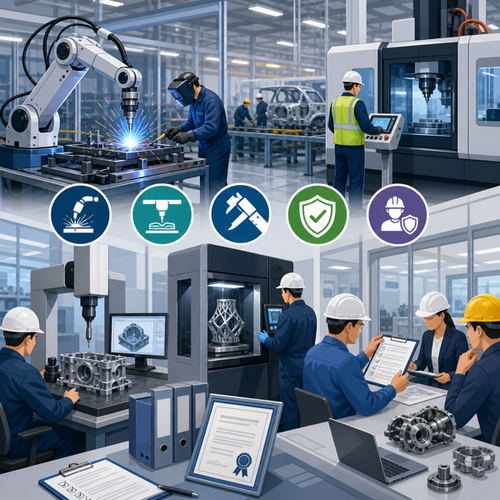
In August 2026, the field of Manufacturing Engineering saw the publication of five important international standards, marking a significant advancement in quality assurance, process optimization, and safety across diverse manufacturing environments. Covering areas from non-destructive testing in thermoplastics and advanced arc welding qualifications to cutting-edge cyber-physical smart machine tool systems, additive manufacturing for aerospace, and updated safety requirements for masonry saws, these standards set new benchmarks for compliance and performance. For industry professionals, staying abreast of these standards is essential to maintaining a competitive edge, ensuring safety, and supporting innovation in manufacturing processes.
Overview / Introduction
Manufacturing Engineering plays a pivotal role in developing and sustaining advanced production systems worldwide. As technology becomes more integrated and complex—incorporating smart controls, automation, and additive processes—international standards are indispensable for ensuring product quality, innovation alignment, and global market access.
This article introduces five newly published standards (August 2026) that impact critical aspects of manufacturing operations, including:
- Non-destructive ultrasonic testing of thermoplastic welds
- Qualifying welding processes using arc energy parameters
- Implementing cyber-physical architectures for smart machining
- Additive manufacturing system reliability in aerospace
- Updated safety for transportable table masonry saws
Professionals will find actionable guidance on compliance, implementation, and best practices for integrating these standards into their operations.
Detailed Standards Coverage
EN 13100-3:2026 – Ultrasonic Testing of Thermoplastics Welded Joints
Non-destructive testing of welded joints in thermoplastics semifinished products – Part 3: Ultrasonic testing
EN 13100-3:2026 establishes a comprehensive framework for the manual ultrasonic examination of commonly used welded joints—heated tool, electrofusion, extrusion, and hot gas—in thermoplastics materials. The standard is applicable to joints in single wall pipes and plates with thicknesses between 10 mm and 100 mm, focusing on the precise detection and characterization of discontinuities without destructive sampling.
Key requirements involve:
- Qualification and certification of personnel per EN ISO 9712
- Use of calibrated ultrasonic test equipment compliant with EN ISO 22232 series
- Probe parameters (frequency range 1–5 MHz, longitudinal wave, optimal angles of incidence and focusing)
- Defined procedures for examination volumes, scanning surfaces, and sensitivity settings
- Detailed reporting procedures, including methods, equipment used, and results
Scope excludes acceptance levels for indications, focusing instead on repeatable, objective test methods usable throughout the manufacturing and operational life of components.
Industries such as plastics manufacturing, pipeline construction, and infrastructure will benefit from improved joint reliability, traceability, and maintenance planning.
Key highlights:
- Covers both new constructions and maintenance inspections
- Updated to accommodate advances in phased array ultrasonic testing
- Enhanced guidance for examining various joint geometries and materials
Access the full standard:View EN 13100-3:2026 on iTeh Standards
ISO/TS 8182:2026 – Arc Energy in Welding Procedures
Welding and allied processes — Requirements and recommendations for the use of the welding parameters related to the arc energy for qualification and specification of welding procedures
ISO/TS 8182:2026 addresses a critical aspect of welding quality management: the correct determination, reporting, and application of arc energy parameters in both the qualification and subsequent specification of welding procedures. Covering all arc welding processes, this technical specification bridges gaps in previous standards (like ISO 3834 and ISO 15607) by detailing how to measure, document, and transfer key data—arc voltage, welding current, speed, and preheat/interpass temperatures—from qualification to production.
The standard defines risk-based requirements for different material applications (low, medium, high risk), offering:
- Procedures for calibrating and validating measurement equipment
- Methods to record and analyze main process phases and weld areas
- Guidelines for calculating arc energy in complex geometries (e.g., pipes, multi-run welds)
- Sample WPQR and WPS documentation (see Annexes)
This is essential for organizations seeking to ensure consistent mechanical and corrosion resistance properties, reduce weld defects, and demonstrate due diligence in both regulated and contractual environments.
Key highlights:
- Clarifies the process of transferring qualification data to manufacturing specifications
- Promotes data-driven quality assurance and traceability
- Introduces explicit risk classifications for welding on critical materials
Access the full standard:View ISO/TS 8182:2026 on iTeh Standards
ISO 23704-4:2026 – Reference Architecture for Smart Machine Tool Systems
General requirements for cyber-physically controlled smart machine tool systems (CPSMT) — Part 4: Requirements and guidelines for implementing reference architecture of CPSMT for subtractive manufacturing
Smart manufacturing and Industry 4.0 initiatives demand interoperable, adaptable shopfloor technologies. ISO 23704-4:2026 provides implementers with requirements and guidelines for realizing reference architectures of cyber-physically controlled smart machine tool systems (CPSMT) focused on subtractive manufacturing.
The standard lays out:
- Implementation architecture for both cyber-physically controlled machine tools (CPCM) and cyber-supporting systems (CSSM)
- Information, communication, and integration models for CPSMTs
- Practical, use-case-driven annexes: systems engineering (SE), stakeholder requirements, and smart factory scenarios
It promotes cross-platform compatibility, high-quality data exchange, and efficient factory operation by standardizing the digital interfaces and functional requirements that underpin smart CNC and auxiliary systems. Applicable to system architects, digitalization leads, and machine tool builders, ISO 23704-4:2026 accelerates the effective deployment of smart manufacturing on the production floor.
Key highlights:
- Supports implementation of Industry 4.0 and smart factory concepts
- Ensures interoperability between cyber and physical elements
- Provides actionable models and use cases for practical deployment
Access the full standard:View ISO 23704-4:2026 on iTeh Standards
EN ISO/ASTM 52941:2026 – Additive Manufacturing System Reliability
Additive manufacturing for aerospace - System performance and reliability tests for laser metal powder-bed fusion machines for metallic materials (ISO/ASTM 52941:2026)
EN ISO/ASTM 52941:2026 brings a unified, international approach to performance and reliability testing for laser metal powder-bed fusion machines—crucial equipment in both aerospace and high-performance manufacturing sectors. The standard covers acceptance, qualification, periodic inspection, and requalification of these advanced additive manufacturing systems.
Its scope includes:
- Testing methodology for continuous and pulsed-wave lasers (beam power, stability, position)
- Mechanical function tests (build platform and feeding platform positioning, powder spreading mechanics)
- Assessment of environmental/operational factors (temperature, humidity, gas purity)
- Optional tests: build area assessments, gas flow, demonstrator artifacts
- Rigorous safety system checks
Users benefit from increased confidence in part quality and process control, with requirements tailored to both aerospace and critical non-aerospace manufacturing under contract. The document ensures that each machine continues to meet stringent industry and customer requirements after maintenance or substantial use.
Key highlights:
- Harmonizes international performance criteria for metal additive manufacturing
- Aligns with aerospace requirements but extensible to other industries
- Facilitates OEM, supplier, and operator confidence in qualification and periodic requalification regimes
Access the full standard:View EN ISO/ASTM 52941:2026 on iTeh Standards
FprEN IEC 62841-3-17:2026 – Safety for Table Masonry Saws
Electric motor-operated hand-held tools, transportable tools, and lawn and garden machinery – Safety – Part 3-17: Particular requirements for transportable table masonry saws
FprEN IEC 62841-3-17:2026 is dedicated to updating occupational and operator safety for transportable table masonry saws. The standard lays out particular requirements and supplementary tests for type 1, type 2, and type 4 table masonry saws equipped with diamond cutting wheels, used to cut materials such as tile, brick, stone, and concrete blocks.
Key elements include:
- Applicability to saws with diamond wheels up to 600 mm (type 1/2) or 260 mm (type 4, continuous rim)
- Supplementary clauses covering protective devices, mechanical strength, overload protection, electrical safety, noise, and vibration emissions
- Detailed product safety labeling and instructions
- Exclusion of bonded abrasive wheel saws and cut-off machines (covered by other standards)
With this update, manufacturers and safety managers will implement best-in-class safeguards—aligning product development and workplace procedures with current international best practices. Transitional periods are provided to allow adaptation to new or revised requirements.
Key highlights:
- Defines mechanical and electrical safety for multiple table masonry saw types
- Aligns with other tool safety standards for rigorous consistency
- Includes detailed marking, guarding, and user instruction requirements
Access the full standard:View FprEN IEC 62841-3-17:2026 on iTeh Standards
Industry Impact & Compliance
The August 2026 set of Manufacturing Engineering standards brings wide-reaching implications. Companies operating in plastics processing, welding fabrication, smart machine development, aerospace supply chains, and power tool production will all see new or enhanced requirements in quality assurance, safety, and digital integration.
Key Compliance Considerations
- Qualification Requirements: Personnel must achieve certifications referenced in standards (e.g., EN ISO 9712 for NDT operators, properly calibrated welding equipment for ISO/TS 8182).
- Documentation and Traceability: Comprehensive recordkeeping is needed (test reports, WPQR/WPS documentation, smart machine integration data).
- Maintenance and Requalification: Aerospace and safety-critical applications will require more rigorous periodic checks and documented proof of ongoing compliance.
- Transitional Periods: Some standards (e.g., FprEN IEC 62841-3-17) provide implementation windows, allowing time to adopt new safety protocols and testing routines.
Benefits for Early Adopters
- Enhanced product reliability and market acceptance
- Greater efficiency through harmonized processes
- Reduced liability and risk of non-compliance penalties
- Easier access to global supply chains where international standards are a prerequisite
Technical Insights
While the five standards span diverse topics, several technical themes recur:
- Focus on Measurability: Whether through calibrated ultrasonic devices, digital arc energy capture, or smart system diagnostics, objective measurement is at the heart of robust compliance.
- Personnel Competency: Increased emphasis on formal qualification and ongoing competency assessment ensures trustworthy inspection, welding, and operation.
- System Integration: From digital twins to smart machine data flows, the need for interoperable data standards and software interfaces is addressed.
- Safety and Reliability: Robust testing, reporting, and labeling underpin both operator and process safety, especially in high-risk applications (aerospace, site tools).
Implementation Best Practices
- Gap Analysis: Assess current equipment, training, and documentation relative to new standard requirements.
- Training: Upgrade personnel qualification and maintain training records to international standards.
- Test Calibration: Ensure all equipment is routinely calibrated and traceable to recognized standards.
- Digital Integration: For advanced manufacturing, implement standardized information models and protocols (as per ISO 23704-4) to future-proof your systems.
- Regular Review: Establish internal audits for periodic updates as standards evolve.
Testing and Certification
- Third-Party Certification: Consider independent certification for markets requiring formal attestation.
- Internal Audits: Routine internal testing aligned with standard requirements will reduce non-compliance risk.
- Supplier Communication: Share updated requirements across the supply chain to assure end-to-end quality and safety.
Conclusion / Next Steps
The August 2026 batch of international standards in Manufacturing Engineering reinforces a global push for safer, smarter, and more reliable manufacturing operations. Organizations should prioritize reviewing these changes, align their practices with updated requirements, and leverage the enhanced guidance for digital transformation, welding quality, NDT reliability, machine safety, and additive manufacturing process control.
Key recommendations:
- Download and review full standards from iTeh Standards using the provided links.
- Conduct internal assessments to identify and close compliance gaps.
- Engage quality, operations, and digital teams in standards rollout projects.
- Stay informed—regulatory and market pressures for formal compliance are only increasing.
Ready to take the next step? Visit iTeh Standards for the latest international standards, implementation guidance, and expert updates. Stay ahead with authoritative information and competitive know-how in Manufacturing Engineering.
Categories
- Latest News
- New Arrivals
- Generalities
- Services and Management
- Natural Sciences
- Health Care
- Environment
- Metrology and Measurement
- Testing
- Mechanical Systems
- Fluid Systems
- Manufacturing
- Energy and Heat
- Electrical Engineering
- Electronics
- Telecommunications
- Information Technology
- Image Technology
- Precision Mechanics
- Road Vehicles
- Railway Engineering
- Shipbuilding
- Aircraft and Space
- Materials Handling
- Packaging
- Textile and Leather
- Clothing
- Agriculture
- Food technology
- Chemical Technology
- Mining and Minerals
- Petroleum
- Metallurgy
- Wood technology
- Glass and Ceramics
- Rubber and Plastics
- Paper Technology
- Paint Industries
- Construction
- Civil Engineering
- Military Engineering
- Entertainment