

ISO/TS 8182:2026
(Main)Welding and allied processes — Requirements and recommendations for the use of the welding parameters related to the arc energy for qualification and specification of welding procedures
- Abstract
This document specifies requirements and recommendations for reporting the welding parameters related to the arc energy of a welding procedure qualification record (WPQR) and transferring this data to a welding procedure specification (WPS) for production welding for all arc welding processes.
- Status
- Published
- Publication Date
- 24-Aug-2026
- Technical Committee
- ISO/TC 44/SC 10 - Quality management in the field of welding
- Drafting Committee
- ISO/TC 44/SC 10 - Quality management in the field of welding
- Current Stage
- 6060 - International Standard published
- Start Date
- 25-Aug-2026
- Due Date
- 25-Jul-2026
- Completion Date
- 25-Aug-2026
Buy Documents
ISO/TS 8182:2026 - Welding and allied processes — Requirements and recommendations for the use of the welding parameters related to the arc energy for qualification and specification of welding procedures
ISO/TS 8182:2026 - Soudage et techniques connexes — Exigences et recommandations pour l’utilisation des paramètres de soudage liés à l’énergie de l'arc pour la qualification et la spécification des modes opératoires de soudage
ISO/TS 8182:2026 is an ISO Technical Specification for welding and allied processes. It specifies how to report welding parameters related to arc energy in a welding procedure qualification record (WPQR) and how to transfer that information into a welding procedure specification (WPS) for production welding in all arc welding processes. In practice, it helps the people who qualify procedures and write WPS documents keep arc voltage, current, speed, temperature and arc energy aligned with the intended application.
What does ISO/TS 8182:2026 specify?
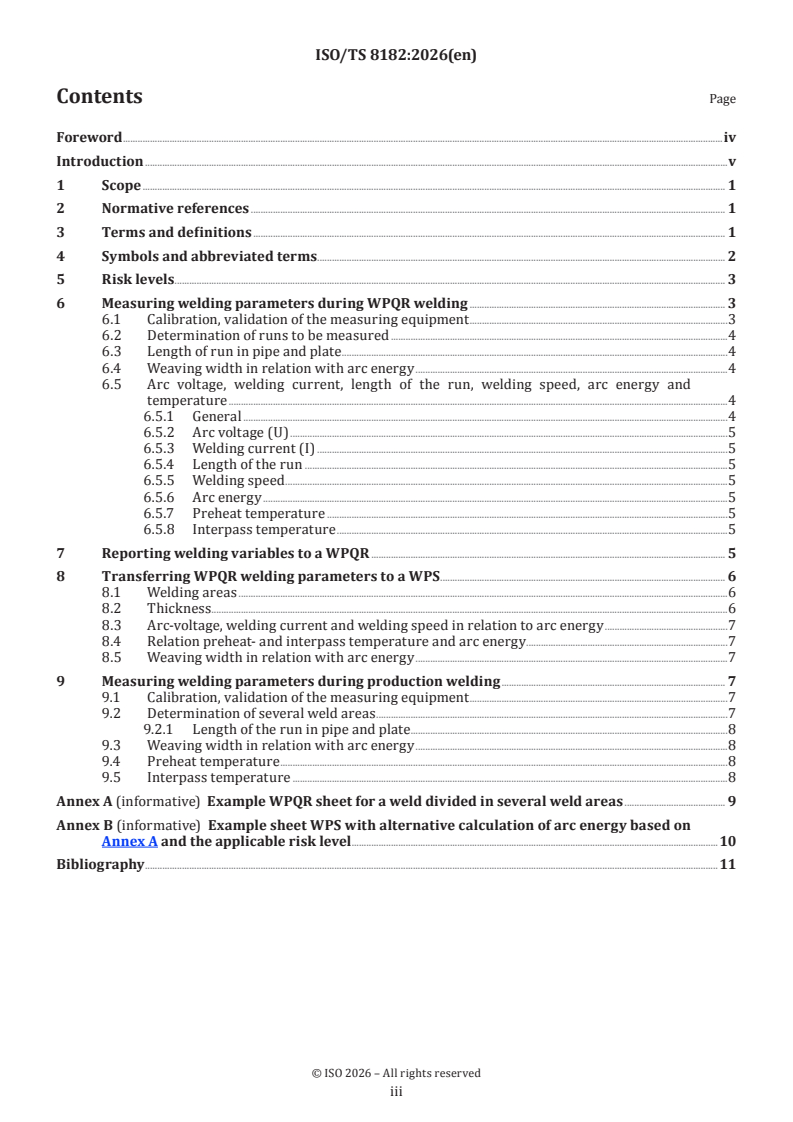
ISO/TS 8182:2026 specifies requirements and recommendations for WPQR reporting and for transferring those data into a WPS for production welding. The document is organized into scope, normative references, terms and definitions, symbols and abbreviated terms, risk levels, measurement rules for qualification and production, reporting rules, transfer rules, and two informative annexes with worked examples.
| Annex | What it covers |
|---|---|
| Annex A | Example WPQR sheet for a weld divided into several weld areas |
| Annex B | Example WPS sheet with an alternative arc-energy calculation based on Annex A and the applicable risk level |
What are the key requirements of ISO/TS 8182:2026?
Measuring during WPQR welding
ISO/TS 8182:2026 requires measuring devices to be calibrated or validated to recognized international or national standards such as ISO 17662 or IEC 60974-14. For medium and high risk levels, each run is measured separately, and run length is handled separately for each weld layer in pipe and plate. In practice, this means the qualification record needs run-by-run data, not just one overall value.
The document also sets rules for weaving, run width and arc energy. When weaving is used and the run width exceeds 25 mm, the qualified arc energy is determined using the weaving-related method described in the document. For wider runs, the way the weld was made affects the energy calculation, so the measurement method must match the actual technique.
Reporting the qualification data
ISO/TS 8182:2026 requires the WPQR to report the essential variables per weld run, including layer or run number, weld area, preheat temperature, interpass temperature, average arc voltage, average welding current, average welding speed and average arc energy. If the power source shows instantaneous power or energy, that information is also documented. This is the data that later supports the WPS limits.
Writing the WPS from the WPQR
ISO/TS 8182:2026 bases the WPS on the calculated arc-energy values from the WPQR, then classifies weld areas according to risk level. For low risk, separate weld areas are not required. For medium risk, the root run and second layer are treated separately, while filling, capping and back runs are grouped. For high risk, the root run, second layer, filling, capping and back runs are each treated as separate areas.
For high-risk applications, the document also ties thickness and cooling mode to the qualification. A qualification made with two-dimensional cooling only covers two-dimensional cooling, and the same applies to three-dimensional cooling. The WPS parameter ranges must be set so that the minimum and maximum arc energy stay within the specified arc-energy range. For high-risk applications, preheat and interpass temperature must be considered together with arc energy because they affect cooling rate and microstructure.
Measuring during production welding
ISO/TS 8182:2026 applies similar measurement discipline during production welding. Measuring devices again need calibration or validation to recognized standards, and the document distinguishes a standard grade for low and medium risk and a precision grade for high risk. For high-risk applications, the power source also needs calibration in the specific current and voltage range used.
The document also states how to determine weld areas, run length in pipe and plate, weaving width, preheat temperature and interpass temperature during production. If infrared thermometers are used for temperature measurement, they shall be validated with a contact thermometer. In practice, this keeps shop-floor measurements comparable with the qualification record.
What terms does ISO/TS 8182:2026 define?
- Documentation value - the arithmetic mean value taken over the main process phase.
- Main process phase - the dominating process phase, usually the longest one in the weld run.
- Weld area - one or more runs on the same side with the same welding process and no intended metallurgical role between them.
- Risk level - the agreed low, medium or high classification used to decide how arc energy is handled for the intended application.
- WPQR (welding procedure qualification record) - the record that captures qualification welding data for later use in procedure specification.
- WPS (welding procedure specification) - the written instruction used for production welding.
- Arc energy (E) - the arc-energy value used to relate welding variables to qualification and WPS limits.
- AIP (average instantaneous power) - the average instantaneous power that may be documented when the power source displays it.
Who uses ISO/TS 8182:2026?
ISO/TS 8182:2026 is used by welding engineers, welding coordinators, quality managers, inspectors and manufacturers who qualify welding procedures and prepare WPS documents. It is especially relevant where mechanical properties, corrosion resistance, hardness or notch toughness are sensitive to heat input. Buyers, contractors and specification writers can also use it when they need a contractual reference for WPQR data and WPS limits.
Which standards are used with ISO/TS 8182:2026?
- ISO 18491 - provides the measurement rules for arc energy and the related quantities used throughout the document.
- ISO 13916 - provides the method for measuring preheating temperature and interpass temperature.
- ISO/TR 25901-1, ISO/TR 25901-3, ISO/TR 25901-4 - provide the vocabulary used for general terms, welding processes and arc welding.
- ISO 17662 - is cited as a recognized standard for calibration, verification and validation of welding equipment.
- IEC 60974-14 - is cited as a recognized standard for calibration, validation and consistency testing of arc welding equipment.
- ISO 15607 - provides the general framework for welding procedure specification and qualification.
- ISO/TR 17671-2:2002, Annex D - provides an alternative calculation method mentioned for high-risk thickness cases.
What does the ISO/TS 8182:2026 document contain?
ISO/TS 8182:2026 contains tables for symbols, risk levels, weld-area classification, calibration grades, run-length treatment and arc-energy ranges. It also includes figures that illustrate the main process phase, weld area and weaving width concepts. The document gives rules for measuring voltage, current, speed, arc energy, preheat temperature and interpass temperature, then shows how to report them in a WPQR and convert them into WPS limits.
Annex A gives a worked example of a WPQR sheet for a weld divided into several weld areas. Annex B gives a worked WPS example that uses an alternative arc-energy calculation based on Annex A and the applicable risk level. The bibliography points to the related standards used for measurement, equipment calibration and welding vocabulary.
Relations
- Effective Date
- 06-Jun-2022
Buy Documents
ISO/TS 8182:2026 - Welding and allied processes — Requirements and recommendations for the use of the welding parameters related to the arc energy for qualification and specification of welding procedures
ISO/TS 8182:2026 - Soudage et techniques connexes — Exigences et recommandations pour l’utilisation des paramètres de soudage liés à l’énergie de l'arc pour la qualification et la spécification des modes opératoires de soudage
Get Certified
Connect with accredited certification bodies for this standard

DVS-ZERT GmbH
German welding certification society.
CARES (UK Certification Authority for Reinforcing Steels)
UK certification for reinforcing steels and construction.
EWF/IIW (European/International Welding Federation)
International welding personnel certification.
Sponsored listings
Frequently Asked Questions
ISO/TS 8182:2026 is a technical specification published by the International Organization for Standardization (ISO). Its full title is "Welding and allied processes — Requirements and recommendations for the use of the welding parameters related to the arc energy for qualification and specification of welding procedures". This standard covers: This document specifies requirements and recommendations for reporting the welding parameters related to the arc energy of a welding procedure qualification record (WPQR) and transferring this data to a welding procedure specification (WPS) for production welding for all arc welding processes.
This document specifies requirements and recommendations for reporting the welding parameters related to the arc energy of a welding procedure qualification record (WPQR) and transferring this data to a welding procedure specification (WPS) for production welding for all arc welding processes.
ISO/TS 8182:2026 is classified under the following ICS (International Classification for Standards) categories: 25.160.10 - Welding processes. The ICS classification helps identify the subject area and facilitates finding related standards.
ISO/TS 8182:2026 has the following relationships with other standards: It is inter standard links to ISO/TR 10687:2022. Understanding these relationships helps ensure you are using the most current and applicable version of the standard.
ISO/TS 8182:2026 is available in PDF format for immediate download after purchase. The document can be added to your cart and obtained through the secure checkout process. Digital delivery ensures instant access to the complete standard document.
Standards Content (Sample)
Technical
Specification
ISO/TS 8182
First edition
Welding and allied
2026-08
processes — Requirements and
recommendations for the use of
the welding parameters related to
the arc energy for qualification and
specification of welding procedures
Soudage et techniques connexes — Exigences et
recommandations pour l’utilisation des paramètres de soudage
liés à l’énergie de l'arc pour la qualification et la spécification des
modes opératoires de soudage
Reference number
© ISO 2026
All rights reserved. Unless otherwise specified, or required in the context of its implementation, no part of this publication may
be reproduced or utilized otherwise in any form or by any means, electronic or mechanical, including photocopying, or posting on
the internet or an intranet, without prior written permission. Permission can be requested from either ISO at the address below
or ISO’s member body in the country of the requester.
ISO copyright office
CP 401 • Ch. de Blandonnet 8
CH-1214 Vernier, Geneva
Phone: +41 22 749 01 11
Email: copyright@iso.org
Website: www.iso.org
Published in Switzerland
ii
Contents Page
Foreword .iv
Introduction .v
1 Scope . 1
2 Normative references . 1
3 Terms and definitions . 1
4 Symbols and abbreviated terms. 2
5 Risk levels . 3
6 Measuring welding parameters during WPQR welding . 3
6.1 Calibration, validation of the measuring equipment .3
6.2 Determination of runs to be measured .4
6.3 Length of run in pipe and plate .4
6.4 Weaving width in relation with arc energy .4
6.5 Arc voltage, welding current, length of the run, welding speed, arc energy and
temperature .4
6.5.1 General .4
6.5.2 Arc voltage (U) .5
6.5.3 Welding current (I) .5
6.5.4 Length of the run .5
6.5.5 Welding speed .5
6.5.6 Arc energy .5
6.5.7 Preheat temperature .5
6.5.8 Interpass temperature .5
7 Reporting welding variables to a WPQR . 5
8 Transferring WPQR welding parameters to a WPS . 6
8.1 Welding areas .6
8.2 Thickness .6
8.3 Arc-voltage, welding current and welding speed in relation to arc energy .7
8.4 Relation preheat- and interpass temperature and arc energy.7
8.5 Weaving width in relation with arc energy .7
9 Measuring welding parameters during production welding . 7
9.1 Calibration, validation of the measuring equipment .7
9.2 Determination of several weld areas .7
9.2.1 Length of the run in pipe and plate .8
9.3 Weaving width in relation with arc energy .8
9.4 Preheat temperature .8
9.5 Interpass temperature .8
Annex A (informative) Example WPQR sheet for a weld divided in several weld areas . 9
Annex B (informative) Example sheet WPS with alternative calculation of arc energy based on
Annex A and the applicable risk level . .10
Bibliography .11
iii
Foreword
ISO (the International Organization for Standardization) is a worldwide federation of national standards
bodies (ISO member bodies). The work of preparing International Standards is normally carried out through
ISO technical committees. Each member body interested in a subject for which a technical committee
has been established has the right to be represented on that committee. International organizations,
governmental and non-governmental, in liaison with ISO, also take part in the work. ISO collaborates closely
with the International Electrotechnical Commission (IEC) on all matters of electrotechnical standardization.
The procedures used to develop this document and those intended for its further maintenance are described
in the ISO/IEC Directives, Part 1. In particular, the different approval criteria needed for the different types
of ISO document should be noted. This document was drafted in accordance with the editorial rules of the
ISO/IEC Directives, Part 2 (see www.iso.org/directives).
ISO draws attention to the possibility that the implementation of this document may involve the use of (a)
patent(s). ISO takes no position concerning the evidence, validity or applicability of any claimed patent
rights in respect thereof. As of the date of publication of this document, ISO had not received notice of (a)
patent(s) which may be required to implement this document. However, implementers are cautioned that
this may not represent the latest information, which may be obtained from the patent database available at
www.iso.org/patents. ISO shall not be held responsible for identifying any or all such patent rights.
Any trade name used in this document is information given for the convenience of users and does not
constitute an endorsement.
For an explanation of the voluntary nature of standards, the meaning of ISO specific terms and expressions
related to conformity assessment, as well as information about ISO's adherence to the World Trade
Organization (WTO) principles in the Technical Barriers to Trade (TBT), see www.iso.org/iso/foreword.html.
This document was prepared by Technical Committee ISO/TC 44, Welding and allied processes, Subcommittee
SC 10, Quality management in the field of welding.
Any feedback or questions on this document should be directed to the user’s
national standards body. A complete listing of these bodies can be found at
www.iso.org/members.html. Official interpretations of ISO/TC 44 documents, where they exist, are
available from this page: https://committee.iso.org/sites/tc44/home/interpretation.html.
iv
Introduction
In quality management systems, welding is classified as a special process — one whose results cannot be
fully verified by subsequent inspection and testing. Therefore, consistent quality can only be ensured if the
process is properly controlled from the outset. ISO 3834-2 and ISO 3834-3 outline the quality requirements
for fusion welding of metallic materials. They require that manufacturers:
— prepare welding procedure specifications (WPS);
— qualify these procedures before production;
— ensure proper implementation of the WPS during fabrication.
ISO 15607 provides the general framework for specifying and qualifying welding procedures. It introduces
several qualification methods but does not provide detailed instructions on:
— measuring welding parameters (e.g., arc energy) during qualification;
— determining the range of qualification;
— translating qualification results into a usable WPS.
In certain situations, for example, when the mechanical or corrosion properties of parent materials and
the weld metal can be strongly degraded by the use of the wide range of arc energy rules as given in the
standards cited in ISO 15607, it can be appropriate to implement additional provisions that may lead to
restrictions. These additional provisions will prevent:
— incorrect parameter ranges in WPS documents;
— non-compliance with mechanical or corrosion resistance requirements;
— inconsistent weld quality across production batches.
This document:
— provides practical requirements and recommendations on how to handle welding procedure qualification
and specification;
— clarifies how to measure and document welding parameters during qualification;
— explains how to define and apply qualification ranges effectively.
This document can serve as a contractual reference for the qualification of a welding procedure qualification
record and/or the creation of a welding procedure specification.
v
Technical Specification ISO/TS 8182:2026(en)
Welding and allied processes — Requirements and
recommendations for the use of the welding parameters
related to the arc energy for qualification and specification of
welding procedures
1 Scope
This document specifies requirements and recommendations for reporting the welding parameters related
to the arc energy of a welding procedure qualification record (WPQR) and transferring this data to a welding
procedure specification (WPS) for production welding for all arc welding processes.
2 Normative references
The following documents are referred to in the text in such a way that some or all of their content constitutes
requirements of this document. For dated references, only the edition cited applies. For undated references,
the latest edition of the referenced document (including any amendments) applies.
ISO 13916, Welding — Measurement of preheating temperature, interpass temperature and preheat
maintenance temperature
ISO 18491, Welding and allied processes — Measurement of arc energies
ISO/TR 25901-1, Welding and allied processes — Vocabulary — Part 1: General terms
ISO/TR 25901-3, Welding and allied processes — Vocabulary — Part 3: Welding processes
ISO/TR 25901-4, Welding and allied processes — Vocabulary — Part 4: Arc welding
3 Terms and definitions
For the purposes of this document, the terms and definitions given in ISO 18491, ISO/TR 25901-1,
ISO/TR 25901-3, ISO/TR 25901-4 and the following apply.
ISO and IEC maintain terminology databases for use in standardization at the following addresses:
— ISO Online browsing platform: available at https:// www .iso .org/ obp
— IEC Electropedia: available at https:// www .electropedia .org/
3.1
documentation value
arithmetic mean value over the main process phase (3.2)
3.2
main process phase
dominating process phase, in most applications the longest process phase
Note 1 to entry: See Figure 1.
Key
1 weld start
2 main process phase
3 weld end
Figure 1 — Main process phase
3.3
weld area
area made up of one or more runs done on the same side with the same welding process and without any
intended metallurgical role between them
Note 1 to entry: See Figure 2.
Key
1 root
2 fill
3 cap
4 root
5 fill
Figure 2 — Weld area
4 Symbols and abbreviated te
...
Spécification
technique
ISO/TS 8182
Première édition
Soudage et techniques connexes —
2026-08
Exigences et recommandations
pour l’utilisation des paramètres de
soudage liés à l’énergie de l'arc pour
la qualification et la spécification
des modes opératoires de soudage
Welding and allied processes — Requirements and
recommendations for the use of the welding parameters related
to the arc energy for qualification and specification of welding
procedures
Numéro de référence
DOCUMENT PROTÉGÉ PAR COPYRIGHT
© ISO 2026
Tous droits réservés. Sauf prescription différente ou nécessité dans le contexte de sa mise en œuvre, aucune partie de cette
publication ne peut être reproduite ni utilisée sous quelque forme que ce soit et par aucun procédé, électronique ou mécanique,
y compris la photocopie, ou la diffusion sur l’internet ou sur un intranet, sans autorisation écrite préalable. Une autorisation peut
être demandée à l’ISO à l’adresse ci-après ou au comité membre de l’ISO dans le pays du demandeur.
ISO copyright office
Case postale 401 • Ch. de Blandonnet 8
CH-1214 Vernier, Genève
Tél.: +41 22 749 01 11
E-mail: copyright@iso.org
Web: www.iso.org
Publié en Suisse
ii
Sommaire Page
Avant-propos .iv
Introduction .v
1 Domaine d'application . 1
2 Références normatives . 1
3 Termes et définitions . 1
4 Symboles et termes abrégés . 2
5 Niveaux de risque . 3
6 Mesure des paramètres de soudage pendant le soudage du PV-QMOS . 4
6.1 Étalonnage, validation de l’équipement de mesure .4
6.2 Détermination des passes à mesurer .4
6.3 Longueur de la passe sur tube et sur tôle .4
6.4 Largeur de balayage par rapport à l’énergie de l’arc .4
6.5 Tension à l’arc, intensité de soudage, longueur de la passe, vitesse de soudage, énergie
de l’arc et température .5
6.5.1 Généralités .5
6.5.2 Tension à l’arc (U) .5
6.5.3 Intensité de soudage (I) .5
6.5.4 Longueur de la passe .5
6.5.5 Vitesse de soudage .5
6.5.6 Énergie de l’arc .5
6.5.7 Température de préchauffage .5
6.5.8 Température entre passes .5
7 Indication de variables de soudage dans un PV-QMOS . 5
8 Transfert de paramètres de soudage du PV-QMOS dans un DMOS . 6
8.1 Zones de soudure .6
8.2 Épaisseur .7
8.3 Tension à l’arc, intensité de soudage et vitesse de soudage par rapport à l’énergie de l’arc .7
8.4 Relation entre la température de préchauffage et entre passes et l’énergie de l’arc .7
8.5 Largeur de balayage par rapport à l'énergie de l’arc .8
9 Mesure des paramètres de soudage lors du soudage de production . 8
9.1 Étalonnage, validation de l’équipement de mesure .8
9.2 Détermination de plusieurs zones de soudure .8
9.2.1 Longueur de la passe dans le tube et sur la tôle .8
9.3 Largeur de balayage par rapport à l’énergie de l’arc .9
9.4 Température de préchauffage .9
9.5 Température entre passes . .9
Annexe A (informative) Exemple de fiche PV-QMOS pour une soudure divisée en plusieurs
zones de soudure . 10
Annexe B (informative) Exemple de fiche DMOS avec calcul alternatif de l’énergie de l’arc basée
sur l’Annexe A et le niveau de risque applicable .11
Bibliographie .12
iii
Avant-propos
L'ISO (Organisation internationale de normalisation) est une fédération mondiale d'organismes nationaux
de normalisation (comités membres de l'ISO). L'élaboration des Normes internationales est en général
confiée aux comités techniques de l'ISO. Chaque comité membre intéressé par une étude a le droit de faire
partie du comité technique créé à cet effet. Les organisations internationales, gouvernementales et non
gouvernementales, en liaison avec l'ISO participent également aux travaux. L'ISO collabore étroitement avec
la Commission électrotechnique internationale (IEC) en ce qui concerne la normalisation électrotechnique.
Les procédures utilisées pour élaborer le présent document et celles destinées à sa mise à jour sont
décrites dans les Directives ISO/IEC, Partie 1. Il convient, en particulier, de prendre note des différents
critères d'approbation requis pour les différents types de documents ISO. Le présent document a
été rédigé conformément aux règles de rédaction données dans les Directives ISO/IEC, Partie 2 (voir
www.iso.org/directives).
L’ISO attire l’attention sur le fait que la mise en application du présent document peut entraîner l’utilisation
d’un ou de plusieurs brevets. L’ISO ne prend pas position quant à la preuve, à la validité et à l’applicabilité de
tout droit de propriété revendiqué à cet égard. À la date de publication du présent document, l’ISO n'avait pas
reçu notification qu’un ou plusieurs brevets pouvaient être nécessaires à sa mise en application. Toutefois,
il y a lieu d’avertir les responsables de la mise en application du présent document que des informations
plus récentes sont susceptibles de figurer dans la base de données de brevets, disponible à l'adresse
www.iso.org/brevets. L’ISO ne saurait être tenue pour responsable de ne pas avoir identifié tout ou partie de
tels droits de propriété.
Les appellations commerciales éventuellement mentionnées dans le présent document sont données pour
information, par souci de commodité, à l'intention des utilisateurs, et ne sauraient constituer un engagement.
Pour une explication de la nature volontaire des normes, la signification des termes et expressions
spécifiques de l'ISO liés à l'évaluation de la conformité, ou pour toute information au sujet de l'adhésion de
l'ISO aux principes de l’Organisation mondiale du commerce (OMC) concernant les obstacles techniques au
commerce (OTC), voir www.iso.org/iso/avant-propos.html.
Le présent document a été élaboré par le Comité technique ISO/TC 44, Soudage et techniques connexes, Sous-
comité SC 10, Gestion de la qualité dans le domaine du soudage.
Il convient que l’utilisateur adresse tout retour d’information ou toute question concernant le
présent document à l’organisme national de normalisation de son pays. Une liste exhaustive desdits
organismes se trouve à l’adresse www.iso.org/members.html. Les interprétations officielles
des documents élaborés par le ISO/TC 44, lorsqu'elles existent, sont disponibles depuis la page:
https://committee.iso.org/sites/tc44/home/interpretation.html.
iv
Introduction
Dans les systèmes de management de la qualité, le soudage est classé comme un procédé spécial, c’est-à-dire
un procédé dont les résultats ne peuvent pas être entièrement vérifiés par des tests ou essais ultérieurs.
Par conséquent, une qualité constante ne peut être garantie que si le procédé est correctement maîtrisé dès
le départ. L'ISO 3834-2 et l'ISO 3834-3 définissent les exigences de qualité pour le soudage par fusion des
matériaux métalliques. Elles exigent que les fabricants:
— préparent les descriptifs de mode opératoire de soudage (DMOS);
— qualifient ces modes opératoires avant la production;
— s'assurent de la bonne application du DMOS lors de la fabrication.
L'ISO 15607 fournit le cadre général pour la spécification et la qualification des modes opératoires de
soudage. Elle présente plusieurs méthodes de qualification, mais ne donne pas d’instructions détaillées
concernant:
— la mesure des paramètres de soudage (par ex.: l’énergie de l'arc) lors de la qualification;
— la détermination du domaine de qualification;
— la traduction des résultats de qualification en un DMOS exploitable.
Dans certaines situations, par exemple lorsque les propriétés mécaniques ou de résistance à la corrosion des
matériaux de base et du métal d’apport peuvent être fortement dégradées par l’application de la large plage
de règles relatives à l’énergie de soudage indiquées dans les normes citées dans l’ISO 15607, il peut être
approprié de mettre en œuvre des dispositions supplémentaires pouvant conduire à des restrictions.
Ces dispositions supplémentaires permettent d’éviter:
— des plages de paramètres incorrectes dans les documents de DMOS;
— la non-conformité aux exigences mécaniques ou de résistance à la corrosion;
— des variations de qualité des soudures entre les lots de production.
Le présent document:
— fournit des exigences et recommandations pratiques sur la manière de gérer la qualification et le
descriptif des modes opératoires de soudage;
— clarifie la manière de mesurer et de documenter les paramètres de soudage lors de la qualification;
— explique comment définir et appliquer efficacement les plages de qualification.
Le présent document peut servir de référence contractuelle pour la qualification d’un procès-verbal de
qualification de mode opératoire de soudage et/ou pour l’élaboration d’un descriptif de mode opératoire de
soudage.
v
Spécification technique ISO/TS 8182:2026(fr)
Soudage et techniques connexes — Exigences et
recommandations pour l’utilisation des paramètres de
soudage liés à l’énergie de l'arc pour la qualification et la
spécification des modes opératoires de soudage
1 Domaine d'application
Le présent document spécifie des exigences et des recommandations pour le relevé des paramètres de
soudage liés à l’énergie de l’arc d’un procès-verbal de qualification de mode opératoire de soudage (PV-
QMOS) et le transfert de ces données vers un descriptif de mode opératoire de soudage (DMOS) pour le
soudage de production pour tous les procédés de soudage à l’arc.
2 Références normatives
Les documents suivants sont cités dans le texte de sorte qu’ils constituent, pour tout ou partie de leur
contenu, des exigences du présent document. Pour les références datées, seule l’édition citée s’applique. Pour
les références non datées, la dernière édition du document de référence s'applique (y compris les éventuels
amendements).
ISO 13916, Soudage — Mesurage de la température de préchauffage, de la température entre passes et de la
température de maintien du préchauffage
ISO 18491, Soudage et techniques connexes — Mesure des énergies de l’arc
ISO/TR 25901-1, Soudage et techniques connexes — Vocabulaire — Partie 1: Termes généraux
ISO/TR 25901-3, Soudage et techniques connexes — Vocabulaire — Partie 3: Procédés de soudage
ISO/TR 25901-4, Soudage et techniques connexes — Vocabulaire — Partie 4: Soudage à l'arc
3 Termes et définitions
Pour les besoins du présent document, les termes et définitions donnés dans l’ISO 18491, l'ISO/TR 25901-1,
l'ISO/TR 25901-3, l'ISO/TR 25901-4 ainsi que les suivants s’appliquent.
L'ISO et l'IEC tiennent à jour des bases de données terminologiques destinées à être utilisées en normalisation,
consultables aux adresses suivantes:
— ISO Online browsing platform: disponible à l'adresse https:// www .iso .org/ obp
— IEC Electropedia: disponible à l’adresse https:// www .electropedia .org/
3.1
valeur à documenter
valeur moyenne arithmétique sur la phase principale du procédé (3.2)
3.2
phase principale du procédé
phase dominante du procédé, phase la plus longue dans la plupart des applications
Note 1 à l'article: Voir Figure 1.
Légende
1 début de la soudure
2 phase du procédé principal
3 fin de la soudure
Figure 1 — Phase principale du procédé
3.3
zone de soudure
zone composée d'une ou plusieurs passes réalisées du même côté avec le même procédé de soudage et sans
rôle métallurgique prévu entre elles
Note 1 à l'article: Voir Figure 2.
Légende
1 racine
2 remplissage
3 passe terminale
4 racine
5 remplissage
Figure 2 — Zone de soudure
4 Symboles et termes abrégés
Pour les besoins du présent document, les symboles généraux et les abréviations donnés dans le
Tableau 1 s’appliquent.
Tableau 1 — Symboles et termes abrégés
Abréviations et
Terme Unité
symboles
E Énergie de l’arc kJ/mm
E Énergie de l’arc la plus faible dans le PV-QMOS kJ/mm
faible
E Énergie de l’arc la plus élevée dans le PV-QMOS kJ/mm
élevée
E Énergie de l’arc moyenne des passes pour une zone de soudure kJ/mm
moy
E Énergie de l’arc minimale qualifiée kJ/mm
min
E Énergie de l’arc maximale qualifiée kJ/mm
max
I Intensité de soudage moyenne d’une passe A
moy
I Limite minimale de l'intensité de soudage dans un DMOS A
min
I Limite maximale de l'intensité de soudage dans un DMOS A
max
t Épaisseur mm
U Tension à l’arc moyenne d’une passe V
moy
U Limite minimale de tension à l’arc dans un DMOS V
min
U Limite maximale de tension à l’arc dans un DMOS V
max
v Vitesse de soudage moyenne d'une passe mm/s
moy
v Vitesse de soudage minimale d’une passe mm/s
min
v Vitesse de soudage maximale d’une passe mm/s
max
W Largeur d’une passe mm
...