

Welding Procedure Qualification Standards: Your Guide to Productivity, Safety, and Scale in Modern Manufacturing
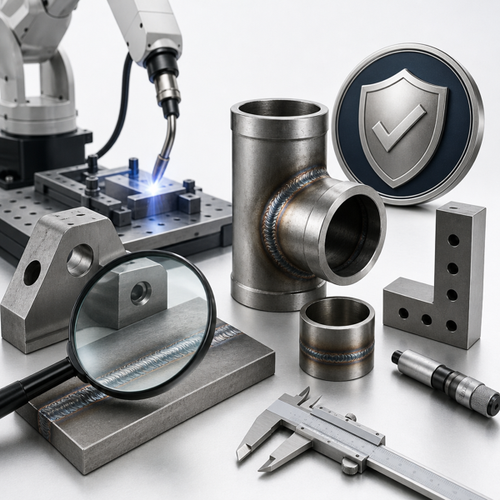
Welding Procedure Qualification Standards: Your Guide to Productivity, Safety, and Scale in Modern Manufacturing
In today's fast-changing world of manufacturing, welding stands at the core of countless operations—joining metals, building infrastructure, and embracing new technologies. Every weld represents not just physical strength, but also product reliability, workplace safety, and operational consistency. With rapid innovations and ever-tighter quality demands, four international standards—ISO 11970:2025, ISO 13916:2025, ISO 15614-9:2025, and ISO/TS 8182:2026—have become an indispensable foundation for any manufacturer that values excellence and sustainable growth. This guide breaks down each standard, explaining its practical significance, key specifications, and why robust welding procedure qualification is more crucial than ever to productivity, security, and scaling your manufacturing business.
Overview / Introduction
Manufacturing industries today face relentless challenges: accelerating production, integrating cutting-edge technologies, ensuring quality, and maintaining global competitiveness. Welding, as a fundamental process, touches nearly every sector—from automotive to construction, oil & gas to energy, and shipbuilding to aerospace. Against this dynamic backdrop, international welding standards transform vague best intentions into clear specifications and actionable procedures.
This article covers four ISO welding standards every manufacturer should know:
- Qualification and specification for steel and nickel-base castings
- Best practices for preheat and interpass temperature measurement
- Underwater hyperbaric (wet) welding procedure testing
- Requirements for arc energy measurement and documentation
You will discover what each standard covers, whom it affects, how to comply, and the tangible benefits—including improved safety, seamless scalability, and the ability to implement new technologies confidently. Whether you’re a technical manager, engineer, quality professional, or business leader, you’ll find practical and accessible insights to help you master welding procedure qualification requirements.
Detailed Standards Coverage
ISO 11970:2025 – Qualification for Welding of Steel and Nickel-base Castings
Specification and qualification of welding procedures for production welding of steel and nickel-base castings
What it covers: This standard specifies how to qualify Welding Procedure Specifications (WPS) for production welding of steel and nickel-based castings. It details the essential steps: drafting a preliminary WPS, carrying out welding procedure qualification tests, and defining what makes a weld procedure valid for various practical operations. It applies primarily to arc welding but can be adapted to other fusion welding processes by agreement.
Key requirements and specifications:
- Preparation of a compliant preliminary welding procedure specification (pWPS), referencing ISO 15609
- Execution and witnessing of welding tests, both destructive and non-destructive—such as visual inspection, radiographic/ultrasonic testing, mechanical tests (tensile, impact, hardness), and macro/micro examinations
- Clear definition of qualification range: material groupings, thickness, type of joint, welding positions, filler metal, heat input, preheat/interpass/post-weld heat treatment
- Non-destructive test acceptance levels (per ISO 5817, NDT standards)
Who needs to comply:
- Steel foundries and nickel-base casting producers
- Manufacturers performing production or finishing welding on steel cast parts
- Contractors, inspectors, and quality assurance personnel specifying or auditing cast component welds
Practical implications: Adhering to ISO 11970 streamlines qualifying new welding procedures, assures the integrity of critical castings, and facilitates consistent, safe, and repeatable weld operations—especially vital when introducing new alloys, modern welding processes, or advanced welding automation.
Notable features:
- Sets out detailed testing regimes, including specimen locations, minimum test piece requirements, and retesting procedures
- Provides for customizing tests to meet purchaser or application-specific needs
- Recognizes previous qualifications if they meet the current qualification range
Key highlights:
- Increases casting integrity and reduces welding defects in production
- Aligns your organization with global industry best practices
- Enables integration of modern traceability, documentation, and digital QA tools
Access the full standard:View ISO 11970:2025 on iTeh Standards
ISO 13916:2025 – Measurement of Preheat and Interpass Temperatures
Welding — Measurement of preheating temperature, interpass temperature and preheat maintenance temperature
What it covers: ISO 13916 establishes the requirements for measuring preheat temperature, interpass temperature, and preheat maintenance temperature during fusion welding. These parameters are essential for producing strong, defect-free welds, especially in materials prone to cracking or with demanding mechanical requirements.
Key requirements and specifications:
- Methods for accurate temperature measurement at the weld zone
- Specific points and times for measuring temperatures—before the initial pass (preheat), between passes (interpass), and maintaining set temperature during welding
- Calibration and suitability for the measurement equipment (e.g., contact thermometers, pyrometers, temperature indicators)
- Recording and traceability of temperature records
- Exclusion: does not cover post-weld heat treatment temperature measurement
Who needs to comply:
- Welders, welding engineers, and quality inspectors in fabrication and assembly industries
- Manufacturers producing safety-, pressure-, or performance-critical welded structures (e.g., pressure vessels, bridges, pipelines)
- Organizations aiming for international certifications or operating in regulated sectors
Practical implications: Applying ISO 13916 standards ensures joints are welded under optimal conditions—preventing hydrogen-induced cracking and ensuring weld metallurgical properties match design expectations. For new materials, automated welding, or remote operations, standardized temperature monitoring becomes a necessity for productivity and product quality.
Notable features:
- Standardizes temperature measurement locations and times, improving reproducibility
- Facilitates compliance with other process and material standards
- Enables proper record keeping for audits, certification, and continuous improvement
Key highlights:
- Reduces variability and risk of weld defects
- Simplifies staff training and onboarding for new welding technologies
- Supports data-driven welding process optimization
Access the full standard:View ISO 13916:2025 on iTeh Standards
ISO 15614-9:2025 – Underwater Hyperbaric Wet Welding Procedure Qualification
Specification and qualification of welding procedures for metallic materials — Welding procedure test — Part 9: Underwater hyperbaric wet welding
What it covers: ISO 15614-9 spells out how to qualify welding procedures for fusion welding of steels in underwater, hyperbaric (high-pressure, wet) environments. It applies to both production and repair welding, and covers leading underwater welding processes: manual metal arc welding (111) and self-shielded tubular-cored arc welding (114).
Key requirements and specifications:
- Qualification via welding procedure tests on representative test pieces, with specification of essential variables
- Parent material qualification groups in line with ISO 15608 (groups 1, 2, 3, 8)
- Detailed test matrix: quality levels (A, B, Z), covering different weldment requirements
- Scope for non-standard parent materials or welding processes by agreement
- Non-destructive and destructive testing requirements: radiographic, ultrasonic, tensile, impact, hardness, and bend tests
- Documentation (WPQR and qualified WPS) for traceability and reproducibility
Who needs to comply:
- Offshore and subsea construction companies
- Shipbuilders and marine repair specialists
- Pipeline contractors, energy producers, civil infrastructure managers
Practical implications: Hyperbaric welding is essential for repairs where dry welding (habitat) is not possible, enabling rapid field interventions and minimizing costly downtime. Strict qualification reduces failure risk underwater—where consequences are severe.
Notable features:
- Differentiates welds by demanding quality levels (A, B, Z)
- Accepts multiple welding processes, accommodating technology advances
- Includes clear testing and acceptance criteria for reliable underwater welds
Key highlights:
- Boosts safety and integrity for critical underwater structures
- Delivers standardization for remote, high-risk environments
- Enables scaling and technology integration in demanding offshore sectors
Access the full standard:View ISO 15614-9:2025 on iTeh Standards
ISO/TS 8182:2026 – Arc Energy Parameters for Qualification and Specification
Welding and allied processes — Requirements and recommendations for the use of the welding parameters related to the arc energy for qualification and specification of welding procedures
What it covers: This technical specification provides robust requirements and best-practice recommendations for recording, calculating, and transferring welding parameters—especially arc energy—from the welding procedure qualification record (WPQR) into the production welding procedure specification (WPS) for all arc welding processes.
Key requirements and specifications:
- Mandatory documentation and calculation of arc energy (including current, voltage, speed)
- Calibration and validation of measuring equipment to assure data accuracy
- Recording temperature variables (preheat, interpass)
- Precise definitions of weld areas, process phases, and the impact of mutual parameters (e.g., weaving width)
- Templates and guidance for transferring measured variables from WPQR to WPS, factoring in risk levels
Who needs to comply:
- Welding engineers, production managers, and quality assurance teams in all sectors utilizing arc welding
- Organizations aiming for advanced digital manufacturing and quality traceability
- Businesses seeking to guarantee weld performance on new or difficult materials
Practical implications: Implementing ISO/TS 8182 ensures that every production weld is executed within validated, controlled parameter limits—replicating the mechanical performance verified during qualification. For Industry 4.0 and data-centric manufacturing, this level of process control is a game-changer, enhancing consistency and reducing rework.
Notable features:
- Integrates arc energy management directly into quality management systems
- Supports auditing, continuous improvement, and digital data transfer
- Addresses risks of parameter drift and weld property degradation
Key highlights:
- Maximizes reproducibility of weld performance
- Accelerates staff onboarding and process scaling
- Facilitates root cause analysis and compliance in failure investigations
Access the full standard:View ISO/TS 8182:2026 on iTeh Standards
Industry Impact & Compliance
How These Standards Affect Manufacturing Businesses
Welding standards aren’t just about following rules—they’re at the heart of product quality, operational efficiency, and reputational risk management. Every welding procedure qualification standard covered here has a direct effect on:
- Reduced failure rates: Standardized qualification protocols mitigate defects that could otherwise result in costly recalls, repairs, or catastrophic failures.
- Market access: Many sectors and clients mandate ISO-standard welding credentials for contracts, particularly in automotive, shipbuilding, energy, offshore, and heavy industry.
- Safety and legal compliance: Demonstrable adherence significantly lowers the risk of workplace injuries, legal claims, and regulatory penalties.
- Technological adoption: The surge of automation, robotics, and digitally controlled welding technologies demands procedures that are traceable, documented, and easily transferable.
Benefits of Compliance:
- New technology integration becomes safer and faster, allowing businesses to scale to larger or more demanding projects.
- Staff training and onboarding are streamlined, as best-practice procedures and acceptance criteria are crystal clear.
- Quality systems gain from enhanced traceability, real-time process monitoring, and digital reporting—key to Industry 4.0 and beyond.
- The risk of non-compliance—including expensive failures, rework, or denied certification—is sharply reduced.
Risks of Non-Compliance:
- Structural or product failures, lost contracts, and reputational damage
- Production delays due to inadequate or rejected welds
- Financial losses and potential legal liabilities due to safety incidents
Implementation Guidance
Getting started with these welding procedure qualification standards doesn’t mean complexity must increase. In fact, their structure and methodology are designed to make implementation practical and results-oriented.
Common Implementation Approaches:
- Gap analysis: Compare your current welding procedures, process controls, and documentation against the requirements of each relevant standard.
- Staff training: Focus on educating welding personnel, inspectors, and quality managers about specific testing, measurement, and recording requirements.
- Test protocols: Prepare and test representative specimens as specified (using designated destructive and non-destructive tests).
- Process control: Integrate required measurement and monitoring (e.g., temperature, arc parameters) with regular calibration of equipment.
- Documentation and traceability: Use standard-compliant forms and digital records—linking WPQR and WPS for every qualified procedure.
- Continuous improvement: Leverage feedback from audits, failures, or near-misses for refining procedures, enhancing robustness over time.
Best Practices for Adoption:
- Involve all relevant stakeholders from the start: welders, engineers, QA staff, and purchasing
- Keep up to date with new editions and related process standards (e.g., ISO 15607, ISO 3834)
- Use digital platforms for managing welding data, especially in multi-site or high-volume operations
- Engage third-party auditors or certification bodies where required or beneficial
- Encourage a culture that treats standards not as compliance hurdles but as business enablers
Resource Recommendations:
- The iTeh Standards platform for easy access to the latest welding specifications and updated revisions
- Specialized welding engineering consultants for high-risk or complex operations
- Industry group seminars, webinars, and training workshops focused on ISO welding qualifications
Conclusion / Next Steps
Key Takeaways:
- ISO welding standards such as 11970:2025, 13916:2025, 15614-9:2025, and TS 8182:2026 are critical to safe, productive, and scalable manufacturing
- These standards ensure consistency in quality, enable safe integration of new welding technologies, and streamline compliance in highly regulated industries
- Implementing them proactively fuels not only risk reduction but also product innovation and operational efficiency
Recommendations:
- Evaluate which welding standards are most relevant to your sector, products, and markets
- Start building your compliance strategy now—using the detailed requirements as a framework for process control, documentation, and technical training
- Leverage the strengths of international standards to create a competitive edge in domestic and global manufacturing
Explore further:
- Stay updated with the latest versions, case studies, and industry news at iTeh Standards
- Train your teams to master the link between welding technical requirements, quality assurance, and business success
- Make your welding process a model for reliability, traceability, and scalable growth in the modern manufacturing era
Categories
- Latest News
- New Arrivals
- Generalities
- Services and Management
- Natural Sciences
- Health Care
- Environment
- Metrology and Measurement
- Testing
- Mechanical Systems
- Fluid Systems
- Manufacturing
- Energy and Heat
- Electrical Engineering
- Electronics
- Telecommunications
- Information Technology
- Image Technology
- Precision Mechanics
- Road Vehicles
- Railway Engineering
- Shipbuilding
- Aircraft and Space
- Materials Handling
- Packaging
- Textile and Leather
- Clothing
- Agriculture
- Food technology
- Chemical Technology
- Mining and Minerals
- Petroleum
- Metallurgy
- Wood technology
- Glass and Ceramics
- Rubber and Plastics
- Paper Technology
- Paint Industries
- Construction
- Civil Engineering
- Military Engineering
- Entertainment