


Fibre Optic Interconnecting Devices: Essential Standards for Business Productivity and Security
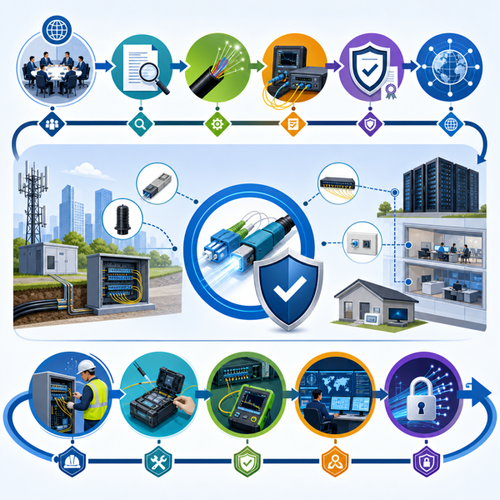
Fibre Optic Interconnecting Devices: Essential Standards for Business Productivity and Security
Modern telecommunications infrastructure is built on the backbone of fibre optic interconnecting devices. These silent heroes—connectors, patch cords, passive components, and rigorous testing methods—enable seamless, secure, and high-speed data transfer across the globe. But how can businesses ensure that their networks are reliable, productive, secure, and easily scalable? The answer lies in international fibre optic standards. In this article, we explore four key standards, each providing precise specifications and guidance that are critical for anyone involved in the telecommunications sector—from network designers to enterprise IT teams. Understanding and implementing these standards is more important than ever, as organizations look to future-proof their operations, guarantee performance, and maintain competitive advantage in the digital economy.
Overview / Introduction
Fibre optic technology underpins almost every aspect of modern connectivity, from long-haul internet cables spanning continents to local enterprise networks and residential broadband. Fibre optic interconnecting devices—connectors, patch cords, and passive components—are the physical touchpoints that ensure signals flow with minimal loss and maximum integrity.
As businesses increasingly depend on uninterrupted, high-speed communications, the importance of international standards in telecommunications cannot be overstated. Standards offer a common language and set of criteria, ensuring that components manufactured anywhere in the world will operate reliably together. They facilitate product compatibility, drive quality improvements, enable scaling up of infrastructure, and reduce operational and security risks.
In this comprehensive guide, you'll discover:
- What these telecommunications standards cover
- How implementing them improves productivity, network security, and scalability
- Key requirements for fibre optic devices and their implications
- Practical insights for compliance and best practices
Whether you’re a business leader, IT professional, engineer, or simply curious about fibre optics, this article demystifies complex standards into accessible insights.
Detailed Standards Coverage
IEC 60874-14-5:1997 - SC-PC Connector for Single-mode Fibre (Type B1)
Connectors for optical fibres and cables - Part 14-5: Detail specification for fibre optic connector type SC-PC untuned terminated to single-mode fibre type B1
This standard defines the requirements and specifications for the SC-PC (Subscriber Connector, Physical Contact) connector, specifically untuned connectors terminated to single-mode optical fibre type B1, widely used in telecommunication and data networks.
Key requirements and scope:
- Detailed mechanical dimensions and tolerances for SC-PC connectors to ensure plug-and-play compatibility
- Optical performance requirements such as attenuation and return loss, designed to minimize signal loss in critical network links
- Environmental and mechanical stress resistance, including temperature ranges, humidity limits, vibration tolerances, pull forces, and torsion—vital for reliable real-world deployment
- Use in data communication applications, including structured cabling compliant with ISO/IEC 11801
- Variants for different cable diameters and ferrule materials (usually zirconia) for versatility in installation
This specification is most relevant to:
- Manufacturers of fibre optic cables and connectors
- Network installers and engineers in enterprise and ISP environments
- Quality assurance and compliance teams
By ensuring consistent build and performance requirements, IEC 60874-14-5 enables mix-and-match use of components from different suppliers without compatibility worries. It also supports reliable scaling and maintenance by ensuring that technicians know exactly what to expect during upgrades or repairs.
Key highlights:
- Detailed mechanical drawings and size tolerances
- Environmental resistance (climatic category 10/60/4)
- Strict optical attenuation and return loss limits for high data integrity
Access the full standard:View IEC 60874-14-5:1997 on iTeh Standards
IEC 60874-19-1:1999 - SC-PC Duplex Connector for Multimode Fibre (A1a, A1b)
Connectors for optical fibres and cables - Part 19-1: Fibre optic patch cord connector type SC-PC (floating duplex) standard terminated on multimode fibre type A1a, A1b - Detail specification
Focusing on duplex (dual-channel) SC-PC connectors for multimode fibre (types A1a, A1b), this standard supports high-bandwidth, multi-channel communication—a backbone for LANs, data centres, and campus networks.
Key requirements and scope:
- Defines physical dimensions, mechanical attributes, and performance characteristics for ‘floating’ duplex connectors
- Ensures proper operation under environmental stressors (temperature, mechanical shock, vibration, humidity)
- Sets performance thresholds for attenuation (<0.75 dB) and connection repeatability
- Specifies cable retention, fibre retention, and mechanical endurance for consistent long-term use
- Requirements for component labelling and colour coding (beige for duplex)
This standard is equally critical for:
- Data centre and enterprise network architects
- System integrators deploying high-capacity fibre backbones
- Manufacturers offering pre-terminated patch cords, assemblies, or modular products
Floating duplex connectors reduce installation complexity and provide flexibility in high-density environments, such as server rooms or patch panels, making rapid deployment and maintenance feasible.
Key highlights:
- Comprehensive testing for climatic and mechanical durability
- Duplex design supports high-throughput network segments
- Interaction requirements to ensure compatibility with industry-standard cabling schemes
Access the full standard:View IEC 60874-19-1:1999 on iTeh Standards
IEC 61300-1:2003 - Basic Test and Measurement Procedures for Fibre Optic Devices
Fibre optic interconnecting devices and passive components - Basic test and measurement procedures - Part 1: General and guidance
IEC 61300-1 is the foundational standard for testing and validating the reliability of all fibre optic interconnecting devices and passive components. It covers all aspects of physical and optical testing, ensuring devices maintain their performance throughout manufacturing, transport, storage, and actual service life.
Key requirements and scope:
- Test methodology for mechanical, climatic, and electrical endurance of connectors, splices, switches, attenuators, and more
- Uniform, reproducible measurement procedures for optical performance (such as insertion loss and return loss)
- Environmental testing for temperature, humidity, mechanical stress, and pressure
- Guidelines for test sample sizes and statistical evaluation
- Clarifies terms, definitions, and calibration
- Specifies standard atmospheric conditions for meaningful result comparisons
Intended for use by:
- Fibre optic component manufacturers (quality control and R&D teams)
- Test engineers and laboratory technicians
- Organizations compiling product specifications for procurement or compliance
Adhering to IEC 61300-1 ensures devices meet minimum global benchmarks, reducing the risk of failure and supporting quality across the supply chain. Repeatable testing improves customer confidence and helps organizations stay ahead of compliance requirements.
Key highlights:
- Standardizes environmental and optical test procedures
- Supports product certification and procurement confidence
- Increases reproducibility and comparability of test results
Access the full standard:View IEC 61300-1:2003 on iTeh Standards
IEC 62552-3:2015 - Energy Consumption and Volume Measurement for Appliances
Household refrigerating appliances - Characteristics and test methods - Part 3: Energy consumption and volume
While primarily associated with household appliances, IEC 62552-3 is included here to demonstrate cross-sector relevance for measurement and performance standards. It describes energy efficiency (and volume) determination methods for cooling equipment—a process increasingly important for telecom operators managing equipment rooms with cooling needs, or for facilities where energy management is essential for cost and sustainability.
Key requirements and scope:
- Defines procedures for determining energy consumption and capacity of refrigerating appliances under varied operating conditions
- Introduces new methodologies to reflect real-world product use, electronic controls, and modern test data acquisition
- Breaks down energy usage into components: steady state, defrost cycles, and recovery
- Mandates multi-temperature testing (16°C and 32°C) and broader parameter monitoring
- Includes duration, temperature sensor placements, calculation approaches, and regional adaptation for energy standards
Relevant for:
- Testing labs and engineers evaluating equipment room cooling
- Facilities managers in telecom operations
- Manufacturers of cooling devices for network enclosures
Rigorous energy measurement ensures not only compliance but can impact operational expenses (OPEX), sustainability performance, and equipment longevity by preventing under- or over-cooling.
Key highlights:
- Complete revision and update to address electronic controls and new energy requirements
- Comprehensive data collection and internal checks for measurement quality
- Flexibility to adapt methodology based on regional regulatory needs
Access the full standard:View IEC 62552-3:2015 on iTeh Standards
Industry Impact & Compliance
Implementing international standards for fibre optic interconnecting devices yields a host of tangible benefits for organizations:
- Interoperability: Buy connectors from different global suppliers and confidently integrate them in networks, reducing vendor lock-in and boosting supply chain resilience.
- Productivity: Standardized patch cords and connectors mean faster deployment, trouble-free maintenance, and simpler staff training—productivity increases as downtime and errors decline.
- Network Security: Robust, standardized connectors reduce the risk of faults that can lead to outages or data breaches, and help organizations ensure their network integrity aligns with best global practices.
- Scalability: Whether expanding a local network or building a new facility, standards-based infrastructure allows seamless scaling and straightforward upgrades.
- Compliance and Market Access: Meeting standards is often a regulatory requirement—especially in critical sectors. It’s also a precondition for entering many procurement contracts or certifications.
- Risk Reduction: Uniform test and measurement methods (like those in IEC 61300-1) help manufacturers catch defects early, improving reliability, reducing warranty claims, and protecting business reputation.
Conversely, non-compliance may lead to:
- Component incompatibility, causing network failures or expensive remedial work
- Increased risk of undetected faults or performance issues
- Barriers to market entry or failed procurement bids
- Increased operational and energy costs (especially critical for cooling and power-intensive sites)
Implementation Guidance
For organizations seeking to adopt these fibre optic standards—and to gain all the associated business advantages—here are best practices and resources:
1. Assess Current Infrastructure
- Audit your current fibre optic devices and network segments. Identify legacy, non-compliant, or undocumented equipment.
2. Strategic Planning
- Integrate standards requirements into purchasing, vendor selection, and design criteria for new projects.
3. Training
- Ensure installation and maintenance staff are familiar with key standards and can recognize compliant versus non-compliant components.
4. Quality Assurance
- Implement standard-compliant test and measurement protocols—including those detailed in IEC 61300-1—across manufacturing and operational processes.
- Maintain full test reports for each significant batch or installation as required by qualification procedures.
5. Documentation and Labelling
- Use clear and standard-compliant labelling (as per the colour and marking rules in connector standards) for easier network mapping and upgrades.
6. Stay Updated
- Monitor updates to standards and integrate revisions promptly. The iTeh Standards portal provides up-to-date versions and related resources.
7. Leverage Technology
- Use computer-based test data collection, analytics, and digital twins to streamline compliance, energy efficiency auditing, and troubleshooting.
8. Engage with Experts
- Partner with consultants or laboratories experienced in international fibre optic standards for design review, compliance audits, or troubleshooting.
Conclusion / Next Steps
For modern businesses, telecommunications reliability is non-negotiable. Implementing the latest international standards for fibre optic interconnecting devices isn’t just about technical compliance. It’s about unlocking real-world productivity, security, and scalable growth—while safeguarding your organization against the risks and inefficiencies of non-standard or obsolete infrastructure.
Whether you’re overseeing a data centre, running an enterprise network, or manufacturing telecom components, take the next step:
- Explore the detailed standards referenced in this guide via the iTeh Standards platform—your global resource for up-to-date, authoritative requirements.
- Audit and upgrade your systems to achieve robust, future-friendly network architecture.
- Train teams and embed standards into your culture of quality and innovation.
Stay ahead in telecommunications—start your compliance journey with iTeh Standards today.
Categories
- Latest News
- New Arrivals
- Generalities
- Services and Management
- Natural Sciences
- Health Care
- Environment
- Metrology and Measurement
- Testing
- Mechanical Systems
- Fluid Systems
- Manufacturing
- Energy and Heat
- Electrical Engineering
- Electronics
- Telecommunications
- Information Technology
- Image Technology
- Precision Mechanics
- Road Vehicles
- Railway Engineering
- Shipbuilding
- Aircraft and Space
- Materials Handling
- Packaging
- Textile and Leather
- Clothing
- Agriculture
- Food technology
- Chemical Technology
- Mining and Minerals
- Petroleum
- Metallurgy
- Wood technology
- Glass and Ceramics
- Rubber and Plastics
- Paper Technology
- Paint Industries
- Construction
- Civil Engineering
- Military Engineering
- Entertainment