


Fibre Optic Interconnecting Devices: Essential Standards for Modern Telecommunications
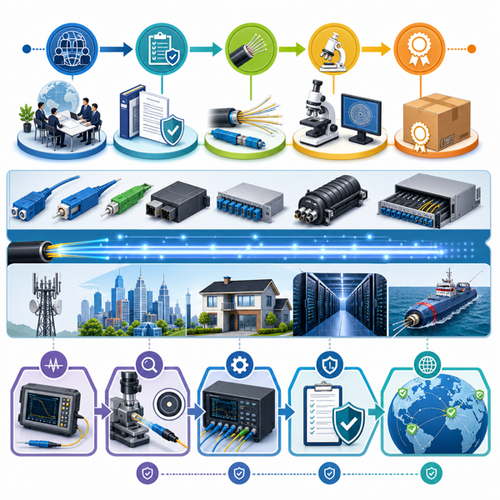
Fibre Optic Interconnecting Devices: Essential Standards for Modern Telecommunications
The rapid evolution of telecommunications relies on a backbone of robust and efficient fibre optic networks. In today’s hyper-connected world, ensuring the performance, safety, and scalability of these systems is not a luxury—it’s a necessity. International standards governing fibre optic interconnecting devices are critical for businesses aiming to keep pace with technological advancements and market demands. This guide explores four pivotal standards shaping the reliability, security, and productivity of fibre optic infrastructures worldwide.
Overview / Introduction
Telecommunications has transformed from traditional copper cables to high-speed, data-packed signals carried by fibre optics. Whether it's streaming, cloud computing, smart devices, or enterprise communications, fibre optics power the digital age with unprecedented bandwidth and reliability. However, optimal performance and compatibility depend on universal standards for the connectors, patch cords, and passive components used in these systems.
Why Are Fibre Optic Standards Critical?
- Consistency: Achieve uniform performance and compatibility across different devices and manufacturers.
- Productivity: Reduce downtime and costly troubleshooting by adhering to proven specifications.
- Security: Ensure safe operation and minimize exposure to data loss or hazards linked to subpar equipment.
- Scalability: Easily expand or upgrade network infrastructure without major overhauls.
By the end of this article, you’ll understand the scope, requirements, and benefits of each international standard, as well as practical guidance for implementation and compliance.
Detailed Standards Coverage
IEC 60874-14-5:1997 – SC-PC Connector Detailed Specification for Single-Mode Fibre B1
Connectors for Optical Fibres and Cables – Part 14-5: Detail Specification for Fibre Optic Connector Type SC-PC Untuned Terminated to Single-Mode Fibre Type B1
What does this standard cover?
IEC 60874-14-5:1997 defines the design, dimensions, and performance requirements for the SC-PC (Subscriber Connector-Physical Contact) type connector terminated to single-mode, type B1 fibre. It is essential for ensuring interoperability and reliable data transfer in datacom applications, especially within ISO/IEC 11801-based premises cabling. Its scope includes physical parameters, environmental conditions, material specifications, and quality assurance procedures.
Key requirements and specifications:
- Mechanical Interface: Precise control over plug and adapter dimensions for SC-PC connectors ensures compatibility and low-loss mating.
- Fibre Requirements: Only type B1 single-mode fibre, with tight tolerances on mode field and cladding diameter.
- Attenuation: Average attenuation below 0.40 dB; 95% probability less than 0.80 dB per mated pair (random connection).
- Environmental Endurance: Climatic category 10/60/4, supporting a range of temperatures and mechanical stresses.
- Assessment Level: Strict quality sampling and fixed sample qualification ensure reliable manufacturing.
- Colour Coding: Blue components (RAL 5015) for easy visual identification.
- Testing: Includes visual inspection, dimensional checks, environmental tests (heat, cold, damp), mechanical endurance (vibration, twist, pull), and optical measurements (attenuation, return loss).
Who needs to comply?
- Manufacturers and integrators of SC-PC connectors
- Network installers for single-mode fibre
- Companies maintaining mission-critical fibre links in data centres, telecom sites, and enterprise networks
Practical implications: Implementing IEC 60874-14-5 ensures that SC-PC connectors meet tight physical and optical performance criteria—crucial for minimizing signal loss, maximizing uptime, and standardizing installations for upgrades or expansions.
Key highlights:
- Precise control of connector geometry for uniform performance
- Adherence to ISO/IEC 11801 for generic cabling
- Robust testing regime for mechanical and optical reliability
Access the full standard:View IEC 60874-14-5:1997 on iTeh Standards
IEC 60874-19-1:1999 – SC-PC Floating Duplex Connector for Multimode Fibre
Connectors for Optical Fibres and Cables – Part 19-1: Fibre Optic Patch Cord Connector Type SC-PC (Floating Duplex) Standard Terminated on Multimode Fibre Type A1a, A1b – Detail Specification
What does this standard cover?
IEC 60874-19-1:1999 specifies the structure, physical properties, and quality conformity requirements for the SC-PC duplex floating connector when factory-terminated to multimode fibre types A1a or A1b. The standard is vital for high-throughput, low-latency local area networks (LANs) and premises cabling infrastructures, especially where duplex communication is required.
Key requirements and specifications:
- Duplex Floating Design: Allows independent movement to maintain alignment and optical performance during connection/disconnection cycles.
- Fibre Types: Suits multimode A1a and A1b fibre, as defined by IEC 60793-2.
- Attenuation: Random-mating attenuation below 0.35 dB (average), 0.75 dB (maximum).
- Dimensional Control: Minutely specified connector and ferrule measurements for duplex function.
- Assessment Level A: Demands rigorous, fixed sample testing with no tolerance for failures.
- Colour Coding: Beige for quick identification (RAL 1013).
- Testing Regime: Stringent quality tests, including mating cycles, mechanical endurance, environmental simulations, and optical property checks.
Who needs to comply?
- Manufacturers of patch cords for data networks
- Local area network builders and IT teams
- Communications infrastructure providers in commercial settings
Practical implications: Complying with this standard prevents signal degradation and connection issues in high-density network environments. It supports reliable, high-bandwidth data transport in settings where component interchangeability and quick repairs/upgrades are necessary.
Key highlights:
- Special focus on duplex floating mechanism for robust, stable connections
- Strict geometric and attenuation benchmarks
- Designed for compatibility with ISO/IEC 11801 premises cabling
Access the full standard:View IEC 60874-19-1:1999 on iTeh Standards
IEC 61300-1:2003 – General Test & Measurement Procedures for Fibre Optic Devices
Fibre Optic Interconnecting Devices and Passive Components – Basic Test and Measurement Procedures – Part 1: General and Guidance
What does this standard cover?
IEC 61300-1:2003 sets out generic, foundational environmental and measurement test procedures applicable to all fibre optic interconnecting devices and passive components. It provides a uniform framework for designing specific component tests, assessment of environmental resistance, and measurement of crucial optical characteristics such as return loss and attenuation.
Key requirements and specifications:
- Test Procedures: Comprehensive protocols for environmental conditioning (temperature, humidity, pressure) and performance measurement before, during, and after exposure.
- Standardization: Provides the baseline for reproducibility across labs, manufacturers, and specification writers.
- Test Sample Control: Defines procedure for pre-conditioning, conditioning, and recovery.
- Atmospheric Control: Specifies the range for temperature (18°C–28°C), humidity (25%–75%), and air pressure (86kPa–106kPa) during testing.
- Reference Methods: Enables specification writers and procurement professionals to draw from standardized procedures, rather than inventing new ones for each application.
Who needs to comply?
- Test laboratories specializing in fibre optic components
- Manufacturers qualifying new or modified products for telecom markets
- Standards writers and quality assurance professionals
Practical implications: Following IEC 61300-1 ensures that product assessment and development are built on trusted, globally recognized methodologies, streamlining certification and market acceptance. It also forms the foundation for all component-specific IEC 61300 series standards.
Key highlights:
- Uniform test bed for fibre optic devices
- Ensures measurement consistency and comparability
- Covers both environmental testing and optical measurement
Access the full standard:View IEC 61300-1:2003 on iTeh Standards
IEC 62552-3:2015 – Test Methods for Energy Consumption and Volume (Household Refrigerating Appliances)
Household Refrigerating Appliances – Characteristics and Test Methods – Part 3: Energy Consumption and Volume
What does this standard cover?
While not a fibre optic or telecom standard in a strict sense, IEC 62552-3:2015 is relevant where telecommunications support or control modern household refrigerating appliances—particularly for smart home, IoT, and building management applications. It details essential characteristics and test methods for determining the energy consumption and internal volume of refrigerating appliances, improving their energy efficiency and integration into smart infrastructure.
Key requirements and specifications:
- Testing Procedures: Thorough methodologies for setting up, conducting, and reporting energy consumption measurements.
- Ambient Temperatures: Tests at both 16°C and 32°C for realistic evaluation under various climate conditions.
- Data Handling: Use of advanced data acquisition and analysis for accurate, high-quality results.
- Load Processing Efficiency: New metrics to evaluate energy impact under real-world usage (like defrost cycles and load changes).
- Volume Calculation: Standardized measurement of usable volume for product comparison.
- Global Applicability: Methodologies account for regional differences in climate and product use, supporting regulatory compliance worldwide.
Who needs to comply?
- Manufacturers of smart household refrigerating appliances
- Building managers and integrators deploying IoT-connected appliances
- Test labs evaluating product performance for international markets
Practical implications: Adopting IEC 62552-3 means reliable, consistent appliance data, essential for integration into energy management systems and for meeting regional efficiency regulations. This is increasingly important as refrigeration appliances are networked within smart homes or smart buildings—applications that often depend on high-reliability telecom connections.
Key highlights:
- Comprehensive and updated testing for real-world appliance operation
- Supports smarter, more energy-efficient home and commercial environments
- Facilitates global trade and certification
Access the full standard:View IEC 62552-3:2015 on iTeh Standards
Industry Impact & Compliance
Fibre optic interconnecting device standards are the foundation for modern telecommunications efficiency, security, and expansion. Businesses rely on these frameworks to ensure:
- Interoperability: Equipment from multiple vendors will operate together without costly reconfiguration.
- Quality Assurance: Rigorously tested, standards-compliant products minimize risk of failure and downtime.
- Regulatory Compliance: Satisfying international and regional rules, often a prerequisite for public and private tenders.
- Competitive Advantage: Future-proofing infrastructure supports new technologies like 5G, streaming, IoT, and beyond.
Risks of non-compliance include:
- Unpredictable network failures
- Voided product warranties
- Increased operational costs due to troubleshooting and replacements
- Potential for regulatory fines or loss of business opportunities
Business benefits of adopting these standards:
- Increased uptime and productivity
- Easier scalability and upgrade paths
- Improved customer experiences thanks to robust connectivity
- Enhanced security through reliable hardware architectures
Implementation Guidance
Adopting international fibre optic standards requires planning, resources, and a commitment to ongoing improvement.
Common Implementation Approaches
- Procurement Policies: Specify that only standards-compliant connectors, cables, and passive components are used in infrastructure builds.
- Vendor Management: Work with suppliers with proven track records in standards compliance.
- Training & Certification: Ensure installation and maintenance staff are trained on proper handling, testing, and documentation procedures as defined by relevant IEC standards.
- Quality Control Systems: Establish regular inspections, testing protocols, and sample-based review processes.
Best Practices for Adopting These Standards
- Engage Early: Integrate standards compliance from the design phase to avoid costly retrofit.
- Use Qualified Laboratories: Ensure third-party testing is done in accredited labs familiar with IEC/ISO protocols.
- Stay Updated: Subscribe to industry alerts for revisions or new editions of key standards.
- Document Everything: Maintain detailed records of compliance, supplier certifications, and internal test results.
Resources for Organizations
- Professional societies such as IEC, IEEE, and industry alliances offer guidance.
- Manufacturer whitepapers and iTeh Standards’ technical libraries can serve as practical references.
- Standards training courses or webinars for engineers, procurement officers, and quality managers.
Conclusion / Next Steps
Key takeaways:
- Fibre optic interconnecting device standards ensure high performance, safety, and the ability to scale modern networks.
- Compliance with IEC 60874-14-5 and IEC 60874-19-1 assures reliable connectors for both single-mode and multimode applications, underpinning the world’s most demanding datacom and telecom systems.
- IEC 61300-1 is the test and measurement backbone, while IEC 62552-3 is essential for integrating smart appliances into connected environments.
- Adopting these standards brings tangible rewards in productivity, risk reduction, and future-readiness.
Recommendations:
- Make standards compliance a core part of your network or product strategy.
- Explore the referenced standards via iTeh Standards (https://standards.iteh.ai) and ensure you’re working with the latest editions.
- Train teams, verify vendors, and document compliance rigorously.
Call to Action:
Make your infrastructure future-ready: Explore these and related standards at iTeh Standards and stay ahead in the telecommunications revolution.
Categories
- Latest News
- New Arrivals
- Generalities
- Services and Management
- Natural Sciences
- Health Care
- Environment
- Metrology and Measurement
- Testing
- Mechanical Systems
- Fluid Systems
- Manufacturing
- Energy and Heat
- Electrical Engineering
- Electronics
- Telecommunications
- Information Technology
- Image Technology
- Precision Mechanics
- Road Vehicles
- Railway Engineering
- Shipbuilding
- Aircraft and Space
- Materials Handling
- Packaging
- Textile and Leather
- Clothing
- Agriculture
- Food technology
- Chemical Technology
- Mining and Minerals
- Petroleum
- Metallurgy
- Wood technology
- Glass and Ceramics
- Rubber and Plastics
- Paper Technology
- Paint Industries
- Construction
- Civil Engineering
- Military Engineering
- Entertainment