


August 2026: Latest Standards in Telecommunications and Audio/Video Engineering
August 2026: Latest Standards in Telecommunications and Audio/Video Engineering
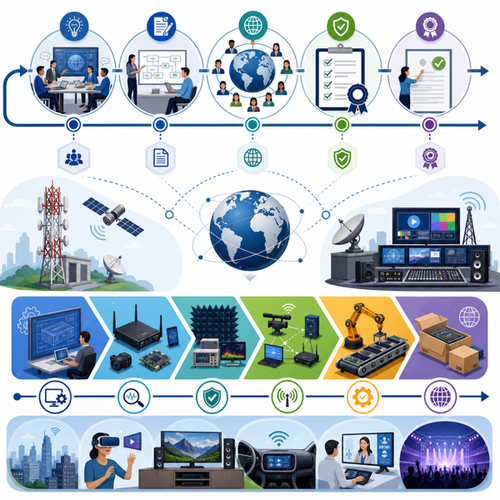
In August 2026, the field of telecommunications and audio/video engineering saw the release of five pivotal international standards, marking significant progress in the reliability, security, interoperability, and innovation of the sector. Covering essential updates on electromagnetic interference control, optical network transmission, cybersecurity for power utilities, interference studies for electronic tolling, and metaverse multimedia system classification, these standards provide critical foundations for both current operations and future technologies. This is Part 1 of 2 in our detailed series on August 2026's standards, offering deep technical insights, compliance strategies, and practical implementation guidance for engineers, compliance professionals, and business leaders alike.
Overview / Introduction
Telecommunications and audio/video engineering are at the core of today's hyper-connected society—enabling everything from global content streaming to secure, resilient power infrastructures. International standards play a vital role in ensuring that products, systems, and services in this domain are safe, interoperable, and effective across different markets. In this article, you’ll discover the core changes and impacts of the latest standards published in August 2026, with guidance on how these new requirements shape compliance, procurement, and engineering best practices.
Whether you work in product development, quality assurance, cyber-physical networks, or digital content delivery, staying up-to-date with these foundational standards is essential for future-proofing your organization and meeting growing regulatory expectations.
Detailed Standards Coverage
EN IEC 60940:2026 – EMI Suppression Components: Rules and Safety
Application of capacitors, resistors, inductors and complete filter units for electromagnetic interference suppression – General rules and safety requirements
Scope and Context: EN IEC 60940:2026 replaces the previous edition with substantial technical and structural revisions. The standard sets comprehensive rules and safety requirements for using capacitors, resistors, inductors, and complete filter units in suppressing electromagnetic interference (EMI) in circuits connected to AC mains (up to 1000 V AC/400 Hz) and DC supplies (up to 1500 V DC). These components are fundamental in safeguarding telecommunication and AV devices against EMI/RFI (radio frequency interference), ensuring uninterrupted and safe operation in complex electromagnetic environments.
Key Specifications and Requirements:
- Defines general safety aspects: selection criteria, component limitations, and failure risk mitigation for EMI suppression.
- Outlines classification for different suppression components (capacitors, resistors, inductors, filters) with detailed rules for their safe application in diverse setups.
- Introduces updated methodologies for determining safe clearance and creepage distances, crucial for system safety and longevity.
- Mandates rigorous provisioning for earth leakage currents and safe component series connections.
- Details fire-risk requirements (passive and active flammability) for suppression components and gives special guidance for X and Y capacitors in AC mains filters.
Target Audience:
- Manufacturers and designers of telecommunications and AV equipment
- Product safety professionals and compliance officers
- Engineers specifying filtering, suppression, or EMC (electromagnetic compatibility) solutions
Practical Implications: Adopting EN IEC 60940:2026 ensures that products meet modern EMI suppression expectations, reduces certification risks, and aligns with global safety requirements. This edition adds expanded content and requirements (Clauses 5-10), reinforcing product safety and reliability.
Key highlights:
- Expanded safety requirements for EMI suppression components
- New and updated guidance on selection, application, and risk mitigation
- Enhanced rules for clearance, creepage, and environmental classification
Access the full standard:View EN IEC 60940:2026 on iTeh Standards
IEC 60728-114:2026 – RFoG Optical Transmission Systems in Cable Networks
Cable networks for television signals, sound signals and interactive services – Part 114: Optical transmission systems using RFoG technology
Scope and Context: IEC 60728-114:2026 defines system and equipment specifications for FTTH/FTTB (fiber to the home/building) networks using RF over Glass (RFoG) technology. This standard covers both forward and return path transmissions with RF subcarrier multiplexing, and especially addresses RFoG systems where return signal transmission uses time division multiple access (TDMA), commonly found in modern DOCSIS deployments. The document lays out system parameters, performance limits, and test measurement methods for reliable, scalable optical networks applicable to television, sound, and interactive services.
Key Requirements and Specifications:
- Specifies architecture and reference models for RFoG networks, including the RFoG Optical Network Unit (R-ONU), optical distribution network (ODN), and headend equipment.
- Details critical measurement methodologies: optical power, wavelength, spectral width, signal-to-noise ratios, crosstalk, and noise performance.
- Provides stringent safety and electromagnetic compatibility (EMC) requirements for optical system hardware.
- Outlines environmental, marking, and interface standards for both R-ONU and headend devices.
- Emphasizes performance monitoring and compliance verification for bidirectional RF communications over optical fiber.
Target Audience:
- Network designers, system integrators, and equipment suppliers for cable TV and broadband
- Engineers managing FTTH/FTTB deployments
- Regulatory authorities and certification bodies
Practical Implications: Implementing IEC 60728-114:2026 ensures robust, scalable, and interference-free triple-play service delivery, optimizing network investments with enhanced optical performance and reliability.
Key highlights:
- Complete RFoG system parameterization—including return path TDMA
- Uniform testing and measurement criteria for RFoG devices and networks
- Robust interface and EMC compliance specifications
Access the full standard:View IEC 60728-114:2026 on iTeh Standards
IEC PAS 61850-90-19:2026 – RBAC for Power Utility Automation (IEC 61850)
Communication networks and systems for power utility automation – Part 90-19: Use of Role Based Access Control (RBAC) with IEC 61850
Scope and Context: IEC PAS 61850-90-19:2026 introduces the application of role-based access control (RBAC) within the IEC 61850 standard environment, aligning with requirements from IEC 62351-8. It focuses on engineering, modeling, and implementing RBAC, where permissions are assigned to roles (rather than individuals), enforcing granular, interoperable permissions for digital substations and other power utility automation systems.
Key Requirements and Specifications:
- RBAC modeling consistent with the IEC 61850 data model, using formalized permission-to-object bindings based on the Substation Configuration Language (SCL).
- Outlines engineering processes for role definition, permission assignment, and implementation across the digital substation ecosystem.
- Covers security best practices for protecting RBAC configurations (at rest, in transit), leveraging protocols such as XML and XACML for serialization, exchange, and logging.
- Details required integration with device templates, access points, and engineering workflows for scalable, secure power utility automation.
Target Audience:
- Power utility automation vendors, system integrators, and operators
- Information security managers in critical infrastructure
- Engineers implementing IEC 61850-based solutions
Practical Implications: This PAS enables standardized, future-proof cybersecurity controls in power utility automation, facilitating regulatory compliance, reducing attack surfaces, and simplifying engineering processes for large-scale multi-vendor environments.
Key highlights:
- Comprehensive RBAC modeling for IEC 61850 environments
- Alignment with IEC 62351-8 cybersecurity requirements
- Practical engineering and interoperability frameworks using SCL and XACML
Access the full standard:View IEC PAS 61850-90-19:2026 on iTeh Standards
CEN/TR 18358:2026 – Interference to Electronic Fee Collection DSRC from 5 GHz RLAN
Electronic fee collection – Interferences on CEN DSRC devices from radio local area network devices operating in the 5 GHz frequency range – Results of a test campaign
Scope and Context: With the rising deployment of 5 GHz Wi-Fi and other radio local area network (RLAN) devices in vehicles, CEN/TR 18358:2026 documents a major European test campaign investigating their effects on CEN Dedicated Short-Range Communication (DSRC) equipment, such as electronic tolling and tachograph systems.
Key Requirements and Results:
- Presents methodologies, setups, and measurement results for real-world RLAN interference to roadside (RSE) and on-board (OBE) DSRC equipment.
- Analyzes effect of frequency, power, channel bandwidth, and directionality for various RLAN device deployments.
- Details critical interference thresholds—demonstrating significant risk when RLAN operates within/adjacent to the DSRC frequency band (especially relevant for new vehicle Wi-Fi deployment).
- Provides data on blocking, error ratios, and impact scenarios, guiding regulatory and mitigation strategies for vehicle-based DSRC systems.
Target Audience:
- Toll system operators and integrators (EFC/DSRC)
- Automotive OEMs planning RLAN deployments
- Regulators, policy makers, and spectrum managers
Practical Implications: The findings warn of possible harmful interference and recommend best practices for spectrum management, device isolation, and compliance in connected vehicle contexts.
Key highlights:
- Definitive test results for RLAN impact on DSRC equipment
- Guidance for automotive and infrastructure deployment to avoid service disruption
- Foundation for future policymaking around vehicular wireless device coexistence
Access the full standard:View CEN/TR 18358:2026 on iTeh Standards
IEC TS 63614-2:2026 – Multimedia Systems for the Metaverse: Classification
Multimedia systems and equipment for metaverse – Part 2: Classification
Scope and Context: IEC TS 63614-2:2026 tackles the emerging spectrum of metaverse technologies, providing a comprehensive framework for classifying multimedia systems, platforms, content, networks, and devices that support immersive virtual/augmented spaces. As the concept of the metaverse expands, this technical specification sets the groundwork for harmonization and future standards development, ensuring consistent terminology and classification criteria across the sector.
Key Specifications:
- Defines metaverse as the seamless integration of the physical and virtual worlds, encompassing content (C), platform (P), network (N), and devices (D).
- Provides structured classifications for current and future metaverse technologies—from AR/VR, NFTs, to networked immersive environments.
- Identifies major technical and standardization challenges across device interoperability, network latency, content rendering, and platform scaling.
- Serves as a reference point for further gap analysis and development (future parts in the IEC 63614 series).
Target Audience:
- Multimedia developers, content creators, and system architects
- Standards bodies developing metaverse-related guidelines
- Strategic technology managers charting virtual/immersive strategy
Practical Implications: Adopting this classification standard allows organizations to anticipate and shape global metaverse innovation, positioning them for upcoming interoperability, compliance, and market opportunities.
Key highlights:
- Universal metaverse classification (Content, Platform, Network, Device)
- Clarity on technical/cultural boundaries and terminology of the metaverse
- Foundation for consistent future standards and cross-industry development
Access the full standard:View IEC TS 63614-2:2026 on iTeh Standards
Industry Impact & Compliance
Adoption of these standards is vital for organizations seeking to maintain global market access, achieve best-in-class system reliability, and ensure ongoing compliance with industry and governmental regulations. Key implications include:
- Compliance Requirements: Immediate need to update EMC test plans, incorporate enhanced safety and access controls, and review RF and optical device specifications according to the latest requirements.
- Market Competitiveness: Early adoption positions firms for preferred procurement status and future-proofs products against evolving customer and regulatory expectations.
- Risk Mitigation: Conformance with updated safety standards (such as EN IEC 60940:2026) reduces product liability exposure and helps mitigate cybersecurity threats in critical infrastructure (IEC PAS 61850-90-19:2026).
- Preparation Timelines: Organizations are urged to audit existing systems, plan phased implementation, and invest in relevant certification and training to ensure full compliance ahead of enforcement deadlines.
Non-compliance or delay may result in:
- Loss of market access or certification
- Increased risk of interference or denial-of-service in critical systems
- Potential legal and reputational risks
Technical Insights
Across these standards, several technical themes and practical considerations emerge:
- EMI/EMC and Safety: Selection and deployment of suppression components must account for real-world voltages, frequencies, insulation distances (clearance & creepage), and system environment—particularly for telecommunications and AV networks.
- Optical and RF Network Performance: Testing and certification should verify compliance with both forward and return path parameters, as well as robustness against interference, noise, and crosstalk, especially in fiber-to-the-home/broadband and vehicular contexts.
- Cybersecurity: Implementation of RBAC in power utility automation, as mandated by IEC PAS 61850-90-19:2026, should include secure engineering, configuration management, and continuous monitoring.
- Metaverse Preparedness: Classifying system components following IEC TS 63614-2:2026 helps organizations develop scalable, interoperable, and standards-based metaverse offerings—critical to future multimedia ecosystems.
Best practices for implementation:
- Map new standard requirements to existing product/system architectures.
- Update procurement and supply chain specifications to reference the latest standards.
- Train personnel on revised compliance and testing protocols.
- Engage with certification and testing bodies early in the process.
- Monitor regulatory and market developments for future standards in this rapidly evolving sector.
Conclusion / Next Steps
The August 2026 updates to international standards for telecommunications and audio/video engineering underscore a period of intense regulatory and technological evolution. Deep integration of EMC best practices, optical and hybrid network advances, improved cybersecurity frameworks, and clear metaverse standards will define future success in the industry.
Recommendations for stakeholders:
- Review and adopt the latest standards now to ensure compliance, market agility, and technical excellence.
- Train teams on new requirements; invest in updated tools and measurement procedures.
- Stay engaged with iTeh Standards and related standardization bodies for timely updates.
- Explore each standard in depth via iTeh Standards to access the full documents, supporting resources, and authoritative guidance.
Part 2 of this series will continue coverage of further standards released this August in telecommunications and audio/video engineering—stay tuned for more insights, technical coverage, and compliance recommendations.
Categories
- Latest News
- New Arrivals
- Generalities
- Services and Management
- Natural Sciences
- Health Care
- Environment
- Metrology and Measurement
- Testing
- Mechanical Systems
- Fluid Systems
- Manufacturing
- Energy and Heat
- Electrical Engineering
- Electronics
- Telecommunications
- Information Technology
- Image Technology
- Precision Mechanics
- Road Vehicles
- Railway Engineering
- Shipbuilding
- Aircraft and Space
- Materials Handling
- Packaging
- Textile and Leather
- Clothing
- Agriculture
- Food technology
- Chemical Technology
- Mining and Minerals
- Petroleum
- Metallurgy
- Wood technology
- Glass and Ceramics
- Rubber and Plastics
- Paper Technology
- Paint Industries
- Construction
- Civil Engineering
- Military Engineering
- Entertainment