

IEC PAS 61850-90-19:2026
(Main)Communication networks and systems for power utility automation - Part 90-19: Use of Role Based Access Control (RBAC) with IEC 61850
- Abstract
IEC PAS 61850-90-19:2026 document takes over the IEC 61850 data model specific definitions such as the definition of permissions and their assignment to roles from IEC 62351-8.
The general requirements for Role-Based Access Control (RBAC) are defined in IEC 62351-8. This part of IEC 61850, which is a Publicly Available Specification, applies those requirements to the IEC 61850 environment, including the RBAC modelling considerations, the impacts on IEC 61850 models and protocols, and the resulting engineering process requirements.
Additionally, the binding of permissions to objects is defined to allow an interoperable implementation regarding the semantic of roles. This is achieved by an assignment to unique data objects based on the SCL description. Note that for this, IEC 61850-6:2009+AMD1:2018+AMD2:2024 is a prerequisite as it defined a unique identification of objects in SCL.
- Status
- Published
- Publication Date
- 19-Aug-2026
- Technical Committee
- TC 57 - Power systems management and associated information exchange
- Drafting Committee
- WG 10 - TC 57/WG 10
- Current Stage
- PPUB - Publication issued
- Start Date
- 20-Aug-2026
- Completion Date
- 21-Aug-2026
Buy Documents
iecpas61850-90-19{ed1.0}en - IEC PAS 61850-90-19:2026 - Communication networks and systems for power utility automation - Part 90-19: Use of Role Based Access Control (RBAC) with IEC 61850
IEC PAS 61850-90-19:2026 is an IEC Publicly Available Specification for communication networks and systems for power utility automation. It applies Role-Based Access Control (RBAC) to the IEC 61850 environment, defining how roles, permissions, object bindings, and engineering data are modelled and exchanged. It is aimed at people who engineer, secure, integrate, operate, or procure IEC 61850 systems, especially where access control must be interoperable across devices and tools.
What does IEC PAS 61850-90-19:2026 specify?
IEC PAS 61850-90-19:2026 specifies how the general RBAC requirements from IEC 62351-8 are applied in IEC 61850 systems. It covers the RBAC model, the impact on IEC 61850 models and protocols, the engineering process, and the secure exchange of the configuration files used to implement access control.
The document also takes over IEC 61850 data model specific definitions such as permissions and their assignment to roles. A key point is the binding of permissions to unique IEC 61850 objects using SCL so that role semantics can be implemented consistently across vendors.
| Annex | What it covers |
|---|---|
| Annex A | Informative examples, including DER-oriented RBAC examples across operational states |
| Annex B | Normative signing of IEC 61850-6 SCL files |
The document is organized into clauses on scope, normative references, terms and abbreviated terms, use cases, engineering, impacts on other IEC 61850 parts, default ACSI service mappings, security of RBAC configuration, serialization mappings, O2OS XML file definition, and engineering use cases.
What are the key requirements of IEC PAS 61850-90-19:2026?
IEC PAS 61850-90-19:2026 requires implementers to treat RBAC as a combination of standardized roles, permissions, object binding, and protected configuration exchange. In practice, this means the access-control model is not only a policy concept - it must be carried through the SCL model, the permission model, and the files used by engineering tools and devices.
Roles, permissions, and interoperability
Clause 5.2 defines pre-defined roles for IEC 61850 use, including VIEWER, OPERATOR, ENGINEER, INSTALLER, SECADM, SECAUD, and RBACMNT. It also defines mandatory pre-defined permissions such as LISTOBJECTS, READVALUES, DATASET, REPORTING, FILEREAD, FILEWRITE, CONTROL, CONFIG, SETTINGGROUP, FILEMNGT, and SECURITY.
This matters because products claiming conformance are expected to support these role and permission concepts, even if some permissions are conditional on the device type. The document also reserves roleID ranges for IEC use and operator-specific roles, which supports interoperability without preventing local extensions.
OperationSets and object binding
Clause 5.3 introduces operationSets as the combination of roles and permissions, and binds them to objects using unique identifiers. The model uses three linked files: SCL for the IEC 61850 objects, XACML for roles and permissions, and O2OS for the object-to-operationSet assignment.
This separation matters in practice because system engineers can work on the SCL model while security engineers define policy in XACML. The O2OS file ties both together so the same policy meaning can be applied to specific Logical Devices, Logical Nodes, DataObjects, DataAttributes, ControlBlocks, and Files.
Engineering workflow and file protection
Clause 5.6 describes the engineering process from manufacturer-provided configuration through utility-defined policy and commissioning. Clause 9 then requires RBAC configuration to be authenticated, integrity-protected, and protected against disclosure.
For practice, this means SCL files, XACML files, and O2OS files are not just data exchange artifacts - they are security-relevant configuration and need signing, validation, and secure transfer. Annex B defines the SCL signing method, while Clause 9 uses the IEC 62351-11 profile for the other RBAC files.
ACSI service mapping
Clause 8 maps default rights to IEC 61850-7-2 Abstract Communication Service Interface (ACSI) service groups such as VIEW, READVALUES, DATASET, REPORTING, FILEREAD, FILEWRITE, CONTROL, CONFIG, SETTINGGROUP, FILEMNGT, and SECURITY. This clause defines which service groups a role may use.
The practical meaning is that access control is enforced both at the service level and at the object level. A role may be allowed to issue a service, but the O2OS-based rules still determine which objects that service can touch.
Serializations and engineering use cases
Clause 10 defines how the abstract RBAC model is serialized to XACML, including PolicySets, Policies, Rules, Targets, Match processing, OperationalState, Area of responsibility, Obligations, and short term access. Clause 11 defines the O2OS XML file structure and how it maps to IEC 61850 SCL elements.
Clause 12 then shows how the same model is used in device template engineering, specification-phase engineering, device-instance-specific assignments, and AccessPoint-specific policies. This is important where one IEC 61850 server exposes several AccessPoints with different permitted actions.
What terms does IEC PAS 61850-90-19:2026 define?
- Role-Based Access Control (RBAC) - An access-control approach where a user or automated agent receives rights through assigned roles.
- OperationSet - A tuple of a role and a permission that can be assigned to a specific object instance.
- Object-to-OperationSet (O2OS) - The configuration file that binds IEC 61850 objects to operationSets using unique identifiers.
- System Configuration Language (SCL) - The IEC 61850 configuration language used here to describe objects and support unique identification.
- eXtensible Access Control Markup Language (XACML) - The policy language used to represent operationSets, roles, permissions, and conditions.
- Policy Enforcement Point (PEP) - The point that checks the RBAC configuration and enforces access decisions on the device or in the ICT.
- Intelligent electronic device (IED) - A field device, gateway, or PC in the control center that participates in the IEC 61850 system.
- Area of responsibility (AoR) - The range of authority used in the access-control model, such as a geographical area, control center, or application set.
Who uses IEC PAS 61850-90-19:2026?
IEC PAS 61850-90-19:2026 is used by product suppliers, system integrators, asset owners, maintenance functions, operational companies (OPCOs), and security managers involved in IEC 61850 systems. The document’s use cases also fit utility security engineers, IED vendors, and tool vendors that prepare, sign, transfer, or enforce RBAC configuration.
In practice, product suppliers use it when preconfiguring device roles and object models. System integrators and utility engineers use it when engineering SCL, XACML, and O2OS files, commissioning IEDs, and assigning permissions to specific devices, AccessPoints, or operational states.
Which standards are used with IEC PAS 61850-90-19:2026?
IEC PAS 61850-90-19:2026 is used with several IEC and external standards that provide the underlying data model, security, and serialization rules.
- IEC 61850-6:2009, IEC 61850-6:2009/AMD2:2024 - Provides SCL and the unique identification of objects needed for O2OS binding.
- IEC 61850-7-2 - Defines the ACSI services that Clause 8 maps to RBAC permissions.
- IEC TR 61850-90-30 - Supports the specification-phase engineering use case.
- IEC TS 62351-1 - Provides the security introduction referenced by the document.
- IEC 62351-6 - Provides secure IEC 61850 communication profiles used for file transfer.
- IEC 62351-8 - Defines the general RBAC framework that this part applies to IEC 61850.
- IEC 62351-11 - Provides the XML security wrapper profile used for RBAC configuration exchange.
- IEC 62351-14 - Provides cyber security event logging referenced by the document.
- IEC 62351-2 - Supplies the general terms and definitions used alongside the RBAC-specific terms.
- RFC 6960, XACML 3.0, and W3C Canonical XML 2.0 - Support certificate status checking, policy expression, and XML canonicalization for signatures.
What does the IEC PAS 61850-90-19:2026 document contain?
IEC PAS 61850-90-19:2026 contains role and permission tables, use-case models, engineering workflows, service-group mappings, and file-structure definitions. It also includes detailed XML attribute tables for XACML and O2OS, plus figures that show commissioning, policy assignment, and template-based engineering.
Annex A gives worked examples for DER applications across different operational states, which helps readers see how roles and permissions change with operating mode. Annex B gives the normative SCL signing method, including signature placement, certificate-chain handling, generation steps, and validation steps for signed IEC 61850 SCL files.
Buy Documents
iecpas61850-90-19{ed1.0}en - IEC PAS 61850-90-19:2026 - Communication networks and systems for power utility automation - Part 90-19: Use of Role Based Access Control (RBAC) with IEC 61850
Get Certified
Connect with accredited certification bodies for this standard

ANCE
Mexican certification and testing association.

Intertek Slovenia
Intertek testing, inspection, and certification services in Slovenia.

LNE (Laboratoire National de Métrologie et d'Essais)
French national laboratory for metrology and testing.
Sponsored listings
Frequently Asked Questions
IEC PAS 61850-90-19:2026 is a technical specification published by the International Electrotechnical Commission (IEC). Its full title is "Communication networks and systems for power utility automation - Part 90-19: Use of Role Based Access Control (RBAC) with IEC 61850". This standard covers: IEC PAS 61850-90-19:2026 document takes over the IEC 61850 data model specific definitions such as the definition of permissions and their assignment to roles from IEC 62351-8. The general requirements for Role-Based Access Control (RBAC) are defined in IEC 62351-8. This part of IEC 61850, which is a Publicly Available Specification, applies those requirements to the IEC 61850 environment, including the RBAC modelling considerations, the impacts on IEC 61850 models and protocols, and the resulting engineering process requirements. Additionally, the binding of permissions to objects is defined to allow an interoperable implementation regarding the semantic of roles. This is achieved by an assignment to unique data objects based on the SCL description. Note that for this, IEC 61850-6:2009+AMD1:2018+AMD2:2024 is a prerequisite as it defined a unique identification of objects in SCL.
IEC PAS 61850-90-19:2026 document takes over the IEC 61850 data model specific definitions such as the definition of permissions and their assignment to roles from IEC 62351-8. The general requirements for Role-Based Access Control (RBAC) are defined in IEC 62351-8. This part of IEC 61850, which is a Publicly Available Specification, applies those requirements to the IEC 61850 environment, including the RBAC modelling considerations, the impacts on IEC 61850 models and protocols, and the resulting engineering process requirements. Additionally, the binding of permissions to objects is defined to allow an interoperable implementation regarding the semantic of roles. This is achieved by an assignment to unique data objects based on the SCL description. Note that for this, IEC 61850-6:2009+AMD1:2018+AMD2:2024 is a prerequisite as it defined a unique identification of objects in SCL.
IEC PAS 61850-90-19:2026 is classified under the following ICS (International Classification for Standards) categories: 33.200 - Telecontrol. Telemetering. The ICS classification helps identify the subject area and facilitates finding related standards.
IEC PAS 61850-90-19:2026 is available in PDF format for immediate download after purchase. The document can be added to your cart and obtained through the secure checkout process. Digital delivery ensures instant access to the complete standard document.
Standards Content (Sample)
IEC PAS 61850-90-19 ®
Edition 1.0 2026-08
PUBLICLY AVAILABLE
SPECIFICATION
Communication networks and systems for power utility automation -
Part 90-19: Use of Role-Based Access Control (RBAC) with IEC 61850
ICS 33.200 ISBN 978-2-8327-1433-1
All rights reserved. Unless otherwise specified, no part of this publication may be reproduced or utilized in any form or
by any means, electronic or mechanical, including photocopying and microfilm, without permission in writing from either
IEC or IEC's member National Committee in the country of the requester. If you have any questions about IEC copyright
or have an enquiry about obtaining additional rights to this publication, please contact the address below or your local
IEC member National Committee for further information.
IEC Secretariat Tel.: +41 22 919 02 11
3, rue de Varembé info@iec.ch
CH-1211 Geneva 20 www.iec.ch
Switzerland
About the IEC
The International Electrotechnical Commission (IEC) is the leading global organization that prepares and publishes
International Standards for all electrical, electronic and related technologies.
About IEC publications
The technical content of IEC publications is kept under constant review by the IEC. Please make sure that you have the
latest edition, a corrigendum or an amendment might have been published.
IEC publications search - IEC Products & Services Portal - products.iec.ch
webstore.iec.ch/advsearchform Discover our powerful search engine and read freely all the
The advanced search enables to find IEC publications by a
publications previews, graphical symbols and the glossary.
variety of criteria (reference number, text, technical With a subscription you will always have access to up to date
committee, …). It also gives information on projects, content tailored to your needs.
replaced and withdrawn publications.
Electropedia - www.electropedia.org
IEC Just Published - webstore.iec.ch/justpublished The world's leading online dictionary on electrotechnology,
Stay up to date on all new IEC publications. Just Published containing more than 22 500 terminological entries in English
details all new publications released. Available online and and French, with equivalent terms in 25 additional languages.
once a month by email. Also known as the International Electrotechnical Vocabulary
(IEV) online.
IEC Customer Service Centre - webstore.iec.ch/csc
If you wish to give us your feedback on this publication or
need further assistance, please contact the Customer
Service Centre: sales@iec.ch.
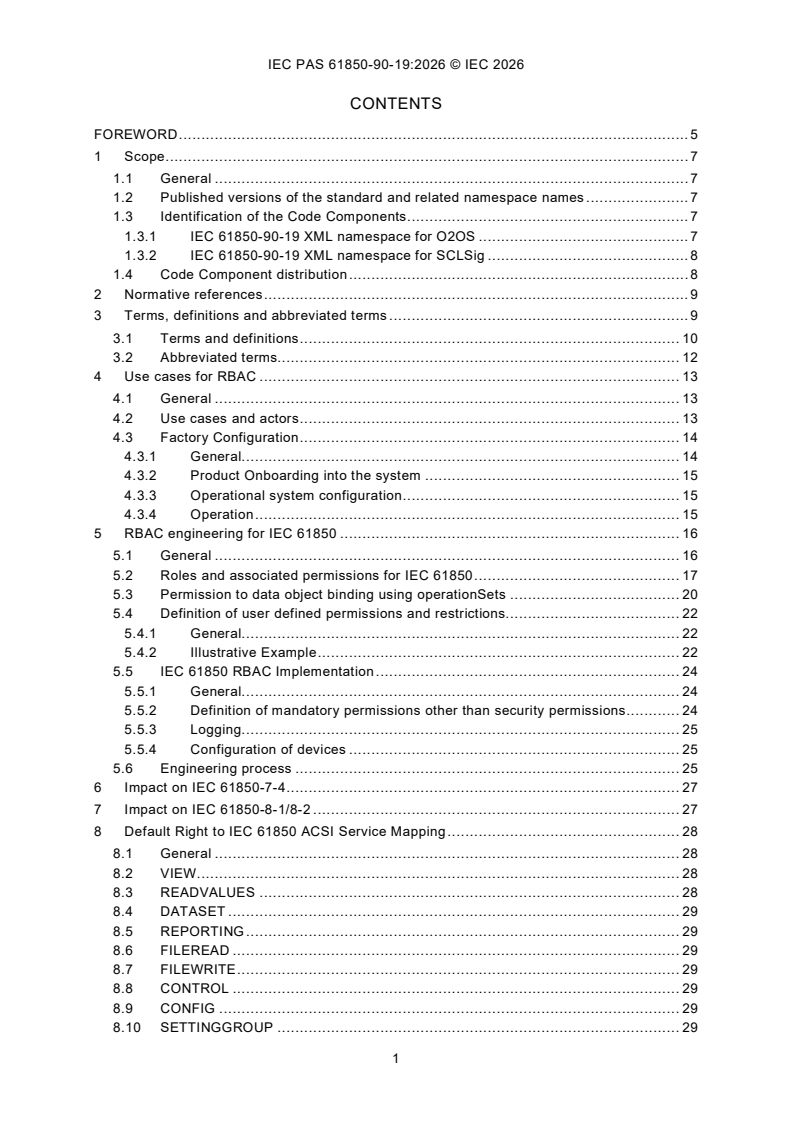
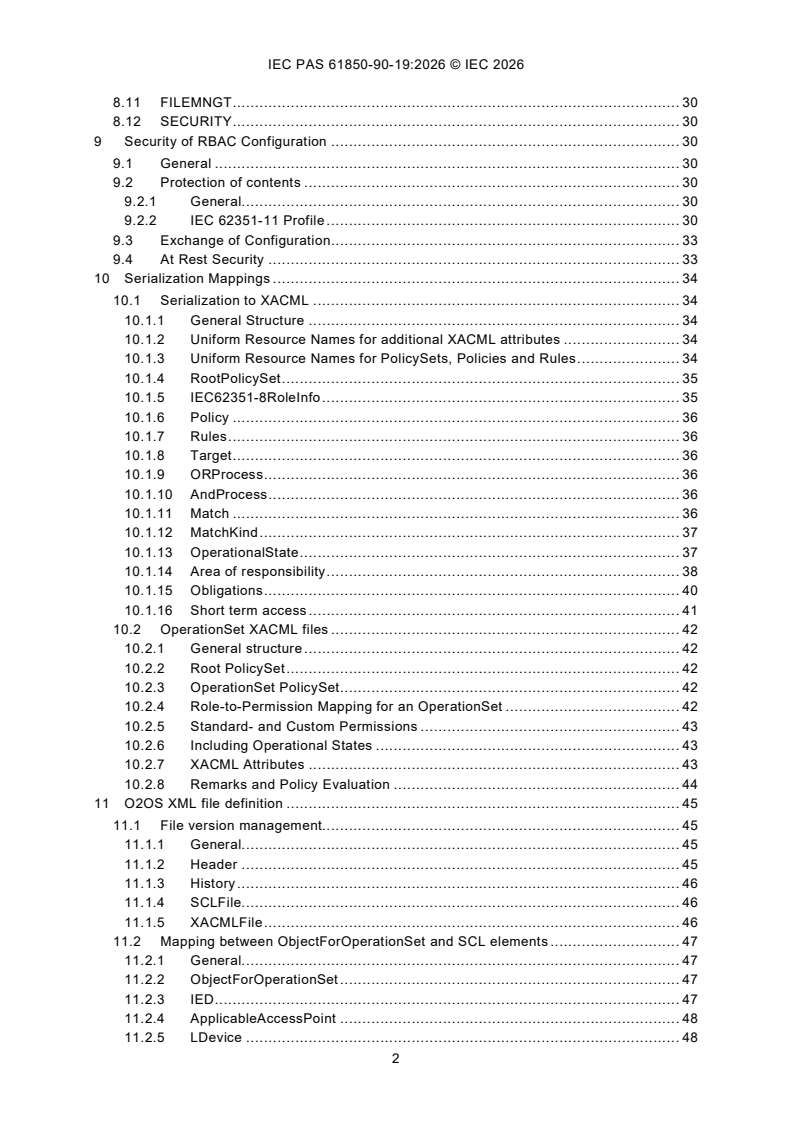
CONTENTS
FOREWORD . 5
1 Scope . 7
1.1 General . 7
1.2 Published versions of the standard and related namespace names . 7
1.3 Identification of the Code Components . 7
1.3.1 IEC 61850-90-19 XML namespace for O2OS . 7
1.3.2 IEC 61850-90-19 XML namespace for SCLSig . 8
1.4 Code Component distribution . 8
2 Normative references . 9
3 Terms, definitions and abbreviated terms . 9
3.1 Terms and definitions . 10
3.2 Abbreviated terms. 12
4 Use cases for RBAC . 13
4.1 General . 13
4.2 Use cases and actors . 13
4.3 Factory Configuration . 14
4.3.1 General. 14
4.3.2 Product Onboarding into the system . 15
4.3.3 Operational system configuration . 15
4.3.4 Operation . 15
5 RBAC engineering for IEC 61850 . 16
5.1 General . 16
5.2 Roles and associated permissions for IEC 61850 . 17
5.3 Permission to data object binding using operationSets . 20
5.4 Definition of user defined permissions and restrictions. 22
5.4.1 General. 22
5.4.2 Illustrative Example . 22
5.5 IEC 61850 RBAC Implementation . 24
5.5.1 General. 24
5.5.2 Definition of mandatory permissions other than security permissions . 24
5.5.3 Logging. 25
5.5.4 Configuration of devices . 25
5.6 Engineering process . 25
6 Impact on IEC 61850-7-4 . 27
7 Impact on IEC 61850-8-1/8-2 . 27
8 Default Right to IEC 61850 ACSI Service Mapping . 28
8.1 General . 28
8.2 VIEW . 28
8.3 READVALUES . 28
8.4 DATASET . 29
8.5 REPORTING . 29
8.6 FILEREAD . 29
8.7 FILEWRITE . 29
8.8 CONTROL . 29
8.9 CONFIG . 29
8.10 SETTINGGROUP . 29
8.11 FILEMNGT . 30
8.12 SECURITY . 30
9 Security of RBAC Configuration . 30
9.1 General . 30
9.2 Protection of contents . 30
9.2.1 General. 30
9.2.2 IEC 62351-11 Profile . 30
9.3 Exchange of Configuration . 33
9.4 At Rest Security . 33
10 Serialization Mappings . 34
10.1 Serialization to XACML . 34
10.1.1 General Structure . 34
10.1.2 Uniform Resource Names for additional XACML attributes . 34
10.1.3 Uniform Resource Names for PolicySets, Policies and Rules . 34
10.1.4 RootPolicySet . 35
10.1.5 IEC62351-8RoleInfo . 35
10.1.6 Policy . 36
10.1.7 Rules . 36
10.1.8 Target . 36
10.1.9 ORProcess . 36
10.1.10 AndProcess . 36
10.1.11 Match . 36
10.1.12 MatchKind . 37
10.1.13 OperationalState . 37
10.1.14 Area of responsibility . 38
10.1.15 Obligations . 40
10.1.16 Short term access . 41
10.2 OperationSet XACML files . 42
10.2.1 General structure . 42
10.2.2 Root PolicySet . 42
10.2.3 OperationSet PolicySet . 42
10.2.4 Role-to-Permission Mapping for an OperationSet . 42
10.2.5 Standard- and Custom Permissions . 43
10.2.6 Including Operational States . 43
10.2.7 XACML Attributes . 43
10.2.8 Remarks and Policy Evaluation . 44
11 O2OS XML file definition . 45
11.1 File version management. 45
11.1.1 General. 45
11.1.2 Header . 45
11.1.3 History . 46
11.1.4 SCLFile. 46
11.1.5 XACMLFile . 46
11.2 Mapping between ObjectForOperationSet and SCL elements . 47
11.2.1 General. 47
11.2.2 ObjectForOperationSet . 47
11.2.3 IED . 47
11.2.4 ApplicableAccessPoint . 48
11.2.5 LDevice . 48
11.2.6 LNode . 48
11.2.7 DataObject . 49
11.2.8 DataAttribute . 49
11.2.9 ControlBlock . 50
11.2.10 Files . 50
12 Engineering use cases . 50
12.1 General . 50
12.2 Engineering with device template phase. 51
12.3 Engineering with specification phase . 52
12.4 Specifying device specific OperationSet assignment . 53
12.5 Engineering with O2OS for a set of device instances following a device
template . 55
12.6 Engineering with AccessPoint specific OperationSet . 55
Annex A (informative) Examples . 57
Annex B (normative) Signing of IEC 61850-6 SCL File . 64
B.1 General . 64
B.2 Explanation of XML Elements and Attributes . 66
B.2.1 XML Namespace . 66
B.2.2 SignatureEntries . 66
B.2.3 SignatureInfo . 67
B.3 Tooling Requirements . 68
B.4 Generation of Signature . 68
B.5 Validation of Signature . 69
Bibliography . 70
Figure 1 – High level RBAC use cases. 13
Figure 2 – Scope of operationSet files . 21
Figure 3 – Assignment of restricted operationSets to example objects . 21
Figure 4 – Example objects provided in SCL . 22
Figure 5 – Assignment of existing (manufacturer defined) operationSets to example
objects . 22
Figure 6 – Assignment of restricted operationSets to example objects. 23
Figure 7 – Commissioning of an IED . 25
Figure 8 – Handling of Permission to Object assignment using SCL, XACML, an O2P
Files . 26
Figure 9 – General IEC 62351-11 XSD layout . 31
Figure 10 – XSD ComplexType definition of HeaderType . 31
Figure 11 – XSD ComplexType definition of information . 32
Figure 12 – SignedInfotype XML structure . 32
Figure 13 – SignatureMethodType structure . 33
Figure 14 – Transforming a received request into a XACML request context. . 34
Figure 15 – Definition of OperationSets using XACML . 42
Figure 16 – O2OS Header UML definition . 45
Figure 17 – Object to OperationSet class diagram . 47
Figure 18 – O2OS engineering with ICD file and superseding O2OS assignment . 51
Figure 19 – O2OS engineering with ICD files . 52
Figure 20 – O2OS engineering with ISD files . 53
Figure 21 – O2OS engineering with IID files . 54
Figure 22 – O2OS engineering with ICD file and superseding O2OS assignment . 55
Figure 23 – AccessPoint specific OperationSet . 56
Figure B.1 – Position of Signing Information in SCL . 65
Figure B.2 – Signing of IEC 61850 SCL files . 66
Table 1 – Published versions and related namespace names . 7
Table 2 – Attributes of the O2OS XML namespace . 7
Table 3 – Attributes of the IEC 61850-6 Signature XML namespace . 8
Table 4 – Actors and actor definitions . 14
Table 5 – Pre-defined roles (as of IEC 62351-8) . 17
Table 6 – List of pre-defined role-to-permission assignments for IEC 61850 . 18
Table 7 – List of mandatory pre-defined permissions . 19
Table 8 – User-Defined Permission . 23
Table 9 – LISTOBJECTS permission and associated ACSI services . 24
Table 10 – Attributes of the Header element . 45
Table 11 – Attributes of the Hitem element . 46
Table 12 – Attributes of the SCLFile element . 46
Table 13 – Attributes of the XACMLFile element . 46
Table 14 – Attributes of the ObjectForOperationSet element . 47
Table 15 – Attributes of the IED element . 48
Table 16 – Attributes of the ApplicableAccessPoint element . 48
Table 17 – Attributes of the LDevice element. 48
Table 18 – Attributes of the LNode element . 49
Table 19 – Attributes of the DataObject element . 49
Table 20 – Attributes of the DataAttribute element . 49
Table 21 – Attributes of the ControlBlock element . 50
Table 22 – Attributes of the Files element . 50
Table A.1 – DER Capabilities vs Roles for the Normal OperationalState . 58
Table A.2 – DER Capabilities vs Roles for the Lockout OperationalState . 60
Table A.3 – DER Capabilities vs Roles for the Test/Maintenance OperationalState . 62
Table B.1 – Allowed algorithm identifiers . 67
INTERNATIONAL ELECTROTECHNICAL COMMISSION
____________
Communication networks and systems for power utility automation -
Part 90-19: Use of Role Based Access Control (RBAC) with IEC 61850
FOREWORD
1) The International Electrotechnical Commission (IEC) is a worldwide organization for standardization comprising
all national electrotechnical committees (IEC National Committees). The object of IEC is to promote international
co-operation on all questions concerning standardization in the electrical and electronic fields. To this end and
in addition to other activities, IEC publishes International Standards, Technical Specifications, Technical Reports,
Publicly Available Specifications (PAS) and Guides (hereafter referred to as "IEC Publication(s)"). Their
preparation is entrusted to technical committees; any IEC National Committee interested in the subject dealt with
may participate in this preparatory work. International, governmental and non-governmental organizations liaising
with the IEC also participate in this preparation. IEC collaborates closely with the International Organization for
Standardization (ISO) in accordance with conditions determined by agreement between the two organizations.
2) The formal decisions or agreements of IEC on technical matters express, as nearly as possible, an international
consensus of opinion on the relevant subjects since each technical committee has representation from all
interested IEC National Committees.
3) IEC Publications have the form of recommendations for international use and are accepted by IEC National
Committees in that sense. While all reasonable efforts are made to ensure that the technical content of IEC
Publications is accurate, IEC cannot be held responsible for the way in which they are used or for any
misinterpretation by any end user.
4) In order to promote international uniformity, IEC National Committees undertake to apply IEC Publications
transparently to the maximum extent possible in their national and regional publications. Any divergence between
any IEC Publication and the corresponding national or regional publication shall be clearly indicated in the latter.
5) IEC itself does not provide any attestation of conformity. Independent certification bodies provide conformity
assessment services and, in some areas, access to IEC marks of conformity. IEC is not responsible for any
services carried out by independent certification bodies.
6) All users should ensure that they have the latest edition of this publication.
7) No liability shall attach to IEC or its directors, employees, servants or agents including individual experts and
members of its technical committees and IEC National Committees for any personal injury, property damage or
other damage of any nature whatsoever, whether direct or indirect, or for costs (including legal fees) and
expenses arising out of the publication, use of, or reliance upon, this IEC Publication or any other IEC
Publications.
8) Attention is drawn to the Normative references cited in this publication. Use of the referenced publications is
indispensable for the correct application of this publication.
9) IEC [draws attention to the possibility that the implementation of this document may involve the use of (a)
patent(s). IEC takes no position concerning the evidence, validity or applicability of any claimed patent rights in
respect thereof. As of the date of publication of this document,[IEC had not received notice of (a) patent(s), which
may be required to implement this document. However, implementers are cautioned that this may not represent
the latest information, which may be obtained from the patent database available at https://patents.iec.ch [and/or]
www.iso.org/patents. IEC shall not be held responsible for identifying any or all such patent rights.
IEC 61850-90-19 has been prepared by IEC Technical Committee 57: Power system control
and associated communications. It is a Publicly Available Specification.
The text of this Publicly Available Specification is based on the following documents:
Draft Report on voting
57/2888/DPAS 57/2946/RVDPAS
Full information on the voting for its approval can be found in the report on voting indicated in
the above table.
The language used for the development of this Publicly Available Specification is English.
This document was drafted in accordance with ISO/IEC Directives, Part 2, and developed in
accordance with ISO/IEC Directives, Part 1 and ISO/IEC Directives, IEC Supplement, available
at www.iec.ch/members_experts/refdocs. The main document types developed by IEC are
described in greater detail at www.iec.ch/publications.
NOTE The following print types are used:
– Definitions from Clause 3: in Courrier New type.
This document includes Code Components i.e. components that are intended to be directly
processed by a computer.
Such content is any text found between the markers and , or
otherwise is clearly labelled in this document as a Code Component.
The purchase of this document carries a copyright license for the purchaser to sell software
containing Code Components from this standard to end users either directly or via distributors,
subject to IEC software licensing conditions, which can be found at: www.iec.ch/CCv1.
A list of all parts of the IEC 61850 series, under the general title: Communication networks and
systems for power utility automation, can be found on the IEC website.
The committee has decided that the contents of this document will remain unchanged until the
stability date indicated on the IEC website under webstore.iec.ch in the data related to the
specific document. At this date, the document will be
– reconfirmed,
– withdrawn, or
– revised.
NOTE In accordance with ISO/IEC Directives, Part 1, IEC PASs are automatically withdrawn after 4 years.
1 Scope
1.1 General
The general requirements for Role-Based Access Control (RBAC) are defined in IEC 62351-8.
This part of IEC 61850, which is a Publicly Available Specification, applies those requirements
to the IEC 61850 environment, including the RBAC modelling considerations, the impacts on
IEC 61850 models and protocols, and the resulting engineering process requirements.
This document takes over the IEC 61850 data model specific definitions such as the definition
of permissions and their assignment to roles from IEC 62351-8.
Additionally, the binding of permissions to objects is defined to allow an interoperable
implementation regarding the semantic of roles. This is achieved by an assignment to unique
data objects based on the SCL description. Note that for this, IEC 61850-
6:2009+AMD1:2018+AMD2:2024 is a prerequisite as it defined a unique identification of objects
in SCL.
1.2 Published versions of the standard and related namespace names
Table 1 provides a reference between all published editions, amendments or corrigenda of this
document and the full name of the namespace.
Table 1 – Published versions and related namespace names
Edition Publication date Webstore Namespace
Edition 1.0 2026-07 IEC 61850-90-19:2026 IEC 61850-90-19-
O2OS:2024A4
Edition 1.0 2026-07 IEC 61850-90-19:2026 IEC 61850-90-19-
SCLSig:2024A2
1.3 Identification of the Code Components
1.3.1 IEC 61850-90-19 XML namespace for O2OS
The namespace associated with this document for O2OS structure is an XML schema (XSD).
The parameters which identify the namespace are provided in Table 2:
Table 2 – Attributes of the O2OS XML namespace
Attribute Content
Namespace nameplate
Namespace Identifier (xmlns) http://www.iec.ch/61850/2024/O2OS/90-19
Version 2024
Revision A
Release 4
XSD version header attribute 2024A4
Mandatory reference name eIEC61850-90-19
Code Component Name IEC_61850-90-19.O2OS.2024A4.DPAS
Namespace dependencies
includes
1.3.2 IEC 61850-90-19 XML namespace for SCLSig
The namespace associated with this document for signing SCL files is an XML schema (XSD).
The parameters which identify the namespace are provided in Table 2:
Table 3 – Attributes of the IEC 61850-6 Signature XML namespace
Attribute Content
Namespace nameplate
Namespace Identifier (xmlns) http://www.iec.ch/61850/2024/SCLSig/90-19
Version 2024
Revision A
Release 2
XSD version header attribute 2024A2
Mandatory reference name eIEC61850-90-19-SCLSig
Code Component Name IEC_61850-90-19.SCLSig.2024A2.DPAS
Namespace dependencies
includes
1.4 Code Component distribution
Each Code Component is a ZIP package containing the electronic representation of the Code
Component itself, with a file describing the content of the package (IECManifest.xml).
The life cycle of a code component is not restricted to the life cycle of the related publication.
The publication life cycle goes through two stages, Version (corresponding to an edition) and
Revision (corresponding to an amendment). A third publication stage (Release) allows
publication of Code Component in case of urgent fixes of InterOp Tissues, thus without need to
publish an amendment.
Consequently, new releases of the Code Component may be released, which supersedes the
previous release, and will be distributed through the IEC TC57 web site at:
https://www.iec.ch/tc57/supportdocuments
The latest version/release of the code component will be found by selecting the file for the code
component with the highest value for VersionStateInfo, e.g. IEC_61850-90-
19.XSD.{VersionStateInfo}.full.zip.
The code component associated to this PAS is an XML schema file (XSD). It is available as a
full version only. It is freely accessible on the IEC website for download at
https://www.iec.ch/tc57/supportdocuments, but the usage remains under the licensing
conditions.
In case of any differences between the downloadable code component and the IEC pdf
published content, the downloadable code component is the valid one; it may be subject to
updates. See included history files.
2 Normative references
The following documents are referred to in the text in such a way that some or all of their content
constitutes requirements of this document. For dated references, only the edition cited applies.
For undated references, the latest edition of the referenced document (including any
amendments) applies.
IEC 61850-6:2009, Communication networks and systems for power utility automation - Part 6:
Configuration description language for communication in electrical substations related to IEDs
IEC 61850-6:2009/AMD2:2024
IEC 61850-7-2, Communication networks and systems for power utility automation - Part 7-2:
Basic information and communication structure - Abstract communication service interface
(ACSI)
IEC TR 61850-90-30, Communication networks and systems for power utility automation –
Part 90-30: IEC 61850 Function Modelling in SCL
IEC TS 62351-1, Power systems management and associated information exchange - Data and
communications security - Part 1: Communication network and system security - Introduction
to security issues
IEC 62351-6, Power systems management and associated information exchange - Data and
communications security - Part 6: Security for IEC 61850
IEC 62351-8, Power systems management and associated information exchange - Data and
communications security - Part 8: Role-based access control for power system management
IEC 62351-11, Power systems management and associated information exchange - Data and
communications security - Part 11: Security for XML documents
IEC 62351-14, Power systems management and associated information exchange - Data and
communications security - Part 14: Cyber security event logging1
RFC 6960, X.509 Internet Public Key Infrastructure Online Certificate Status Protocol - OCSP
XACML, eXtensible Access Control Markup Language (XACML) Version 3.0 [OASIS]
W3C Canonical XML Version 2.0
https://www.w3.org/TR/xml-c14n2/
3 Terms, definitions and abbreviated terms
For the purposes of this document, the terms and definitions given in IEC 62351-2 and the
following definitions, which are taken from IEC 62351-8:2025 and enhanced with further
information, apply.
ISO and IEC maintain terminology databases for use in standardization at the following
addresses:
– IEC Electropedia: available at https://www.electropedia.org/
– ISO Online browsing platform: available at https://www.iso.org/obp
___________
Under preparation. Stage at the time of publication: IEC/ACDV 62351-14:2025.
3.1 Terms and definitions
3.1.1
area of responsibility
range of authority
Note 1 to entry: Some examples: geographical area; based on network segregation; control center; or software
applications.
3.1.2
access token
evidence or testimonials concerning one’s right to credit, confidence, or authority
3.1.3
holder
entity that possesses or owns an access token
3.1.4
issuer
entity that issues an access token
3.1.5
object
any system resource subject to access control such as a file, printer, terminal, database record,
etc.
3.1.6
operation
executable image of a program which upon invocation executes some function/activity for the
subject
3.1.7
OperationSet
tuple(s) of a role and a permission, which can be assigned to dedicated objects = object
instances (e.g. FW)
3.1.8
permission
right to execute an action on a system object (e.g., permission = FILEWRITE: action = write;
system object = FILE)
Note 1 to entry: Normative reference can be found in IEC 62351-8.
3.1.9
privilege
attribute or property assigned to a subject by an authority
Note 1 to entry: Normative reference can be found in IEC 62351-8.
3.1.10
right
atomic set of independent actions (e.g., read, write)
Note 1 to entry: Normative reference can be found in IEC 62351-8.
3.1.11
role
job function within the context of an organization with some semantics associated regarding the
authority and responsibility conferred on the user assigned to the role
Note 1 to entry: A Role subsumes a set of rights.
Pre-defined role: a role that is defined in this document.
Default role: a role that is defined by the vendor of the protection equipment (not by its specification) and that is valid
generally for all objects of that vendor.
Specific role: a role that is defined by the utility operator for its particular needs.
3.1.12
security
cyber-security
3.1.13
service
right/privilege/permission granted to an entity to use the abstract service
Note 1 to entry: IEC 61850 defines abstract services in IEC 61850-7-2. The Service construct in this document
correlates to an IEC 62351-8 action.
3.1.14
session
encounter between a user and an application or with the computer in general
Note 1 to entry: One user session is the time between starting the communication channel (either local or remote)
and terminating (either by the user or the system).
3.1.15
static separation of duty
SSD
enforcement constraints on the assignment of users to roles
Note 1 to entry: Membership in one role may prevent the User from being a member of one or more other roles,
depending on the SSD rules enforced.
3.1.16
out-of-band
communications which occur outside of a previously established communication method or
channel
3.1.17
subject
user or automated agent
Note 1 to entry: A subject is a right holder. It shall have a name attribute whose value is mandatory. It is this name
that shall be used to enroll a subject in a particular role.
3.1.18
token
physical instance of an access token
3.1.19
user
human being
3.2 Abbreviated terms
For the purposes of this document, the terms and definitions of IEC TS 62351-1 apply, as well
as the following.
Acronym Meaning
AC Attribute certificate
ACL Access control list
ACRL Attribute certificate revocation list
ACSI Abstract communication system interface
AMI Advanced metering infrastructure
AoR Area of responsibility
Categories Collection of rights to ease administration of custom defined roles
CIM Common Information model
CRL Certificate revocation list
DCB Device configuration bundle
DER Distributed energy resource
HMAC Keyed-hash message authentication code
HMI Human machine interface
IED Intelligent electronic device; stands for a field device, a gateway or
a PC in the net control centre
ID Identity
IS International standard
ISA Instrument system and automation society
LDAP Lightweight directory access protocol
LD Logical device (IEC 61850)
LN Logical node (IEC 61850)
MRID Master Resource Identifier
O2OS Object-to-OperationSet (configuration file)
OCSP Online certificate status protocol
OID Object identifier
OSI Open systems interconnection
PKI Public key infrastructure; the complete set of processes required to
provide encryption and digital signature services
PDP Policy decision point
PEP Policy Enforcement Point
PMI Privilege management infrastructure; the complete set of processes
required to provide an authorization service
RBAC Role-based access control
SCL System configuration language (IEC 61850)
SSL Secure socket layer
SW Software
TCP Transport control protocol
TLS Transport layer security
UID Universal identifier
XACML eXtended Access Control Markup Language
4 Use cases for RBAC
4.1 General
This clause describes the use cases and involved actors motivating the support of role-based
access control. It outlines specifics for which in the following clauses technical approaches and
solutions are specified, which map role based access control as outlined in IEC 62351-8 to the
IEC 61850 data model.
4.2 Use cases and actors
uc Use Case Model
Factory Configuration
Product Supplier
«precedes»
Product Onboarding into
System
System Integrator
«precedes»
Operational System
Configuration
«include»
Asset Owner 1
Maintenance
«extend»
Operation
Short Term Access
«include»
Asset Owner 2
«extend»
«include»
Diagnostics and
«include»
Maintenance
Operational Restrictions
Security Manager
Operation Based on
State
OPCO 2
OPCO 1
Figure 1 – High level RBAC use cases
Figure 1 shows the high-level use cases that are used to derive the requirements for this
standard. The figure defines both actors and use cases.
Table 4 – Actors and actor definitions
Actor Definition
Product Supplier Represents the product supplier of equipment that will be integrated into a
system. Typically, the product being provided would be some type of
Intelligent Electronic Device (IED), communication equipment, or software
applications.
NOTE This definition aligns with IEC/ISA 62443.
System Integrator It represents a function that integrates the system components and
determines communication information exchanges to fulfill the operational
requirements provided by the Asset Owners. The function may be
provided by a third-party entity selected by the Asset Owner(s) or an
internal function of the Asset Owner.
NOTE This definition aligns with IEC/ISA 62443.
From an IEC 61850 perspective, the System Integrator is responsible for
producing the System Configuration Description (SCD).
Asset Owner Is the owner of the system or equipment within an IEC 61850 system. In
many situations, the IEC 61850 system may consist of assets owned by
different entities. This separation is denoted in Figure 1 as Asset Owner 1
and Asset Owner 2.
NOTE This definition aligns with IEC/ISA 62443.
Maintenance It represents a function that provides the maintenance service on the
system. This function may be provided by an asset owner approved third-
party or may be provided by the Asset Owner.
Operational Company (OPCO) It represents a function that is monitoring and/or controlling assets in the
system. OPCO(s) may be an asset owner approved or an internal Asset
Owner function. The depiction of OPCO 1 and OPCO 2 depicts that the
functionality and/or responsibilities may be split between one or more
OPCOs.
Security Manager This is a function approved by the Asset Owners that provides
cybersecurity guidance and configuration to the system.
NOTE The Security Manager may be assigned IEC 62351-8 predefined
roles, which relate to security administration (e.g. SECADM, SECAUD,
RBACMNT).
Figure 1 provides several major use cases that follow the typical life cycle of a system:
– Factory Configuration: Relates to a particular product supplier configuring a product. Once
the product is ready to be provided, based on Asset Owner requirements, the product is
onboarded.
– Product Onboarding into System: The product is integrated by a System Integrator based
on the requirements provided by the Asset Owner(s). Once onboarding is completed, the
Operational System configuration proceeds.
– Once the System is configured and tested, it is deployed and becomes operational (e.g.,
the Operation use case).
4.3 Factory Configuration
4.3.1 General
A Product Supplier provides a product typically with a default parameter configuration and
security configuration. When the product is received by the System Integrator/function, there
needs to be a mechanism for the receiving entity to update parameters and security
configuration. This means that there is a requirement that the configuration(s) provided by the
Product Supplier must document this mechanism. The documentation should also describe how
to disable/replace a
...