

ASTM F780-93a(2018)
(Test Method)Standard Test Method for Linear Deformation and Breaking Strength of Alpine Skis
General Information
- Abstract
SIGNIFICANCE AND USE
4.1 This test method provides information concerning the resistance of a ski to permanent bending and an indication of its basic strength. It is not intended to evaluate the data with regard to the quality of the ski.
SCOPE
1.1 This test method covers the determination of linear deformation load and breaking load for Alpine skis.2
1.2 This test method is applicable to all Alpine skis.
1.3 This standard does not purport to address all of the safety concerns, if any, associated with its use. It is the responsibility of the user of this standard to establish appropriate safety, health, and environmental practices and determine the applicability of regulatory limitations prior to use.
1.4 This international standard was developed in accordance with internationally recognized principles on standardization established in the Decision on Principles for the Development of International Standards, Guides and Recommendations issued by the World Trade Organization Technical Barriers to Trade (TBT) Committee.
- Status
- Published
- Publication Date
- 30-Jun-2018
- Technical Committee
- F27 - Snow and Water Sports
- Drafting Committee
- F27.30 - Skiing and Snowboarding Equipment


Overview
ASTM F780-93a(2018) - Standard Test Method for Linear Deformation and Breaking Strength of Alpine Skis is an internationally recognized method developed by ASTM. Its primary purpose is to determine the resistance of alpine skis to permanent bending (linear deformation) and to measure their basic breaking strength. This standardized method is applicable to all types of alpine skis, providing critical data to manufacturers, researchers, and regulatory bodies involved in the design, evaluation, and quality assurance of ski equipment.
The ASTM F780-93a(2018) test method ensures consistency and comparability in measuring the physical properties of alpine skis, thereby supporting safety, product innovation, and compliance with international norms. The standard does not make judgments on overall ski quality; rather, it focuses on specific mechanical attributes essential for equipment performance and durability.
Key Topics
- Linear Deformation Load: The method defines how to assess the load required to cause a permanent linear deformation in an alpine ski. This load is key for understanding a ski's resistance to bending during use.
- Breaking Load: The standard measures the maximum load a ski can withstand before structural failure occurs, providing vital safety and durability information.
- Test Apparatus: Specifies the configuration and accuracy requirements for test devices, including adjustable supports, load application systems, and instruments for measuring deflection with high precision.
- Test Procedure: Includes guidelines for ski conditioning, test setup, load application rates, and interpretation of results via load-deflection diagrams.
- Precision and Bias: Addresses the destructive nature of the test and discusses that no bias is present, as results are defined strictly by the method itself.
- Reporting: Recommends clear documentation of the test standard designation, ski identification details, and any deviations from prescribed procedures.
Applications
The ASTM F780-93a(2018) standard is widely used in several practical scenarios:
- Product Development: Ski manufacturers rely on this method to test prototypes and refine materials or construction techniques for improved performance and durability.
- Research and Innovation: Laboratories and institutions use these procedures to conduct comparative studies, advance ski technology, and develop safer alpine equipment.
- Quality Assurance: Routine use of the standard enables consistent batch testing for production quality, ensuring product reliability before market release.
- Regulatory Compliance: Demonstrates adherence to international safety and performance requirements, supporting market access and customer confidence.
- Equipment Comparison: Provides a benchmark for comparing different brands, models, or design options in terms of strength and resistance to deformation.
Related Standards
- ASTM D2240 – Standard Test Method for Rubber Property-Durometer Hardness (useful for rubber layers used in load application plates in the ski test setup)
- ASTM F472 – Terminology for Geometry of Alpine Skis (provides definitions relevant to ski dimensions and properties)
- ISO/DIS 6265 – International standard for alpine ski testing (ASTM F780-93a(2018) is designed to align closely with this ISO standard for harmonized global practices)
Keywords: Alpine skis, linear deformation, breaking strength, ASTM F780, test method, ski strength testing, ski durability, snow sports equipment standards, quality assurance, load-deflection testing.
By following ASTM F780-93a(2018), stakeholders in the alpine ski industry can ensure their products meet recognized international benchmarks for mechanical performance, strengthening safety and consumer trust.
Relations
- Effective Date
- 01-Jul-2018
- Effective Date
- 15-Jul-2011
- Effective Date
- 01-Oct-2006
- Effective Date
- 10-Aug-1998
Frequently Asked Questions
ASTM F780-93a(2018) is a standard published by ASTM International. Its full title is "Standard Test Method for Linear Deformation and Breaking Strength of Alpine Skis". This standard covers: SIGNIFICANCE AND USE 4.1 This test method provides information concerning the resistance of a ski to permanent bending and an indication of its basic strength. It is not intended to evaluate the data with regard to the quality of the ski. SCOPE 1.1 This test method covers the determination of linear deformation load and breaking load for Alpine skis.2 1.2 This test method is applicable to all Alpine skis. 1.3 This standard does not purport to address all of the safety concerns, if any, associated with its use. It is the responsibility of the user of this standard to establish appropriate safety, health, and environmental practices and determine the applicability of regulatory limitations prior to use. 1.4 This international standard was developed in accordance with internationally recognized principles on standardization established in the Decision on Principles for the Development of International Standards, Guides and Recommendations issued by the World Trade Organization Technical Barriers to Trade (TBT) Committee.
SIGNIFICANCE AND USE 4.1 This test method provides information concerning the resistance of a ski to permanent bending and an indication of its basic strength. It is not intended to evaluate the data with regard to the quality of the ski. SCOPE 1.1 This test method covers the determination of linear deformation load and breaking load for Alpine skis.2 1.2 This test method is applicable to all Alpine skis. 1.3 This standard does not purport to address all of the safety concerns, if any, associated with its use. It is the responsibility of the user of this standard to establish appropriate safety, health, and environmental practices and determine the applicability of regulatory limitations prior to use. 1.4 This international standard was developed in accordance with internationally recognized principles on standardization established in the Decision on Principles for the Development of International Standards, Guides and Recommendations issued by the World Trade Organization Technical Barriers to Trade (TBT) Committee.
ASTM F780-93a(2018) is classified under the following ICS (International Classification for Standards) categories: 97.220.20 - Winter sports equipment. The ICS classification helps identify the subject area and facilitates finding related standards.
ASTM F780-93a(2018) has the following relationships with other standards: It is inter standard links to ASTM F780-93a(2012), ASTM F472-11, ASTM F472-92(2006), ASTM F472-92(1998). Understanding these relationships helps ensure you are using the most current and applicable version of the standard.
ASTM F780-93a(2018) is available in PDF format for immediate download after purchase. The document can be added to your cart and obtained through the secure checkout process. Digital delivery ensures instant access to the complete standard document.
Standards Content (Sample)
This international standard was developed in accordance with internationally recognized principles on standardization established in the Decision on Principles for the
Development of International Standards, Guides and Recommendations issued by the World Trade Organization Technical Barriers to Trade (TBT) Committee.
Designation: F780 −93a (Reapproved 2018)
Standard Test Method for
Linear Deformation and Breaking Strength of Alpine Skis
ThisstandardisissuedunderthefixeddesignationF780;thenumberimmediatelyfollowingthedesignationindicatestheyearoforiginal
adoptionor,inthecaseofrevision,theyearoflastrevision.Anumberinparenthesesindicatestheyearoflastreapproval.Asuperscript
epsilon (´) indicates an editorial change since the last revision or reapproval.
1. Scope 4. Significance and Use
1.1 This test method covers the determination of linear 4.1 This test method provides information concerning the
deformation load and breaking load for Alpine skis.
resistanceofaskitopermanentbendingandanindicationofits
basic strength. It is not intended to evaluate the data with
1.2 This test method is applicable to all Alpine skis.
regard to the quality of the ski.
1.3 This standard does not purport to address all of the
safety concerns, if any, associated with its use. It is the
5. Apparatus
responsibility of the user of this standard to establish appro-
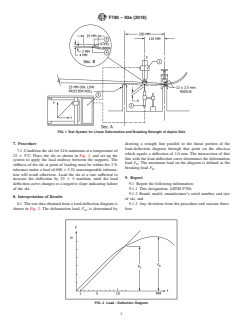
5.1 This test method shall be conducted on a device (see
priate safety, health, and environmental practices and deter-
Fig. 1) equipped with adjustable supports, a load (F) applica-
mine the applicability of regulatory limitations prior to use.
tion system (1) with a range of at least 20 000 N and reading
1.4 This international standard was developed in accor-
accuracy of 650 N, and with an instrument (2) for reading
dance with internationally recognized principles on standard-
bending deformation (d) with an accuracy of 0.01 mm. The
ization established in the Decision on Principles for the
system must have a controlled deflection rate. A standard
Development of International Standards, Guides and Recom-
universal tension/compression testing machine with X−Y
mendations issued by the World Trade Organization Technical
recorder (3) is typical of such a system.
Barriers to Trade (TBT) Committee.
5.2 The test method is made with the ski in its normal
2. Referenced Documents
horizontalposition,andtheoverhangingportionsoftheskiare
2.1 ASTM Standards:
left free to deflect.
D2240TestMethodforRubberProperty—DurometerHard-
5.3 The test system shall be set up in accordance with Fig.
ness
1 (Section A) with a 250-mm distance between supports and
F472Terminology for Geometry of Alpine Skis
onesupportmadewitha25-mmdiameter,low-frictionrollerat
point of contact with the ski. The end support shall be so
3. Terminology
designed as to have a hinged clamp which prohibits linear
3.1 Definitions of Terms Specific to This Standard:
displacement, yet permits rotation about the support. The load
3.1.1 breaking load (F )—the maximum load applied in
B is applied through a plate as shown in Fig. 1 (Section B), 25
accordance with Sections 6 and 7 (that is, the maximum load
mm wide and of length equal to or slightly greater than the
which the ski can sustain).
width of the ski, made up of a steel plate (5) and a hard rubber
(95 65ShoreAdurometer;seeTestMethodD2240)layer(4).
3.1.2 deformation load (F )—the load applied in accor-
D
The plate must be free to rotate under loading ram.
dancewithSection6thatcausesapermanentdeformationof1
mm at the load application point of the ski.
6. Determination of Load Application Point
6.1 In order to obtain comparable values, the test shall be
This test method is under the jurisdiction of ASTM Committee F27 on Snow
conducted at the load application point with a separation
and Water Sports and is the direct responsibility of F27.30 on Skiing and
between the supports of 250 6 0.5 mm. Determine the load
Snowboarding Equipment.
application point by moving the ski in a longitudinal direction
Current edition approved July 1, 2018. Published August 2018. Originally
approved in 1982. Last previous edition approved in 2012 as F780–93a (2012).
on the supports until a deflection is obtained under a load of
DOI: 10.1520/F0780-93A
...