


ASTM E696-07(2018)
(Specification)Standard Specification for Tungsten-Rhenium Alloy Thermocouple Wire
Standard Specification for Tungsten-Rhenium Alloy Thermocouple Wire
ABSTRACT
This specification covers the requirements for bare solid conductors made of tungsten and rhenium alloy thermoelements supplied in matched pairs. These thermoelements shall be suitable for use in either bead-insulated, bare-wire thermocouples, or in compacted metal-sheathed, ceramic insulated thermocouple material or assemblies. Unless otherwise noted, all information in this specification applies to both thermocouple combinations of tungsten-3 % rhenium versus tungsten-25 % rhenium (W3Re/W25Re) and tungsten-5 % rhenium versus tungsten-26 % rhenium (W5Re/W26Re; Type C). Thermoelements should meet specified physical, mechanical, thermoelectric, and compositional requirements.
SCOPE
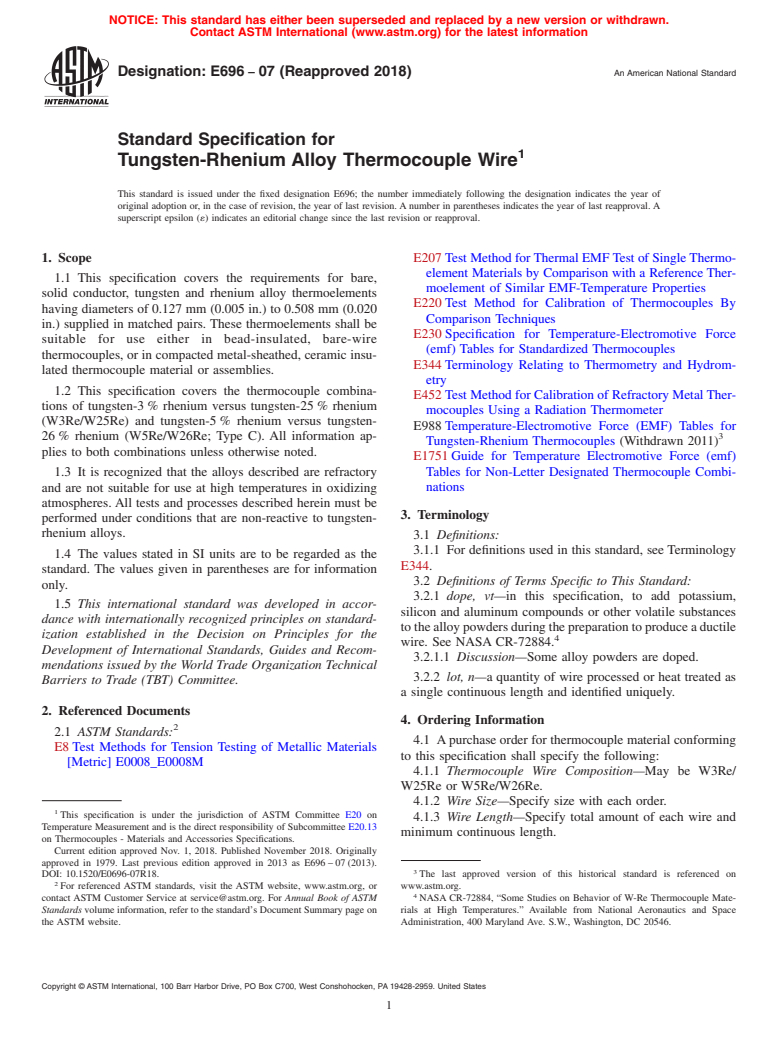
1.1 This specification covers the requirements for bare, solid conductor, tungsten and rhenium alloy thermoelements having diameters of 0.127 mm (0.005 in.) to 0.508 mm (0.020 in.) supplied in matched pairs. These thermoelements shall be suitable for use either in bead-insulated, bare-wire thermocouples, or in compacted metal-sheathed, ceramic insulated thermocouple material or assemblies.
1.2 This specification covers the thermocouple combinations of tungsten-3 % rhenium versus tungsten-25 % rhenium (W3Re/W25Re) and tungsten-5 % rhenium versus tungsten-26 % rhenium (W5Re/W26Re; Type C). All information applies to both combinations unless otherwise noted.
1.3 It is recognized that the alloys described are refractory and are not suitable for use at high temperatures in oxidizing atmospheres. All tests and processes described herein must be performed under conditions that are non-reactive to tungsten-rhenium alloys.
1.4 The values stated in SI units are to be regarded as the standard. The values given in parentheses are for information only.
1.5 This international standard was developed in accordance with internationally recognized principles on standardization established in the Decision on Principles for the Development of International Standards, Guides and Recommendations issued by the World Trade Organization Technical Barriers to Trade (TBT) Committee.
General Information
Buy Standard
Standards Content (Sample)
NOTICE: This standard has either been superseded and replaced by a new version or withdrawn.
Contact ASTM International (www.astm.org) for the latest information
Designation: E696 − 07 (Reapproved 2018) An American National Standard
Standard Specification for
Tungsten-Rhenium Alloy Thermocouple Wire
This standard is issued under the fixed designation E696; the number immediately following the designation indicates the year of
original adoption or, in the case of revision, the year of last revision. A number in parentheses indicates the year of last reapproval. A
superscript epsilon (´) indicates an editorial change since the last revision or reapproval.
1. Scope E207 Test Method for Thermal EMF Test of Single Thermo-
element Materials by Comparison with a Reference Ther-
1.1 This specification covers the requirements for bare,
moelement of Similar EMF-Temperature Properties
solid conductor, tungsten and rhenium alloy thermoelements
E220 Test Method for Calibration of Thermocouples By
having diameters of 0.127 mm (0.005 in.) to 0.508 mm (0.020
Comparison Techniques
in.) supplied in matched pairs. These thermoelements shall be
E230 Specification for Temperature-Electromotive Force
suitable for use either in bead-insulated, bare-wire
(emf) Tables for Standardized Thermocouples
thermocouples, or in compacted metal-sheathed, ceramic insu-
E344 Terminology Relating to Thermometry and Hydrom-
lated thermocouple material or assemblies.
etry
1.2 This specification covers the thermocouple combina-
E452 Test Method for Calibration of Refractory Metal Ther-
tions of tungsten-3 % rhenium versus tungsten-25 % rhenium
mocouples Using a Radiation Thermometer
(W3Re/W25Re) and tungsten-5 % rhenium versus tungsten-
E988 Temperature-Electromotive Force (EMF) Tables for
26 % rhenium (W5Re/W26Re; Type C). All information ap-
Tungsten-Rhenium Thermocouples (Withdrawn 2011)
plies to both combinations unless otherwise noted.
E1751 Guide for Temperature Electromotive Force (emf)
Tables for Non-Letter Designated Thermocouple Combi-
1.3 It is recognized that the alloys described are refractory
and are not suitable for use at high temperatures in oxidizing nations
atmospheres. All tests and processes described herein must be
3. Terminology
performed under conditions that are non-reactive to tungsten-
rhenium alloys.
3.1 Definitions:
3.1.1 For definitions used in this standard, see Terminology
1.4 The values stated in SI units are to be regarded as the
E344.
standard. The values given in parentheses are for information
3.2 Definitions of Terms Specific to This Standard:
only.
3.2.1 dope, vt—in this specification, to add potassium,
1.5 This international standard was developed in accor-
silicon and aluminum compounds or other volatile substances
dance with internationally recognized principles on standard-
to the alloy powders during the preparation to produce a ductile
ization established in the Decision on Principles for the
wire. See NASA CR-72884.
Development of International Standards, Guides and Recom-
3.2.1.1 Discussion—Some alloy powders are doped.
mendations issued by the World Trade Organization Technical
3.2.2 lot, n—a quantity of wire processed or heat treated as
Barriers to Trade (TBT) Committee.
a single continuous length and identified uniquely.
2. Referenced Documents
4. Ordering Information
2.1 ASTM Standards:
4.1 A purchase order for thermocouple material conforming
E8 Test Methods for Tension Testing of Metallic Materials
to this specification shall specify the following:
[Metric] E0008_E0008M
4.1.1 Thermocouple Wire Composition—May be W3Re/
W25Re or W5Re/W26Re.
4.1.2 Wire Size—Specify size with each order.
This specification is under the jurisdiction of ASTM Committee E20 on
4.1.3 Wire Length—Specify total amount of each wire and
Temperature Measurement and is the direct responsibility of Subcommittee E20.13
minimum continuous length.
on Thermocouples - Materials and Accessories Specifications.
Current edition approved Nov. 1, 2018. Published November 2018. Originally
approved in 1979. Last previous edition approved in 2013 as E696 – 07 (2013).
DOI: 10.1520/E0696-07R18. The last approved version of this historical standard is referenced on
For referenced ASTM standards, visit the ASTM website, www.astm.org, or www.astm.org.
contact ASTM Customer Service at service@astm.org. For Annual Book of ASTM NASA CR-72884, “Some Studies on Behavior of W-Re Thermocouple Mate-
Standards volume information, refer to the standard’s Document Summary page on rials at High Temperatures.” Available from National Aeronautics and Space
the ASTM website. Administration, 400 Maryland Ave. S.W., Washington, DC 20546.
Copyright © ASTM International, 100 Barr Harbor Drive, PO Box C700, West Conshohocken, PA 19428-2959. United States
E696 − 07 (2018)
4.1.4 Thermocouple Calibration—Calibration will be in shown in Guide E1751 for W3Re/W25Re or Specification
accordance with Section 5.1.4 unless otherwise specified. E230 for Type C (W5Re/W26Re).
4.1.5 Supplementary Requirements—See the Supplementary 5.1.4.3 The initial calibration tolerance shall be in accor-
Requirements section of this specification. dance with Table 1 (W3Re/W25Re). or Specification E230
4.1.6 Instructions for Spooling, Packaging, and Labeling— (W5Re/W26Re), as appropriate.
Packaging will be in accordance with Section 10 unless
5.2 Composition:
otherwise specified.
5.2.1 Positive thermoelement:
4.1.7 Tests and Certifications Required from the
5.2.1.1 The positive thermoelement for the W3Re/W25Re
Processor—Certification will be in accordance with Section 9
combination shall have a nominal composition of 97 % tung-
unless otherwise specified.
sten and 3 % rhenium.
5.2.1.2 The positive thermoelement for the W5Re/W26Re
5. Materials and Manufacture
combination shall have a nominal composition of 95 % tung-
5.1 Thermocouple Wire:
sten and 5 % rhenium.
5.1.1 General—The thermoelements shall be tungsten-3 %
5.2.1.3 The positive thermoelement shall be doped to pro-
rhenium and tungsten-25 % rhenium or tungsten-5 % rhenium vide desirable grain structure and workability and maintain
and tungsten-26 % rhenium (Type C), as indicated on the
ductility after high temperature use.
purchase order. 5.2.2 Negative thermoelement:
5.1.2 Physical:
5.2.2.1 The negative thermoelement for the W3Re/W25Re
5.1.2.1 The diameter of each wire shall be within 60.01 mm combination shall have a nominal composition of 75 % tung-
(0.0005 in.) of the ordered size for 0.5 mm (0.02 in.) diameter
sten and 25 % rhenium.
wire and smaller. The diameter of each wire shall be uniform 5.2.2.2 The negative thermoelement for the W5Re/W26Re
end-to-end to within 0.01 mm (0.0005 in.) for 0.5 mm (0.02
combination shall have a nominal composition of 74 % tung-
in.) diameter wire and smaller. sten and 26 % rhenium.
5.1.2.2 The wires shall be solid, round, smooth and be free
6. Lot Identification
of weld joints, slivers, kinks, pits or nicks exceeding 5 % of
6.1 Thermocouple wires, test results and certifications shall
diameter.
be identified by manufacturer’s lot number.
5.1.2.3 The wire surface shall be uniformly clean and free of
discoloration.
7. Lot Designation
5.1.2.4 Mechanical or optical methods may be used to
7.1 A vendor who purchases wire from processors for
verify the requirements of 5.1.2.1, 5.1.2.2, and 5.1.2.3.
repackaging and resale shall supply, for each spool, the wire
5.1.3 Mechanical:
processor’s name, lot number and certification to the customer.
5.1.3.1 The wires shall withstand, at a temperature of 20 to
35 °C (68 to 95 °F), wrapping five turns around a mandrel fiv
...
This document is not an ASTM standard and is intended only to provide the user of an ASTM standard an indication of what changes have been made to the previous version. Because
it may not be technically possible to adequately depict all changes accurately, ASTM recommends that users consult prior editions as appropriate. In all cases only the current version
of the standard as published by ASTM is to be considered the official document.
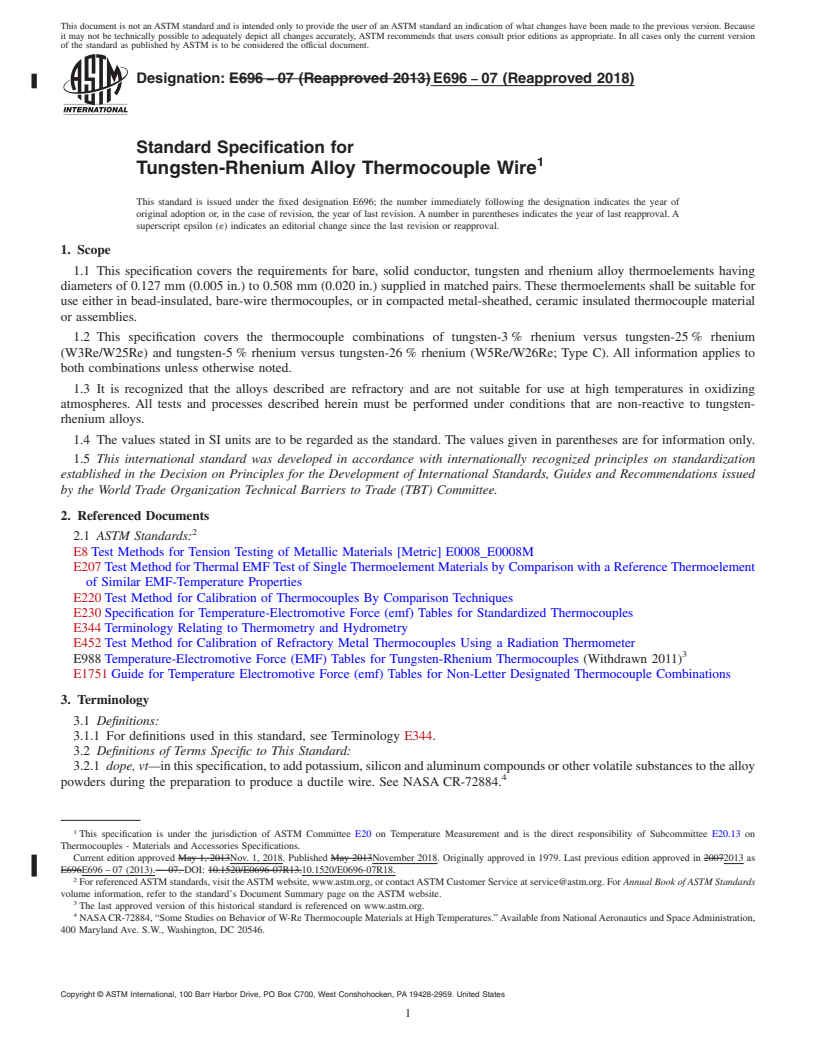
Designation: E696 − 07 (Reapproved 2013) E696 − 07 (Reapproved 2018)
Standard Specification for
Tungsten-Rhenium Alloy Thermocouple Wire
This standard is issued under the fixed designation E696; the number immediately following the designation indicates the year of
original adoption or, in the case of revision, the year of last revision. A number in parentheses indicates the year of last reapproval. A
superscript epsilon (´) indicates an editorial change since the last revision or reapproval.
1. Scope
1.1 This specification covers the requirements for bare, solid conductor, tungsten and rhenium alloy thermoelements having
diameters of 0.127 mm (0.005 in.) to 0.508 mm (0.020 in.) supplied in matched pairs. These thermoelements shall be suitable for
use either in bead-insulated, bare-wire thermocouples, or in compacted metal-sheathed, ceramic insulated thermocouple material
or assemblies.
1.2 This specification covers the thermocouple combinations of tungsten-3 % rhenium versus tungsten-25 % rhenium
(W3Re/W25Re) and tungsten-5 % rhenium versus tungsten-26 % rhenium (W5Re/W26Re; Type C). All information applies to
both combinations unless otherwise noted.
1.3 It is recognized that the alloys described are refractory and are not suitable for use at high temperatures in oxidizing
atmospheres. All tests and processes described herein must be performed under conditions that are non-reactive to tungsten-
rhenium alloys.
1.4 The values stated in SI units are to be regarded as the standard. The values given in parentheses are for information only.
1.5 This international standard was developed in accordance with internationally recognized principles on standardization
established in the Decision on Principles for the Development of International Standards, Guides and Recommendations issued
by the World Trade Organization Technical Barriers to Trade (TBT) Committee.
2. Referenced Documents
2.1 ASTM Standards:
E8 Test Methods for Tension Testing of Metallic Materials [Metric] E0008_E0008M
E207 Test Method for Thermal EMF Test of Single Thermoelement Materials by Comparison with a Reference Thermoelement
of Similar EMF-Temperature Properties
E220 Test Method for Calibration of Thermocouples By Comparison Techniques
E230 Specification for Temperature-Electromotive Force (emf) Tables for Standardized Thermocouples
E344 Terminology Relating to Thermometry and Hydrometry
E452 Test Method for Calibration of Refractory Metal Thermocouples Using a Radiation Thermometer
E988 Temperature-Electromotive Force (EMF) Tables for Tungsten-Rhenium Thermocouples (Withdrawn 2011)
E1751 Guide for Temperature Electromotive Force (emf) Tables for Non-Letter Designated Thermocouple Combinations
3. Terminology
3.1 Definitions:
3.1.1 For definitions used in this standard, see Terminology E344.
3.2 Definitions of Terms Specific to This Standard:
3.2.1 dope, vt—in this specification, to add potassium, silicon and aluminum compounds or other volatile substances to the alloy
powders during the preparation to produce a ductile wire. See NASA CR-72884.
This specification is under the jurisdiction of ASTM Committee E20 on Temperature Measurement and is the direct responsibility of Subcommittee E20.13 on
Thermocouples - Materials and Accessories Specifications.
Current edition approved May 1, 2013Nov. 1, 2018. Published May 2013November 2018. Originally approved in 1979. Last previous edition approved in 20072013 as
E696E696 – 07 (2013). – 07. DOI: 10.1520/E0696-07R13.10.1520/E0696-07R18.
For referenced ASTM standards, visit the ASTM website, www.astm.org, or contact ASTM Customer Service at service@astm.org. For Annual Book of ASTM Standards
volume information, refer to the standard’s Document Summary page on the ASTM website.
The last approved version of this historical standard is referenced on www.astm.org.
NASA CR-72884, “Some Studies on Behavior of W-Re Thermocouple Materials at High Temperatures.” Available from National Aeronautics and Space Administration,
400 Maryland Ave. S.W., Washington, DC 20546.
Copyright © ASTM International, 100 Barr Harbor Drive, PO Box C700, West Conshohocken, PA 19428-2959. United States
E696 − 07 (2018)
3.2.1.1 Discussion—
Some alloy powders are doped.
3.2.2 lot, n—a quantity of wire processed or heat treated as a single continuous length and identified uniquely.
4. Ordering Information
4.1 A purchase order for thermocouple material conforming to this specification shall specify the following:
4.1.1 Thermocouple Wire Composition—May be W3Re/W25Re or W5Re/W26Re.
4.1.2 Wire Size—Specify size with each order.
4.1.3 Wire Length—Specify total amount of each wire and minimum continuous length.
4.1.4 Thermocouple Calibration—Calibration will be in accordance with Section 5.1.4 unless otherwise specified.
4.1.5 Supplementary Requirements—See the Supplementary Requirements section of this specification.
4.1.6 Instructions for Spooling, Packaging, and Labeling—Packaging will be in accordance with Section 10 unless otherwise
specified.
4.1.7 Tests and Certifications Required from the Processor—Certification will be in accordance with Section 9 unless otherwise
specified.
5. Materials and Manufacture
5.1 Thermocouple Wire:
5.1.1 General—The thermoelements shall be tungsten-3 % rhenium and tungsten-25 % rhenium or tungsten-5 % rhenium and
tungsten-26 % rhenium (Type C), as indicated on the purchase order.
5.1.2 Physical:
5.1.2.1 The diameter of each wire shall be within 60.01 mm (0.0005 in.) of the ordered size for 0.5 mm (0.02 in.) diameter
wire and smaller. The diameter of each wire shall be uniform end-to-end to within 0.01 mm (0.0005 in.) for 0.5 mm (0.02 in.)
diameter wire and smaller.
5.1.2.2 The wires shall be solid, round, smooth and be free of weld joints, slivers, kinks, pits or nicks exceeding 5 % of diameter.
5.1.2.3 The wire surface shall be uniformly clean and free of discoloration.
5.1.2.4 Mechanical or optical methods may be used to verify the requirements of 5.1.2.1, 5.1.2.2, and 5.1.2.3.
5.1.3 Mechanical:
5.1.3.1 The wires shall withstand, at a temperature of 20 to 35 °C (68 to 95 °F), wrapping five turns around a mandrel five times
the diameter of the wire without breaking or splitting.
5.1.3.2 The tests shall be made on at least one specimen from each end of each lot of wire.
5.1.4 Thermoelectric:
5.1.4.1 The emf versus temperature characteristics of the matched thermoelements shall be determined using procedures
described in Test Methods E207, E220, or E452.
5.1.4.2 The emf versus temperature relationship of the matched pair of thermoelements shall comply with the values shown in
Guide E1751 for W3Re/W25Re or Specification E230 for Type C (W5Re/W26Re).
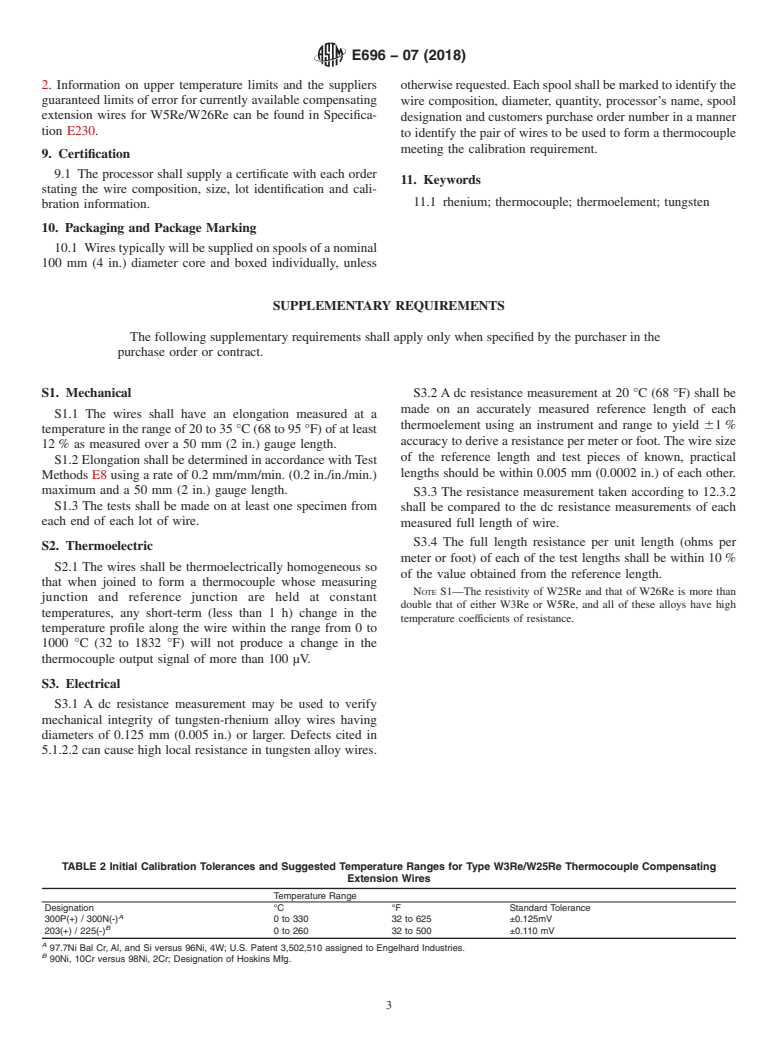
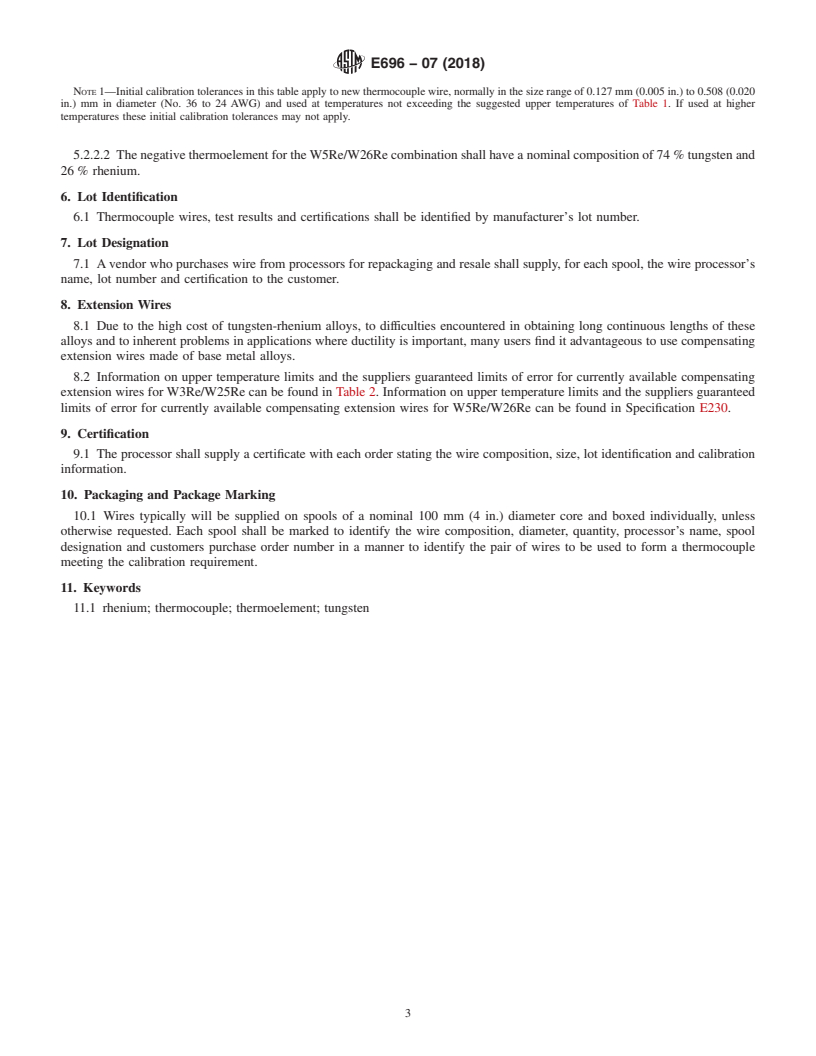
5.1.4.3 The initial calibration tolerance shall be in accordance with Table 1 (W3Re/W25Re). or Specification E230
(W5Re/W26Re), as appropriate.
5.2 Composition:
5.2.1 Positive thermoelement:
5.2.1.1 The positive thermoelement for the W3Re/W25Re combination shall have a nominal composition of 97 % tungsten and
3 % rhenium.
5.2.1.2 The positive thermoelement for the W5Re/W26Re combination shall have a nominal composition of 95 % tungsten and
5 % rhenium.
5.2.1.3 The positive thermoelement shall be doped to provide desirable grain structure and workability and maintain ductility
after high temperature use.
5.2.2 Negative thermoelement:
5.2.2.1 The negative thermoelement for the W3Re/W25Re combination shall have a nominal composition of 75 %
...
Questions, Comments and Discussion
Ask us and Technical Secretary will try to provide an answer. You can facilitate discussion about the standard in here.