


ASTM C217/C217M-20
(Test Method)Standard Test Method for Weather Resistance of Slate
Standard Test Method for Weather Resistance of Slate
SIGNIFICANCE AND USE
4.1 This test method is useful in indicating the differences in weather resistance between various slates. This test method provides one element in the comparison of slates.
SCOPE
1.1 This test method covers two procedures for weather resistance of slate in all outdoor installations by determining the depth of softening by a shear/scratch tester or by hand scraping after soaking in 1 % sulfuric acid.
Note 1: The test is based on the fact that slates containing pyrite, calcite, and carbon undergo a chemical weathering which results in the conversion of the calcite particles to gypsum. The swelling action that results causes disintegration of the slate. The extent of this action on various slates in the test has been found to correlate with the durability of the materials in actual weathering.
1.2 The values stated in either SI units or inch-pound units are to be regarded separately as standard. The values stated in each system are not necessarily exact equivalents; therefore, to ensure conformance with the standard, each system shall be used independently of the other, and values from the two systems shall not be combined.
1.3 This standard does not purport to address all of the safety concerns, if any, associated with its use. It is the responsibility of the user of this standard to establish appropriate safety, health, and environmental practices and determine the applicability of regulatory limitations prior to use.
1.4 This international standard was developed in accordance with internationally recognized principles on standardization established in the Decision on Principles for the Development of International Standards, Guides and Recommendations issued by the World Trade Organization Technical Barriers to Trade (TBT) Committee.
General Information
Buy Standard



Standards Content (Sample)
NOTICE: This standard has either been superseded and replaced by a new version or withdrawn.
Contact ASTM International (www.astm.org) for the latest information
Designation: C217/C217M − 20
Standard Test Method for
1
Weather Resistance of Slate
This standard is issued under the fixed designation C217/C217M; the number immediately following the designation indicates the year
of original adoption or, in the case of revision, the year of last revision. A number in parentheses indicates the year of last reapproval.
A superscript epsilon (´) indicates an editorial change since the last revision or reapproval.
1. Scope* 3. Terminology
1.1 This test method covers two procedures for weather 3.1 Definitions—All definitions are in accordance with Ter-
resistance of slate in all outdoor installations by determining minology C119.
the depth of softening by a shear/scratch tester or by hand
4. Significance and Use
scraping after soaking in 1 % sulfuric acid.
4.1 Thistestmethodisusefulinindicatingthedifferencesin
NOTE 1—The test is based on the fact that slates containing pyrite,
weather resistance between various slates. This test method
calcite, and carbon undergo a chemical weathering which results in the
provides one element in the comparison of slates.
conversion of the calcite particles to gypsum. The swelling action that
results causes disintegration of the slate. The extent of this action on
5. Apparatus
various slates in the test has been found to correlate with the durability of
the materials in actual weathering.
5.1 Either one of the following shall be used:
1.2 The values stated in either SI units or inch-pound units 5.1.1 Shear/Scratch Tester, (see Fig. 1) with the shearing
3
are to be regarded separately as standard. The values stated in tool, Model S-20 , or its equivalent. The apparatus includes a
each system are not necessarily exact equivalents; therefore, to removable scale beam that is mounted on a pivotal shaft
ensure conformance with the standard, each system shall be projecting from an adjustable gage block that can be raised or
used independently of the other, and values from the two lowered, corresponding with the thickness of a test specimen
systems shall not be combined. upto0.5in.[12.7mm].Thescalebeamissetatanangleof70°
referencing the shaft it pivots on. A calibrated weight and
1.3 This standard does not purport to address all of the
sliding weight are mounted on the scale beam to achieve the
safety concerns, if any, associated with its use. It is the
desired load. Operated by an on/off switch, the motorized
responsibility of the user of this standard to establish appro-
turntablerotatescounterclockwiseataconstantspeedof0.6 6
priate safety, health, and environmental practices and deter-
0.1 r/min.
mine the applicability of regulatory limitations prior to use.
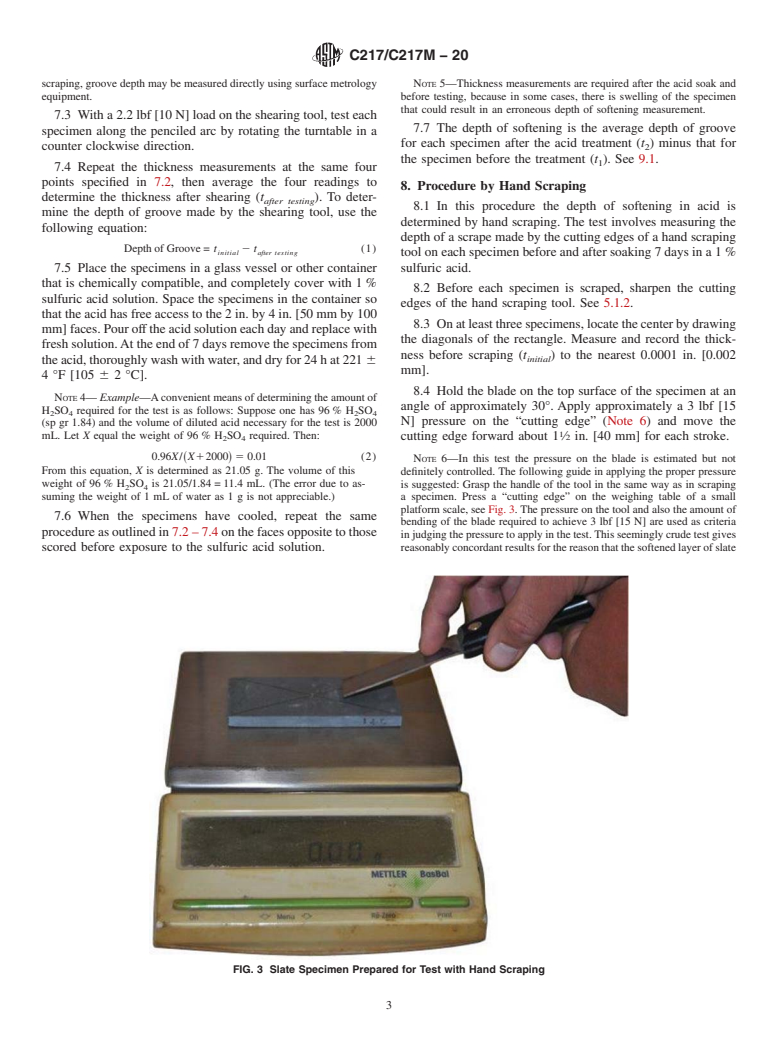
5.1.2 Hand Scraping Tool—The scraping tool shall be made
1.4 This international standard was developed in accor-
by grinding down the square edge blade of a metal putty knife
dance with internationally recognized principles on standard-
1 3
to a length of 3 6 ⁄8 in. [75 6 3 mm] and a width of ⁄4 in. [20
ization established in the Decision on Principles for the
mm]. Prior to every test, the end of the blade shall be ground
Development of International Standards, Guides and Recom-
to a plane surface perpendicular to the length of the tool to
mendations issued by the World Trade Organization Technical
form a sharp edge with either side of the blade. These sharp
Barriers to Trade (TBT) Committee.
edges are referred to as the “cutting edges.”
2. Referenced Documents
6. Test Specimens
2
2.1 ASTM Standards:
6.1 Prepare not less than three specimens, each a minimum
C119 Terminology Relating to Dimension Stone
of 2 in. by 4 in. [50 mm by 100 mm] measured along the
C1799 Guide to Dimension Stone Test Specimen Sampling
cleavage faces, for determining the depth of softening in a 1 %
and Preparation
solution of sulfuric acid.The 2 in. by 4 in. [50 mm by 100 mm]
faces shall be ground smooth and finished with No. 80
1 abrasive. Specimens cut from sheared or punched slate shall
This test method is under the jurisdiction of ASTM Committee C18 on
Dimension Stone and is the direct responsibility of Subcommittee C18.01 on Test
have no saw cut nearer than 1 in. [25 mm] from the edges or
Methods.
nail holes.
Current edition approved May 15, 2020. Published July 2020. Originally
approved in 1948. Last previous edition approved in 2015 as C217/C217M–15a.
3
DOI: 10.1520/C0217_C0217M-20. The sole source of supply known to the committee at this time is Taber
2
For referenced ASTM standards, visit the ASTM website, www.astm.org, or Industries, North Tonawanda, NY. If you are aware of alternative suppliers, please
contact ASTM Customer Service at service@astm.org. For Annual Book of ASTM provide this information toASTM International Headquarters. Your comments will
1
Standards volume information, refer to the standard’s Document Summary page on receive careful conside
...
This document is not an ASTM standard and is intended only to provide the user of an ASTM standard an indication of what changes have been made to the previous version. Because
it may not be technically possible to adequately depict all changes accurately, ASTM recommends that users consult prior editions as appropriate. In all cases only the current version
of the standard as published by ASTM is to be considered the official document.
Designation: C217/C217M − 15a C217/C217M − 20
Standard Test Method for
1
Weather Resistance of Slate
This standard is issued under the fixed designation C217/C217M; the number immediately following the designation indicates the year
of original adoption or, in the case of revision, the year of last revision. A number in parentheses indicates the year of last reapproval.
A superscript epsilon (´) indicates an editorial change since the last revision or reapproval.
1. Scope Scope*
1.1 This test method covers two procedures for weather resistance of slate in all outdoor installations by determining the depth
of softening by a shear/scratch tester or by hand scraping. scraping after soaking in 1 % sulfuric acid.
NOTE 1—The test is based on the fact that slates containing pyrite, calcite, and carbon undergo a chemical weathering which results in the conversion
of the calcite particles to gypsum. The swelling action that results causes disintegration of the slate. The extent of this action on various slates in the test
has been found to correlate with the durability of the materials in actual weathering.
1.2 Units—The values stated in either SI units or inch-pound units are to be regarded separately as standard. The values stated
in each system mayare not benecessarily exact equivalents; therefore, to ensure conformance with the standard, each system shall
be used independently of the other. Combiningother, and values from the two systems may result in non-conformance with the
standard.shall not be combined.
1.3 This standard does not purport to address all of the safety concerns, if any, associated with its use. It is the responsibility
of the user of this standard to establish appropriate safety safety, health, and healthenvironmental practices and determine the
applicability of regulatory limitations prior to use.
1.4 This international standard was developed in accordance with internationally recognized principles on standardization
established in the Decision on Principles for the Development of International Standards, Guides and Recommendations issued
by the World Trade Organization Technical Barriers to Trade (TBT) Committee.
2. Referenced Documents
2
2.1 ASTM Standards:
C119 Terminology Relating to Dimension Stone
C1799 Guide to Dimension Stone Test Specimen Sampling and Preparation
3. Terminology
3.1 Definitions—All definitions are in accordance with Terminology C119.
4. Significance and Use
4.1 This test method is useful in indicating the differences in weather resistance between various slates. This test method also
provides one element in the comparison of slates.
5. Apparatus
5.1 Either one of the following shall be used:
3
5.1.1 Shear/Scratch Tester, (see Fig. 1) with the shear hardness shearing tool, Model S-20 , or its equivalent. The apparatus
includes a removable scale beam that is mounted on a pivotal shaft projecting from an adjustable gage block that can be raised
or lowered, corresponding with the thickness of a test specimen up to 0.5 in. [12.7 mm]. The scale beam is set at an angle of 70°
referencing the shaft it pivots on. A calibrated weight and sliding weight are mounted on the scale beam to achieve the desired load.
Operated by an on/off switch, the motorized turntable rotates counter clockwise at a constant speed of 0.6 6 0.1 r/min.
1
This test method is under the jurisdiction of ASTM Committee C18 on Dimension Stone and is the direct responsibility of Subcommittee C18.01 on Test Methods.
Current edition approved Nov. 1, 2015May 15, 2020. Published November 2015July 2020. Originally approved in 1948. Last previous edition approved in 2015 as
C217/C217M–15.–15a. DOI: 10.1520/C0217_C0217M-15A.10.1520/C0217_C0217M-20.
2
For referenced ASTM standards, visit the ASTM website, www.astm.org, or contact ASTM Customer Service at service@astm.org. For Annual Book of ASTM Standards
volume information, refer to the standard’s Document Summary page on the ASTM website.
3
The sole source of supply known to the committee at this time is Taber Industries, North Tonawanda, NY. If you are aware of alternative suppliers, please provide this
1
information to ASTM International Headquarters. Your comments will receive careful consideration at a meeting of the responsible technical committee, which you may
attend.
*A Summary of Changes section appears at the end of this standard
Copyright © ASTM International, 100 Barr Harbor Drive, PO Box C700, West Conshohocken, PA 19428-2959. United States
1
---------------------- Page: 1 ----------------------
C217/C217M − 20
FIG. 1 S
...
Questions, Comments and Discussion
Ask us and Technical Secretary will try to provide an answer. You can facilitate discussion about the standard in here.