

ASTM D6333-23
(Practice)Standard Practice for Collection of Dislodgeable Pesticide Residues from Floors
General Information
- Abstract
SIGNIFICANCE AND USE
5.1 This practice may be used to estimate the potential for human exposure to pesticide residues that may be dislodged from residential floor surfaces by dermal contact. The sampling device employed is designed to approximately replicate the pressure applied by a 9 kg child crawling or walking on the floor.
5.2 Laboratory tests and field studies have shown that the transfer coefficient of the sampling device for collection of dried pesticide residues from nylon plush carpets is two to three times higher than that of a dry hand (palm only) pressed ten times at 7300 Pa over the same area of carpet (2, 4, 5).
5.3 This practice has been found suitable for use on plush and level loop carpets and vinyl flooring (2, 3).
5.4 This practice does not describe procedures for evaluation of the safety of floor surfaces or the potential for human exposure to dislodgeable pesticide residues. It is the user's responsibility to evaluate the data collected by this practice and make such determinations in consideration of other available information.
SCOPE
1.1 This practice covers a procedure for collection of dislodgeable pesticide residues from indoor floor surfaces.
1.2 This practice and the sampling methodology described are applicable to bare floors or covered floor surfaces, for example, carpeting and vinyl flooring.
1.3 This practice and the sampling methodology described are applicable to all pesticides listed in Practice D4861 whether applied directly to the floor surface or transported there by migration within the room or tracked in from outdoors.
1.4 Floor surfaces for which this practice has been successfully applied include nylon plush carpeting, polypropylene level-loop carpeting, and vinyl flooring.
1.5 Sample analysis will be dependent upon the nature of the pesticides targeted and is beyond the scope of this practice; however, the analytical procedures discussed in Practice D4861 are applicable to this practice.
1.6 The values stated in SI units are to be regarded as the standard. No other units of measurement are included in this standard.
1.7 This standard does not purport to address all of the safety concerns, if any, associated with its use. It is the responsibility of the user of this standard to establish appropriate safety, health, and environmental practices and determine the applicability of regulatory limitations prior to use.
1.8 This international standard was developed in accordance with internationally recognized principles on standardization established in the Decision on Principles for the Development of International Standards, Guides and Recommendations issued by the World Trade Organization Technical Barriers to Trade (TBT) Committee.
- Status
- Published
- Publication Date
- 31-Aug-2023
- Technical Committee
- D22 - Air Quality
- Drafting Committee
- D22.05 - Indoor Air
Buy Documents
ASTM D6333-23 - Standard Practice for Collection of Dislodgeable Pesticide Residues from Floors
REDLINE ASTM D6333-23 - Standard Practice for Collection of Dislodgeable Pesticide Residues from Floors
Overview
ASTM D6333-23: Standard Practice for Collection of Dislodgeable Pesticide Residues from Floors provides a comprehensive procedure for sampling and collecting pesticide residues that can be dislodged from indoor floor surfaces. Developed by ASTM International, this standard addresses the need for reliable data on potential human exposure-especially for children-by replicating the pressure that a crawling or walking child would exert on a floor. This practice is applicable to bare floors, carpets, and vinyl flooring, and is instrumental for assessing the presence and potential transfer of pesticide residues in residential and indoor environments.
Key Topics
- Sampling Methodology: Utilizes a polyurethane foam (PUF) roller to collect dislodgeable pesticide residues from specified floor surfaces, simulating normal contact pressures.
- Applicable Surfaces: Designed for use on nylon plush carpets, polypropylene level-loop carpets, vinyl flooring, and other common indoor floor types.
- Sampling Process: Involves systematic rolling of a prepared PUF ring sampler over a measured surface area, followed by laboratory analysis of collected residues.
- Target Pesticides: The procedure is suitable for collecting residues of all pesticides listed in ASTM Practice D4861, regardless of whether they are directly applied or introduced via migration or tracking.
- Quality Assurance: Recommends collecting multiple samples per room, includes field blanks, and stresses the need for proper sample collection, labeling, and storage.
- Limitations: This standard does not cover the evaluation of human exposure risk or the safety of the residues but serves as a means to collect relevant data for such assessments.
Applications
- Exposure Assessment: Assists in estimating the potential for human dermal exposure to pesticide residues, especially critical for vulnerable populations such as young children in residential environments.
- Environmental Health Studies: Provides a reproducible method for researchers and regulatory agencies conducting studies on indoor air quality, surface contamination, or the effectiveness of cleaning protocols in removing pesticide residues.
- Regulatory Compliance: Acts as a reference for professionals and organizations responsible for monitoring compliance with national or local environmental and health standards related to pesticide use indoors.
- Pesticide Efficacy and Safety Evaluation: Used to gather evidence for determining the need for further safety studies or improvements in pesticide application and indoor hygiene practices.
Related Standards
- ASTM D4861: Practice for Sampling and Selection of Analytical Techniques for Pesticides and Polychlorinated Biphenyls in Air. Integral for sample analysis guidance referenced by D6333.
- ASTM D1193: Specification for Reagent Water. Ensures the quality of water used in sample preparation and analysis.
- ASTM D1356: Terminology Relating to Sampling and Analysis of Atmospheres. Provides definitions for terms used in D6333.
- ASTM E1 & E337: Specifications for thermometers and methods for measuring humidity, both relevant to monitoring environmental conditions during sampling.
Practical Value
By following ASTM D6333-23, laboratories, environmental consultants, public health professionals, and regulatory authorities can achieve consistent, reliable data collection on dislodgeable pesticide residues from indoor floors. This improves the scientific basis for exposure risk assessments and supports informed decision-making for safeguarding indoor environments, particularly those used by young children and sensitive populations. The standard’s methodology is specifically tailored to replicate typical indoor contact scenarios, making it especially valuable for real-world exposure studies and ongoing monitoring efforts.
Key SEO Keywords: ASTM D6333-23, dislodgeable pesticide residue, PUF roller sampling, indoor floor pesticide testing, pesticide exposure assessment, residential carpet pesticide sampling.
Relations
- Replaces
ASTM D6333-17 - Standard Practice for Collection of Dislodgeable Pesticide Residues from Floors - Effective Date
- 01-Sep-2023
- Effective Date
- 01-Sep-2023
Buy Documents
ASTM D6333-23 - Standard Practice for Collection of Dislodgeable Pesticide Residues from Floors
REDLINE ASTM D6333-23 - Standard Practice for Collection of Dislodgeable Pesticide Residues from Floors
Frequently Asked Questions
ASTM D6333-23 is a standard published by ASTM International. Its full title is "Standard Practice for Collection of Dislodgeable Pesticide Residues from Floors". This standard covers: SIGNIFICANCE AND USE 5.1 This practice may be used to estimate the potential for human exposure to pesticide residues that may be dislodged from residential floor surfaces by dermal contact. The sampling device employed is designed to approximately replicate the pressure applied by a 9 kg child crawling or walking on the floor. 5.2 Laboratory tests and field studies have shown that the transfer coefficient of the sampling device for collection of dried pesticide residues from nylon plush carpets is two to three times higher than that of a dry hand (palm only) pressed ten times at 7300 Pa over the same area of carpet (2, 4, 5). 5.3 This practice has been found suitable for use on plush and level loop carpets and vinyl flooring (2, 3). 5.4 This practice does not describe procedures for evaluation of the safety of floor surfaces or the potential for human exposure to dislodgeable pesticide residues. It is the user's responsibility to evaluate the data collected by this practice and make such determinations in consideration of other available information. SCOPE 1.1 This practice covers a procedure for collection of dislodgeable pesticide residues from indoor floor surfaces. 1.2 This practice and the sampling methodology described are applicable to bare floors or covered floor surfaces, for example, carpeting and vinyl flooring. 1.3 This practice and the sampling methodology described are applicable to all pesticides listed in Practice D4861 whether applied directly to the floor surface or transported there by migration within the room or tracked in from outdoors. 1.4 Floor surfaces for which this practice has been successfully applied include nylon plush carpeting, polypropylene level-loop carpeting, and vinyl flooring. 1.5 Sample analysis will be dependent upon the nature of the pesticides targeted and is beyond the scope of this practice; however, the analytical procedures discussed in Practice D4861 are applicable to this practice. 1.6 The values stated in SI units are to be regarded as the standard. No other units of measurement are included in this standard. 1.7 This standard does not purport to address all of the safety concerns, if any, associated with its use. It is the responsibility of the user of this standard to establish appropriate safety, health, and environmental practices and determine the applicability of regulatory limitations prior to use. 1.8 This international standard was developed in accordance with internationally recognized principles on standardization established in the Decision on Principles for the Development of International Standards, Guides and Recommendations issued by the World Trade Organization Technical Barriers to Trade (TBT) Committee.
SIGNIFICANCE AND USE 5.1 This practice may be used to estimate the potential for human exposure to pesticide residues that may be dislodged from residential floor surfaces by dermal contact. The sampling device employed is designed to approximately replicate the pressure applied by a 9 kg child crawling or walking on the floor. 5.2 Laboratory tests and field studies have shown that the transfer coefficient of the sampling device for collection of dried pesticide residues from nylon plush carpets is two to three times higher than that of a dry hand (palm only) pressed ten times at 7300 Pa over the same area of carpet (2, 4, 5). 5.3 This practice has been found suitable for use on plush and level loop carpets and vinyl flooring (2, 3). 5.4 This practice does not describe procedures for evaluation of the safety of floor surfaces or the potential for human exposure to dislodgeable pesticide residues. It is the user's responsibility to evaluate the data collected by this practice and make such determinations in consideration of other available information. SCOPE 1.1 This practice covers a procedure for collection of dislodgeable pesticide residues from indoor floor surfaces. 1.2 This practice and the sampling methodology described are applicable to bare floors or covered floor surfaces, for example, carpeting and vinyl flooring. 1.3 This practice and the sampling methodology described are applicable to all pesticides listed in Practice D4861 whether applied directly to the floor surface or transported there by migration within the room or tracked in from outdoors. 1.4 Floor surfaces for which this practice has been successfully applied include nylon plush carpeting, polypropylene level-loop carpeting, and vinyl flooring. 1.5 Sample analysis will be dependent upon the nature of the pesticides targeted and is beyond the scope of this practice; however, the analytical procedures discussed in Practice D4861 are applicable to this practice. 1.6 The values stated in SI units are to be regarded as the standard. No other units of measurement are included in this standard. 1.7 This standard does not purport to address all of the safety concerns, if any, associated with its use. It is the responsibility of the user of this standard to establish appropriate safety, health, and environmental practices and determine the applicability of regulatory limitations prior to use. 1.8 This international standard was developed in accordance with internationally recognized principles on standardization established in the Decision on Principles for the Development of International Standards, Guides and Recommendations issued by the World Trade Organization Technical Barriers to Trade (TBT) Committee.
ASTM D6333-23 is classified under the following ICS (International Classification for Standards) categories: 97.150 - Floor coverings. The ICS classification helps identify the subject area and facilitates finding related standards.
ASTM D6333-23 has the following relationships with other standards: It is inter standard links to ASTM D6333-17, ASTM D7297-21. Understanding these relationships helps ensure you are using the most current and applicable version of the standard.
ASTM D6333-23 is available in PDF format for immediate download after purchase. The document can be added to your cart and obtained through the secure checkout process. Digital delivery ensures instant access to the complete standard document.
Standards Content (Sample)
This international standard was developed in accordance with internationally recognized principles on standardization established in the Decision on Principles for the
Development of International Standards, Guides and Recommendations issued by the World Trade Organization Technical Barriers to Trade (TBT) Committee.
Designation: D6333 − 23
Standard Practice for
Collection of Dislodgeable Pesticide Residues from Floors
This standard is issued under the fixed designation D6333; the number immediately following the designation indicates the year of
original adoption or, in the case of revision, the year of last revision. A number in parentheses indicates the year of last reapproval. A
superscript epsilon (´) indicates an editorial change since the last revision or reapproval.
1. Scope 2. Referenced Documents
1.1 This practice covers a procedure for collection of
2.1 ASTM Standards:
dislodgeable pesticide residues from indoor floor surfaces.
D1193 Specification for Reagent Water
D1356 Terminology Relating to Sampling and Analysis of
1.2 This practice and the sampling methodology described
Atmospheres
are applicable to bare floors or covered floor surfaces, for
D4861 Practice for Sampling and Selection of Analytical
example, carpeting and vinyl flooring.
Techniques for Pesticides and Polychlorinated Biphenyls
1.3 This practice and the sampling methodology described
in Air
are applicable to all pesticides listed in Practice D4861 whether
E1 Specification for ASTM Liquid-in-Glass Thermometers
applied directly to the floor surface or transported there by
E337 Test Method for Measuring Humidity with a Psy-
migration within the room or tracked in from outdoors.
chrometer (the Measurement of Wet- and Dry-Bulb Tem-
1.4 Floor surfaces for which this practice has been success-
peratures)
fully applied include nylon plush carpeting, polypropylene
level-loop carpeting, and vinyl flooring.
3. Terminology
1.5 Sample analysis will be dependent upon the nature of
3.1 Definitions—For definitions of terms used in this
the pesticides targeted and is beyond the scope of this practice;
practice, refer to Terminology D1356.
however, the analytical procedures discussed in Practice
3.1.1 dislodgeable residue, n—that part of the residue of a
D4861 are applicable to this practice.
chemical deposited on a solid surface that may be transferred
by direct contact to human skin or clothing (sometimes called
1.6 The values stated in SI units are to be regarded as the
transferable residue).
standard. No other units of measurement are included in this
standard.
3.1.2 sampling traverse, n—the distance from the starting
1.7 This standard does not purport to address all of the point to the end point over which the sampling media contacts
safety concerns, if any, associated with its use. It is the the floor surface for collection of a single sample.
responsibility of the user of this standard to establish appro-
3.1.3 transfer coeffıcient, n—the ratio of the amount of
priate safety, health, and environmental practices and deter-
pesticide residue collected by the sampling media to the area of
mine the applicability of regulatory limitations prior to use.
the surface contacted by the media during a single sampling
1.8 This international standard was developed in accor-
traverse.
dance with internationally recognized principles on standard-
3.1.4 transfer effıciency, n—the ratio of the transfer coeffi-
ization established in the Decision on Principles for the
cient to the pesticide surface loading determined by analysis of
Development of International Standards, Guides and Recom-
deposition coupons placed strategically on the test surface
mendations issued by the World Trade Organization Technical
before the pesticide application.
Barriers to Trade (TBT) Committee.
This practice is under the jurisdiction of ASTM Committee D22 on Air Quality
and is the direct responsibility of Subcommittee D22.05 on Indoor Air. For referenced ASTM standards, visit the ASTM website, www.astm.org, or
Current edition approved Sept. 1, 2023. Published September 2023. Originally contact ASTM Customer Service at service@astm.org. For Annual Book of ASTM
approved in 1998. Last previous edition approved in 2017 as D6333 – 17. DOI: Standards volume information, refer to the standard’s Document Summary page on
10.1520/D6333-23. the ASTM website.
Copyright © ASTM International, 100 Barr Harbor Drive, PO Box C700, West Conshohocken, PA 19428-2959. United States
D6333 − 23
4. Summary of Practice exposure to dislodgeable pesticide residues. It is the user’s
responsibility to evaluate the data collected by this practice and
4.1 The sampling method described in this practice is taken
3 make such determinations in consideration of other available
from published work (1-4).
information.
4.2 Dislodgeable pesticide residues from floor surfaces are
collected by transfer to an annular ring of polyurethane foam
6. Interferences
(PUF), which is rolled across the floor at a constant speed and
6.1 There are no known interferences to the collection of
applied pressure.
dislodgeable pesticide residues from floors using this practice.
4.3 The PUF sampling ring is slipped over a cylindrical
The presence of excessive moisture levels in carpeting, as may
metal axle that functions as the front wheel of the PUF roller
be the case shortly after a wet cleaning operation, may affect
apparatus. The apparatus is typically constructed of aluminum
the dislodgeability of residues, possibly yielding higher than
and consists of a frame with two permanent rear wheels and the
normal results.
detachable axle cylinder on the front.
6.2 Analytical interferences may be caused by contaminants
4.4 Weights are attached to the roller frame to apply the
in the sampling medium, solvents, and reagents and on
desired downward force on the PUF roller ring (sampling
glassware and other sampling or sample processing hardware
pressure). A total weight of 3.88 kg provides a sampling
that result in discrete artifacts and elevated baselines, or both,
pressure of 8300 Pa, corresponding approximately to that of a
in the detector profiles. For potential analytical interferences,
9 kg child crawling or walking.
refer to Practice D4861.
4.5 A handle is connected at the rear of the roller frame to
push or pull the device across the floor surface. 7. Apparatus
4.6 A template or similar measuring device is used to
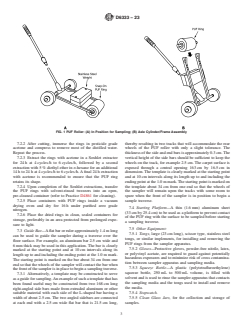
7.1 PUF Roller Sampler, (as shown in Fig. 1) may be
identify the area to be sampled. The axle cylinder is fitted with constructed by a machinist using primarily aluminum materi-
a clean PUF ring, and the roller is then pushed at a constant rate
als. The typical apparatus consists of a frame (12.4 cm by
of approximately 10 cm/s over a distance of 1.0 m and then 25.4 cm) that is attached to a rear axle that holds a swivel joint
immediately pulled in the reverse direction back over the same
in the center for attaching the handle and has two aluminum
sampling area at the same rate of speed, ending at the original wheels (2.5 cm wide by 10.2 cm diameter). The distance
starting position.
between the outside of the two wheels is 21.6 cm and between
the inside of the wheels is 16.5 cm. An aluminum cylinder
4.7 The PUF ring is removed from the detached axle
(7.6 cm long by 4.3 cm diameter) is attached to the front of the
cylinder and placed in a sealed container for transport to the
sampler frame by 6 mm diameter hex head axle bolts on the
laboratory for analysis.
cylinder that fit into slots on the frame. This cylinder serves as
4.8 The PUF ring is extracted and analyzed using specific
the front axle and holds the PUF sampling medium (see 7.2).
analytical procedures for the pesticides of interest. Typical
The front axle cylinder is secured in the slots by spring steel
methods involve Soxhlet extraction with analysis of extracts by
retaining clips that permit easy attachment and removal of the
gas chromatography/mass spectrometry (GC/MS), gas
cylinder. The handle for the sampler is two pieces that screw
chromatography/electron capture detection (GC/ECD), or
together (102 cm long by 1.3 cm diameter, overall) and then
other techniques noted in Practice D4861.
screw into the swivel joint on the rear axle. Two stainless steel
blocks, each measuring 12.7 cm by 7.3 cm by 2.5 cm and
5. Significance and Use
having a combined weight of 3.88 kg, are attached to the center
5.1 This practice may be used to estimate the potential for
of the frame through holes that fit over 3 mm diameter threaded
human exposure to pesticide residues that may be dislodged
posts on either side of the frame. The weights are secured to the
from residential floor surfaces by dermal contact. The sampling
frame with hand-tightened knurled nuts.
device employed is designed to approximately replicate the
NOTE 1—Although the use of stainless steel to construct the weights is
pressure applied by a 9 kg child crawling or walking on the
not required (other materials of similar density will suffice), the ease of
floor.
cleaning and resistance to corrosion make this metal very useful.
5.2 Laboratory tests and field studies have shown that the
7.2 PUF Sampling Medium—The sampling medium con-
transfer coefficient of the sampling device for collection of
sists of an annular plug cut from a sheet of medium density
dried pesticide residues from nylon plush carpets is two to
(0.029 g ⁄cm ) open-cell, polyether-type polyurethane foam,
three times higher than that of a dry hand (palm only) pressed
7.6 cm thick.
ten times at 7300 Pa over the same area of carpet (2, 4, 5).
NOTE 2—This foam is the type used commercially in upholstery and is
5.3 This practice has been found suitable for use on plush
widely used for air sampling. It is the same type as that described in
and level loop carpets and vinyl flooring (2, 3).
Practice D4861, but has a higher density.
5.4 This practice does not describe procedures for evalua- 7.2.1 Cut the foam sheet stock with a high-speed cutting die
tion of the safety of floor surfaces or the potential for human
lubricated with distilled water to produce an annular ring
8.9 cm O.D. by 4.2 cm I.D. Alternatively, the PUF sheet stock
may be immersed in distilled water and compressed to achieve
The boldface numbers in parentheses refer to the list of references at the end of
this standard. saturation prior to cutting.
D6333 − 23
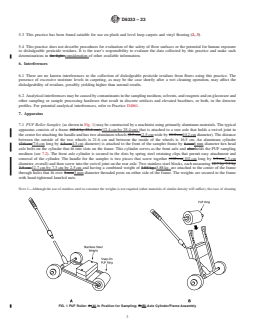
FIG. 1 PUF Roller: (A) In Position for Sampling; (B) Axle Cylinder/Frame Assembly
7.2.2 After cutting, immerse the rings in pesticide grade thereby resulting in two tracks that will accommodate the rear
acetone and compress to remove most of the distilled water. wheels of the PUF roller with only a slight tolerance. The
Repeat the process. thickness of the side and end bars is approximately 0.3 cm. The
7.2.3 Extract the rings with acetone in a Soxhlet extractor vertical height of the side bars should be sufficient to keep the
for 24 h at 4 cycles ⁄h to 6 cycles ⁄h, followed by a second wheels on the track, for example 2.5 cm. The carpet surface is
extraction with 5 % diethyl ether in n-hexane for an additional exposed through a central opening 163 cm by 16.5 cm in
14 h to 24 h at 4 cycles ⁄h to 6 cycles ⁄h. A final 24 h extraction dimension. The template is clearly marked at the starting point
with acetone is recommended to ensure that the PUF ring and at 10 cm intervals along its length up to and including the
retains its shape. ending point at the 1.0 m mark. The starting point is marked on
7.2.4 Upon completion of the Soxhlet extractions, transfer the template about 34 cm from one end so that the wheels of
the PUF rings with solvent-rinsed tweezers into an open, the sampler will remain upon the tracks with some room to
pre-cleaned container (refer to Practice D4861 for cleaning). spare when the front of the sampler is in position to begin a
7.2.5 Place containers with PUF rings inside a vacuum sample traverse.
drying oven and dry for 16 h under purified zero grade
7.4 Starting Platform—A thin (1.6 mm) aluminum sheet
nitrogen.
(33 cm by 25.4 cm) to be used as a platform to prevent contact
7.2.6 Place the dried rings in clean, sealed containers for
of the PUF ring with the surface to be sampled before starting
storage, preferably in an area protected from prolonged expo-
a sampling traverse.
sure to light.
7.5 Other Equipment:
7.3 Guide Bar—A flat bar or ruler approximately 1.4 m long
7.5.1 Tongs, large (23 cm long), scissor type, stainless steel
can be used to guide the sampler during a traverse over the
tongs, or similar implements, for installing and removing the
floor surface. For example, an aluminum bar 2.5 cm wide and
PUF rings from the sampler apparatus.
6 mm thick may be used in this application. The bar is clearly
7.5.2 Gloves—Protective gloves, powder-free nitrile, latex,
marked at the starting point and at 10 cm intervals along its
or polyvinyl acetate, are required to guard against potentially
length up to and including the ending point at the 1.0 m mark.
hazardous exposures and to minimize risk of cross contamina-
The starting point is marked on the bar about 34 cm from one
tion between sampler apparatus and sampling media.
end so that the wheels of the sampler will contact the bar when
7.5.3 Squeeze Bottle—A plastic (polytetrafluroethylene)
the front of the sampler is in place to begin a sampling traverse.
squeeze bottle, 250 mL to 500 mL volume, is filled with
7.3.1 Alternatively, a template may be constructed to serve
solvent and is used to rinse the sampler apparatus that contacts
as a guide for sampling. An example of such a template that has
the sampling media and the tongs used to install and remove
been found useful may be constructed from two 168 cm long
the media.
right-angled side bars made from extruded aluminum or other
7.5.4 Stopwatch.
suitable material with each side of the L-shaped bar having a
width of about 2.5 cm. The two angled sidebars are connected 7.5.5 Clean Glass Jars, for the collection and storage of
at each end with a 2.5 cm wide flat bar that is 21.5 cm long, samples.
D6333 − 23
7.5.6 Thermometer (see Specification E1). weight rests against the sa
...
This document is not an ASTM standard and is intended only to provide the user of an ASTM standard an indication of what changes have been made to the previous version. Because
it may not be technically possible to adequately depict all changes accurately, ASTM recommends that users consult prior editions as appropriate. In all cases only the current version
of the standard as published by ASTM is to be considered the official document.
Designation: D6333 − 17 D6333 − 23
Standard Practice for
Collection of Dislodgeable Pesticide Residues from Floors
This standard is issued under the fixed designation D6333; the number immediately following the designation indicates the year of
original adoption or, in the case of revision, the year of last revision. A number in parentheses indicates the year of last reapproval. A
superscript epsilon (´) indicates an editorial change since the last revision or reapproval.
1. Scope
1.1 This practice covers a procedure for collection of dislodgeable pesticide residues from indoor floor surfaces.
1.2 This practice and the sampling methodology described are applicable to bare floors or covered floor surfaces, for example,
carpeting and vinyl flooring.
1.3 This practice and the sampling methodology described are applicable to all pesticides listed in Practice D4861 whether applied
directly to the floor surface or transported there by migration within the room or tracked in from outdoors.
1.4 Floor surfaces for which this practice has been successfully applied include nylon plush carpeting, polypropylene level-loop
carpeting, and vinyl flooring.
1.5 Sample analysis will be dependent upon the nature of the pesticides targeted and is beyond the scope of this practice; however,
the analytical procedures discussed in Practice D4861 are applicable to this practice.
1.6 The values stated in SI units are to be regarded as the standard. No other units of measurement are included in this standard.
1.7 This standard does not purport to address all of the safety concerns, if any, associated with its use. It is the responsibility
of the user of this standard to establish appropriate safety and healthsafety, health, and environmental practices and determine
the applicability of regulatory limitations prior to its use.
1.8 This international standard was developed in accordance with internationally recognized principles on standardization
established in the Decision on Principles for the Development of International Standards, Guides and Recommendations issued
by the World Trade Organization Technical Barriers to Trade (TBT) Committee.
2. Referenced Documents
2.1 ASTM Standards:
D1193 Specification for Reagent Water
D1356 Terminology Relating to Sampling and Analysis of Atmospheres
D4861 Practice for Sampling and Selection of Analytical Techniques for Pesticides and Polychlorinated Biphenyls in Air
E1 Specification for ASTM Liquid-in-Glass Thermometers
E337 Test Method for Measuring Humidity with a Psychrometer (the Measurement of Wet- and Dry-Bulb Temperatures)
This practice is under the jurisdiction of ASTM Committee D22 on Air Quality and is the direct responsibility of Subcommittee D22.05 on Indoor Air.
Current edition approved March 1, 2017Sept. 1, 2023. Published March 2017September 2023. Originally approved in 1998. Last previous edition approved in 20102017
as D6333 – 10.D6333 – 17. DOI: 10.1520/D6333-17.10.1520/D6333-23.
For referenced ASTM standards, visit the ASTM website, www.astm.org, or contact ASTM Customer Service at service@astm.org. For Annual Book of ASTM Standards
volume information, refer to the standard’s Document Summary page on the ASTM website.
Copyright © ASTM International, 100 Barr Harbor Drive, PO Box C700, West Conshohocken, PA 19428-2959. United States
D6333 − 23
3. Terminology
3.1 Definitions—For definitions of terms used in this practice, refer to Terminology D1356.
3.1.1 dislodgeable residue—residue, n—that part of the residue of a chemical deposited on a solid surface that may be transferred
by direct contact to human skin or clothing (sometimes called transferable residue).
3.1.2 sampling traverse—traverse, n—the distance from the starting point to the end point over which the sampling media contacts
the floor surface for collection of a single sample.
3.1.3 transfer coeffıcient—coeffıcient, n—the ratio of the amount of pesticide residue collected by the sampling media to the area
of the surface contacted by the media during a single sampling traverse.
3.1.4 transfer effıciency—effıciency, n—the ratio of the transfer coefficient to the pesticide surface loading determined by analysis
of deposition coupons placed strategically on the test surface before the pesticide application.
4. Summary of Practice
4.1 The sampling method described in this practice is taken from published work (1-4).
4.2 Dislodgeable pesticide residues from floor surfaces are collected by transfer to an annular ring of polyurethane foam (PUF),
which is rolled across the floor at a constant speed and applied pressure.
4.3 The PUF sampling ring is slipped over a cylindrical metal axle that functions as the front wheel of the PUF roller apparatus.
The apparatus is typically constructed of aluminum and consists of a frame with two permanent rear wheels and the detachable
axle cylinder on the front.
4.4 Weights are attached to the roller frame to apply the desired downward force on the PUF roller ring (sampling pressure). A
total weight of 3.88 kg 3.88 kg provides a sampling pressure of 8300 Pa, 8300 Pa, corresponding approximately to that of a 9 kg
9 kg child crawling or walking.
4.5 A handle is connected at the rear of the roller frame to push or pull the device across the floor surface.
4.6 A template or similar measuring device is used to identify the area to be sampled. The axle cylinder is fitted with a clean PUF
ring, and the roller is then pushed at a constant rate of approximately 10 cm/s over a distance of 1.0 m and then immediately pulled
in the reverse direction back over the same sampling area at the same rate of speed, ending at the original starting position.
4.7 The PUF ring is removed from the detached axle cylinder and placed in a sealed container for transport to the laboratory for
analysis.
4.8 The PUF ring is extracted and analyzed using specific analytical procedures for the pesticides of interest. Typical methods
involve Soxhlet extraction with analysis of extracts by gas chromatography/mass spectrometry (GC/MS), gas chromatography/
electron capture detection (GC/ECD), or other techniques noted in Practice D4861.
5. Significance and Use
5.1 This practice may be used to estimate the potential for human exposure to pesticide residues that may be dislodged from
residential floor surfaces by dermal contact. The sampling device employed is designed to approximately replicate the pressure
applied by a 9 kg child crawling or walking on the floor.
5.2 Laboratory tests and field studies have shown that the transfer coefficient of the sampling device for collection of dried
pesticide residues from nylon plush carpets is two to three times higher than that of a dry hand (palm only) pressed ten times at
7300 Pa over the same area of carpet (2, 4, 5).
The boldface numbers in parentheses refer to the list of references at the end of this standard.
D6333 − 23
5.3 This practice has been found suitable for use on plush and level loop carpets and vinyl flooring (2, 3).
5.4 This practice does not describe procedures for evaluation of the safety of floor surfaces or the potential for human exposure
to dislodgeable pesticide residues. It is the user’s responsibility to evaluate the data collected by this practice and make such
determinations in the light consideration of other available information.
6. Interferences
6.1 There are no known interferences to the collection of dislodgeable pesticide residues from floors using this practice. The
presence of excessive moisture levels in carpeting, as may be the case shortly after a wet cleaning operation, may affect the
dislodgeability of residues, possibly yielding higher than normal results.
6.2 Analytical interferences may be caused by contaminants in the sampling medium, solvents, and reagents and on glassware and
other sampling or sample processing hardware that result in discrete artifacts and elevated baselines, or both, in the detector
profiles. For potential analytical interferences, refer to Practice D4861.
7. Apparatus
7.1 PUF Roller Sampler, (as shown in Fig. 1) may be constructed by a machinist using primarily aluminum materials. The typical
apparatus consists of a frame (12.4 by 25.4 cm) (12.4 cm by 25.4 cm) that is attached to a rear axle that holds a swivel joint in
the center for attaching the handle and has two aluminum wheels (2.5-cm(2.5 cm wide by 10.2-cm10.2 cm diameter). The distance
between the outside of the two wheels is 21.6 cm and between the inside of the wheels is 16.5 cm. An aluminum cylinder
(7.6-cm(7.6 cm long by 4.3-cm4.3 cm diameter) is attached to the front of the sampler frame by 6-mm6 mm diameter hex head
axle bolts on the cylinder that fit into slots on the frame. This cylinder serves as the front axle and also holds the PUF sampling
medium (see 7.2). The front axle cylinder is secured in the slots by spring steel retaining clips that permit easy attachment and
removal of the cylinder. The handle for the sampler is two pieces that screw together (102-cm(102 cm long by 1.3-cm1.3 cm
diameter, overall) and then screw into the swivel joint on the rear axle. Two stainless steel blocks, each measuring 12.7 by 7.3 by
2.5 cm 12.7 cm by 7.3 cm by 2.5 cm and having a combined weight of 3.88 kg, 3.88 kg, are attached to the center of the frame
through holes that fit over 3-mm3 mm diameter threaded posts on either side of the frame. The weights are secured to the frame
with hand-tightened knurled nuts.
NOTE 1—Although the use of stainless steel to construct the weights is not required (other materials of similar density will suffice), the ease of cleaning
FIG. 1 PUF Roller: A.(A) In Position for Sampling; B.(B) Axle Cylinder/Frame Assembly
D6333 − 23
and resistance to corrosion make this metal very useful.
7.2 PUF Sampling Medium—The sampling medium consists of an annular plug cut from a sheet of medium density (0.029
(0.029 g g/cm⁄cm ) open-cell, polyether-type polyurethane foam, 7.6-cm7.6 cm thick.
NOTE 2—This foam is the type used commercially in upholstery and is widely used for air sampling. It is the same type as that described in Practice
D4861, but has a higher density.
7.2.1 Cut the foam sheet stock with a high-speed cutting die lubricated with distilled water to produce an annular ring
8.9-cm8.9 cm O.D. by 4.2-cm4.2 cm I.D. Alternatively, the PUF sheet stock may be immersed in distilled water and compressed
to achieve saturation prior to cutting.
7.2.2 After cutting, immerse the rings in pesticide grade acetone and compress to remove most of the distilled water. Repeat the
process.
7.2.3 Extract the rings with acetone in a Soxhlet extractor for 24 h at 424 h at 4 cycles ⁄h to 66 cycles cycles/h, ⁄h, followed by
a second extraction with 5 % diethyl ether in n-hexane for an additional 14 to 24 h at 414 h to 24 h at 4 cycles ⁄h to 66 cycles
cycles/h. ⁄h. A final 24-h24 h extraction with acetone is recommended to ensure that the PUF ring retains its shape.
7.2.4 Upon completion of the Soxhlet extractions, transfer the PUF rings with solvent-rinsed tweezers into an open, pre-cleaned
container (refer to Practice D4861 for cleaning).
7.2.5 Place containers with PUF rings inside a vacuum drying oven and dry for 16 h 16 h under purified zero grade nitrogen.
7.2.6 Place the dried rings in clean, sealed containers for storage, preferably in an area protected from prolonged exposure to light.
7.3 Guide Bar—A flat bar or ruler approximately 1.4-m1.4 m long can be used to guide the sampler during a traverse over the floor
surface. For example, an aluminum bar 2.5-cm2.5 cm wide and 6-mm6 mm thick may be used in this application. The bar is clearly
marked at the starting point and at 10-cm10 cm intervals along its length up to and including the ending point at the 1.0-m1.0 m
mark. The starting point is marked on the bar about 34 cm 34 cm from one end so that the wheels of the sampler will contact the
bar when the front of the sampler is in place to begin a sampling traverse.
7.3.1 Alternatively, a template may be constructed to serve as a guide for sampling. An example of such a template that has been
found useful may be constructed from two 168-cm168 cm long right-angled side bars made from extruded aluminum or other
suitable material with each side of the L-shaped bar having a width of about 2.5 cm. 2.5 cm. The two angled sidebars are connected
at each end with a 2.5-cm2.5 cm wide flat bar that is 21.5-cm21.5 cm long, thereby resulting in two tracks that will accommodate
the rear wheels of the PUF roller with only a slight tolerance. The thickness of the side and end bars is approximately 0.3 cm.
0.3 cm. The vertical height of the side bars should be sufficient to keep the wheels on the track, for example 2.5 cm. The carpet
surface is exposed through a central opening 163 by 16.5 cm 163 cm by 16.5 cm in dimension. The template is clearly marked
at the starting point and at 10-cm10 cm intervals along its length up to and including the ending point at the 1.0-m1.0 m mark. The
starting point is marked on the template about 34 cm from one end so that the wheels of the sampler will remain upon the tracks
with some room to spare when the front of the sampler is in position to begin a sample traverse.
7.4 Starting Platform—A thin (1.6-mm)(1.6 mm) aluminum sheet (33 by 25.4 cm) (33 cm by 25.4 cm) to be used as a platform
to prevent contact of the PUF ring with the surface to be sampled before starting a sampling traverse.
7.5 Other Equipment:
7.5.1 Tongs, large (23-cm(23 cm long), scissor type, stainless steel tongs, or similar implements, for installing and removing the
PUF rings from the sampler apparatus.
7.5.2 Gloves—Protective gloves, powder-free nitrile, latex, or polyvinyl acetate, are required to guard against potentially
hazardous exposures and to minimize risk of cross contamination between sampler apparatus and sampling media.
7.5.3 Squeeze Bottle—A plastic (polytetrafluroethylene) squeeze bottle, 250–500-mL 250 mL to 500 mL volume, is filled with
solvent and is used to rinse the sampler apparatus that contacts the sampling media and the tongs used to install and remove the
media.
---------------------
...