

ASTM D6962-24
(Practice)Standard Practice for Operation of a Roller Chair Tester for Pile Yarn Floor Coverings
General Information
- Abstract
SIGNIFICANCE AND USE
5.1 This practice is applicable for use in testing the durability of pile yarn floor covering of all types.
5.2 This practice is designed to simulate the stress on a pile yarn floor covering from the action of weighted roller chair castors over an extended period of time.
5.3 The specimen is tested under conditions that may simulate an actual flooring installation. This may include the pile yarn floor covering plus a specified underlayment cushion.
5.4 This practice is used to prepare specimens for additional testing, including but not limited to: visual assessment of delamination of the secondary backing, visual assessment of the pile surface, resistance to delamination measurement, tuft bind, and pile yarn raveling.
SCOPE
1.1 This practice covers a procedure for the operation of a weighted roller chair testing device that rotates and moves across a test specimen of pile yarn floor coverings.
1.2 This practice is applicable for testing unused pile yarn floor covering of all types.
1.3 The values stated in inch-pound units are to be regarded as standard. The values given in parentheses are mathematical conversions to SI units that are provided for information only and are not considered standard.
1.4 This standard does not purport to address all of the safety concerns, if any, associated with its use. It is the responsibility of the user of this standard to establish appropriate safety, health, and environmental practices and determine the applicability of regulatory limitations prior to use.
1.5 This international standard was developed in accordance with internationally recognized principles on standardization established in the Decision on Principles for the Development of International Standards, Guides and Recommendations issued by the World Trade Organization Technical Barriers to Trade (TBT) Committee.
- Status
- Published
- Publication Date
- 31-Dec-2023
- Technical Committee
- D13 - Textiles
- Drafting Committee
- D13.21 - Pile Floor Coverings
Buy Documents

ASTM D6962-24 - Standard Practice for Operation of a Roller Chair Tester for Pile Yarn Floor Coverings
REDLINE ASTM D6962-24 - Standard Practice for Operation of a Roller Chair Tester for Pile Yarn Floor Coverings
Overview
ASTM D6962-24 – Standard Practice for Operation of a Roller Chair Tester for Pile Yarn Floor Coverings provides a comprehensive methodology for operating a weighted roller chair tester to assess the durability of pile yarn floor coverings. Developed by ASTM International, this standard ensures that pile yarn carpets and similar floor coverings are tested under controlled, repeatable conditions that closely simulate real-world wear from office chair castors or similar rolling pressure.
This practice is essential for manufacturers, test laboratories, and quality assurance professionals assessing carpet and rug products. It covers all pile yarn floor covering types, including their installation with various underlayments and adhesives, to evaluate their performance under mechanical stress.
Key Topics
- Durability Testing: The main focus is testing the durability of pile yarn floor coverings using a roller chair tester, which imitates the effects of weighted chair castors over extended periods.
- Simulated Flooring Installation: Testing conditions may include setup with specific underlayment cushions, closely simulating actual real-world installations.
- Test Specimen Preparation: Instructions are provided for preparing test specimens, including the use of adhesives and securing methods applicable to full circle or semi-circular samples.
- Performance Assessment: Post-test evaluations may include:
- Visual assessments of delamination of secondary backing
- Inspections of the pile surface
- Resistance to delamination measurements
- Tuft bind and pile yarn raveling analysis
- Apparatus and Materials: Details are outlined for the roller chair tester device, including the circular table, roller fixture, weights, protective cage, and vacuum system for lint and dust removal.
- Operational Safety: Procedures to ensure the safe operation of equipment and sample handling, including the use of safety interlocks and protective covers.
Applications
Adhering to ASTM D6962-24 delivers practical benefits across the flooring industry:
- Product Development: Carpet manufacturers and designers use this standard to rigorously evaluate the durability and longevity of pile yarn floor coverings against caster-induced wear.
- Quality Control: Enables routine assessment in production and ensures products meet industry standards before reaching customers.
- Third-Party Testing: Independent laboratories employ the roller chair tester method for consistent, objective results in comparative product evaluations.
- Installation Planning: Flooring professionals and specifiers can use test data obtained per ASTM D6962 to choose floor coverings and underlayments suited to environments with frequent rolling chair traffic, such as offices and commercial spaces.
- Research and Certification: Supports academic and industrial research into textile floor covering performance, and is often referenced in certification and compliance documentation.
Related Standards
For a thorough evaluation and understanding of pile yarn floor coverings, refer to these related ASTM standards:
- ASTM D123 – Terminology Relating to Textiles: Provides definitions for terms used throughout textile standards.
- ASTM D1776 – Practice for Conditioning and Testing Textiles: Guides the preparation and conditioning of textile samples.
- ASTM D2240 – Test Method for Rubber Property-Durometer Hardness: Used for measuring the hardness of chair castor wheels.
- ASTM D5684 – Terminology Relating to Pile Floor Coverings: Defines terms specific to carpets and similar products.
Keywords: ASTM D6962-24, roller chair tester, pile yarn floor covering, durability testing, carpet evaluation, caster chair tester, delamination, underlayment, flooring standards, textile testing.
By following ASTM D6962-24, organizations can ensure consistent, reliable assessment of carpet durability, fostering improved product quality, customer satisfaction, and industry compliance.
Relations
- Effective Date
- 01-Jan-2024
- Effective Date
- 01-Jan-2024
- Effective Date
- 01-Jan-2024
- Effective Date
- 01-Jan-2024
- Effective Date
- 01-Jan-2024
- Effective Date
- 01-Jan-2024
- Effective Date
- 01-Jan-2024
Buy Documents
ASTM D6962-24 - Standard Practice for Operation of a Roller Chair Tester for Pile Yarn Floor Coverings
REDLINE ASTM D6962-24 - Standard Practice for Operation of a Roller Chair Tester for Pile Yarn Floor Coverings
Frequently Asked Questions
ASTM D6962-24 is a standard published by ASTM International. Its full title is "Standard Practice for Operation of a Roller Chair Tester for Pile Yarn Floor Coverings". This standard covers: SIGNIFICANCE AND USE 5.1 This practice is applicable for use in testing the durability of pile yarn floor covering of all types. 5.2 This practice is designed to simulate the stress on a pile yarn floor covering from the action of weighted roller chair castors over an extended period of time. 5.3 The specimen is tested under conditions that may simulate an actual flooring installation. This may include the pile yarn floor covering plus a specified underlayment cushion. 5.4 This practice is used to prepare specimens for additional testing, including but not limited to: visual assessment of delamination of the secondary backing, visual assessment of the pile surface, resistance to delamination measurement, tuft bind, and pile yarn raveling. SCOPE 1.1 This practice covers a procedure for the operation of a weighted roller chair testing device that rotates and moves across a test specimen of pile yarn floor coverings. 1.2 This practice is applicable for testing unused pile yarn floor covering of all types. 1.3 The values stated in inch-pound units are to be regarded as standard. The values given in parentheses are mathematical conversions to SI units that are provided for information only and are not considered standard. 1.4 This standard does not purport to address all of the safety concerns, if any, associated with its use. It is the responsibility of the user of this standard to establish appropriate safety, health, and environmental practices and determine the applicability of regulatory limitations prior to use. 1.5 This international standard was developed in accordance with internationally recognized principles on standardization established in the Decision on Principles for the Development of International Standards, Guides and Recommendations issued by the World Trade Organization Technical Barriers to Trade (TBT) Committee.
SIGNIFICANCE AND USE 5.1 This practice is applicable for use in testing the durability of pile yarn floor covering of all types. 5.2 This practice is designed to simulate the stress on a pile yarn floor covering from the action of weighted roller chair castors over an extended period of time. 5.3 The specimen is tested under conditions that may simulate an actual flooring installation. This may include the pile yarn floor covering plus a specified underlayment cushion. 5.4 This practice is used to prepare specimens for additional testing, including but not limited to: visual assessment of delamination of the secondary backing, visual assessment of the pile surface, resistance to delamination measurement, tuft bind, and pile yarn raveling. SCOPE 1.1 This practice covers a procedure for the operation of a weighted roller chair testing device that rotates and moves across a test specimen of pile yarn floor coverings. 1.2 This practice is applicable for testing unused pile yarn floor covering of all types. 1.3 The values stated in inch-pound units are to be regarded as standard. The values given in parentheses are mathematical conversions to SI units that are provided for information only and are not considered standard. 1.4 This standard does not purport to address all of the safety concerns, if any, associated with its use. It is the responsibility of the user of this standard to establish appropriate safety, health, and environmental practices and determine the applicability of regulatory limitations prior to use. 1.5 This international standard was developed in accordance with internationally recognized principles on standardization established in the Decision on Principles for the Development of International Standards, Guides and Recommendations issued by the World Trade Organization Technical Barriers to Trade (TBT) Committee.
ASTM D6962-24 is classified under the following ICS (International Classification for Standards) categories: 97.150 - Floor coverings. The ICS classification helps identify the subject area and facilitates finding related standards.
ASTM D6962-24 has the following relationships with other standards: It is inter standard links to ASTM D6962-20, ASTM D5684-19a, ASTM D8397-23, ASTM D7330-22, ASTM D7799-12a(2021), ASTM D6719-22e1, ASTM D5253-04(2016). Understanding these relationships helps ensure you are using the most current and applicable version of the standard.
ASTM D6962-24 is available in PDF format for immediate download after purchase. The document can be added to your cart and obtained through the secure checkout process. Digital delivery ensures instant access to the complete standard document.
Standards Content (Sample)
This international standard was developed in accordance with internationally recognized principles on standardization established in the Decision on Principles for the
Development of International Standards, Guides and Recommendations issued by the World Trade Organization Technical Barriers to Trade (TBT) Committee.
Designation: D6962 − 24
Standard Practice for
Operation of a Roller Chair Tester for Pile Yarn Floor
Coverings
This standard is issued under the fixed designation D6962; the number immediately following the designation indicates the year of
original adoption or, in the case of revision, the year of last revision. A number in parentheses indicates the year of last reapproval. A
superscript epsilon (´) indicates an editorial change since the last revision or reapproval.
1. Scope 3.1.1 The following terms are relevant to this practice:
carpet, durability, finished, finished pile yarn floor covering,
1.1 This practice covers a procedure for the operation of a
floor covering, pile, pile yarn floor covering, practice, resis-
weighted roller chair testing device that rotates and moves
tance to delamination, secondary backing, textile floor
across a test specimen of pile yarn floor coverings.
covering, tufted fabric, underlay.
1.2 This practice is applicable for testing unused pile yarn
3.2 For all other terminology related to textiles, refer to
floor covering of all types.
Terminology D123.
1.3 The values stated in inch-pound units are to be regarded
as standard. The values given in parentheses are mathematical
4. Summary of Test Method
conversions to SI units that are provided for information only
4.1 The carpet test specimen is secured to a table with the
and are not considered standard.
pile surface exposed and is subjected to the action of three
1.4 This standard does not purport to address all of the
castors which produce an eccentric turning motion under a
safety concerns, if any, associated with its use. It is the
weighted roller chair device that moves across the test speci-
responsibility of the user of this standard to establish appro-
men for a specified number of cycles.
priate safety, health, and environmental practices and deter-
mine the applicability of regulatory limitations prior to use. 5. Significance and Use
1.5 This international standard was developed in accor-
5.1 This practice is applicable for use in testing the dura-
dance with internationally recognized principles on standard-
bility of pile yarn floor covering of all types.
ization established in the Decision on Principles for the
5.2 This practice is designed to simulate the stress on a pile
Development of International Standards, Guides and Recom-
yarn floor covering from the action of weighted roller chair
mendations issued by the World Trade Organization Technical
castors over an extended period of time.
Barriers to Trade (TBT) Committee.
5.3 The specimen is tested under conditions that may
2. Referenced Documents
simulate an actual flooring installation. This may include the
2.1 ASTM Standards:
pile yarn floor covering plus a specified underlayment cushion.
D123 Terminology Relating to Textiles
5.4 This practice is used to prepare specimens for additional
D1776 Practice for Conditioning and Testing Textiles
testing, including but not limited to: visual assessment of
D2240 Test Method for Rubber Property—Durometer Hard-
delamination of the secondary backing, visual assessment of
ness
the pile surface, resistance to delamination measurement, tuft
D5684 Terminology Relating to Pile Floor Coverings
bind, and pile yarn raveling.
3. Terminology
6. Apparatus and Materials
3.1 For definitions of terms relating to Pile Floor Coverings,
6.1 Roller Chair Tester is constructed of steel with a rotating
D13.21, refer to Terminology D5684.
circular table and a weighted roller fixture, rotating off-center
to the table. The apparatus also has electronic controls, a
This practice is under the jurisdiction of ASTM Committee D13 on Textiles and
protective cage, and a vacuum system to remove lint and dust.
is the direct responsibility of Subcommittee D13.21 on Pile Floor Coverings.
The area of contact between the rollers and the pile yarn wear
Current edition approved Jan. 1, 2024. Published February 2024. Originally
will be an annulus with an outside diameter of 23.6 6 0.6 in.
approved in 2003. Last previous edition approved in 2020 as D6962–20. DOI:
10.1520/D6962-24.
(600 6 15 mm) and inside diameter of 3.9 6 0.6 in. (100 6 15
For referenced ASTM standards, visit the ASTM website, www.astm.org, or
mm).
contact ASTM Customer Service at service@astm.org. For Annual Book of ASTM
6.1.1 Rotating circular table is 31.3 in. 6 0.4 in. (795 mm 6
Standards volume information, refer to the standard’s Document Summary page on
the ASTM website. 10 mm) diameter and 0.5 in. 6 0.1 in. (12 mm 6 1 mm) thick
Copyright © ASTM International, 100 Barr Harbor Drive, PO Box C700, West Conshohocken, PA 19428-2959. United States
D6962 − 24
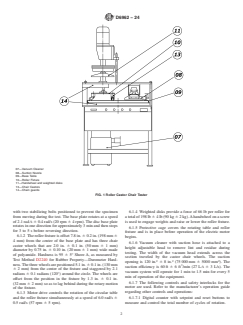
07—Vacuum Cleaner
08—Suction Nozzle
09—Base Table
10—Roller Fixture
11—Handwheel and weighted disks
13—Chair Castors
14—Chain guards
FIG. 1 Roller Castor Chair Tester
with two stabilizing bolts positioned to prevent the specimen 6.1.4 Weighted disks provide a force of 66 lb per roller for
from moving during the test. The base plate rotates at a speed a total of 198 lb 6 4 lb (90 kg 6 2 kg). A handwheel on a screw
of 2.1 rad ⁄s 6 0.4 rad/s (20 rpm 6 4 rpm). The disc base plate is used to engage weights and raise or lower the roller fixture.
rotates in one direction for approximately 3 min and then stops
6.1.5 Protective cage covers the rotating table and roller
for 3 to 5 s before reversing direction.
fixture and is in place before operation of the electric motor
6.1.2 The roller fixture is offset 7.8 in. 6 0.2 in. (198 mm 6
begins.
4 mm) from the center of the base plate and has three chair
6.1.6 Vacuum cleaner with suction hose is attached to a
castor wheels that are 2.0 in. 6 0.1 in. (50 mm 6 1 mm)
height adjustable head to remove lint and residue during
diameter by 0.75 in. 6 0.10 in. (20 mm 6 1 mm) wide made
testing. The width of the vacuum head extends across the
of polyamide. Hardness is 95 6 5° Shore A, as measured by
section traveled by the castor chair wheels. The suction
Test Method D2240 for Rubber Property—Durometer Hard-
2 2 2
opening is 120 in. 6 8 in. (75 000 mm 6 5000 mm ). The
ness. The three wheels are positioned 5.1 in. 6 0.1 in. (130 mm
suction efficiency is 60 ft 6 6 ft /min (27 L ⁄s 6 3 L/s). The
6 2 mm) from the center of the fixture and staggered by 2.1
vacuum system will operate for 1 min to 1.5 min for every 5
radians 6 0.1 radians (120°) around the circle. The wheels are
min of operation of the equipment.
offset from the position in the fixture by 1.3 in. 6 0.1 in.
6.1.7 The following controls and safety interlocks for the
(32 mm 6 2 mm) so as to lag behind during the rotary motion
motor are used. Refer to the manufacturer’s operation guide
of the fixture.
regarding other controls and operations:
6.1.3 Motor drive controls the rotation of the circular table
6.1.7.1 Digital counter with setpoint and reset buttons to
and the roller fixture simultaneously at a speed of 6.0 rad/s 6
0.5 rad/s (57 rpm 6 5 rpm). measure and control the total number of cycles of rotation.
D6962 − 24
6.1.7.2 Safety limit switches interlocked to the motor to pressure sensitive adhesive, tack strips, and wood screws if the
prevent access to rotating parts during operation. specimen is mounted on plywood.
6.1.7.3 Limit switch in the sample area interlocked to the
6.5 An upright vacuum cleaner, with a rotating brush and
motor to prevent damage to the equipment in the event the
beater bar, unless this type of apparatus is not recommended by
specimen obstructs the rotational path.
the manufacturer of the pile yarn floor cov
...
This document is not an ASTM standard and is intended only to provide the user of an ASTM standard an indication of what changes have been made to the previous version. Because
it may not be technically possible to adequately depict all changes accurately, ASTM recommends that users consult prior editions as appropriate. In all cases only the current version
of the standard as published by ASTM is to be considered the official document.
Designation: D6962 − 20 D6962 − 24
Standard Practice for
Operation of a Roller Chair Tester for Pile Yarn Floor
Coverings
This standard is issued under the fixed designation D6962; the number immediately following the designation indicates the year of
original adoption or, in the case of revision, the year of last revision. A number in parentheses indicates the year of last reapproval. A
superscript epsilon (´) indicates an editorial change since the last revision or reapproval.
1. Scope
1.1 This practice covers a procedure for the operation of a weighted roller chair testing device that rotates and moves across a test
specimen of pile yarn floor coverings.
1.2 This practice is applicable for testing unused pile yarn floor covering of all types.
1.3 The values stated in inch-pound units are to be regarded as standard. The values given in parentheses are mathematical
conversions to SI units that are provided for information only and are not considered standard.
1.4 This standard does not purport to address all of the safety concerns, if any, associated with its use. It is the responsibility
of the user of this standard to establish appropriate safety, health, and environmental practices and determine the applicability of
regulatory limitations prior to use.
1.5 This international standard was developed in accordance with internationally recognized principles on standardization
established in the Decision on Principles for the Development of International Standards, Guides and Recommendations issued
by the World Trade Organization Technical Barriers to Trade (TBT) Committee.
2. Referenced Documents
2.1 ASTM Standards:
D123 Terminology Relating to Textiles
D1776 Practice for Conditioning and Testing Textiles
D2240 Test Method for Rubber Property—Durometer Hardness
D5684 Terminology Relating to Pile Floor Coverings
3. Terminology
3.1 For definitions of terms relating to Pile Floor Coverings, D13.21, refer to Terminology D5684.
3.1.1 The following terms are relevant to this practice: carpet, durability, finished, finished pile yarn floor covering, floor covering,
pile, pile yarn floor covering, practice, resistance to delamination, secondary backing, textile floor covering, tufted fabric, underlay.
3.2 For all other terminology related to textiles, refer to Terminology D123.
This practice is under the jurisdiction of ASTM Committee D13 on Textiles and is the direct responsibility of Subcommittee D13.21 on Pile Floor Coverings.
Current edition approved Nov. 1, 2020Jan. 1, 2024. Published November 2020February 2024. Originally approved in 2003. Last previous edition approved in 20172020
as D6962–17. DOI: 10.1520/D6962-20.–20. DOI: 10.1520/D6962-24.
For referenced ASTM standards, visit the ASTM website, www.astm.org, or contact ASTM Customer Service at service@astm.org. For Annual Book of ASTM Standards
volume information, refer to the standard’s Document Summary page on the ASTM website.
Copyright © ASTM International, 100 Barr Harbor Drive, PO Box C700, West Conshohocken, PA 19428-2959. United States
D6962 − 24
4. Summary of Test Method
4.1 The carpet test specimen is secured to a table with the pile surface exposed and is subjected to the action of three castors which
produce an eccentric turning motion under a weighted roller chair device that moves across the test specimen for a specified
number of cycles.
5. Significance and Use
5.1 This practice is applicable for use in testing the durability of pile yarn floor covering of all types.
5.2 This practice is designed to simulate the stress on a pile yarn floor covering from the action of weighted roller chair castors
over an extended period of time.
5.3 The specimen is tested under conditions that may simulate an actual flooring installation. This may include the pile yarn floor
covering plus a specified underlayment cushion.
5.4 This practice is used to prepare specimens for additional testing, including but not limited to: visual assessment of
delamination of the secondary backing, visual assessment of the pile surface, resistance to delamination measurement, tuft bind,
and pile yarn raveling.
6. Apparatus and Materials
6.1 Roller Chair Tester is constructed of steel with a rotating circular table and a weighted roller fixture, rotating off-center to the
table. The apparatus also has electronic controls, a protective cage, and a vacuum system to remove lint and dust. The area of
contact between the rollers and the pile yarn wear will be an annulus with an outside diameter of 23.6 6 0.6 in. (600 6 15 mm)
and inside diameter of 3.9 6 0.6 in. (100 6 15 mm).
6.1.1 Rotating circular table is 31.3 in. 6 0.4 in. (795(795 mm 6 10 mm) diameter and 0.5 in. 6 0.1 in. (12(12 mm 6 1 mm)
thick with two stabilizing bolts positioned to prevent the specimen from moving during the test. The base plate rotates at a speed
of 2.12.1 rad ⁄s 6 0.4 rad/s (20(20 rpm 6 4 rpm). The disc base plate rotates in one direction for approximately 3 min and then
stops for 3 to 5 s before reversing direction.
6.1.2 The roller fixture is offset 7.8 in. 6 0.2 in. (198(198 mm 6 4 mm) from the center of the base plate and has three chair castor
wheels that are 2.0 in. 6 0.1 in. (50(50 mm 6 1 mm) diameter by 0.75 in. 6 0.10 in. (20(20 mm 6 1 mm) wide made of
polyamide. Hardness is 95 6 5° Shore A, as measured by Test Method D2240 for Rubber Property—Durometer Hardness. The
three wheels are positioned 5.15.1 in. 6 0.1 in. (130(130 mm 6 2 mm) from the center of the fixture and staggered by 2.1 radians
6 0.1 radians (120°) around the circle. The wheels are offset from the position in the fixture by 1.3 in. 6 0.1 in. (32(32 mm 6
2 mm) so as to lag behind during the rotary motion of the fixture.
6.1.3 Motor drive controls the rotation of the circular table and the roller fixture simultaneously at a speed of 6.0 rad/s 6 0.5 rad/s
(57(57 rpm 6 5 rpm).
6.1.4 Weighted disks provide a force of 66 lb per roller for a total of 198 lb 6 4 lb (90(90 kg 6 2 kg). A handwheel on a screw
is used to engage weights and raise or lower the roller fixture.
6.1.5 Protective cage covers the rotating table and roller fixture and is in place before operation of the electric motor begins.
6.1.6 Vacuum cleaner with suction hose is attached to a height adjustable head to remove lint and residue during testing. The width
2 2
of the vacuum head extends across the section traveled by the castor chair wheels. The suction opening is 120 in. 6 8 inin.
2 3
(75 000(75 000 mm 6 5000 mm ). The suction efficiency is 6060 ft 6 6 ft /min (27(27 L ⁄s 6 3 L/s). The vacuum system will
operate for 1 min to 1.5 min for every 5 min of operation of the equipment.
6.1.7 The following controls and safety interlocks for the motor are used. Refer to the manufacturer’s operation guide regarding
other controls and operations:
6.1.7.1 Digital counter with setpoint and reset buttons to measure and control the total number of cycles of rotation.
D6962 − 24
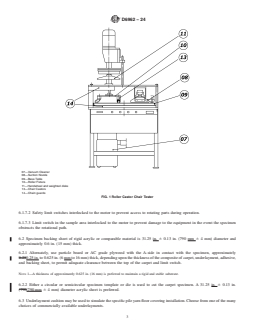
07—Vacuum Cleaner
08—Suction Nozzle
09—Base Table
10—Roller Fixture
11—Handwheel and weighted disks
13—Chair Castors
14—Chain guards
FIG. 1 Roller Castor Chair Tester
6.1.7.2 Safety limit switches interlocked to the motor to prevent access to rotating parts during operation.
6.1.7.3 Limit switch in the sample area interlocked to the motor to prevent damage to the equipment in the event the specimen
obstructs the rotational path.
6.2 Specimen backing sheet of rigid acrylic or comparable material is 31.25 in. 6 0.13 in. (790 mm 6 4 mm) diameter and
approximately 0.6 in. (15 mm) thick.
6.2.1 Alternately, use particle board or AC grade plywood with the A-side in
...