


ASTM F1063-09(2018)
(Practice)Standard Practice for Functional Inspections and Adjustments of Alpine Ski/Binding/Boot Systems
Standard Practice for Functional Inspections and Adjustments of Alpine Ski/Binding/Boot Systems
SIGNIFICANCE AND USE
4.1 The purpose of this practice is to aid in providing the end user with an appropriately functioning system with appropriate release torque setting(s).
4.2 The definitions and tolerances defined in this practice do not necessarily apply to procedures incorporating an inspection interval or schedule, in which such procedures are specified by the binding manufacturer. This practice is not intended to be a method for evaluating equipment design.
Note 2: Refer to Practice F1064 for definitions and tolerances pertaining to the evaluation of equipment once in use.
SCOPE
1.1 This practice provides procedures for inspection and adjustment of alpine ski/binding/boot systems.
1.2 This practice should be followed for systems, whether newly mounted or previously mounted, when work is performed on the system that may affect its release function, unless otherwise specified by the binding manufacturer in non-rental applications.
1.3 Nonapplicability of this function and release inspection practice to rental shop operations is based upon the existence of applicable ASTM practices.
Note 1: Refer to Practice F1064 for equivalent procedures and tolerances for complete and incomplete rental systems.
1.4 The values stated in SI units are to be regarded as standard. No other units of measurement are included in this standard.
1.5 This international standard was developed in accordance with internationally recognized principles on standardization established in the Decision on Principles for the Development of International Standards, Guides and Recommendations issued by the World Trade Organization Technical Barriers to Trade (TBT) Committee.
General Information
Buy Standard
Standards Content (Sample)
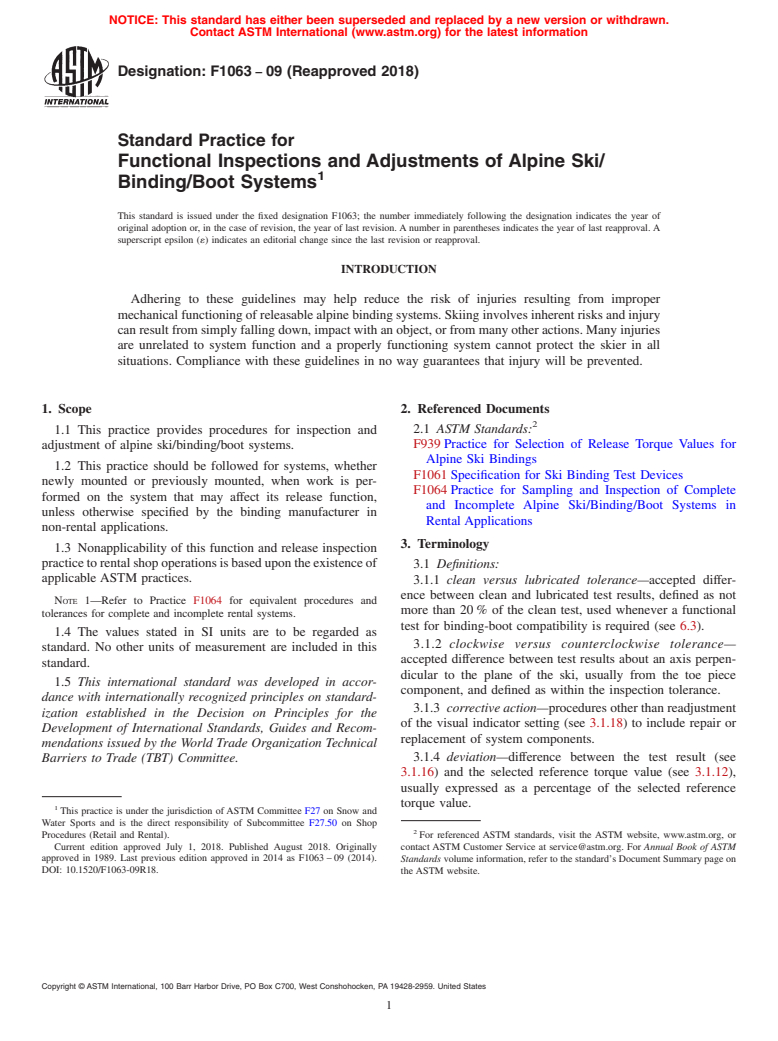
NOTICE: This standard has either been superseded and replaced by a new version or withdrawn.
Contact ASTM International (www.astm.org) for the latest information
Designation: F1063 − 09 (Reapproved 2018)
Standard Practice for
Functional Inspections and Adjustments of Alpine Ski/
Binding/Boot Systems
This standard is issued under the fixed designation F1063; the number immediately following the designation indicates the year of
original adoption or, in the case of revision, the year of last revision. A number in parentheses indicates the year of last reapproval. A
superscript epsilon (´) indicates an editorial change since the last revision or reapproval.
INTRODUCTION
Adhering to these guidelines may help reduce the risk of injuries resulting from improper
mechanicalfunctioningofreleasablealpinebindingsystems.Skiinginvolvesinherentrisksandinjury
canresultfromsimplyfallingdown,impactwithanobject,orfrommanyotheractions.Manyinjuries
are unrelated to system function and a properly functioning system cannot protect the skier in all
situations. Compliance with these guidelines in no way guarantees that injury will be prevented.
1. Scope 2. Referenced Documents
1.1 This practice provides procedures for inspection and 2.1 ASTM Standards:
F939 Practice for Selection of Release Torque Values for
adjustment of alpine ski/binding/boot systems.
Alpine Ski Bindings
1.2 This practice should be followed for systems, whether
F1061 Specification for Ski Binding Test Devices
newly mounted or previously mounted, when work is per-
F1064 Practice for Sampling and Inspection of Complete
formed on the system that may affect its release function,
and Incomplete Alpine Ski/Binding/Boot Systems in
unless otherwise specified by the binding manufacturer in
Rental Applications
non-rental applications.
3. Terminology
1.3 Nonapplicability of this function and release inspection
practicetorentalshopoperationsisbasedupontheexistenceof
3.1 Definitions:
applicable ASTM practices.
3.1.1 clean versus lubricated tolerance—accepted differ-
ence between clean and lubricated test results, defined as not
NOTE 1—Refer to Practice F1064 for equivalent procedures and
more than 20 % of the clean test, used whenever a functional
tolerances for complete and incomplete rental systems.
test for binding-boot compatibility is required (see 6.3).
1.4 The values stated in SI units are to be regarded as
3.1.2 clockwise versus counterclockwise tolerance—
standard. No other units of measurement are included in this
accepted difference between test results about an axis perpen-
standard.
dicular to the plane of the ski, usually from the toe piece
1.5 This international standard was developed in accor-
component, and defined as within the inspection tolerance.
dance with internationally recognized principles on standard-
3.1.3 corrective action—procedures other than readjustment
ization established in the Decision on Principles for the
of the visual indicator setting (see 3.1.18) to include repair or
Development of International Standards, Guides and Recom-
replacement of system components.
mendations issued by the World Trade Organization Technical
3.1.4 deviation—difference between the test result (see
Barriers to Trade (TBT) Committee.
3.1.16) and the selected reference torque value (see 3.1.12),
usually expressed as a percentage of the selected reference
torque value.
This practice is under the jurisdiction of ASTM Committee F27 on Snow and
Water Sports and is the direct responsibility of Subcommittee F27.50 on Shop
Procedures (Retail and Rental). For referenced ASTM standards, visit the ASTM website, www.astm.org, or
Current edition approved July 1, 2018. Published August 2018. Originally contact ASTM Customer Service at service@astm.org. For Annual Book of ASTM
approved in 1989. Last previous edition approved in 2014 as F1063 – 09 (2014). Standards volume information, refer to the standard’s Document Summary page on
DOI: 10.1520/F1063-09R18. the ASTM website.
Copyright © ASTM International, 100 Barr Harbor Drive, PO Box C700, West Conshohocken, PA 19428-2959. United States
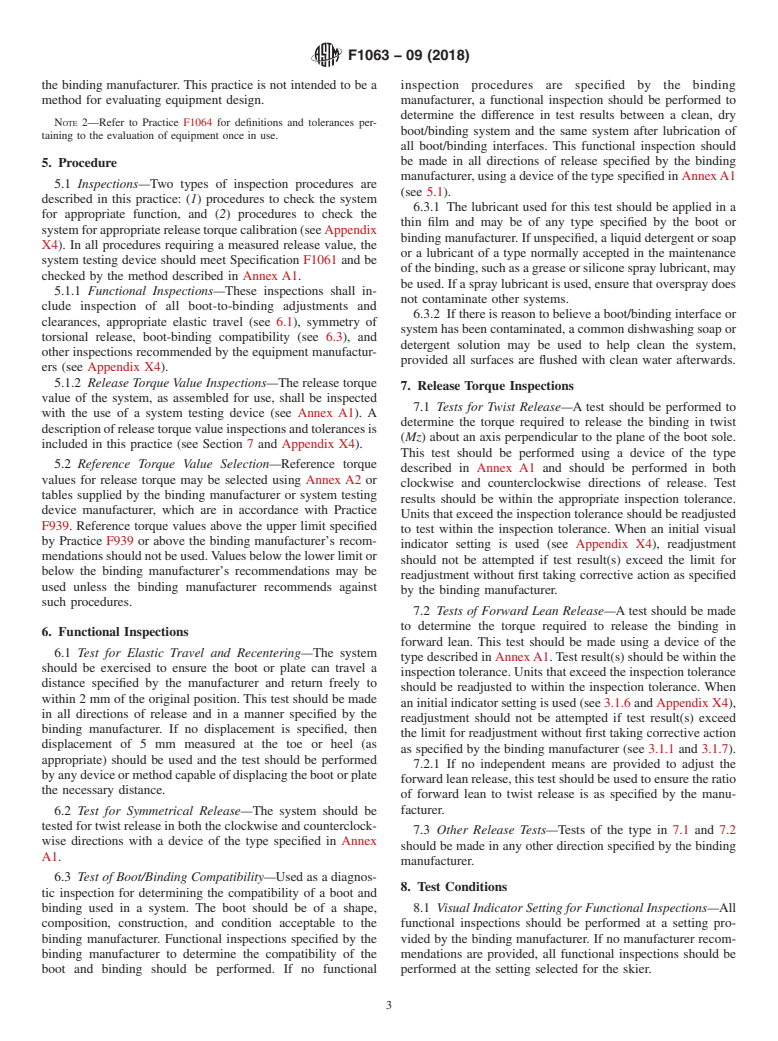
F1063 − 09 (2018)
3.1.5 in use tolerance—accepted difference between the (1) (–)—a symbol, that when placed to the left of Type 1
reference torque value and the test result(s), defined as 630 % (see 3.1.14.1), provides release/retention values lower than
Type I, corresponds to a further increase in the risk of
of the reference torque value, or 65 Nm for twist and 20 Nm
inadvertent binding release in order to gain increased releas-
for forward lean, whichever is greater, or two horizontal rows
ability in a fall.
up or down from the selected reference torque value deter-
(2) (+)—asymbol,thatwhenplacedtotherightofTypeIII
mined on the binding manufacturer’s adjustment chart. In the
(see 3.1.14.3), provides release/retention values higher than
absence of an applicable manufacturer’s chart, use Annex A2.
Type III, corresponds to a further decrease in releasability in a
For non-rental applications, this tolerance is used as the upper
fall in order to gain a decreased risk of inadvertent binding
and lower limit for determining if system release values are
release.
acceptable for in-use or in-service purposes, after said system
3.1.12 reference torque value—nominalreleasetorquevalue
has been released to the customer. This limit is derived from
derived from a document compatible with Practice F939, such
PracticeF1064,3.1.1 Class 1 deviation.Thisdeviation(616to
as Annex A2, or information supplied by the binding or test
30 %, or two horizontal rows up or down from the selected
device manufacturer.
reference torque value) is defined as a minor deviation that
3.1.13 skier code—letter code derived from the binding
does not require corrective action for equipment that is
manufacturer’s adjustment chart, based on a skier’s parameters
in-service, in rental applications. It is used as the upper and
(height, weight, age, and skier type).
lower limit for readjustment of the binding.
3.1.14 skier type—classification, selected by the skier, for
3.1.6 initial visual indicator setting—visualindicatorsetting
the type of skiing to be undertaken.
derived from the binding manufacturer’s adjustment chart.
3.1.14.1 Type I—designation that provides lower than aver-
3.1.7 inspection tolerance—accepteddifferencebetweenthe
age release/retention values; corresponds to an increased risk
reference torque value and the test result. Defined as 615 % of
of inadvertent binding release in order to gain releasability in
the reference torque value, or 63 Nm for twist and 610 Nm
a fall; also applies to entry level skiers uncertain of their
forforwardlean,whicheverisgreater,oronehorizontalrowup
classification.
or down from the selected reference torque value determined
3.1.14.2 Type II—designation that provides average release/
on the binding manufacturer’s adjustment chart, (see Annex
retention values appropriate for most recreational skiing;
A2). It is used as the criteria for prompting consultation of the
applies to skiers not classified as in Type I or Type III.
binding manufacturer’s troubleshooting procedures or read-
3.1.14.3 Type III—designation that provides higher than
justment of the binding, or a combination of both.
average release/retention values; corresponds to decreased
3.1.7.1 Discussion—When an algorithm or table is used to
releasability in a fall in order to gain a decreased risk of
provide a value, either may be used (differences may be
inadvertent binding release.
insignificant).
3.1.14.4 (/)—a symbol that separates skier type
designations, used when, as a result of troubleshooting, differ-
3.1.8 limit for readjustment—accepted difference between
ent skier types have been selected for determining twist (M ),
the reference torque value (see 3.1.12) and test result(s) (see
x
and forward lean (M ) release/retention values; shown in the
z
3.1.16), defined as 630 % of the reference torque value, or 65
order (twist/forward lean) or (T/H) to denote toe piece (T) and
Nmfortwistand20Nmforforwardlean,whicheverisgreater,
heel piece (H) of this ski binding. Other conventions may be
or two horizontal rows up or down from the selected reference
used to record different skier types for twist and forward lean
torque value determined on the binding manufacturer’s adjust-
when required by the documentation
ment chart (see Annex A2). For a reference torque value of 8
3.1.15 system—group of interacting components, usually
Nm in twist and 29 Nm in forward lean (Skier Code A in
comprised of a ski, binding, and boot.
Annex A2), the limit for readjustment is one row up or two
rows down on the adjustment chart. The limit for readjustment 3.1.16 test result—middle quantitative value of three repeti-
tions of the same test.
is used as the upper and lower limit for readjustment of the
binding.
3.1.17 troubleshooting—binding manufacturer’s recom-
mendations or procedures of analyzing system failure.
3.1.9 measured release value—release torque value deter-
3.1.18 visual indicator setting—setting displayed on the
mined by the use of a testing device of the type defined in
binding’s release/retention adjustment scale.
Annex A1.
3.1.10 readjustment value—value that shall be added or
4. Significance and Use
subtracted from the initial visual indicator setting to bring the
4.1 The purpose of this practice is to aid in providing the
test result within the inspection tolerance.
end user with an appropriately functioning system with appro-
3.1.11 release/retention value—release torque of the ski/
priate release torque setting(s).
binding/boot system.
4.2 Thedefinitionsandtolerancesdefinedinthispracticedo
3.1.11.1 discretionary settings—visual indicator settings
notnecessarilyapplytoproceduresincorporatinganinspection
higher or lower than the normal setting range: interval or schedule, in which such procedures are specified by
F1063 − 09 (2018)
the binding manufacturer. This practice is not intended to be a inspection procedures are specified by the binding
method for evaluating equipment design. manufacturer, a functional inspection should be performed to
determine the difference in test results between a clean, dry
NOTE 2—Refer to Practice F1064 for definitions and tolerances per-
boot/binding system and the same system after lubrication of
taining to the evaluation of equipment once in use.
all boot/binding interfaces. This functional inspection should
be made in all directions of release specified by the binding
5. Procedure
manufacturer, using a device of the type specified in AnnexA1
5.1 Inspections—Two types of inspection procedures are
(see 5.1).
described in this practice: (1) procedures to check the system
6.3.1 The lubricant used for this test should be applied in a
for appropriate function, and (2) procedures to check the
thin film and may be of any type specified by the boot or
systemforappropriatereleasetorquecalibration(seeAppendix
binding manufacturer. If unspecified, a liquid detergent or soap
X4). In all procedures requiring a measured release value, the
or a lubricant of a type normally accepted in the maintenance
system testing device should meet Specification F1061 and be
ofthebinding,suchasagreaseorsiliconespraylubricant,may
checked by the method described in Annex A1.
be used. If a spray lubricant is used, ensure that overspray does
5.1.1 Functional Inspections—These inspections shall in-
not contaminate other systems.
clude inspection of all boot-to-binding adjustments and
6.3.2 If there is reason to believe a boot/binding interface or
clearances, appropriate elastic travel (see 6.1), symmetry of
system has been contaminated, a common dishwashing soap or
torsional release, boot-binding compatibility (see 6.3), and
detergent solution may be used to help clean the system,
other inspections recommended by the equipment manufactur-
provided all surfaces are flushed with clean water afterwards.
ers (see Appendix X4).
5.1.2 Release Torque Value Inspections—The release torque
7. Release Torque Inspections
value of the system, as assembled for use, shall be inspected
7.1 Tests for Twist Release—A test should be performed to
with the use of a system testing device (see Annex A1). A
determine the torque required to release the binding in twist
descriptionofreleasetorquevalueinspectionsandtolerancesis
(Mz) about an axis perpendicular to the plane of the boot sole.
included in this practice (see Section 7 and Appendix X4).
This test should be performed using a device of the type
5.2 Reference Torque Value Selection—Reference torque
described in Annex A1 and should be performed in both
values for release torque may be selected using Annex A2 or
clockwise and counterclockwise directions of release. Test
tables supplied by the binding manufacturer or system testing
results should be within the appropriate inspection tolerance.
device manufacturer, which are in accordance with Practice
Units that exceed the inspection tolerance should be readjusted
F939. Reference torque values above the upper limit specified
to test within the inspection tolerance. When an initial visual
by Practice F939 or above the binding manufacturer’s recom-
indicator setting is used (see Appendix X4), readjustment
mendationsshouldnotbeused.Valuesbelowthelowerlimitor
should not be attempted if test result(s) exceed the limit for
below the binding manufacturer’s recommendations may be
readjustment without first taking corrective action as specified
used unless the binding manufacturer recommends against
by the binding manufacturer.
such procedures.
7.2 Tests of Forward Lean Release—A test should be made
to determine the torque required to release the binding in
6. Functional Inspections
forward lean. This test should be made using a device of the
6.1 Test for Elastic Travel and Recentering—The system
type described in AnnexA1.Test result(s) should be within the
should be exercised to ensure the boot or plate can travel a
inspection tolerance. Units that exceed the inspection tolerance
distance specified by the manufacturer and return freely to
should be readjusted to within the inspection tolerance. When
within 2 mm of the original position. This test should be made
aninitialindicatorsettingisused(see3.1.6andAppendixX4),
in all directions of release and in a manner specified by the
readjustment should not be attempted if test result(s) exceed
binding manufacturer. If no displacement is specified, then
the limit for readjustment without first taking corrective action
displacement of 5 mm measured at the toe or heel (as
as specified by the binding manufacturer (see 3.1.1 and 3.1.7).
appropriate) should be used and the test should be performed
7.2.1 If no independent means are provided to adjust the
byanydeviceormethodcapableofdisplacingthebootorplate
forwardleanrelease,thistestshouldbeusedtoensuretheratio
the necessary distance.
of forward lean to twist release is as specified by the manu-
...
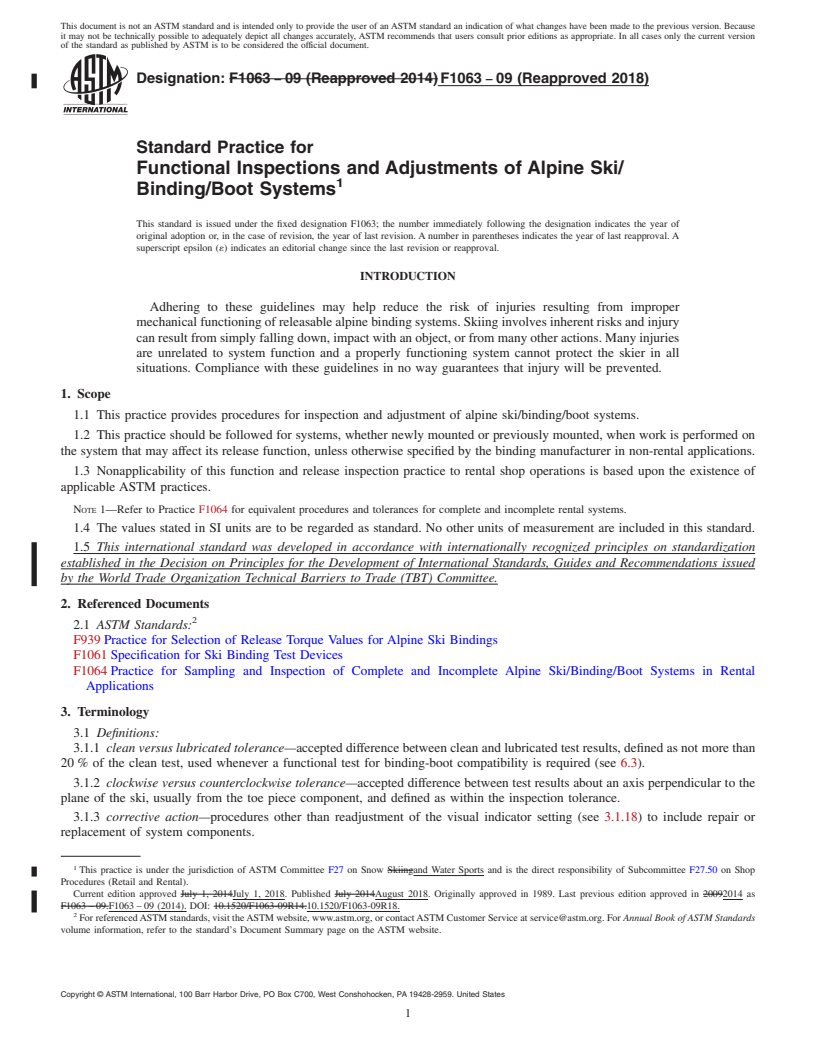
This document is not an ASTM standard and is intended only to provide the user of an ASTM standard an indication of what changes have been made to the previous version. Because
it may not be technically possible to adequately depict all changes accurately, ASTM recommends that users consult prior editions as appropriate. In all cases only the current version
of the standard as published by ASTM is to be considered the official document.
Designation: F1063 − 09 (Reapproved 2014) F1063 − 09 (Reapproved 2018)
Standard Practice for
Functional Inspections and Adjustments of Alpine Ski/
Binding/Boot Systems
This standard is issued under the fixed designation F1063; the number immediately following the designation indicates the year of
original adoption or, in the case of revision, the year of last revision. A number in parentheses indicates the year of last reapproval. A
superscript epsilon (´) indicates an editorial change since the last revision or reapproval.
INTRODUCTION
Adhering to these guidelines may help reduce the risk of injuries resulting from improper
mechanical functioning of releasable alpine binding systems. Skiing involves inherent risks and injury
can result from simply falling down, impact with an object, or from many other actions. Many injuries
are unrelated to system function and a properly functioning system cannot protect the skier in all
situations. Compliance with these guidelines in no way guarantees that injury will be prevented.
1. Scope
1.1 This practice provides procedures for inspection and adjustment of alpine ski/binding/boot systems.
1.2 This practice should be followed for systems, whether newly mounted or previously mounted, when work is performed on
the system that may affect its release function, unless otherwise specified by the binding manufacturer in non-rental applications.
1.3 Nonapplicability of this function and release inspection practice to rental shop operations is based upon the existence of
applicable ASTM practices.
NOTE 1—Refer to Practice F1064 for equivalent procedures and tolerances for complete and incomplete rental systems.
1.4 The values stated in SI units are to be regarded as standard. No other units of measurement are included in this standard.
1.5 This international standard was developed in accordance with internationally recognized principles on standardization
established in the Decision on Principles for the Development of International Standards, Guides and Recommendations issued
by the World Trade Organization Technical Barriers to Trade (TBT) Committee.
2. Referenced Documents
2.1 ASTM Standards:
F939 Practice for Selection of Release Torque Values for Alpine Ski Bindings
F1061 Specification for Ski Binding Test Devices
F1064 Practice for Sampling and Inspection of Complete and Incomplete Alpine Ski/Binding/Boot Systems in Rental
Applications
3. Terminology
3.1 Definitions:
3.1.1 clean versus lubricated tolerance—accepted difference between clean and lubricated test results, defined as not more than
20 % of the clean test, used whenever a functional test for binding-boot compatibility is required (see 6.3).
3.1.2 clockwise versus counterclockwise tolerance—accepted difference between test results about an axis perpendicular to the
plane of the ski, usually from the toe piece component, and defined as within the inspection tolerance.
3.1.3 corrective action—procedures other than readjustment of the visual indicator setting (see 3.1.18) to include repair or
replacement of system components.
This practice is under the jurisdiction of ASTM Committee F27 on Snow Skiingand Water Sports and is the direct responsibility of Subcommittee F27.50 on Shop
Procedures (Retail and Rental).
Current edition approved July 1, 2014July 1, 2018. Published July 2014August 2018. Originally approved in 1989. Last previous edition approved in 20092014 as
F1063 – 09.F1063 – 09 (2014). DOI: 10.1520/F1063-09R14.10.1520/F1063-09R18.
For referenced ASTM standards, visit the ASTM website, www.astm.org, or contact ASTM Customer Service at service@astm.org. For Annual Book of ASTM Standards
volume information, refer to the standard’s Document Summary page on the ASTM website.
Copyright © ASTM International, 100 Barr Harbor Drive, PO Box C700, West Conshohocken, PA 19428-2959. United States
F1063 − 09 (2018)
3.1.4 deviation—difference between the test result (see 3.1.16) and the selected reference torque value (see 3.1.12), usually
expressed as a percentage of the selected reference torque value.
3.1.5 in use tolerance—accepted difference between the reference torque value and the test result(s), defined as 630 % of the
reference torque value, or 65 Nm for twist and 20 Nm for forward lean, whichever is greater, or two horizontal rows up or down
from the selected reference torque value determined on the binding manufacturer’s adjustment chart. In the absence of an
applicable manufacturer’s chart, use Annex A2. For non-rental applications, this tolerance is used as the upper and lower limit for
determining if system release values are acceptable for in-use or in-service purposes, after said system has been released to the
customer. This limit is derived from Practice F1064, 3.1.1 Class 1 deviation. This deviation (616 to 30 %, or two horizontal rows
up or down from the selected reference torque value) is defined as a minor deviation that does not require corrective action for
equipment that is in-service, in rental applications. It is used as the upper and lower limit for readjustment of the binding.
3.1.6 initial visual indicator setting—visual indicator setting derived from the binding manufacturer’s adjustment chart.
3.1.7 inspection tolerance—accepted difference between the reference torque value and the test result. Defined as 615 % of the
reference torque value, or 63 Nm for twist and 610 Nm for forward lean, whichever is greater, or one horizontal row up or down
from the selected reference torque value determined on the binding manufacturer’s adjustment chart, (see Annex A2). It is used
as the criteria for prompting consultation of the binding manufacturer’s troubleshooting procedures or readjustment of the binding,
or a combination of both.
3.1.7.1 Discussion—
When an algorithm or table is used to provide a value, either may be used (differences may be insignificant).
3.1.8 limit for readjustment—accepted difference between the reference torque value (see 3.1.12) and test result(s) (see 3.1.16),
defined as 630 % of the reference torque value, or 65 Nm for twist and 20 Nm for forward lean, whichever is greater, or two
horizontal rows up or down from the selected reference torque value determined on the binding manufacturer’s adjustment chart
(see Annex A2). For a reference torque value of 8 Nm in twist and 29 Nm in forward lean (Skier Code A in Annex A2), the limit
for readjustment is one row up or two rows down on the adjustment chart. The limit for readjustment is used as the upper and lower
limit for readjustment of the binding.
3.1.9 measured release value—release torque value determined by the use of a testing device of the type defined in Annex A1.
3.1.10 readjustment value—value that shall be added or subtracted from the initial visual indicator setting to bring the test result
within the inspection tolerance.
3.1.11 release/retention value—release torque of the ski/binding/boot system.
3.1.11.1 discretionary settings—visual indicator settings higher or lower than the normal setting rangerange:
(1) (–)—a symbol, that when placed to the left of Type 1 (see 3.1.14.1), provides release/retention values lower than Type I,
corresponds to a further increase in the risk of inadvertent binding release in order to gain increased releasability in a fall.
(1) (–)—a symbol, that when placed to the left of Type 1 (see 3.1.14.1), provides release/retention values lower than Type I,
corresponds to a further increase in the risk of inadvertent binding release in order to gain increased releasability in a fall.
(2) (+)—a symbol, that when placed to the right of Type III (see 3.1.14.3), provides release/retention values higher than Type
III, corresponds to a further decrease in releasability in a fall in order to gain a decreased risk of inadvertent binding release.
(2) (+)—a symbol, that when placed to the right of Type III (see 3.1.14.3), provides release/retention values higher than Type
III, corresponds to a further decrease in releasability in a fall in order to gain a decreased risk of inadvertent binding release.
3.1.12 reference torque value—nominal release torque value derived from a document compatible with Practice F939, such as
Annex A2, or information supplied by the binding or test device manufacturer.
3.1.13 skier code—letter code derived from the binding manufacturer’s adjustment chart, based on a skier’s parameters (height,
weight, age, and skier type).
3.1.14 skier type—classification, selected by the skier, for the type of skiing to be undertaken.
3.1.14.1 Type I—designation that provides lower than average release/retention values; corresponds to an increased risk of
inadvertent binding release in order to gain releasability in a fall; also applies to entry level skiers uncertain of their classification.
3.1.14.2 Type II—designation that provides average release/retention values appropriate for most recreational skiing; applies to
skiers not classified as in Type I or Type III.
3.1.14.3 Type III—designation that provides higher than average release/retention values; corresponds to decreased releasability
in a fall in order to gain a decreased risk of inadvertent binding release.
3.1.14.4 (/)—a symbol that separates skier type designations, used when, as a result of troubleshooting, different skier types have
been selected for determining twist (M ), and forward lean (M ) release/retention values; shown in the order (twist/forward lean)
x z
or (T/H) to denote toe piece (T) and heel piece (H) of this ski binding. Other conventions may be used to record different skier
types for twist and forward lean when required by the documentation
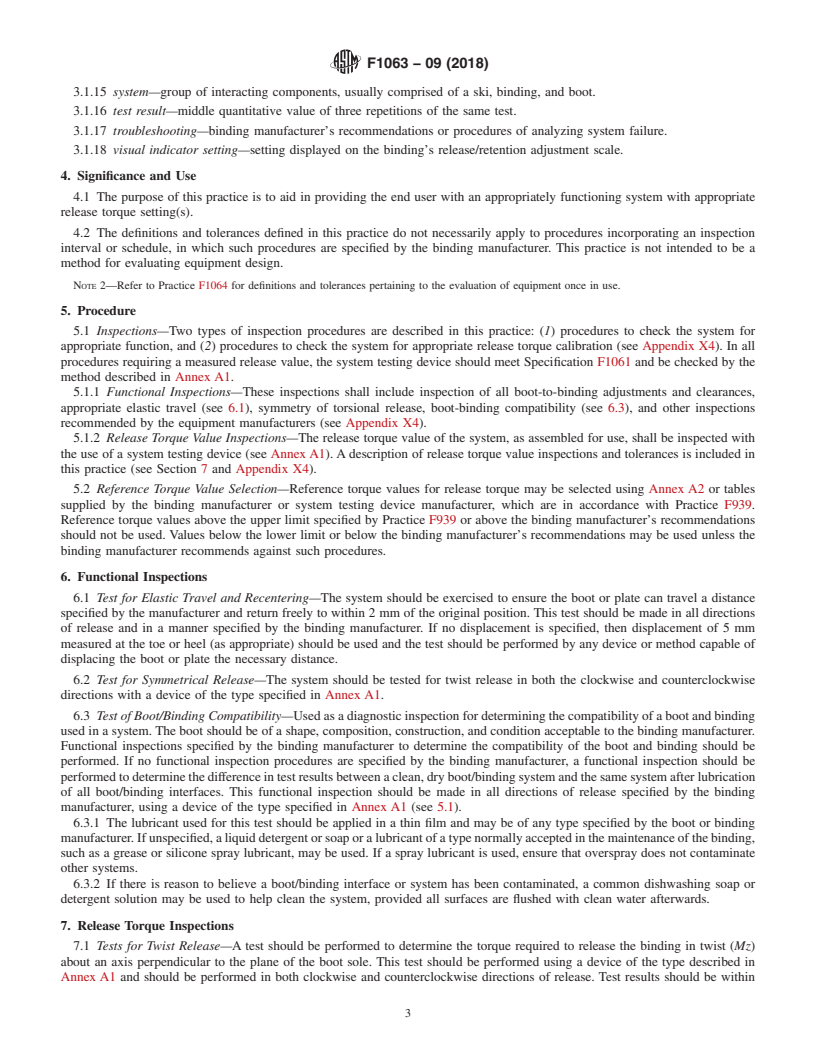
F1063 − 09 (2018)
3.1.15 system—group of interacting components, usually comprised of a ski, binding, and boot.
3.1.16 test result—middle quantitative value of three repetitions of the same test.
3.1.17 troubleshooting—binding manufacturer’s recommendations or procedures of analyzing system failure.
3.1.18 visual indicator setting—setting displayed on the binding’s release/retention adjustment scale.
4. Significance and Use
4.1 The purpose of this practice is to aid in providing the end user with an appropriately functioning system with appropriate
release torque setting(s).
4.2 The definitions and tolerances defined in this practice do not necessarily apply to procedures incorporating an inspection
interval or schedule, in which such procedures are specified by the binding manufacturer. This practice is not intended to be a
method for evaluating equipment design.
NOTE 2—Refer to Practice F1064 for definitions and tolerances pertaining to the evaluation of equipment once in use.
5. Procedure
5.1 Inspections—Two types of inspection procedures are described in this practice: (1) procedures to check the system for
appropriate function, and (2) procedures to check the system for appropriate release torque calibration (see Appendix X4). In all
procedures requiring a measured release value, the system testing device should meet Specification F1061 and be checked by the
method described in Annex A1.
5.1.1 Functional Inspections—These inspections shall include inspection of all boot-to-binding adjustments and clearances,
appropriate elastic travel (see 6.1), symmetry of torsional release, boot-binding compatibility (see 6.3), and other inspections
recommended by the equipment manufacturers (see Appendix X4).
5.1.2 Release Torque Value Inspections—The release torque value of the system, as assembled for use, shall be inspected with
the use of a system testing device (see Annex A1). A description of release torque value inspections and tolerances is included in
this practice (see Section 7 and Appendix X4).
5.2 Reference Torque Value Selection—Reference torque values for release torque may be selected using Annex A2 or tables
supplied by the binding manufacturer or system testing device manufacturer, which are in accordance with Practice F939.
Reference torque values above the upper limit specified by Practice F939 or above the binding manufacturer’s recommendations
should not be used. Values below the lower limit or below the binding manufacturer’s recommendations may be used unless the
binding manufacturer recommends against such procedures.
6. Functional Inspections
6.1 Test for Elastic Travel and Recentering—The system should be exercised to ensure the boot or plate can travel a distance
specified by the manufacturer and return freely to within 2 mm of the original position. This test should be made in all directions
of release and in a manner specified by the binding manufacturer. If no displacement is specified, then displacement of 5 mm
measured at the toe or heel (as appropriate) should be used and the test should be performed by any device or method capable of
displacing the boot or plate the necessary distance.
6.2 Test for Symmetrical Release—The system should be tested for twist release in both the clockwise and counterclockwise
directions with a device of the type specified in Annex A1.
6.3 Test of Boot/Binding Compatibility—Used as a diagnostic inspection for determining the compatibility of a boot and binding
used in a system. The boot should be of a shape, composition, construction, and condition acceptable to the binding manufacturer.
Functional inspections specified by the binding manufacturer to determine the compatibility of the boot and binding should be
performed. If no functional inspection procedures are specified by the binding manufacturer, a functional inspection should be
performed to determine the difference in test results between a clean, dry boot/binding system and the same system after lubrication
of all boot/binding interfaces. This functional inspection should be made in all directions of release specified by the binding
manufacturer, using a device of the type specified in Annex A1 (see 5.1).
6.3.1 The lubricant used for this test should be applied in a thin film and may be of any type specified by the boot or binding
manufacturer. If unspecified, a liquid detergent or soap or a lubricant of a type normally accepted in the maintenance of the binding,
such as a grease or silicone spray lubricant, may be used. If a spray lubricant is used, ensure that overspray does not contaminate
other systems.
6.3.2 If there is reason to believe a boot/binding interface or system has been contaminated, a common dishwashing soap or
detergent solution may be used to help clean the system, provided all surfaces are flushed with clean water a
...
Questions, Comments and Discussion
Ask us and Technical Secretary will try to provide an answer. You can facilitate discussion about the standard in here.