


ASTM E2107-06(2014)
(Practice)Standard Practice for Environmental Regulatory Compliance Audits
Standard Practice for Environmental Regulatory Compliance Audits
SIGNIFICANCE AND USE
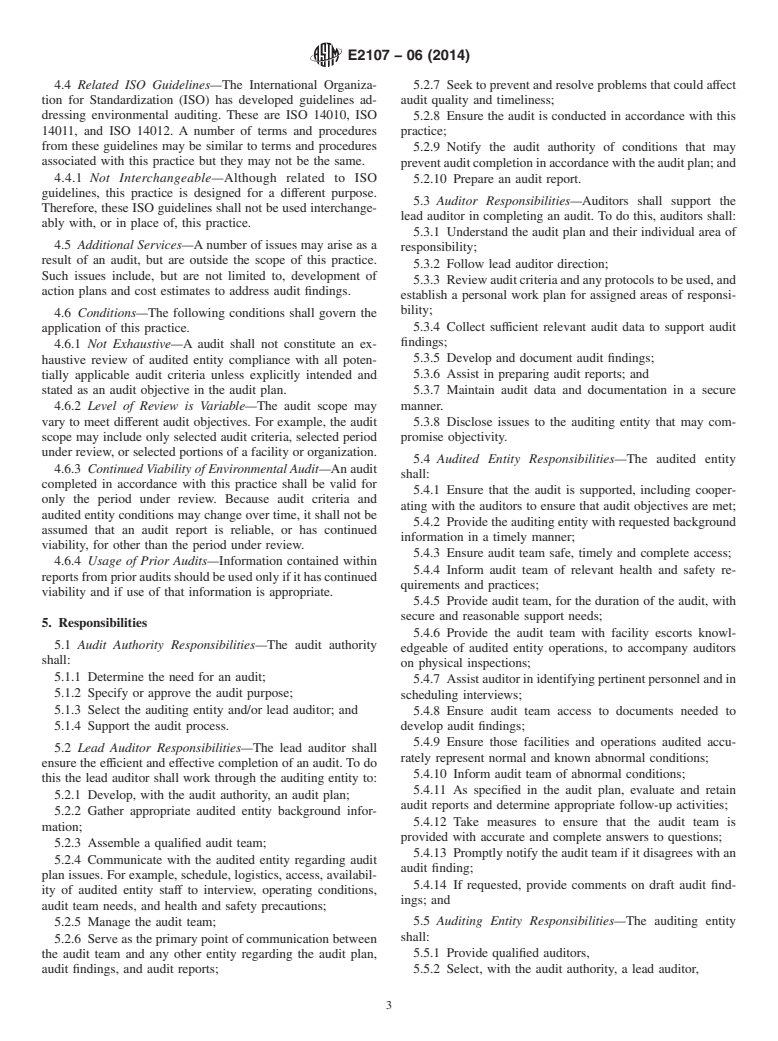
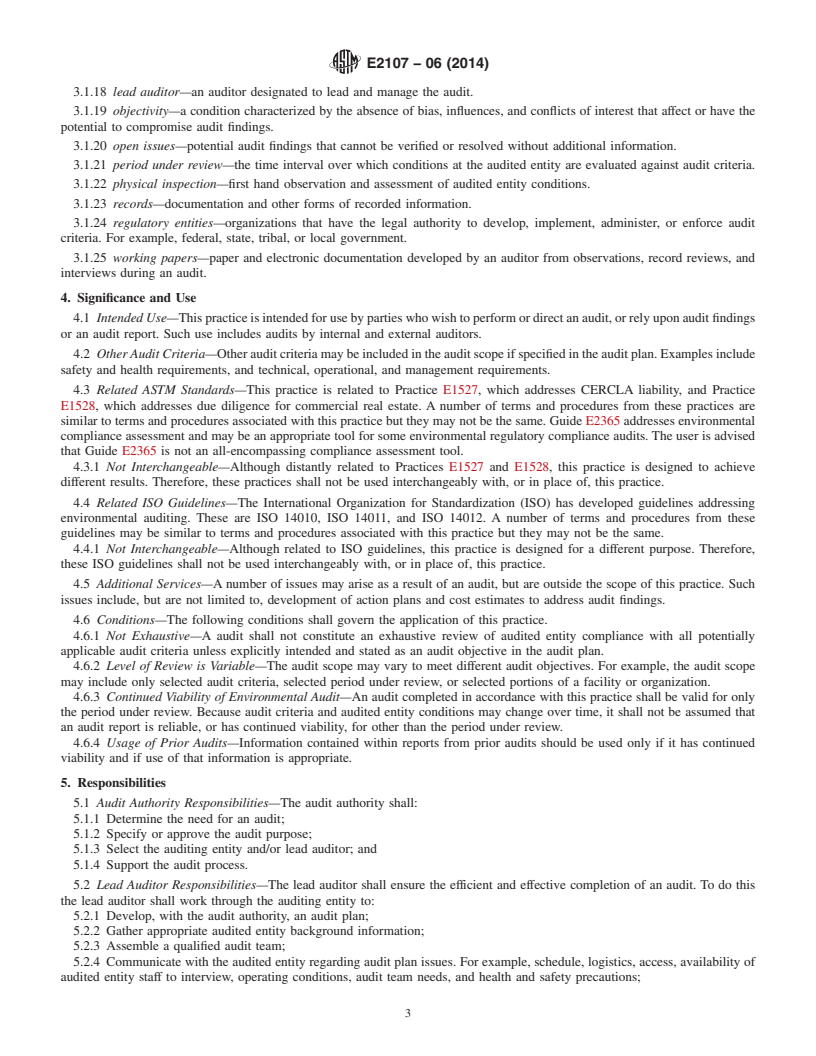
4.1 Intended Use—This practice is intended for use by parties who wish to perform or direct an audit, or rely upon audit findings or an audit report. Such use includes audits by internal and external auditors.
4.2 Other Audit Criteria—Other audit criteria may be included in the audit scope if specified in the audit plan. Examples include safety and health requirements, and technical, operational, and management requirements.
4.3 Related ASTM Standards—This practice is related to Practice E1527, which addresses CERCLA liability, and Practice E1528, which addresses due diligence for commercial real estate. A number of terms and procedures from these practices are similar to terms and procedures associated with this practice but they may not be the same. Guide E2365 addresses environmental compliance assessment and may be an appropriate tool for some environmental regulatory compliance audits. The user is advised that Guide E2365 is not an all-encompassing compliance assessment tool.
4.3.1 Not Interchangeable—Although distantly related to Practices E1527 and E1528, this practice is designed to achieve different results. Therefore, these practices shall not be used interchangeably with, or in place of, this practice.
4.4 Related ISO Guidelines—The International Organization for Standardization (ISO) has developed guidelines addressing environmental auditing. These are ISO 14010, ISO 14011, and ISO 14012. A number of terms and procedures from these guidelines may be similar to terms and procedures associated with this practice but they may not be the same.
4.4.1 Not Interchangeable—Although related to ISO guidelines, this practice is designed for a different purpose. Therefore, these ISO guidelines shall not be used interchangeably with, or in place of, this practice.
4.5 Additional Services—A number of issues may arise as a result of an audit, but are outside the scope of this practice. Such issues include, but are not limited to, development of actio...
SCOPE
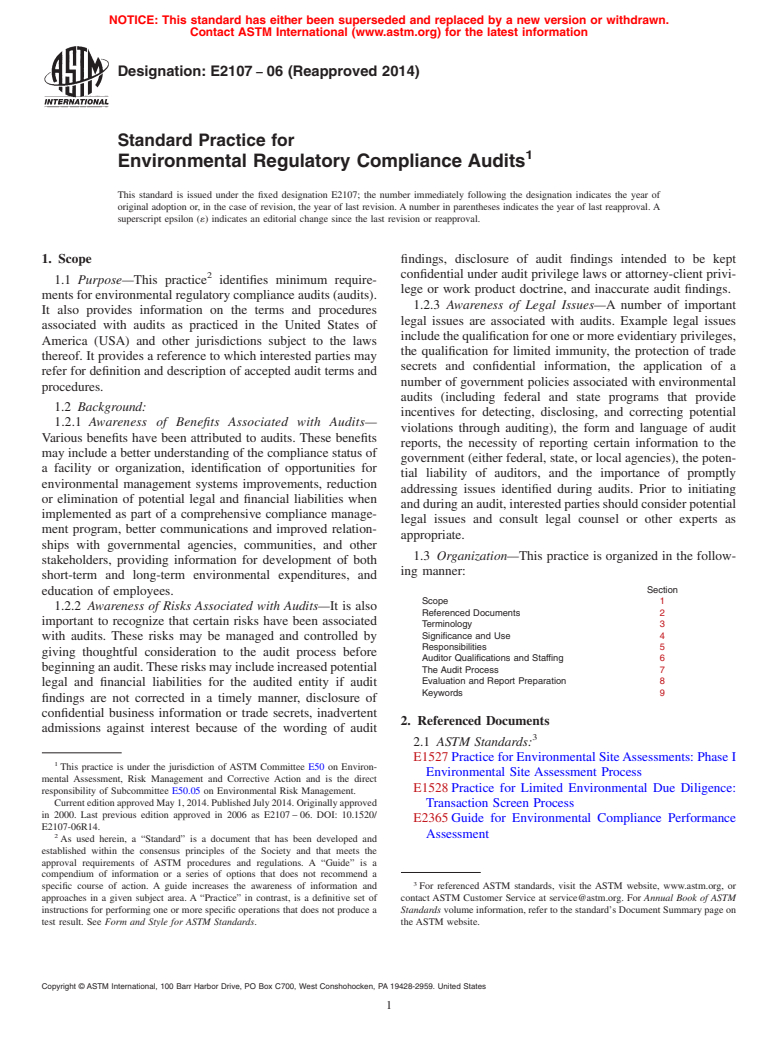
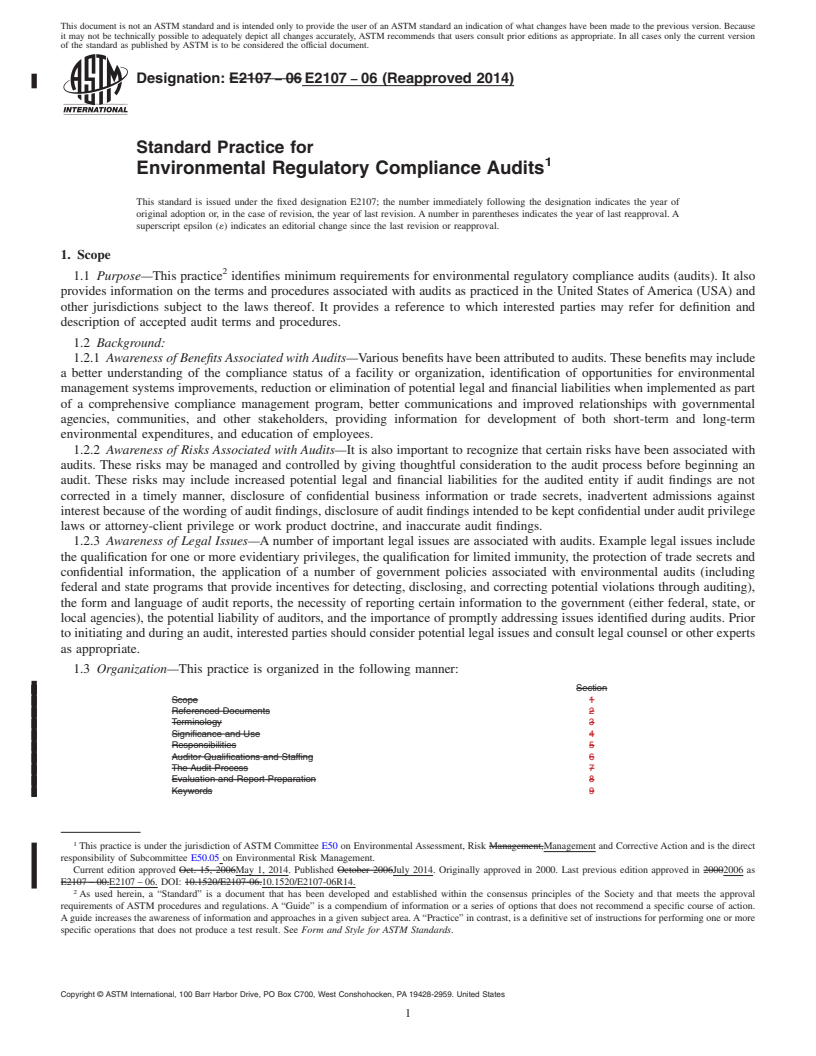
1.1 Purpose—This practice2 identifies minimum requirements for environmental regulatory compliance audits (audits). It also provides information on the terms and procedures associated with audits as practiced in the United States of America (USA) and other jurisdictions subject to the laws thereof. It provides a reference to which interested parties may refer for definition and description of accepted audit terms and procedures.
1.2 Background:
1.2.1 Awareness of Benefits Associated with Audits—Various benefits have been attributed to audits. These benefits may include a better understanding of the compliance status of a facility or organization, identification of opportunities for environmental management systems improvements, reduction or elimination of potential legal and financial liabilities when implemented as part of a comprehensive compliance management program, better communications and improved relationships with governmental agencies, communities, and other stakeholders, providing information for development of both short-term and long-term environmental expenditures, and education of employees.
1.2.2 Awareness of Risks Associated with Audits—It is also important to recognize that certain risks have been associated with audits. These risks may be managed and controlled by giving thoughtful consideration to the audit process before beginning an audit. These risks may include increased potential legal and financial liabilities for the audited entity if audit findings are not corrected in a timely manner, disclosure of confidential business information or trade secrets, inadvertent admissions against interest because of the wording of audit findings, disclosure of audit findings intended to be kept confidential under audit privilege laws or attorney-client privilege or work product doctrine, and inaccurate audit findings.
1.2.3 Awareness of Legal Issues—A number of important legal issues are associat...
General Information
Buy Standard
Standards Content (Sample)
NOTICE: This standard has either been superseded and replaced by a new version or withdrawn.
Contact ASTM International (www.astm.org) for the latest information
Designation: E2107 − 06 (Reapproved 2014)
Standard Practice for
Environmental Regulatory Compliance Audits
This standard is issued under the fixed designation E2107; the number immediately following the designation indicates the year of
original adoption or, in the case of revision, the year of last revision. A number in parentheses indicates the year of last reapproval. A
superscript epsilon (´) indicates an editorial change since the last revision or reapproval.
1. Scope findings, disclosure of audit findings intended to be kept
confidential under audit privilege laws or attorney-client privi-
1.1 Purpose—This practice identifies minimum require-
lege or work product doctrine, and inaccurate audit findings.
ments for environmental regulatory compliance audits (audits).
1.2.3 Awareness of Legal Issues—A number of important
It also provides information on the terms and procedures
legal issues are associated with audits. Example legal issues
associated with audits as practiced in the United States of
includethequalificationforoneormoreevidentiaryprivileges,
America (USA) and other jurisdictions subject to the laws
the qualification for limited immunity, the protection of trade
thereof. It provides a reference to which interested parties may
secrets and confidential information, the application of a
refer for definition and description of accepted audit terms and
number of government policies associated with environmental
procedures.
audits (including federal and state programs that provide
1.2 Background:
incentives for detecting, disclosing, and correcting potential
1.2.1 Awareness of Benefits Associated with Audits—
violations through auditing), the form and language of audit
Various benefits have been attributed to audits. These benefits
reports, the necessity of reporting certain information to the
may include a better understanding of the compliance status of
government (either federal, state, or local agencies), the poten-
a facility or organization, identification of opportunities for
tial liability of auditors, and the importance of promptly
environmental management systems improvements, reduction
addressing issues identified during audits. Prior to initiating
or elimination of potential legal and financial liabilities when
andduringanaudit,interestedpartiesshouldconsiderpotential
implemented as part of a comprehensive compliance manage-
legal issues and consult legal counsel or other experts as
ment program, better communications and improved relation-
appropriate.
ships with governmental agencies, communities, and other
1.3 Organization—This practice is organized in the follow-
stakeholders, providing information for development of both
ing manner:
short-term and long-term environmental expenditures, and
Section
education of employees.
Scope 1
1.2.2 Awareness of Risks Associated with Audits—It is also
Referenced Documents 2
important to recognize that certain risks have been associated
Terminology 3
Significance and Use 4
with audits. These risks may be managed and controlled by
Responsibilities 5
giving thoughtful consideration to the audit process before
Auditor Qualifications and Staffing 6
beginninganaudit.Theserisksmayincludeincreasedpotential
The Audit Process 7
Evaluation and Report Preparation 8
legal and financial liabilities for the audited entity if audit
Keywords 9
findings are not corrected in a timely manner, disclosure of
confidential business information or trade secrets, inadvertent
2. Referenced Documents
admissions against interest because of the wording of audit
2.1 ASTM Standards:
E1527 Practice for Environmental SiteAssessments: Phase I
This practice is under the jurisdiction of ASTM Committee E50 on Environ-
Environmental Site Assessment Process
mental Assessment, Risk Management and Corrective Action and is the direct
E1528 Practice for Limited Environmental Due Diligence:
responsibility of Subcommittee E50.05 on Environmental Risk Management.
CurrenteditionapprovedMay1,2014.PublishedJuly2014.Originallyapproved
Transaction Screen Process
in 2000. Last previous edition approved in 2006 as E2107 – 06. DOI: 10.1520/
E2365 Guide for Environmental Compliance Performance
E2107-06R14.
Assessment
As used herein, a “Standard” is a document that has been developed and
established within the consensus principles of the Society and that meets the
approval requirements of ASTM procedures and regulations. A “Guide” is a
compendium of information or a series of options that does not recommend a
specific course of action. A guide increases the awareness of information and For referenced ASTM standards, visit the ASTM website, www.astm.org, or
approaches in a given subject area. A “Practice” in contrast, is a definitive set of contact ASTM Customer Service at service@astm.org. For Annual Book of ASTM
instructions for performing one or more specific operations that does not produce a Standards volume information, refer to the standard’s Document Summary page on
test result. See Form and Style for ASTM Standards. the ASTM website.
Copyright © ASTM International, 100 Barr Harbor Drive, PO Box C700, West Conshohocken, PA 19428-2959. United States
E2107 − 06 (2014)
2.2 ISO Standards: 3.1.14 auditing entity—the organization that provides audi-
ISO 14010 Guidelines for Environmental Auditing— tors.
General Principles
3.1.15 auditor—a person qualified to conduct an audit.
ISO 14011 Guidelines for Environmental Auditing—Audit
3.1.16 environmental regulatory compliance audit
Procedures—Auditing of Environmental Management
4 (audit)—a systematic, documented, and objective review of an
Systems
audited entity to evaluate its compliance status relative to audit
ISO 14012 Guidelines for Environmental Auditing—
4 criteria.
Qualification Criteria for Environmental Auditors
3.1.17 independence—a condition characterized by organi-
3. Terminology
zational standing where an auditor is free to conduct an audit
without being controlled or influenced by others.
3.1 Definitions of Terms Specific to This Standard:
3.1.1 action plan—a plan to address audit findings that
3.1.18 lead auditor—an auditor designated to lead and
describes planned response actions, parties responsible for
manage the audit.
their execution, and expected completion dates.
3.1.19 objectivity—a condition characterized by the absence
3.1.2 audit authority—the entity or body that authorizes, or
of bias, influences, and conflicts of interest that affect or have
initiates, the audit process. The audit authority may be internal
the potential to compromise audit findings.
or external to the audited entity.
3.1.20 open issues—potential audit findings that cannot be
3.1.3 audit criteria—enforceable environmental require-
verified or resolved without additional information.
ments that are applicable to an audited entity. Examples
3.1.21 period under review—the time interval over which
include laws, regulations, orders, and permits.
conditions at the audited entity are evaluated against audit
3.1.4 audit data—information obtained during an audit to
criteria.
support audit findings.
3.1.22 physical inspection—first hand observation and as-
3.1.5 audit finding—a statement of audited entity conditions
sessment of audited entity conditions.
at the time of the audit compared to audit criteria. Audit
3.1.23 records—documentation and other forms of recorded
findings shall be based upon verifiable audit data and may be
information.
either positive or negative with respect to audit criteria.
3.1.24 regulatory entities—organizations that have the legal
3.1.6 audit objective(s)—broad statement(s) of what the
authority to develop, implement, administer, or enforce audit
audit intends to accomplish.
criteria.Forexample,federal,state,tribal,orlocalgovernment.
3.1.7 audit plan—documentation that describes the audit.
3.1.25 working papers—paper and electronic documenta-
Elements that should be included or referenced in the audit
tion developed by an auditor from observations, record
plan are: the audit objective; audit scope; identities of the
reviews, and interviews during an audit.
auditing entity, audit team, and audit authority; audit schedule;
auditor health and safety issues; audit report preparation;
4. Significance and Use
record retention and management requirements; logistics;
working papers management; a process for promptly commu-
4.1 Intended Use—This practice is intended for use by
nicating auditor concerns for potential environmental or regu-
parties who wish to perform or direct an audit, or rely upon
latory impact including concerns requiring further evaluation;
audit findings or an audit report. Such use includes audits by
special conditions or requirements; and whatever measures, if
internal and external auditors.
any, desired to maximize audit confidentiality.
4.2 Other Audit Criteria—Other audit criteria may be in-
3.1.8 audit purpose—reason for the audit.
cluded in the audit scope if specified in the audit plan.
3.1.9 audit protocol—a list of issues or questions designed
Examples include safety and health requirements, and
to address the audit objective(s) based upon audit criteria.
technical, operational, and management requirements.
3.1.10 audit report—a written summary of audit findings
4.3 Related ASTM Standards—This practice is related to
that is objective, clear, concise, constructive, and timely.
Practice E1527, which addresses CERCLA liability, and Prac-
3.1.11 audit scope—a description of what is to be audited. tice E1528, which addresses due diligence for commercial real
The audit scope shall include a description of the period under estate.Anumber of terms and procedures from these practices
review, the audited entity, and the audit criteria. are similar to terms and procedures associated with this
practice but they may not be the same. Guide E2365 addresses
3.1.12 audit team—one or more auditors responsible for
environmental compliance assessment and may be an appro-
conducting an audit. The audit team may be supported by
priate tool for some environmental regulatory compliance
technical experts and auditors-in-training.
audits. The user is advised that Guide E2365 is not an
3.1.13 audited entity—a facility, organization, or part
all-encompassing compliance assessment tool.
thereof, that is the subject of an audit.
4.3.1 Not Interchangeable—Although distantly related to
PracticesE1527andE1528,thispracticeisdesignedtoachieve
different results. Therefore, these practices shall not be used
Available fromAmerican National Standards Institute (ANSI), 25 W. 43rd St.,
4th Floor, New York, NY 10036, http://www.ansi.org. interchangeably with, or in place of, this practice.
E2107 − 06 (2014)
4.4 Related ISO Guidelines—The International Organiza- 5.2.7 Seek to prevent and resolve problems that could affect
tion for Standardization (ISO) has developed guidelines ad- audit quality and timeliness;
dressing environmental auditing. These are ISO 14010, ISO
5.2.8 Ensure the audit is conducted in accordance with this
14011, and ISO 14012. A number of terms and procedures practice;
from these guidelines may be similar to terms and procedures
5.2.9 Notify the audit authority of conditions that may
associated with this practice but they may not be the same.
preventauditcompletioninaccordancewiththeauditplan;and
4.4.1 Not Interchangeable—Although related to ISO
5.2.10 Prepare an audit report.
guidelines, this practice is designed for a different purpose.
5.3 Auditor Responsibilities—Auditors shall support the
Therefore, these ISO guidelines shall not be used interchange-
lead auditor in completing an audit. To do this, auditors shall:
ably with, or in place of, this practice.
5.3.1 Understand the audit plan and their individual area of
4.5 Additional Services—Anumber of issues may arise as a
responsibility;
result of an audit, but are outside the scope of this practice.
5.3.2 Follow lead auditor direction;
Such issues include, but are not limited to, development of
5.3.3 Reviewauditcriteriaandanyprotocolstobeused,and
action plans and cost estimates to address audit findings.
establish a personal work plan for assigned areas of responsi-
bility;
4.6 Conditions—The following conditions shall govern the
5.3.4 Collect sufficient relevant audit data to support audit
application of this practice.
findings;
4.6.1 Not Exhaustive—A audit shall not constitute an ex-
5.3.5 Develop and document audit findings;
haustive review of audited entity compliance with all poten-
tially applicable audit criteria unless explicitly intended and 5.3.6 Assist in preparing audit reports; and
stated as an audit objective in the audit plan. 5.3.7 Maintain audit data and documentation in a secure
manner.
4.6.2 Level of Review is Variable—The audit scope may
vary to meet different audit objectives. For example, the audit 5.3.8 Disclose issues to the auditing entity that may com-
scope may include only selected audit criteria, selected period promise objectivity.
under review, or selected portions of a facility or organization.
5.4 Audited Entity Responsibilities—The audited entity
4.6.3 Continued Viability of Environmental Audit—An audit
shall:
completed in accordance with this practice shall be valid for
5.4.1 Ensure that the audit is supported, including cooper-
only the period under review. Because audit criteria and
ating with the auditors to ensure that audit objectives are met;
audited entity conditions may change over time, it shall not be
5.4.2 Provide the auditing entity with requested background
assumed that an audit report is reliable, or has continued
information in a timely manner;
viability, for other than the period under review.
5.4.3 Ensure audit team safe, timely and complete access;
4.6.4 Usage of Prior Audits—Information contained within
5.4.4 Inform audit team of relevant health and safety re-
reportsfrompriorauditsshouldbeusedonlyifithascontinued
quirements and practices;
viability and if use of that information is appropriate.
5.4.5 Provide audit team, for the duration of the audit, with
secure and reasonable support needs;
5. Responsibilities
5.4.6 Provide the audit team with facility escorts knowl-
5.1 Audit Authority Responsibilities—The audit authority
edgeable of audited entity operations, to accompany auditors
shall:
on physical inspections;
5.1.1 Determine the need for an audit;
5.4.7 Assistauditorinidentifyingpertinentpersonnelandin
5.1.2 Specify or approve the audit purpose;
scheduling interviews;
5.1.3 Select the auditing entity and/or lead auditor; and
5.4.8 Ensure audit team access to documents needed to
5.1.4 Support the audit process. develop audit findings;
5.4.9 Ensure those facilities and operations audited accu-
5.2 Lead Auditor Responsibilities—The lead auditor shall
rately represent normal and known abnorm
...
This document is not an ASTM standard and is intended only to provide the user of an ASTM standard an indication of what changes have been made to the previous version. Because
it may not be technically possible to adequately depict all changes accurately, ASTM recommends that users consult prior editions as appropriate. In all cases only the current version
of the standard as published by ASTM is to be considered the official document.
Designation: E2107 − 06 E2107 − 06 (Reapproved 2014)
Standard Practice for
Environmental Regulatory Compliance Audits
This standard is issued under the fixed designation E2107; the number immediately following the designation indicates the year of
original adoption or, in the case of revision, the year of last revision. A number in parentheses indicates the year of last reapproval. A
superscript epsilon (´) indicates an editorial change since the last revision or reapproval.
1. Scope
1.1 Purpose—This practice identifies minimum requirements for environmental regulatory compliance audits (audits). It also
provides information on the terms and procedures associated with audits as practiced in the United States of America (USA) and
other jurisdictions subject to the laws thereof. It provides a reference to which interested parties may refer for definition and
description of accepted audit terms and procedures.
1.2 Background:
1.2.1 Awareness of Benefits Associated with Audits—Various benefits have been attributed to audits. These benefits may include
a better understanding of the compliance status of a facility or organization, identification of opportunities for environmental
management systems improvements, reduction or elimination of potential legal and financial liabilities when implemented as part
of a comprehensive compliance management program, better communications and improved relationships with governmental
agencies, communities, and other stakeholders, providing information for development of both short-term and long-term
environmental expenditures, and education of employees.
1.2.2 Awareness of Risks Associated with Audits—It is also important to recognize that certain risks have been associated with
audits. These risks may be managed and controlled by giving thoughtful consideration to the audit process before beginning an
audit. These risks may include increased potential legal and financial liabilities for the audited entity if audit findings are not
corrected in a timely manner, disclosure of confidential business information or trade secrets, inadvertent admissions against
interest because of the wording of audit findings, disclosure of audit findings intended to be kept confidential under audit privilege
laws or attorney-client privilege or work product doctrine, and inaccurate audit findings.
1.2.3 Awareness of Legal Issues—A number of important legal issues are associated with audits. Example legal issues include
the qualification for one or more evidentiary privileges, the qualification for limited immunity, the protection of trade secrets and
confidential information, the application of a number of government policies associated with environmental audits (including
federal and state programs that provide incentives for detecting, disclosing, and correcting potential violations through auditing),
the form and language of audit reports, the necessity of reporting certain information to the government (either federal, state, or
local agencies), the potential liability of auditors, and the importance of promptly addressing issues identified during audits. Prior
to initiating and during an audit, interested parties should consider potential legal issues and consult legal counsel or other experts
as appropriate.
1.3 Organization—This practice is organized in the following manner:
Section
Scope 1
Referenced Documents 2
Terminology 3
Significance and Use 4
Responsibilities 5
Auditor Qualifications and Staffing 6
The Audit Process 7
Evaluation and Report Preparation 8
Keywords 9
This practice is under the jurisdiction of ASTM Committee E50 on Environmental Assessment, Risk Management,Management and Corrective Action and is the direct
responsibility of Subcommittee E50.05 on Environmental Risk Management.
Current edition approved Oct. 15, 2006May 1, 2014. Published October 2006July 2014. Originally approved in 2000. Last previous edition approved in 20002006 as
E2107 – 00.E2107 – 06. DOI: 10.1520/E2107-06.10.1520/E2107-06R14.
As used herein, a “Standard” is a document that has been developed and established within the consensus principles of the Society and that meets the approval
requirements of ASTM procedures and regulations. A “Guide” is a compendium of information or a series of options that does not recommend a specific course of action.
A guide increases the awareness of information and approaches in a given subject area. A “Practice” in contrast, is a definitive set of instructions for performing one or more
specific operations that does not produce a test result. See Form and Style for ASTM Standards.
Copyright © ASTM International, 100 Barr Harbor Drive, PO Box C700, West Conshohocken, PA 19428-2959. United States
E2107 − 06 (2014)
Section
Scope 1
Referenced Documents 2
Terminology 3
Significance and Use 4
Responsibilities 5
Auditor Qualifications and Staffing 6
The Audit Process 7
Evaluation and Report Preparation 8
Keywords 9
2. Referenced Documents
2.1 ASTM Standards:
E1527 Practice for Environmental Site Assessments: Phase I Environmental Site Assessment Process
E1528 Practice for Limited Environmental Due Diligence: Transaction Screen Process
E2365 Guide for Environmental Compliance Performance Assessment
2.2 ISO Standards:
ISO 14010 Guidelines for Environmental Auditing—General Principles
ISO 14011 Guidelines for Environmental Auditing—Audit Procedures—Auditing of Environmental Management Systems
ISO 14012 Guidelines for Environmental Auditing—Qualification Criteria for Environmental Auditors
3. Terminology
3.1 Definitions of Terms Specific to This Standard:
3.1.1 action plan—a plan to address audit findings that describes planned response actions, parties responsible for their
execution, and expected completion dates.
3.1.2 audit authority—the entity or body that authorizes, or initiates, the audit process. The audit authority may be internal or
external to the audited entity.
3.1.3 audit criteria—enforceable environmental requirements that are applicable to an audited entity. Examples include laws,
regulations, orders, and permits.
3.1.4 audit data—information obtained during an audit to support audit findings.
3.1.5 audit finding—a statement of audited entity conditions at the time of the audit compared to audit criteria. Audit findings
shall be based upon verifiable audit data and may be either positive or negative with respect to audit criteria.
3.1.6 audit objective(s)—broad statement(s) of what the audit intends to accomplish.
3.1.7 audit plan—documentation that describes the audit. Elements that should be included or referenced in the audit plan are:
the audit objective; audit scope; identities of the auditing entity, audit team, and audit authority; audit schedule; auditor health and
safety issues; audit report preparation; record retention and management requirements; logistics; working papers management; a
process for promptly communicating auditor concerns for potential environmental or regulatory impact including concerns
requiring further evaluation; special conditions or requirements; and whatever measures, if any, desired to maximize audit
confidentiality.
3.1.8 audit purpose—reason for the audit.
3.1.9 audit protocol—a list of issues or questions designed to address the audit objective(s) based upon audit criteria.
3.1.10 audit report—a written summary of audit findings that is objective, clear, concise, constructive, and timely.
3.1.11 audit scope—a description of what is to be audited. The audit scope shall include a description of the period under review,
the audited entity, and the audit criteria.
3.1.12 audit team—one or more auditors responsible for conducting an audit. The audit team may be supported by technical
experts and auditors-in-training.
3.1.13 audited entity—a facility, organization, or part thereof, that is the subject of an audit.
3.1.14 auditing entity—the organization that provides auditors.
3.1.15 auditor—a person qualified to conduct an audit.
3.1.16 environmental regulatory compliance audit (audit)—a systematic, documented, and objective review of an audited entity
to evaluate its compliance status relative to audit criteria.
3.1.17 independence—a condition characterized by organizational standing where an auditor is free to conduct an audit without
being controlled or influenced by others.
For referenced ASTM standards, visit the ASTM website, www.astm.org, or contact ASTM Customer Service at service@astm.org. For Annual Book of ASTM Standards
volume information, refer to the standard’s Document Summary page on the ASTM website.
Available from American National Standards Institute (ANSI), 25 W. 43rd St., 4th Floor, New York, NY 10036, http://www.ansi.org.
E2107 − 06 (2014)
3.1.18 lead auditor—an auditor designated to lead and manage the audit.
3.1.19 objectivity—a condition characterized by the absence of bias, influences, and conflicts of interest that affect or have the
potential to compromise audit findings.
3.1.20 open issues—potential audit findings that cannot be verified or resolved without additional information.
3.1.21 period under review—the time interval over which conditions at the audited entity are evaluated against audit criteria.
3.1.22 physical inspection—first hand observation and assessment of audited entity conditions.
3.1.23 records—documentation and other forms of recorded information.
3.1.24 regulatory entities—organizations that have the legal authority to develop, implement, administer, or enforce audit
criteria. For example, federal, state, tribal, or local government.
3.1.25 working papers—paper and electronic documentation developed by an auditor from observations, record reviews, and
interviews during an audit.
4. Significance and Use
4.1 Intended Use—This practice is intended for use by parties who wish to perform or direct an audit, or rely upon audit findings
or an audit report. Such use includes audits by internal and external auditors.
4.2 Other Audit Criteria—Other audit criteria may be included in the audit scope if specified in the audit plan. Examples include
safety and health requirements, and technical, operational, and management requirements.
4.3 Related ASTM Standards—This practice is related to Practice E1527, which addresses CERCLA liability, and Practice
E1528, which addresses due diligence for commercial real estate. A number of terms and procedures from these practices are
similar to terms and procedures associated with this practice but they may not be the same. Guide E2365 addresses environmental
compliance assessment and may be an appropriate tool for some environmental regulatory compliance audits. The user is advised
that Guide E2365 is not an all-encompassing compliance assessment tool.
4.3.1 Not Interchangeable—Although distantly related to Practices E1527 and E1528, this practice is designed to achieve
different results. Therefore, these practices shall not be used interchangeably with, or in place of, this practice.
4.4 Related ISO Guidelines—The International Organization for Standardization (ISO) has developed guidelines addressing
environmental auditing. These are ISO 14010, ISO 14011, and ISO 14012. A number of terms and procedures from these
guidelines may be similar to terms and procedures associated with this practice but they may not be the same.
4.4.1 Not Interchangeable—Although related to ISO guidelines, this practice is designed for a different purpose. Therefore,
these ISO guidelines shall not be used interchangeably with, or in place of, this practice.
4.5 Additional Services—A number of issues may arise as a result of an audit, but are outside the scope of this practice. Such
issues include, but are not limited to, development of action plans and cost estimates to address audit findings.
4.6 Conditions—The following conditions shall govern the application of this practice.
4.6.1 Not Exhaustive—A audit shall not constitute an exhaustive review of audited entity compliance with all potentially
applicable audit criteria unless explicitly intended and stated as an audit objective in the audit plan.
4.6.2 Level of Review is Variable—The audit scope may vary to meet different audit objectives. For example, the audit scope
may include only selected audit criteria, selected period under review, or selected portions of a facility or organization.
4.6.3 Continued Viability of Environmental Audit—An audit completed in accordance with this practice shall be valid for only
the period under review. Because audit criteria and audited entity conditions may change over time, it shall not be assumed that
an audit report is reliable, or has continued viability, for other than the period under review.
4.6.4 Usage of Prior Audits—Information contained within reports from prior audits should be used only if it has continued
viability and if use of that information is appropriate.
5. Responsibilities
5.1 Audit Authority Responsibilities—The audit authority shall:
5.1.1 Determine the need for an audit;
5.1.2 Specify or approve the audit purpose;
5.1.3 Select the auditing entity and/or lead auditor; and
5.1.4 Support the audit process.
5.2 Lead Auditor Responsibilities—The lead auditor shall ensure the efficient and effective completion of an audit. To do this
the lead auditor shall work through the auditing entity to:
5.2.1 Develop, with the audit authority, an audit plan;
5.2.2 Gather appropriate audited entity background information;
5.2.3 Assemble a qualified audit team;
5.2.4 Communicate with the audited entity regarding audit plan issues. For example, schedule, logistics, access, availability of
audited entity staff to interview, operating conditions, audit team needs, and health and safety precautions;
E2107 − 06 (2014)
5.2.5 Manage the audit team;
5.2.6 Serve as the primary point of communication between the audit team and any other entity regarding the audit plan, audit
findings, and audit reports;
5.2.7 Seek to prevent and resolve problems that could affect audit quality and timeliness;
5.2.8 Ensure the audit is conducted in accordance with this practice;
5.2.9 Notify the audit authority of conditions that may prevent audit completion in accordance with the audit plan; and
5.2.10 Prepare an audit report.
5.3 Auditor Responsibilities—Auditors shall support the lead auditor in completing an audit. To do this, auditors shall:
5.3.1 Understand the audit plan and their individual area of responsibility;
5.3.2 Foll
...
Questions, Comments and Discussion
Ask us and Technical Secretary will try to provide an answer. You can facilitate discussion about the standard in here.