


ASTM E2915-13
(Guide)Standard Guide for Emergency Operations Center (EOC) Management
Standard Guide for Emergency Operations Center (EOC) Management
SIGNIFICANCE AND USE
5.1 Coordination of response and recovery support cannot be performed well if the EOC team lacks an appropriate operating environment. An operating environment that increases stress in staff or hinders the ability to perform basic tasks will ultimately degrade the effectiveness of the EOC team. EOC management must be accomplished in parallel with incident management support and should be transparent to the EOC team. EOC management must also be consistent with and support the incident management system used by the EOC team (for example, the Incident Command System mandated for use in the United States under the National Incident Management System). Effecitve EOC management can be attributed to good preplanning and related training. This guide provides the emergency management community with practical concepts and approaches for effective EOC management.
SCOPE
1.1 This guide provides general guidelines for the management of an emergency operations center (EOC) prior to, during, and after activation for emergency or disaster support.
1.2 An EOC is where the coordination of response and recovery support is performed, but the EOC is also a physical location that generates its own demands. For the EOC team to perform effectively, the physical and organizational demands of the EOC as a facility must be met. EOC management is distinct from the operational management of the incident.
1.3 This guide may also serve as a foundation for management of a smaller facility such as a department operations center (DOC), larger facilities such as a regional operations center (ROC), or state operations center (SOC) with a broader area of responsibility and more extensive need to communicate and coordinate with others.
1.4 This guide applies to fixed facilities and does not specifically address portable or field-deployable EOCs at temporary locations, virtual EOCs using communications technology to link geographically separated participants, or EOC relocation under a Continuity of Operations Plan (COOP). However, elements within this document will apply to these situations.
1.5 This guide is the second in a series regarding the EOC. For the Standard Guide for EOC Development, see Guide E2668.
1.6 This document includes some references and terminology specific to the United States of America but may be adapted for use elsewhere.
1.7 This standard does not purport to address all of the safety concerns, if any, associated with its use. It is the responsibility of the user of this standard to establish appropriate safety and health practices and determine the applicability of regulatory limitations prior to use.
General Information
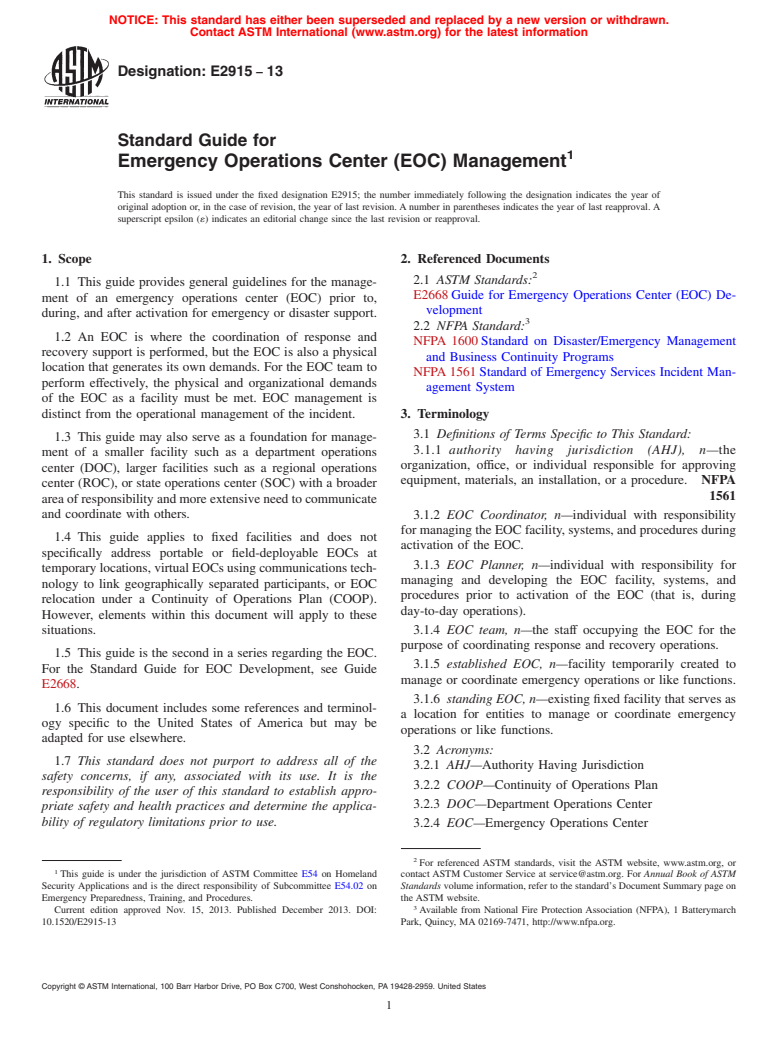

Standards Content (Sample)
NOTICE: This standard has either been superseded and replaced by a new version or withdrawn.
Contact ASTM International (www.astm.org) for the latest information
Designation: E2915 − 13
Standard Guide for
1
Emergency Operations Center (EOC) Management
This standard is issued under the fixed designation E2915; the number immediately following the designation indicates the year of
original adoption or, in the case of revision, the year of last revision. A number in parentheses indicates the year of last reapproval. A
superscript epsilon (´) indicates an editorial change since the last revision or reapproval.
1. Scope 2. Referenced Documents
2
2.1 ASTM Standards:
1.1 This guide provides general guidelines for the manage-
E2668 Guide for Emergency Operations Center (EOC) De-
ment of an emergency operations center (EOC) prior to,
velopment
during, and after activation for emergency or disaster support.
3
2.2 NFPA Standard:
1.2 An EOC is where the coordination of response and
NFPA 1600 Standard on Disaster/Emergency Management
recovery support is performed, but the EOC is also a physical
and Business Continuity Programs
location that generates its own demands. For the EOC team to
NFPA 1561 Standard of Emergency Services Incident Man-
perform effectively, the physical and organizational demands
agement System
of the EOC as a facility must be met. EOC management is
distinct from the operational management of the incident. 3. Terminology
3.1 Definitions of Terms Specific to This Standard:
1.3 This guide may also serve as a foundation for manage-
3.1.1 authority having jurisdiction (AHJ), n—the
ment of a smaller facility such as a department operations
organization, office, or individual responsible for approving
center (DOC), larger facilities such as a regional operations
equipment, materials, an installation, or a procedure. NFPA
center (ROC), or state operations center (SOC) with a broader
1561
area of responsibility and more extensive need to communicate
and coordinate with others. 3.1.2 EOC Coordinator, n—individual with responsibility
for managing the EOC facility, systems, and procedures during
1.4 This guide applies to fixed facilities and does not
activation of the EOC.
specifically address portable or field-deployable EOCs at
3.1.3 EOC Planner, n—individual with responsibility for
temporary locations, virtual EOCs using communications tech-
managing and developing the EOC facility, systems, and
nology to link geographically separated participants, or EOC
procedures prior to activation of the EOC (that is, during
relocation under a Continuity of Operations Plan (COOP).
day-to-day operations).
However, elements within this document will apply to these
3.1.4 EOC team, n—the staff occupying the EOC for the
situations.
purpose of coordinating response and recovery operations.
1.5 This guide is the second in a series regarding the EOC.
3.1.5 established EOC, n—facility temporarily created to
For the Standard Guide for EOC Development, see Guide
manage or coordinate emergency operations or like functions.
E2668.
3.1.6 standing EOC, n—existing fixed facility that serves as
1.6 This document includes some references and terminol-
a location for entities to manage or coordinate emergency
ogy specific to the United States of America but may be
operations or like functions.
adapted for use elsewhere.
3.2 Acronyms:
1.7 This standard does not purport to address all of the
3.2.1 AHJ—Authority Having Jurisdiction
safety concerns, if any, associated with its use. It is the
3.2.2 COOP—Continuity of Operations Plan
responsibility of the user of this standard to establish appro-
3.2.3 DOC—Department Operations Center
priate safety and health practices and determine the applica-
bility of regulatory limitations prior to use.
3.2.4 EOC—Emergency Operations Center
2
For referenced ASTM standards, visit the ASTM website, www.astm.org, or
1
This guide is under the jurisdiction of ASTM Committee E54 on Homeland contact ASTM Customer Service at service@astm.org. For Annual Book of ASTM
Security Applications and is the direct responsibility of Subcommittee E54.02 on Standards volume information, refer to the standard’s Document Summary page on
Emergency Preparedness, Training, and Procedures. the ASTM website.
3
Current edition approved Nov. 15, 2013. Published December 2013. DOI: Available from National Fire Protection Association (NFPA), 1 Batterymarch
10.1520/E2915-13 Park, Quincy, MA 02169-7471, http://www.nfpa.org.
Copyright © ASTM International, 100 Barr Harbor Drive, PO Box C700, West Conshohocken, PA 19428-2959. United States
1
---------------------- Page: 1 ----------------------
E2915 − 13
3.2.5 EOP—Emergency Operations Plan 6.2 Part of the complexity of EOC management is that these
tasks fall into a number of different areas of expertise and can
3.2.6 NFPA—National Fire Protection Agency
require different skill sets. Consequently, it is easy for critical
3.2.7 ROC—Regional Operations Center
tasks to be overlooked or not consi
...
Questions, Comments and Discussion
Ask us and Technical Secretary will try to provide an answer. You can facilitate discussion about the standard in here.