

ASTM C584-81(2016)
(Test Method)Standard Test Method for Specular Gloss of Glazed Ceramic Whitewares and Related Products
General Information
- Abstract
SIGNIFICANCE AND USE
4.1 This test method provides a means of establishing specular gloss limits for bright, semi-mat, and mat glazed surfaces. It is realized that specular gloss measurements do not always correlate well with visual rankings of glossiness because specular gloss is only one of several related appearance attributes that produce the sensation of gloss. However, the prescribed test method is of sufficient accuracy for the intended purpose.
Note 1: If a greater degree of distinction between bright glazed surfaces is desired, the 20° geometry instrument will provide it.4
SCOPE
1.1 This test method covers the determination of 60° specular gloss of glazed ceramic whitewares and related products.
1.2 This standard does not purport to address all of the safety concerns, if any, associated with its use. It is the responsibility of the user of this standard to establish appropriate safety and health practices and determine the applicability of regulatory limitations prior to use.
- Status
- Published
- Publication Date
- 30-Jun-2016
- Technical Committee
- C21 - Ceramic Whitewares and Related Products
- Drafting Committee
- C21.03 - Methods for Whitewares and Environmental Concerns


Overview
ASTM C584-81(2016), titled Standard Test Method for Specular Gloss of Glazed Ceramic Whitewares and Related Products, is a key international standard developed by ASTM International. This test method outlines a procedure for determining the 60° specular gloss of glazed ceramic whitewares and similar materials. Specular gloss is a measure of how much light is reflected in a mirror-like manner, contributing significantly to the aesthetic quality and perceived finish of ceramic products.
This standard is essential for manufacturers, quality control laboratories, and researchers working with glazed ceramics, ensuring consistency and comparability in gloss measurements across the industry. It supports product quality assurance, compliance with visual standards, and market acceptance for ceramics and related products.
Key Topics
Scope and Purpose:
- Covers the determination of 60° specular gloss for glazed ceramic whitewares and related products.
- Provides guidance for establishing gloss limits for bright, semi-mat, and mat glazed surfaces.
- Notes that specular gloss is only one aspect of surface appearance, and may not always align with visual perception.
Apparatus Requirements:
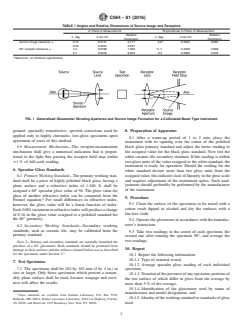
- Utilizes a glossmeter with a standardized configuration: an incandescent light source, lens system, specimen holder, and a receptor aligned to the 60° geometry.
- Requires primary and secondary working standards, such as polished black glass and ceramic tile, for instrument calibration.
Specimen Preparation and Test Procedure:
- Surfaces to be tested should be clean and free from contaminants. Standard specimen size is typically 102 by 102 mm.
- The procedure involves averaging two gloss readings per specimen, with the second reading taken after rotating the specimen 90°.
Reporting and Precision:
- Reports should include material type, gloss readings, any significant surface variation, glossmeter identification, and standard references.
- The method offers high repeatability (1% for same instrument) and reproducibility (5% between instruments), supporting reliable quality control.
Applications
Implementing ASTM C584-81(2016) provides several practical benefits in the ceramics industry and related fields:
- Quality Control: Enables consistent and objective measurement of the gloss finish in production batches, reducing variability and ensuring adherence to product specifications.
- Product Development: Assists R&D teams in optimizing glazing formulations and firing techniques to achieve desired surface finishes.
- Accreditation and Certification: Facilitates compliance with international regulatory and customer requirements for surface appearance and finish.
- Market Differentiation: Supports clear communication of product attributes in technical datasheets and marketing materials.
- Comparative Evaluation: Enables manufacturers and buyers to assess gloss level differences between products under standardized conditions.
Related Standards
- ASTM D523 - Test Method for Specular Gloss: A referenced general method for measuring specular gloss, applicable to a wide range of materials beyond ceramics.
- ISO 2813 - Paints and Varnishes - Determination of Gloss Value at 20°, 60°, and 85°: The corresponding international standard for gloss measurement on paint finishes, which may be relevant for comparison or harmonization with ASTM C584.
- ASTM C21 - Committee on Ceramic Whitewares and Related Products: The technical committee responsible for this and related standards in ceramics.
Adhering to ASTM C584-81(2016) ensures uniformity and confidence in gloss measurement for glazed ceramic whitewares, underpinning product reliability, quality, and customer satisfaction. For more information or access to the standard, visit ASTM International.
Relations
- Effective Date
- 01-Jul-2016
- Effective Date
- 01-Jan-2014
- Effective Date
- 01-Jun-2008
- Effective Date
- 01-Feb-2008
- Effective Date
- 10-May-1999
- Effective Date
- 01-Jul-2016
Frequently Asked Questions
ASTM C584-81(2016) is a standard published by ASTM International. Its full title is "Standard Test Method for Specular Gloss of Glazed Ceramic Whitewares and Related Products". This standard covers: SIGNIFICANCE AND USE 4.1 This test method provides a means of establishing specular gloss limits for bright, semi-mat, and mat glazed surfaces. It is realized that specular gloss measurements do not always correlate well with visual rankings of glossiness because specular gloss is only one of several related appearance attributes that produce the sensation of gloss. However, the prescribed test method is of sufficient accuracy for the intended purpose. Note 1: If a greater degree of distinction between bright glazed surfaces is desired, the 20° geometry instrument will provide it.4 SCOPE 1.1 This test method covers the determination of 60° specular gloss of glazed ceramic whitewares and related products. 1.2 This standard does not purport to address all of the safety concerns, if any, associated with its use. It is the responsibility of the user of this standard to establish appropriate safety and health practices and determine the applicability of regulatory limitations prior to use.
SIGNIFICANCE AND USE 4.1 This test method provides a means of establishing specular gloss limits for bright, semi-mat, and mat glazed surfaces. It is realized that specular gloss measurements do not always correlate well with visual rankings of glossiness because specular gloss is only one of several related appearance attributes that produce the sensation of gloss. However, the prescribed test method is of sufficient accuracy for the intended purpose. Note 1: If a greater degree of distinction between bright glazed surfaces is desired, the 20° geometry instrument will provide it.4 SCOPE 1.1 This test method covers the determination of 60° specular gloss of glazed ceramic whitewares and related products. 1.2 This standard does not purport to address all of the safety concerns, if any, associated with its use. It is the responsibility of the user of this standard to establish appropriate safety and health practices and determine the applicability of regulatory limitations prior to use.
ASTM C584-81(2016) is classified under the following ICS (International Classification for Standards) categories: 81.060.20 - Ceramic products. The ICS classification helps identify the subject area and facilitates finding related standards.
ASTM C584-81(2016) has the following relationships with other standards: It is inter standard links to ASTM C584-81(2011), ASTM D523-14, ASTM D523-08, ASTM D523-89(2008), ASTM D523-89(1999), ASTM E179-17(2022). Understanding these relationships helps ensure you are using the most current and applicable version of the standard.
ASTM C584-81(2016) is available in PDF format for immediate download after purchase. The document can be added to your cart and obtained through the secure checkout process. Digital delivery ensures instant access to the complete standard document.
Standards Content (Sample)
This international standard was developed in accordance with internationally recognized principles on standardization established in the Decision on Principles for the
Development of International Standards, Guides and Recommendations issued by the World Trade Organization Technical Barriers to Trade (TBT) Committee.
Designation: C584 − 81 (Reapproved 2016)
Standard Test Method for
Specular Gloss of Glazed Ceramic Whitewares and Related
Products
This standard is issued under the fixed designation C584; the number immediately following the designation indicates the year of
original adoption or, in the case of revision, the year of last revision. A number in parentheses indicates the year of last reapproval. A
superscript epsilon (´) indicates an editorial change since the last revision or reapproval.
NOTE 1—If a greater degree of distinction between bright glazed
1. Scope
surfaces is desired, the 20° geometry instrument will provide it.
1.1 This test method covers the determination of 60° specu-
lar gloss of glazed ceramic whitewares and related products.
5. Apparatus
1.2 This standard does not purport to address all of the
5.1 Instrumental Components—The apparatus shall consist
safety concerns, if any, associated with its use. It is the
of an incandescent light source and lens furnishing an incident
responsibility of the user of this standard to establish appro-
beam of rays of required aperture, means for locating the
priate safety and health practices and determine the applica-
surface of the specimen, and a receptor located to receive the
bility of regulatory limitations prior to use.
required pyramid of rays reflected from the specimen. The
receptor shall be a photosensitive device having maximum
2. Referenced Documents
response near the middle of the visible region of the specimen.
2.1 ASTM Standards:
5.2 Geometric Conditions—The axis of the incident beam
D523 Test Method for Specular Gloss
shall be 60° from the perpendicular to the specimen surface.
The axis of the receptor beam shall be coincident with the
3. Terminology
mirror image of the axis of the incident beam. A flat piece of
3.1 Definitions:
polished black glass in the specimen position shall form an
3.1.1 specular gloss—the ratio of reflected to incident light,
image of the source in the center of the receptor window. The
times 1000, for specified apertures of illumination and recep-
length of the illuminated area of the specimen shall be equal to
tionwhentheaxisofreceptioncoincideswiththemirrorimage
notmorethanonethirdthedistancefromthecenterofthisarea
of the axis of illumination.
to the receptor field stop.The axis of the incident beam and the
axis of the receptor shall be within 0.1° of the nominal value
4. Significance and Use
indicated by the geometry. The dimensions and tolerances of
4.1 This test method provides a means of establishing
the source and receptor shall be as indicated in Table 1 (see
specular gloss limits for bright, semi-mat, and mat glazed
also Test Method D523). The angular dimensions of the
surfaces. It is realized that specular gloss measurements do not
receptor field stop are measured from the receptor lens in a
always correlate well with visual rankings of glossiness be-
collimated-beam type instrument, and from the test surface in
cause specular gloss is only one of several related appearance
a converging-beam type instrument. See Fig. 1 for a general-
attributes that produce the sensation of gloss. However, the
ized illustration of the dimensions. The tolerances are chosen
prescribedtestmethodisofsufficientaccuracyfortheintended
so that errors of no more than one gloss unit at any point on the
purpose.
scale will result from errors in the source and receptor
apertures.
5.3 Vignetting—There shall be no vignetting of rays that lie
ThistestmethodisunderthejurisdictionofASTMCommitteeC21onCeramic within the field angles specified in 5.2.
Whitewares and Related Products and is the direct responsibility of Subcommittee
5.4 Spectral Conditions—Results should not differ signifi-
C21.03 on Methods for Whitewares and Environmental Concerns.
Current edition approved July 1, 2016. Published July 2016. Originally approved cantly from those obtained with a source-filter photocell
in 1965. Last previous edition approved in 2011 as C584 – 81 (2011). DOI:
combination that is spectrally corrected to yield CIE luminous
10.1520/C0584–81R16.
efficiency with CIE Source C. Since specular reflection is, in
For referenced ASTM standards, visit the ASTM website, www.astm.org, or
contact ASTM Customer Service at service@astm.org. For Annual Book of ASTM
Standards volume information, refer to the standard’s Document Summary page on
the ASTM website. DOI: 10.1520/C0584-81R06. For more complete data see Hammond III, H. K., and Nimeroff, I.,“ Measure-
See Illing, A. M., “Comparison of Instrument Measurement and Visual mentofSixty-DegreeSpecularGloss,” Journal of Research,Nat.BureauStandards,
Estimation of Specular Gloss of Glazed Ceramic Tile,” Materials Research & Vol 44, June 1950 ( RP 2105): also Hunter, R. S., “Gloss Evaluation of Materials,”
Standards, Vol 2, No. 2, Feb. 1962, p. 117. ASTM Bulletin, No. 186, December 1962.
Copyright © ASTM International, 100 Barr Harbor Drive, PO Box C700, West Conshohocken, PA 19428-2959. United States
C584 − 81 (2016)
TABLE 1 Angles and Relative Dimensions of Source Image and Receptors
In Plane of Measurement Perpendicular to Plane of Measurement
Relative Relative
θ, deg 2 tan θ/2 θ, deg 2 tan θ/2
Dimension Dimension
A
Source image tolerance ± 0.75 0.0131 0.171 3.0 0.0524 0.682
0.25 0.0044 0.057
60° receptor tolerance ± 4.4 0.0768 1.000 11.7 0.2049 2.668
0.1 0.0018 0.023 0.2 0.0035 0.046
A
Maximum; no minimum specification.
FIG. 1 Generalized Glossmeter Showing Apertures and Source Image F
...