

ASTM D7781-23
(Test Method)Standard Test Method for Nitrite-Nitrate in Water by Nitrate Reductase
General Information
- Abstract
SIGNIFICANCE AND USE
5.1 This test method replaces Methods D1254 (Nitrite) and D992 (Nitrate). The nitrite test method (Method D1254) used a reagent that is considered to be a potential carcinogen. The nitrate test method (Method D992) has been shown to have relatively large errors when used in wastewaters and also has greater manipulative difficulties than the test method described herein.
5.2 This test method can be used in place of Test Methods D3867 (Nitrite-Nitrate). Test Methods D3867 uses cadmium for the reduction of nitrate to nitrite. Cadmium is considered a toxic metal. Also, the heterogeneous cadmium reductant creates greater difficulty than the reduction described in this test method.
SCOPE
1.1 This test method is applicable to the determination of nitrate plus nitrite (as nitrogen) in drinking water, surface, saline, wastewater, and ground waters. The applicable range of this test method is from 0.05 to 5 mg/L of nitrogen. The range may be extended upward by dilution of an appropriate aliquot. The 40 CFR Part 136 Method Detection Limit (MDL) is 0.02 mg/L.
1.2 It is the user's responsibility to ensure the validity of this test method for waters of untested matrices. The quality control criteria in Section 17 for method blanks, laboratory control samples, matrix spikes and matrix duplicates must be met.
1.3 The values stated in SI units are regarded as standard. No other units of measurement are included in this standard.
1.4 This standard does not purport to address all of the safety concerns, if any, associated with its use. It is the responsibility of the user of this standard to establish appropriate safety, health, and environmental practices and determine the applicability of regulatory limitations prior to use.
1.5 This international standard was developed in accordance with internationally recognized principles on standardization established in the Decision on Principles for the Development of International Standards, Guides and Recommendations issued by the World Trade Organization Technical Barriers to Trade (TBT) Committee.
- Status
- Published
- Publication Date
- 31-Mar-2023
- Technical Committee
- D19 - Water
- Drafting Committee
- D19.05 - Inorganic Constituents in Water
Overview
ASTM D7781-23 is the Standard Test Method for Nitrite-Nitrate in Water by Nitrate Reductase, developed by ASTM International. This standard specifies procedures for the determination of combined nitrate and nitrite (as nitrogen) in various water matrices, including drinking water, surface water, saline water, groundwater, and wastewater. The method utilizes the enzyme nitrate reductase to reduce nitrate to nitrite, which is subsequently measured using a colorimetric reaction and spectrophotometric detection.
This test method provides a safer and more reliable alternative to earlier ASTM methods that involved hazardous reagents or toxic metals, such as carcinogenic compounds and cadmium. The applicable concentration range is from 0.05 to 5 mg/L of nitrogen, with a method detection limit (MDL) as low as 0.02 mg/L, and the range can be extended by dilution where needed.
Key Topics
- Nitrate and Nitrite Detection: Accurate measurement of nitrate and nitrite concentrations for regulatory compliance and environmental monitoring.
- Nitrate Reductase Enzymatic Reduction: Use of NAD(P)H:nitrate reductase enzyme for nitrate-to-nitrite conversion, avoiding toxic cadmium reduction processes.
- Spectrophotometric Determination: Quantification via the Griess reaction, which forms a colored azo dye detectable at approximately 540 nm.
- Applicable Water Types: Comprehensive applicability to potable water, groundwaters, surface waters, saline/brackish waters, and wastewaters.
- Quality Control Measures: Requirements for method blanks, laboratory control samples, matrix spikes, and duplicates to ensure validity and precision of results.
- Environmental and Health Safety: Eliminates carcinogenic and toxic reagents, offering a method that improves both operator safety and environmental impact.
- Regulatory Considerations: Meets international principles for standardization and is aligned with US EPA (40 CFR Part 136) requirements.
Applications
The ASTM D7781-23 standard is widely used for:
- Drinking Water Quality Monitoring: Ensures compliance with health-based standards for nitrate and nitrite, critical for water utilities and laboratories.
- Wastewater Assessment: Monitors nutrient pollution and process performance in municipal and industrial wastewater treatment plants.
- Environmental Water Analysis: Supports watershed management and ecological studies by tracking nitrogen species in surface and groundwater.
- Saline and Brackish Water Testing: Adaptable for marine and estuarine environments through the use of synthetic seawater standards.
- Regulatory Reporting: Accepted method for reporting nitrite and nitrate concentrations for regulatory agencies and environmental compliance.
- Research and Laboratory Validation: Provides a robust, validated procedure for academic, government, and commercial laboratories.
Related Standards
- ASTM D3867: Test Methods for Nitrite-Nitrate in Water (cadmium reduction method; replaced by D7781-23 for safer alternatives).
- ASTM D1193: Specification for Reagent Water.
- ASTM D1141: Practice for Preparation of Substitute Ocean Water (for saline samples).
- ASTM D5810: Guide for Spiking into Aqueous Samples (for quality control).
- ASTM D6146: Guide for Monitoring Aqueous Nutrients in Watersheds.
- ASTM D1129: Terminology Relating to Water.
- ASTM D1254 / D0992: Withdrawn methods for nitrite and nitrate, respectively, replaced for improved safety and accuracy.
Keywords: nitrate, nitrite, drinking water testing, wastewater analysis, nitrate reductase, Griess reaction, water quality, spectrophotometric method, ASTM D7781-23, environmental monitoring, regulatory compliance, nitrogen analysis.
Relations
- Effective Date
- 01-May-2020
- Effective Date
- 01-Aug-2018
- Effective Date
- 15-Jun-2012
- Effective Date
- 01-May-2011
- Effective Date
- 01-Mar-2010
- Effective Date
- 15-May-2009
- Effective Date
- 15-Jul-2008
- Effective Date
- 15-Apr-2007
- Effective Date
- 01-Sep-2006
- Effective Date
- 01-Sep-2006
- Effective Date
- 15-Aug-2006
- Effective Date
- 01-Mar-2006
- Effective Date
- 15-Feb-2006
- Effective Date
- 01-Jul-2004
- Effective Date
- 01-Mar-2004
Get Certified
Connect with accredited certification bodies for this standard

CIS Institut d.o.o.
Personal Protective Equipment (PPE) certification body. Notified Body NB-2890 for EU Regulation 2016/425 PPE.

Kiwa BDA Testing
Building and construction product certification.
Kmetijski inštitut Slovenije
Agricultural Institute of Slovenia. Soil testing, plant health, agricultural product analysis.
Sponsored listings
Frequently Asked Questions
ASTM D7781-23 is a standard published by ASTM International. Its full title is "Standard Test Method for Nitrite-Nitrate in Water by Nitrate Reductase". This standard covers: SIGNIFICANCE AND USE 5.1 This test method replaces Methods D1254 (Nitrite) and D992 (Nitrate). The nitrite test method (Method D1254) used a reagent that is considered to be a potential carcinogen. The nitrate test method (Method D992) has been shown to have relatively large errors when used in wastewaters and also has greater manipulative difficulties than the test method described herein. 5.2 This test method can be used in place of Test Methods D3867 (Nitrite-Nitrate). Test Methods D3867 uses cadmium for the reduction of nitrate to nitrite. Cadmium is considered a toxic metal. Also, the heterogeneous cadmium reductant creates greater difficulty than the reduction described in this test method. SCOPE 1.1 This test method is applicable to the determination of nitrate plus nitrite (as nitrogen) in drinking water, surface, saline, wastewater, and ground waters. The applicable range of this test method is from 0.05 to 5 mg/L of nitrogen. The range may be extended upward by dilution of an appropriate aliquot. The 40 CFR Part 136 Method Detection Limit (MDL) is 0.02 mg/L. 1.2 It is the user's responsibility to ensure the validity of this test method for waters of untested matrices. The quality control criteria in Section 17 for method blanks, laboratory control samples, matrix spikes and matrix duplicates must be met. 1.3 The values stated in SI units are regarded as standard. No other units of measurement are included in this standard. 1.4 This standard does not purport to address all of the safety concerns, if any, associated with its use. It is the responsibility of the user of this standard to establish appropriate safety, health, and environmental practices and determine the applicability of regulatory limitations prior to use. 1.5 This international standard was developed in accordance with internationally recognized principles on standardization established in the Decision on Principles for the Development of International Standards, Guides and Recommendations issued by the World Trade Organization Technical Barriers to Trade (TBT) Committee.
SIGNIFICANCE AND USE 5.1 This test method replaces Methods D1254 (Nitrite) and D992 (Nitrate). The nitrite test method (Method D1254) used a reagent that is considered to be a potential carcinogen. The nitrate test method (Method D992) has been shown to have relatively large errors when used in wastewaters and also has greater manipulative difficulties than the test method described herein. 5.2 This test method can be used in place of Test Methods D3867 (Nitrite-Nitrate). Test Methods D3867 uses cadmium for the reduction of nitrate to nitrite. Cadmium is considered a toxic metal. Also, the heterogeneous cadmium reductant creates greater difficulty than the reduction described in this test method. SCOPE 1.1 This test method is applicable to the determination of nitrate plus nitrite (as nitrogen) in drinking water, surface, saline, wastewater, and ground waters. The applicable range of this test method is from 0.05 to 5 mg/L of nitrogen. The range may be extended upward by dilution of an appropriate aliquot. The 40 CFR Part 136 Method Detection Limit (MDL) is 0.02 mg/L. 1.2 It is the user's responsibility to ensure the validity of this test method for waters of untested matrices. The quality control criteria in Section 17 for method blanks, laboratory control samples, matrix spikes and matrix duplicates must be met. 1.3 The values stated in SI units are regarded as standard. No other units of measurement are included in this standard. 1.4 This standard does not purport to address all of the safety concerns, if any, associated with its use. It is the responsibility of the user of this standard to establish appropriate safety, health, and environmental practices and determine the applicability of regulatory limitations prior to use. 1.5 This international standard was developed in accordance with internationally recognized principles on standardization established in the Decision on Principles for the Development of International Standards, Guides and Recommendations issued by the World Trade Organization Technical Barriers to Trade (TBT) Committee.
ASTM D7781-23 is classified under the following ICS (International Classification for Standards) categories: 13.060.50 - Examination of water for chemical substances. The ICS classification helps identify the subject area and facilitates finding related standards.
ASTM D7781-23 has the following relationships with other standards: It is inter standard links to ASTM D1129-13(2020)e2, ASTM D6146-97(2018), ASTM D6146-97(2012), ASTM D5810-96(2011), ASTM D1129-10, ASTM D3867-09, ASTM D1141-98(2008), ASTM D6146-97(2007), ASTM D1129-06ae1, ASTM D1129-06a, ASTM D5810-96(2006), ASTM D1193-06, ASTM D1129-06, ASTM D3867-04, ASTM D1129-04e1. Understanding these relationships helps ensure you are using the most current and applicable version of the standard.
ASTM D7781-23 is available in PDF format for immediate download after purchase. The document can be added to your cart and obtained through the secure checkout process. Digital delivery ensures instant access to the complete standard document.
Standards Content (Sample)
This international standard was developed in accordance with internationally recognized principles on standardization established in the Decision on Principles for the
Development of International Standards, Guides and Recommendations issued by the World Trade Organization Technical Barriers to Trade (TBT) Committee.
Designation: D7781 − 23
Standard Test Method for
Nitrite-Nitrate in Water by Nitrate Reductase
This standard is issued under the fixed designation D7781; the number immediately following the designation indicates the year of
original adoption or, in the case of revision, the year of last revision. A number in parentheses indicates the year of last reapproval. A
superscript epsilon (´) indicates an editorial change since the last revision or reapproval.
1. Scope D1193 Specification for Reagent Water
D1254 Method of Test for Nitrite Ion in Water (Withdrawn
1.1 This test method is applicable to the determination of
1980)
nitrate plus nitrite (as nitrogen) in drinking water, surface,
D3867 Test Methods for Nitrite-Nitrate in Water
saline, wastewater, and ground waters. The applicable range of
D5810 Guide for Spiking into Aqueous Samples
this test method is from 0.05 to 5 mg/L of nitrogen. The range
D6146 Guide for Monitoring Aqueous Nutrients in Water-
may be extended upward by dilution of an appropriate aliquot.
sheds
The 40 CFR Part 136 Method Detection Limit (MDL) is 0.02
mg/L.
3. Terminology
1.2 It is the user’s responsibility to ensure the validity of this
3.1 Definitions—For definitions of terms used in these test
test method for waters of untested matrices. The quality control
methods, refer to Terminology D1129.
criteria in Section 17 for method blanks, laboratory control
3.2 Definitions of Terms Specific to This Standard:
samples, matrix spikes and matrix duplicates must be met.
3.2.1 bispecific NaR, n—nitrate reductase that can use either
1.3 The values stated in SI units are regarded as standard.
NADH or NADPH as its electron donor (cofactor).
No other units of measurement are included in this standard.
3.2.2 discrete analyzer, n—a programmable, computer-
1.4 This standard does not purport to address all of the
controlled instrument that automates wet-chemical analysis by
safety concerns, if any, associated with its use. It is the
using one or more robotic arms interfaced to high-precision
responsibility of the user of this standard to establish appro-
volumetric dispensers to aspirate and dispense samples,
priate safety, health, and environmental practices and deter-
standards, diluents, and reagents.
mine the applicability of regulatory limitations prior to use.
1.5 This international standard was developed in accor-
3.2.3 Greiss reaction, n—chemical formation of an azo dye
dance with internationally recognized principles on standard-
by diazotization of nitrite ion with sulfanilamide and subse-
ization established in the Decision on Principles for the
quent coupling with N-(1-naphthyl)ethylenediamine hydro-
Development of International Standards, Guides and Recom-
chloride.
mendations issued by the World Trade Organization Technical
3.2.4 NADH, n—nicotinamide adenine dinucleotide, re-
Barriers to Trade (TBT) Committee.
duced form is a coenzyme found in all living cells.
2. Referenced Documents
3.2.5 NADPH, n—nicotinamide adenine dinucleotide
2.1 ASTM Standards: phosphate, reduced form is a coenzyme found in all living
D0992 Method of Test for Nitrate Ion in Water (Withdrawn cells; NADP+ is the oxidizing form and NADPH is the
1983) reducing form.
D1129 Terminology Relating to Water
3.2.6 nitrate reductase (NaR), n—NADH:NaR (EC1.7.1.1
D1141 Practice for Preparation of Substitute Ocean Water
and CAS 9013-03-0) or bispecific NaR (EC 1.7.1.2 and CAS
9029-27-0) with 1 unit of enzyme activity defined as 1
This test method is under the jurisdiction of ASTM Committee D19 on Water
micromol nitrite produced per minute at 30 °C, at pH 7 with
and is the direct responsibility of Subcommittee D19.05 on Inorganic Constituents
NADH (refer to 3.2.4 and 10.2) as an electron donor.
in Water.
Current edition approved April 1, 2023. Published April 2023. Originally
approved in 2014. Last previous edition was approved in 2014 as D7781 – 14 which 4. Summary of Test Method
was withdrawn January 2023 and reinstated in April 2023. DOI: 10.1520/D7781-23.
4.1 Nitrite-Nitrate Nitrogen—The sample is mixed with a
For referenced ASTM standards, visit the ASTM website, www.astm.org, or
contact ASTM Customer Service at service@astm.org. For Annual Book of ASTM
buffered solution containing NAD(P)H: nitrate reductase (EC
Standards volume information, refer to the standard’s Document Summary page on
1.7.1-3) and NADH or NADPH to reduce nitrate ion to nitrite
the ASTM website.
ion. The combined nitrite-nitrate (expressed as mg/L
The last approved version of this historical standard is referenced on
www.astm.org. NO +NO -N) is determined by diazotizing the total nitrite ion
3 2
Copyright © ASTM International, 100 Barr Harbor Drive, PO Box C700, West Conshohocken, PA 19428-2959. United States
D7781 − 23
TABLE 1 Determination of Nitrate in the Presence of Potential
with sulfanilamide and coupling with N-(1-naphthyl) ethylene-
Interferences
diamine dihydrochloride to form a highly colored azo dye that
Unspiked Spiked
is measured spectrophotometrically at about 540 nm.
Concentration Spike
Sample Sample %
Species Added Added
Result Results Recovery
4.2 Nitrite Nitrogen—The nitrite ion (expressed as mg/L
(mg/L) (mg/L)
(mg/L) (mg/L)
NO -N) originally present in the sample can be determined
-
Cl 500 0.02 0.23 0.200 105
separately by carrying out the procedure and omitting the
0.17 2.54 2.50 95
reduction step.
-
F 500 0.01 0.22 0.200 105
4.3 Nitrate Nitrogen—The nitrate ion as nitrogen can be
-
calculated as the difference between the combined nitrate plus
Br 500 <0.01 0.21 0.200 100
0.15 2.65 2.50 100
nitrite (NO +NO -N) and the nitrite (NO -N):
3 2 2
-3
mg⁄LNO 2 N 5 mg⁄L~NO 1 NO 2 N! 2 mg⁄L~NO 2 N! PO 500 0.01 0.22 0.200 105
3 3 2 2
0.14 2.54 2.50 96
(1)
-2
SO 500 <0.01 0.21 0.200 105
5. Significance and Use
0.14 2.53 2.50 96
5.1 This test method replaces Methods D1254 (Nitrite) and
Fe 500 0.17 2.60 2.50 97
D992 (Nitrate). The nitrite test method (Method D1254) used
1.0 <0.01 0.21 0.200 105
0.168 2.59 2.50 96
a reagent that is considered to be a potential carcinogen. The
nitrate test method (Method D992) has been shown to have
Zn 1.0 <0.01 0.22 0.200 110
relatively large errors when used in wastewaters and also has 0.14 2.64 2.50 100
greater manipulative difficulties than the test method described
Al 1.0 <0.01 0.21 0.200 105
herein.
0.14 2.53 2.50 96
5.2 This test method can be used in place of Test Methods
-
BrO 1.0 <0.01 0.22 0.200 110
D3867 (Nitrite-Nitrate). Test Methods D3867 uses cadmium
0.17 2.64 2.50 99
for the reduction of nitrate to nitrite. Cadmium is considered a
-
ClO 1.0 0.01 0.22 0.200 110
toxic metal. Also, the heterogeneous cadmium reductant cre-
0.14 2.54 2.50 96
ates greater difficulty than the reduction described in this test
-
CLo 1.0 0.23 2.45 2.50 89
method.
CHCL >Miscibility <0.01 0.21 0.200 105
6. Interferences
6.1 Turbid samples should be filtered prior to analysis to
eliminate particulate interference.
7.2 Purity of Water—Unless otherwise indicated, references
6.2 Sample color that absorbs at wavelengths between 520
to water shall be understood to mean reagent water conforming
and 540 nm interferes with the absorbance measurements.
to Specification D1193, Type I or Type II. Other reagent water
When color is suspect, analyze a sample blank, omitting the
types may be used, provided it is first ascertained that the water
N-(1-naphthyl)ethylenediamine dihydrochloride from the color
is of sufficiently high purity to permit its use without adversely
reagent.
affecting the bias and precision of these test methods.
NOTE 1—The instrumentation described in this standard may automati-
cally correct for some turbidity and sample color. See the instrument
8. Sampling and Sample Preservation
manual for further information.
8.1 Collect the sample in accordance with Guide D6146.
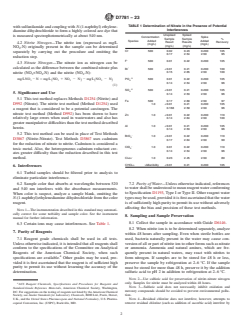
6.3 Certain ions may cause interferences. See Table 1.
8.2 When nitrite ion is to be determined separately, analyze
7. Purity of Reagents
within 48 hours after sampling. Even when sterile bottles are
7.1 Reagent grade chemicals shall be used in all tests. used, bacteria naturally present in the water may cause con-
Unless otherwise indicated, it is intended that all reagents shall version of all or part of nitrite ion to other forms such as nitrate
conform to the specifications of the Committee on Analytical or ammonia. Ammonia and natural amines, which are fre-
Reagents of the American Chemical Society, when such quently present in natural waters, may react with nitrites to
specifications are available. Other grades may be used, pro- form nitrogen. If samples are to be stored for 48 h or less,
vided it is first ascertained that the reagent is of sufficient high
preserve the sample by refrigeration at 2–6 °C. If the sample
purity to permit its use without lessening the accuracy of the must be stored for more than 48 h, preserve it by the addition
determination.
sulfuric acid to pH 2 in addition to refrigeration at 2–6 °C.
NOTE 2—Use sulfuric acid for preservation of nitrite-nitrate nitrogen
only. Samples for nitrite must be analyzed within 48 hours.
ACS Reagent Chemicals, Specifications and Procedures for Reagents and
NOTE 3—Sulfuric acid does not necessarily inhibit oxidation and
Standard-Grade Reference Materials, American Chemical Society, Washington,
mercury compounds should be avoided to prevent environmental pollu-
DC. For suggestions on the testing of reagents not listed by the American Chemical
tion.
Society, see Analar Standards for Laboratory Chemicals, BDH Ltd., Poole, Dorset,
U.K., and the United States Pharmacopeia and National Formulary, U.S. Pharma- NOTE 4—Residual chlorine does not interfere, however, attempts to
copeial Convention, Inc. (USPC), Rockville, MD. remove residual chlorine (such as addition of ascorbic acid) interfere by
D7781 − 23
TABLE 2 Example Concentrations of Calibration Standards
10.5 N-(1-naphthyl)ethylenediamine dihydrochloride
mL of 10 mg/L Standard Solution/100 mL (NED) Solution (1 g ⁄L)—dissolve 1 g NED
NO -N or NO -N, mg/L
3 2
final volume
(C H NHCH CH NH ·2HCl) in about 500 mL reagent water
10 7 2 2 2
0.05 0.5
contained in a 1000 mL volumetric flask, dilute to the mark and
0.1 1.0
mix. Transfer to a glass or amber screw-cap container. This
0.5 5.0
1.0 10
solution is stable for 6 months at 20 °C.
2.0 20
3.0 30
10.6 Nitrate Reductase (NaR)—Follow the manufacturer’s
5.0 50
instructions for preparing a solution of 1 unit NaR (refer to
3.2.6) activity per mL of phosphate buffer (refer to 10.1).
Dilute 3 units NaR to 20 mL with phosphate buffer. Store the
TABLE 3 Reduction Efficiency
solution at 2–6 °C, where it is stable for 8 hours. Prepare
mL of 10 mg/L Standard Solution/100 mL
NO -N or NO -N, mg/L
3 2
sufficient NaR for the total number of samples and standards to
final volume
be analyzed.
Mean (%) 103
Standard Deviation 4.14
Lower Limit (%) 91 NOTE 7—For some NaR forms, high phenolic content humic substances
Upper Limit (%) 115
(>2 mg dissolved organic carbon /L) have little affect on the NaR activity
in the temperature range of 5–15 °C, but become increasingly inhibitory in
the temperature range of 20–30 °C. Humic substances at the operation
temperatures specified in this standard do not inhibit other forms of NaR.
If humic acids are expected to be present the user must verify reduction
inhibiting reduction of nitrate to nitrite. Do attempt to remove residual
efficiency of the NaR is use by analysis of Quality Control checks that
chlorine.
approximate the sample matrix.
9. Apparatus
10.7 Nitrate Solution, Stock (1000 mg/L NO -N)—Dry po-
tassium nitrate (KNO ) in an oven at 105 °C for 24 h. Dissolve
9.1 Automated discrete analysis system (see 3.2.2).
7.218 g in water in about 500 mL reagent water contained in a
10. Reagents
1000 mL volumetric flask, dilute to the mark and mix. This
solution is stable for up to 2 months with refrigeration.
10.1 Phosphate Buffer Solution—Dissolve 3.75 g of potas-
Alternatively, certified nitrate stock solutions are commercially
sium dihydrogen phosphate (KH2PO4), 0.01 g of disodium
available through chemical supply vendors and may be used.
ethylenediaminetetraacetate dehydrate
(C H O N Na ·2H O), and 1.4 g potassium hydroxide
10 14 8 2 2 2
10.8 Nitrate Solution, Standard (10 mg/L NO -N)—Dilute
(KOH) in about 500 mL reagent water contained in a 1000 mL
10 mL of stock nitrate solution (10.7) to 1 L with water and
volumetric flask, dilute to the mark and mix. Transfer this
store in a dark bottle. Prepare fresh as needed.
solution to a screw-cap container and store at 2–6 °C. This
10.9 Nitrite Solution, Stock (1000 mg/L NO -N)—Place
solution is stable for 6 months.
about 7 g of potassium nitrite (KNO ) in a tared 125-mL beaker
10.2 β-nicotinamide adenine dinucleotide, Reduced Form
and dry for about 24 h to a constant weight in a desiccator
(NADH) Stock Solution (2 mg/mL)—Dissolve 0.1 g NADH
containing a suitable desiccant. Adjust the weight of the dry
(C H N O P ) in 25 mL of reagent water contained in a 50
21 27 7 14 2
potassium nitrite to 6.072 g. Add 50 mL of water to the beaker,
mL volumetric flask, dilute to the mark and mix. Transfer 1-mL
stir until dissolved, and transfer quantitatively to a 1000-mL
aliquots to 1.5 mL snap-cap colorless polypropylene vials and
volumetric flask. Dilute to the mark with water store in a
store at –20 °C. Stable for 1 month.
sterilized bottle under refrigeration. Prepare fresh as needed.
NOTE 5—NADH is a hygroscopic white powder that is freely soluble in
Alternatively, certified nitrite stock solutions are commercially
water. The solids are stable if stored dry and protected from light. Neutral
available through chemical supply vendors and may be used.
solutions are colorless and stable for 1 week if stored at 4 °C, but
decompose rapidly under basic or acidic conditions.
NOTE 8—Potassium nitrite is easily oxidized; use only dry, free flowing
10.3 NADH Working Solution—Thaw one 1-mL vial of
white, or yellowish white crystalline powder of this reagent.
NADH stock (refer to 10.2) and dilute to 10 mL with phosphate
10.10 Nitrite Solution, Standard (10 mg/L NO -N)—Dilute
buffer (refer to 10.1). This reagent is stable for about 8 hours.
10 mL of stock nitrite solution (10.9) to 1 L with water. This
Prepare sufficient NADH working solution for the number of
solution is unstable; prepare fresh as needed.
samples and standards to be analyzed.
NOTE 6—NADH inhibits color formation in the Greiss reaction (refer to
11. Hazards
3.2.3). The molar concentration of NADH in the reduction medium should
be about twice that of the highest calibration standard.
11.1 All reagents and standards should be prepared in
volumes consistent with laboratory use to minimize the gen-
10.4 Sulfanilamide (SAN) Reagent (10 g ⁄L)—While stirring
eration of waste.
constantly add 300 mL of concentrated hydrochloric acid (HCl,
37 % w/v)) and 10 g of sulfanilamide (SAN, C H N O S) to
6 8 2 2
about 500 mL reagent water contained in a 1000 mL volumet-
ric flask, dilute to the mark and mix. This solution is stable for
NaR available from the Nitrate Elimination Company Inc. (NECi),
about six months when stored in a brown bottle at 20 °C. www.nitrate.com, has been found suitable.
D7781 − 23
12. Calibration 13. Conditioning
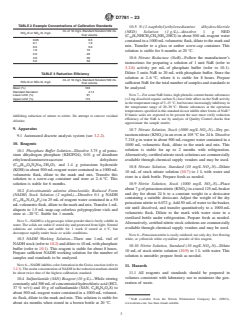
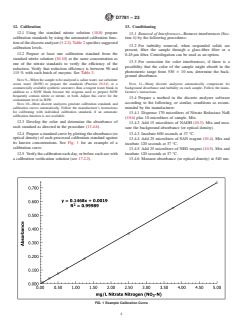
12.1 Using the standard nitrate solution (10.8) prepare
13.1 Removal of Interferences—Remove interferences (Sec-
calibration standards by using the automated calibration func-
tion 6) by the following procedures:
tion of the discrete analyzer (3.2.2). Table 2 specifies suggested
13.2 For turbidity removal, when suspended solids are
calibration levels.
present, filter the sample through a glass-fiber filter or a
12.2 Prepare at least one calibration standard from the
0.45-μm filte
...