


ASTM D5845-01(2011)
(Test Method)Standard Test Method for Determination of MTBE, ETBE, TAME, DIPE, Methanol, Ethanol and tert-Butanol in Gasoline by Infrared Spectroscopy
Standard Test Method for Determination of MTBE, ETBE, TAME, DIPE, Methanol, Ethanol and <span class="italic">tert</span>-Butanol in Gasoline by Infrared Spectroscopy
SIGNIFICANCE AND USE
Alcohols and ethers are added to gasoline to produce a reformulated lower emissions gasoline. Alcohols and ethers may also be added to gasoline to increase the octane number. Type and concentration of various oxygenates are specified and regulated to ensure acceptable commercial gasoline quality. Driveability, vapor pressure, phase separation, and evaporative emissions are some of the concerns associated with oxygenated fuels.
This test method is faster, simpler, less expensive and more portable than current methods.
This test method may be applicable for quality control in the production of gasoline.
This test method is not suitable for testing for compliance with federal regulations.
False positive readings for some of the samples tested in the round robin were sometimes observed. As only extreme base gasolines were tested in the round robin, no definitive statement can be made as to the expected frequency or magnitude of false positives expected in a wider range of base gasolines.
SCOPE
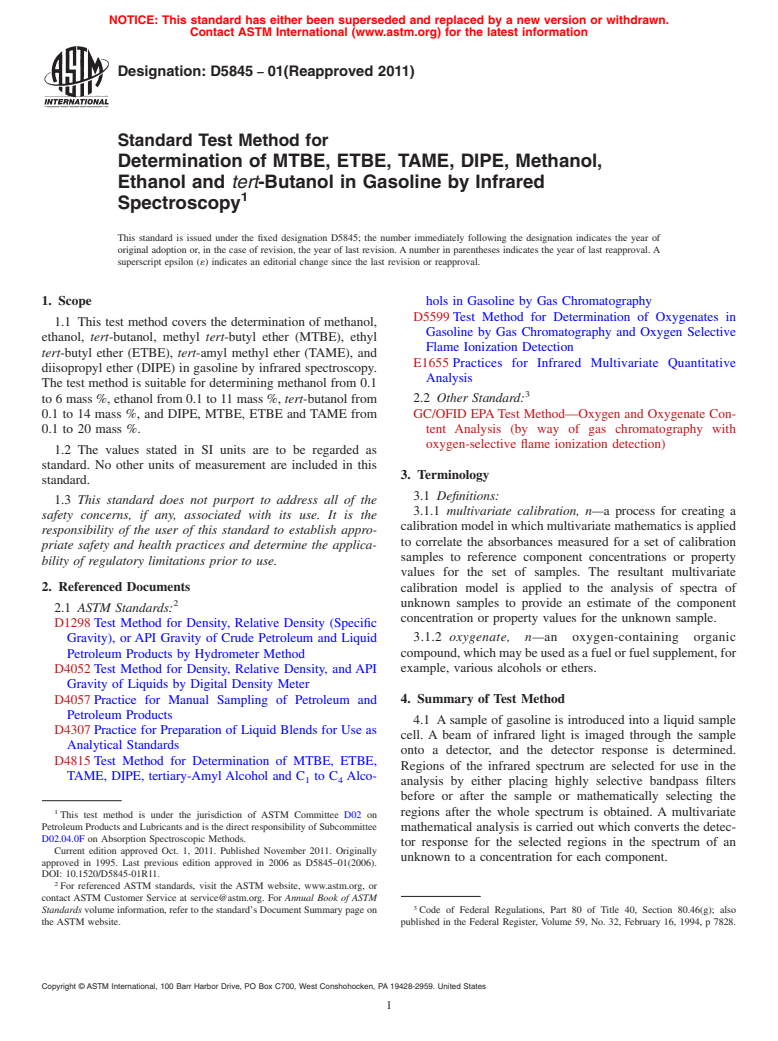
1.1 This test method covers the determination of methanol, ethanol, tert-butanol, methyl tert-butyl ether (MTBE), ethyl tert-butyl ether (ETBE), tert-amyl methyl ether (TAME), and diisopropyl ether (DIPE) in gasoline by infrared spectroscopy. The test method is suitable for determining methanol from 0.1 to 6 mass %, ethanol from 0.1 to 11 mass %, tert-butanol from 0.1 to 14 mass %, and DIPE, MTBE, ETBE and TAME from 0.1 to 20 mass %.
1.2 The values stated in SI units are to be regarded as standard. No other units of measurement are included in this standard.
1.3 This standard does not purport to address all of the safety concerns, if any, associated with its use. It is the responsibility of the user of this standard to establish appropriate safety and health practices and determine the applicability of regulatory limitations prior to use.
General Information
Standards Content (Sample)
NOTICE: This standard has either been superseded and replaced by a new version or withdrawn.
Contact ASTM International (www.astm.org) for the latest information
Designation: D5845 − 01(Reapproved 2011)
Standard Test Method for
Determination of MTBE, ETBE, TAME, DIPE, Methanol,
Ethanol and tert-Butanol in Gasoline by Infrared
Spectroscopy
This standard is issued under the fixed designation D5845; the number immediately following the designation indicates the year of
original adoption or, in the case of revision, the year of last revision. A number in parentheses indicates the year of last reapproval. A
superscript epsilon (´) indicates an editorial change since the last revision or reapproval.
1. Scope hols in Gasoline by Gas Chromatography
D5599 Test Method for Determination of Oxygenates in
1.1 This test method covers the determination of methanol,
Gasoline by Gas Chromatography and Oxygen Selective
ethanol, tert-butanol, methyl tert-butyl ether (MTBE), ethyl
Flame Ionization Detection
tert-butyl ether (ETBE), tert-amyl methyl ether (TAME), and
E1655 Practices for Infrared Multivariate Quantitative
diisopropyl ether (DIPE) in gasoline by infrared spectroscopy.
Analysis
The test method is suitable for determining methanol from 0.1
to 6 mass %, ethanol from 0.1 to 11 mass %, tert-butanol from 2.2 Other Standard:
0.1 to 14 mass %, and DIPE, MTBE, ETBE and TAME from GC/OFID EPATest Method—Oxygen and Oxygenate Con-
0.1 to 20 mass %. tent Analysis (by way of gas chromatography with
oxygen-selective flame ionization detection)
1.2 The values stated in SI units are to be regarded as
standard. No other units of measurement are included in this
3. Terminology
standard.
3.1 Definitions:
1.3 This standard does not purport to address all of the
3.1.1 multivariate calibration, n—a process for creating a
safety concerns, if any, associated with its use. It is the
calibration model in which multivariate mathematics is applied
responsibility of the user of this standard to establish appro-
to correlate the absorbances measured for a set of calibration
priate safety and health practices and determine the applica-
samples to reference component concentrations or property
bility of regulatory limitations prior to use.
values for the set of samples. The resultant multivariate
2. Referenced Documents
calibration model is applied to the analysis of spectra of
2 unknown samples to provide an estimate of the component
2.1 ASTM Standards:
concentration or property values for the unknown sample.
D1298 Test Method for Density, Relative Density (Specific
3.1.2 oxygenate, n—an oxygen-containing organic
Gravity), or API Gravity of Crude Petroleum and Liquid
Petroleum Products by Hydrometer Method compound,whichmaybeusedasafuelorfuelsupplement,for
example, various alcohols or ethers.
D4052 Test Method for Density, Relative Density, and API
Gravity of Liquids by Digital Density Meter
D4057 Practice for Manual Sampling of Petroleum and 4. Summary of Test Method
Petroleum Products
4.1 A sample of gasoline is introduced into a liquid sample
D4307 Practice for Preparation of Liquid Blends for Use as
cell. A beam of infrared light is imaged through the sample
Analytical Standards
onto a detector, and the detector response is determined.
D4815 Test Method for Determination of MTBE, ETBE,
Regions of the infrared spectrum are selected for use in the
TAME, DIPE, tertiary-Amyl Alcohol and C to C Alco-
1 4
analysis by either placing highly selective bandpass filters
before or after the sample or mathematically selecting the
regions after the whole spectrum is obtained. A multivariate
This test method is under the jurisdiction of ASTM Committee D02 on
Petroleum Products and Lubricants and is the direct responsibility of Subcommittee
mathematical analysis is carried out which converts the detec-
D02.04.0F on Absorption Spectroscopic Methods.
tor response for the selected regions in the spectrum of an
Current edition approved Oct. 1, 2011. Published November 2011. Originally
unknown to a concentration for each component.
approved in 1995. Last previous edition approved in 2006 as D5845–01(2006).
DOI: 10.1520/D5845-01R11.
For referenced ASTM standards, visit the ASTM website, www.astm.org, or
contact ASTM Customer Service at service@astm.org. For Annual Book of ASTM
Standards volume information, refer to the standard’s Document Summary page on Code of Federal Regulations, Part 80 of Title 40, Section 80.46(g); also
the ASTM website. published in the Federal Register, Volume 59, No. 32, February 16, 1994, p 7828.
Copyright © ASTM International, 100 Barr Harbor Drive, PO Box C700, West Conshohocken, PA 19428-2959. United States
D5845 − 01 (2011)
5. Significance and Use 7.1.6 Ethyl tert-butyl ether, ETBE,
7.1.7 tert-Amyl methyl ether, TAME, and
5.1 Alcohols and ethers are added to gasoline to produce a
7.1.8 Diisopropyl ether, DIPE.
reformulated lower emissions gasoline. Alcohols and ethers
may also be added to gasoline to increase the octane number. 7.2 Warning—These materials are flammable and may be
Typeandconcentrationofvariousoxygenatesarespecifiedand harmful if ingested or inhaled.
regulated to ensure acceptable commercial gasoline quality.
8. Sampling and Sample Handling
Driveability, vapor pressure, phase separation, and evaporative
8.1 General Requirements:
emissionsaresomeoftheconcernsassociatedwithoxygenated
8.1.1 Gasoline samples must be handled with meticulous
fuels.
care to prevent evaporative loss and composition changes.
5.2 This test method is faster, simpler, less expensive and
8.1.2 Gasoline samples to be analyzed by the test method
more portable than current methods.
shall be obtained using method(s) specified by governmental
5.3 Thistestmethodmaybeapplicableforqualitycontrolin
regulatory agencies or by the procedures outlined in Practice
the production of gasoline.
D4057 (or equivalent). Do not use the “Sampling by Water
Displacement” method as some alcohols or ethers might be
5.4 This test method is not suitable for testing for compli-
extracted into the water phase.
ance with federal regulations.
8.1.3 Protect samples from excessive temperatures prior to
5.5 False positive readings for some of the samples tested in
testing. This can be accomplished by storage in an appropriate
the round robin were sometimes observed. As only extreme
ice bath or refrigerator at 0 to 5°C.
base gasolines were tested in the round robin, no definitive
8.1.4 Donottestsamplesstoredinleakycontainers.Discard
statement can be made as to the expected frequency or
and obtain a new sample if leaks are detected.
magnitude of false positives expected in a wider range of base
8.1.5 Performtheoxygenatedeterminationonfreshsamples
gasolines.
from containers that are at least 80 % full. If sample containers
are less than 80 % full or have been opened and sampled
6. Apparatus
multiple times, a new sample shall be obtained.
6.1 Mid-IR Spectrometric Analyzer, of one of the following
8.2 Sample Handling During Analysis:
types:
8.2.1 Prior to the analysis of samples by infrared spectros-
6.1.1 Filter-based Mid-IR Test Apparatus—The type of
copy, the samples should be allowed to equilibrate to the
apparatus suitable for use in this test method minimally
temperature at which they should be analyzed (15 to 38°C).
employs an IR source, an infrared transmission cell or a liquid
8.2.2 After withdrawing the sample, reseal the container,
attenuated total internal reflection cell, wavelength discrimi-
and store the sample in an ice bath or a refrigerator at 0 to 5°C.
nating filters, a chopper wheel, a detector, anA-D converter, a
microprocessor, and a sample introduction system.
9. Preparation, Calibration, and Qualification of the
6.1.2 Fourier Transform Mid-IR Test Apparatus—The type
Infrared Test Apparatus
of apparatus suitable for use in this test method employs an IR
9.1 Preparation—Prepare the instrument for operation in
source, an infrared transmission cell or a liquid attenuated total
accordance with the manufacturer’s instructions.
internal reflection cell, a scanning interferometer, a detector, an
9.2 Calibration—Each instrument must be calibrated by the
A-D converter, a microprocessor and a sample introduction
manufacturer or user in accordance with Practice E1655. This
system.
practice serves as a guide for the multivariate calibration of
6.1.3 Dispersive Mid-IR Test Apparatus—The type of appa-
infrared spectrometers used in determining the physical char-
ratus suitable for use in this test method minimally employs an
acteristics of petroleum and petrochemical products. The
IR source, an infrared transmission cell or a liquid attenuated
procedures describe treatment of the data, development of the
total internal reflection cell, a wavelength dispersive element
calibration, and qualification of the instrument. Note that bias
such as a grating or prism, a chopper wheel, a detector, anA-D
and slope adjustments are specifically not recommended to
converter, a microprocessor and a sample introduction system.
improve calibration or prediction statistics for IR multivariate
7. Reagents and Materials
models.
7.1 Samples for Calibration and Quality Control Check
9.3 Qualification of Instrument—The instrument must be
Solutions—Use of chemicals of at least 99 % purity is highly
qualifiedaccordingtotheprocedureinAnnexA1toensurethat
recommended when preparing calibration and quality control
the instrument accurately and precisely measures each oxygen-
check samples. If reagents of high purity are not available, an
ate in the presence of typical gasoline compounds or other
accurate assay of the reagent must be performed using a
oxygenates that, in typical concentrations, present spectral
properly calibrated GC or other techniques (for example, water
interferences. General classes of compounds that will cause
determination).
interferences include aromatics, branched aliphatic hydrocar-
7.1.1 Base gasolines containing no oxygenates,
bons, and other oxygenates.
7.1.2 Methanol,
10. Quality Control Standards
7.1.3 Ethanol,
7.1.4 tert-Butanol, 10.1 Confirm the proper operation of the instrument each
7.1.5 Methyl tert-butyl ether, MTBE, day it is used by analyzing at least one quality control standard
D5845 − 01 (2011)
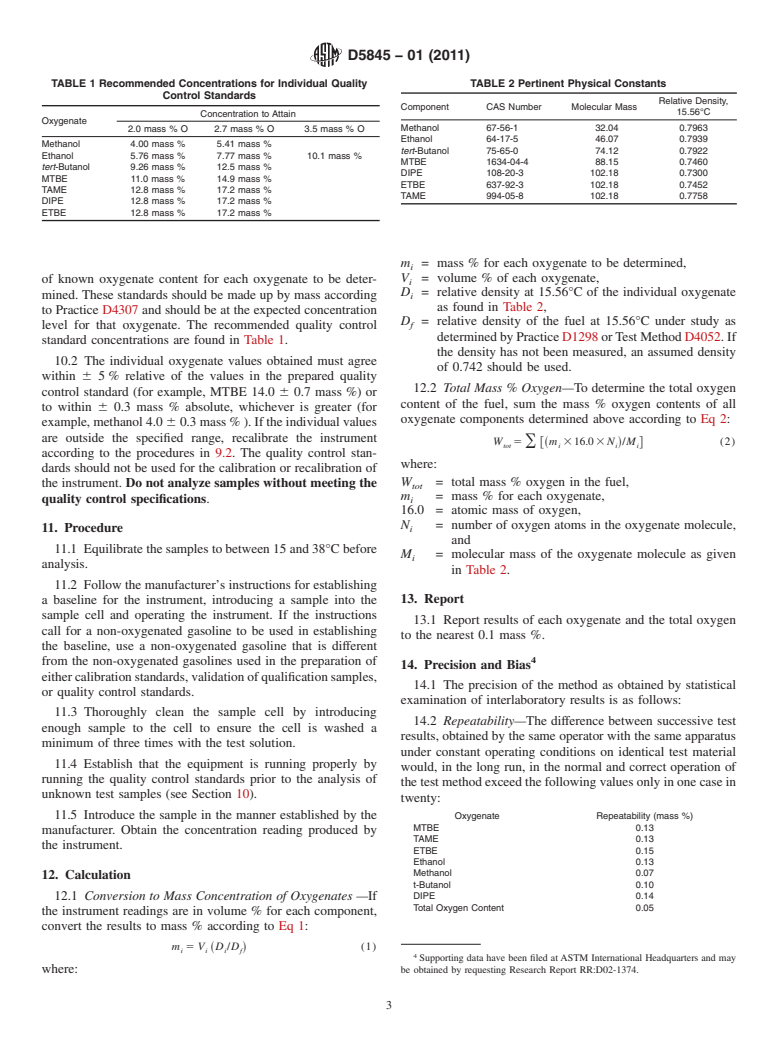
TABLE 1 Recommended Concentrations for Individual Quality TABLE 2 Pertinent Physical Constants
Control Standards
Relative Density,
Component CAS Number Molecular Mass
15.56°C
Concentration to Attain
Oxygenate
Methanol 6
...
Questions, Comments and Discussion
Ask us and Technical Secretary will try to provide an answer. You can facilitate discussion about the standard in here.