


ASTM D3205-86(1991)
(Test Method)Standard Test Method for Viscosity of Asphalt with Cone and Plate Viscometer (Withdrawn 2000)
Standard Test Method for Viscosity of Asphalt with Cone and Plate Viscometer (Withdrawn 2000)
SCOPE
1.1 This test method covers the determination of the viscosity of asphalt cements by means of a cone-plate viscometer. It is applicable to materials having viscosities in the range from 10 to 10 P (10 to 10 Pa[dot]s) and is therefore suitable for use at temperatures where viscosity is in the range indicated. The shear rate may vary between approximately 10 to 10 s and the method is suitable for determination on materials having either Newtonian or non-Newtonian flow properties.
1.2 This standard may involve hazardous materials, operations, and equipment. This standard does not purport to address all of the safety problems associated with its use. It is the responsibility of the user of this standard to establish appropriate safety and health practices and determine the applicability of regulatory limitations prior to use.
General Information
Standards Content (Sample)
Designation: D 3205 – 86 (Reapproved 1991)
AMERICAN SOCIETY FOR TESTING AND MATERIALS
100 Barr Harbor Dr., West Conshohocken, PA 19428
Reprinted from the Annual Book of ASTM Standards. Copyright ASTM
Standard Test Method for
Viscosity of Asphalt with Cone and Plate Viscometer
This standard is issued under the fixed designation D 3205; the number immediately following the designation indicates the year of
original adoption or, in the case of revision, the year of last revision. A number in parentheses indicates the year of last reapproval. A
superscript epsilon (e) indicates an editorial change since the last revision or reapproval.
1. Scope 4. Summary of Method
1.1 This test method covers the determination of the viscos- 4.1 The sample is placed between the cone-and-plate assem-
ity of asphalt cements by means of a cone-plate viscometer. It bly which is then brought to the test temperature. Weights
is applicable to materials having viscosities in the range from acting through a pulley apply torque to the cone and the
3 10 2 9
10 to 10 P (10 to 10 Pa·s) and is therefore suitable for use angular velocity of the cone is measured. Viscosity in poises
at temperatures where viscosity is in the range indicated. The and shear rate in reciprocal seconds are calculated from the
−3 2 −1
shear rate may vary between approximately 10 to 10 s and angular velocity, torque, and calibration constants.
the method is suitable for determination on materials having 4.2 Some asphalt cements may fracture at shear stresses
either Newtonian or non-Newtonian flow properties. within the range of this instrument. This fracture stress may be
1.2 This standard does not purport to address all of the reported.
safety concerns, if any, associated with its use. It is the
5. Significance and Use
responsibility of the user of this standard to establish appro-
5.1 The rheological properties of asphalt cements are used
priate safety and health practices and determine the applica-
for specification purposes for road pavement construction. The
bility of regulatory limitations prior to use.
instrument provides measurements over a wide range of
2. Referenced Documents
temperatures for use in research and development of asphalt
cements and other bituminous materials.
2.1 ASTM Standards:
C 670 Practice for Preparing Precision and Bias Statements
6. Apparatus
for Test Methods for Construction Materials
,
5 6
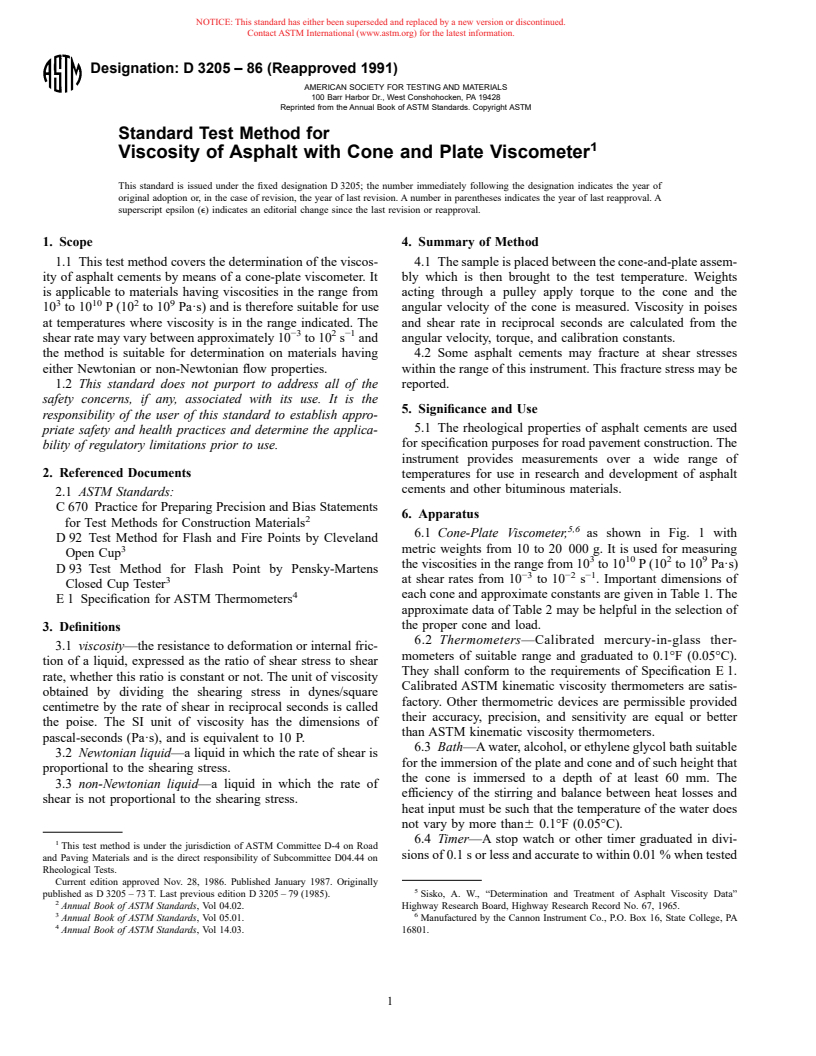
6.1 Cone-Plate Viscometer, as shown in Fig. 1 with
D 92 Test Method for Flash and Fire Points by Cleveland
3 metric weights from 10 to 20 000 g. It is used for measuring
Open Cup
3 10 2 9
the viscosities in the range from 10 to 10 P (10 to 10 Pa·s)
D 93 Test Method for Flash Point by Pensky-Martens
−3 −2 −1
3 at shear rates from 10 to 10 s . Important dimensions of
Closed Cup Tester
4 each cone and approximate constants are given in Table 1. The
E 1 Specification for ASTM Thermometers
approximate data of Table 2 may be helpful in the selection of
the proper cone and load.
3. Definitions
6.2 Thermometers—Calibrated mercury-in-glass ther-
3.1 viscosity—the resistance to deformation or internal fric-
mometers of suitable range and graduated to 0.1°F (0.05°C).
tion of a liquid, expressed as the ratio of shear stress to shear
They shall conform to the requirements of Specification E 1.
rate, whether this ratio is constant or not. The unit of viscosity
Calibrated ASTM kinematic viscosity thermometers are satis-
obtained by dividing the shearing stress in dynes/square
factory. Other thermometric devices are permissible provided
centimetre by the rate of shear in reciprocal seconds is called
their accuracy, precision, and sensitivity are equal or better
the poise. The SI unit of viscosity has the dimensions of
than ASTM kinematic viscosity thermometers.
pascal-seconds (Pa·s), and is equivalent to 10 P.
6.3 Bath—A water, alcohol, or ethylene glycol bath suitable
3.2 Newtonian liquid—a liquid in which the rate of shear is
for the immersion of the plate and cone and of such height that
proportional to the shearing stress.
the cone is immersed to a depth of at least 60 mm. The
3.3 non-Newtonian liquid—a liquid in which the rate of
efficiency of the stirring and balance between heat losses and
shear is not proportional to the shearing stress.
heat input must be such that the temperature of the water does
not vary by more than6 0.1°F (0.05°C).
6.4 Timer—A stop watch or other timer graduated in divi-
This test method is under the jurisdiction of ASTM Committee D-4 on Road
sions of 0.1 s or less and accurate to within 0.01 % when tested
and Paving Materials and is the direct responsibility of Subcommittee D04.44 on
Rheological Tests.
Current edition approved Nov. 28, 1986. Published January 1987. Originally
published as D 3205 – 73 T. Last previous edition D 3205 – 79 (1985). Sisko, A. W., “Determination and Treatment of Asphalt Viscosity Data”
Annual Book of ASTM Standards, Vol 04.02. Highway Research Board, Highway Research Record No. 67, 1965.
3 6
Annual Book of ASTM Standards, Vol 05.01. Manufactured by the Cannon Instrument Co., P.O. Box 16, State College, PA
Annual Book of ASTM Standards, Vol 14.03. 16801.
D 3205
constant, K , and the friction correction F, as follows:
D
7.1.1 To calculate the shear stress constant, K , proceed as
S
follows:
7.1.1.1 Using an accurate micrometer, measure the cone
radius, r (diameter/2) to an accuracy of 60.05 mm (60.002
in.). The effective drum radius is the drum radius plus half the
string thickness: measure the effective drum radius, R,toan
accuracy of 60.05 mm (60.002 in.). Calculate K in dynes per
S
(centimetre squared) gram as follows:
K 5 3g R/2pr (1)
S
where:
r 5 radius of cone, cm,
R 5 effective radius of drum, cm, and
g 5 gravitational constant, 980 dynes/g.
7.1.2 Determine the shear rate constant, K , for each cone
D
by direct calibration with viscosity standards (see Table 3 for
available calibration standards). This is obtained by the
following procedure:
FIG. 1 Assembly View of Viscometer
7.1.2.1 Measure the angle of rotation, u, in degrees, and the
time, t, in seconds, at applied loads, L, from 5 to 500 g (the
TABLE 1 Approximate Instrument Cone Sizes and Constants
range of applied loads will depend on the size of the cone being
Approximate Approximate Approximate Cone Constant calibrated).
A
Cone No. Cone Radius, Cone Angle, K ,
−1 S
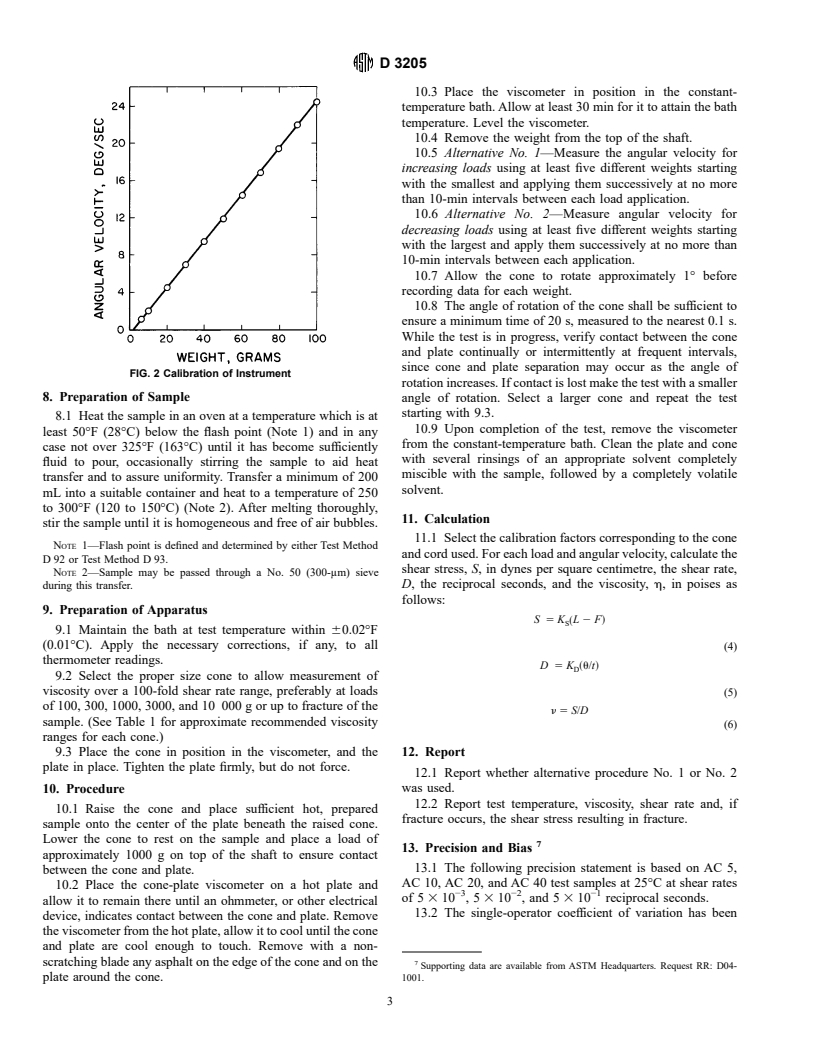
7.1.2.2 Plot the angular velocity, u/t, in degrees per second,
K , deg
B C D 2
cm deg dynes/cm ·g
as the ordinate versus the applied load, L, in grams, as the
8 3.75 0.5 2.0 31 250
4 1.88 0.5 2.0 2000 abscissa as shown in the example of Fig. 2. Determine the
2 0.94 0.5 2.0
slope, m, of the line and calculate K in reciprocal degrees as
D
A
Other cone sizes may be used.
follows:
B
Exact cone and drum radii must be measured to determine K by calculation.
S
C
K 5 K /hm
Exact cone angle may be calculated from the determination of K by viscosity
D D S
standards and measured cone and drum radii. K is the reciprocal of the angle
(2)
D
between the cone and plate.
where:
K 5 has the value determined in Eq. 1,
TABLE 2 Approximate Loads and Viscosities at Shear Rates of
S
−1 −2 −1
1, 10 , and 10 s h5 viscosity of standard oil, P, and
m 5 slope of regression line resulting from plotting u/t
Approximate Viscosities, MP, at Shear
Rates of versus L.
Cone No. Load, g
−1 −1 −1 −2 −1
7.1.3 Determine the friction correction, F, in grams by one
1s 10 s 10 s
of the following methods:
8 100 0.003 0.03 0.03
...
Questions, Comments and Discussion
Ask us and Technical Secretary will try to provide an answer. You can facilitate discussion about the standard in here.