


ASTM F2079-09(2017)
(Test Method)Standard Test Method for Measuring Intrinsic Elastic Recoil of Balloon-Expandable Stents
Standard Test Method for Measuring Intrinsic Elastic Recoil of Balloon-Expandable Stents
SIGNIFICANCE AND USE
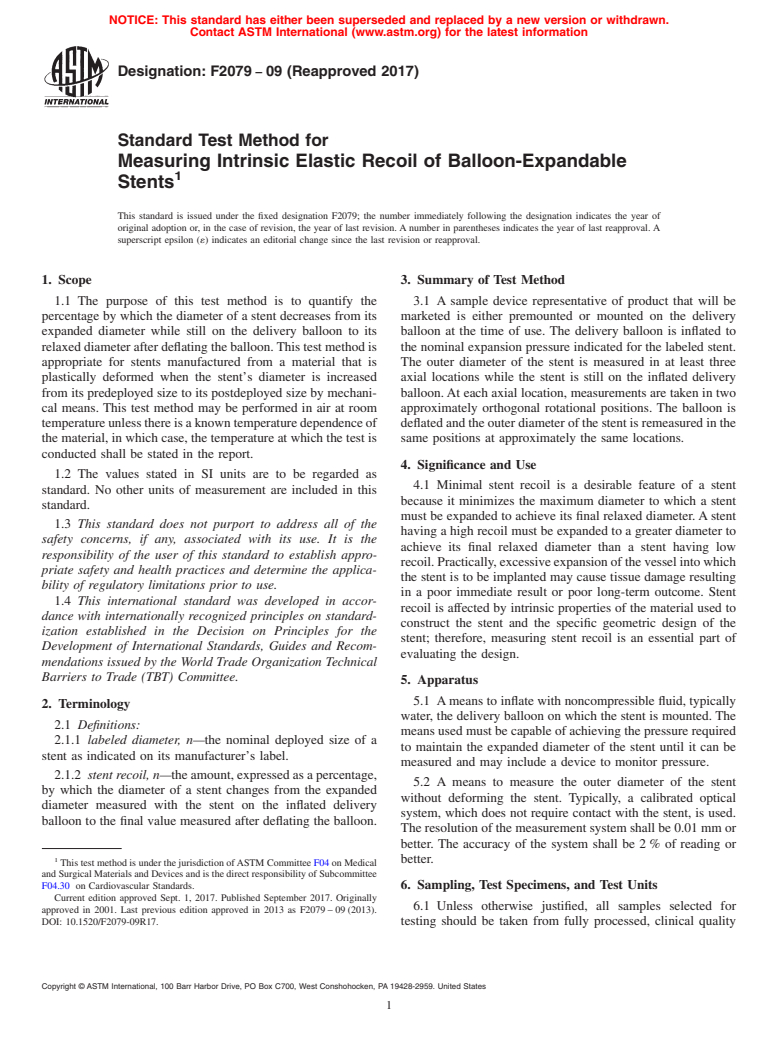
4.1 Minimal stent recoil is a desirable feature of a stent because it minimizes the maximum diameter to which a stent must be expanded to achieve its final relaxed diameter. A stent having a high recoil must be expanded to a greater diameter to achieve its final relaxed diameter than a stent having low recoil. Practically, excessive expansion of the vessel into which the stent is to be implanted may cause tissue damage resulting in a poor immediate result or poor long-term outcome. Stent recoil is affected by intrinsic properties of the material used to construct the stent and the specific geometric design of the stent; therefore, measuring stent recoil is an essential part of evaluating the design.
SCOPE
1.1 The purpose of this test method is to quantify the percentage by which the diameter of a stent decreases from its expanded diameter while still on the delivery balloon to its relaxed diameter after deflating the balloon. This test method is appropriate for stents manufactured from a material that is plastically deformed when the stent's diameter is increased from its predeployed size to its postdeployed size by mechanical means. This test method may be performed in air at room temperature unless there is a known temperature dependence of the material, in which case, the temperature at which the test is conducted shall be stated in the report.
1.2 The values stated in SI units are to be regarded as standard. No other units of measurement are included in this standard.
1.3 This standard does not purport to address all of the safety concerns, if any, associated with its use. It is the responsibility of the user of this standard to establish appropriate safety and health practices and determine the applicability of regulatory limitations prior to use.
1.4 This international standard was developed in accordance with internationally recognized principles on standardization established in the Decision on Principles for the Development of International Standards, Guides and Recommendations issued by the World Trade Organization Technical Barriers to Trade (TBT) Committee.
General Information
Buy Standard
Standards Content (Sample)
NOTICE: This standard has either been superseded and replaced by a new version or withdrawn.
Contact ASTM International (www.astm.org) for the latest information
Designation: F2079 − 09 (Reapproved 2017)
Standard Test Method for
Measuring Intrinsic Elastic Recoil of Balloon-Expandable
Stents
This standard is issued under the fixed designation F2079; the number immediately following the designation indicates the year of
original adoption or, in the case of revision, the year of last revision. A number in parentheses indicates the year of last reapproval. A
superscript epsilon (´) indicates an editorial change since the last revision or reapproval.
1. Scope 3. Summary of Test Method
1.1 The purpose of this test method is to quantify the 3.1 A sample device representative of product that will be
percentage by which the diameter of a stent decreases from its marketed is either premounted or mounted on the delivery
expanded diameter while still on the delivery balloon to its balloon at the time of use. The delivery balloon is inflated to
relaxed diameter after deflating the balloon.This test method is the nominal expansion pressure indicated for the labeled stent.
appropriate for stents manufactured from a material that is The outer diameter of the stent is measured in at least three
plastically deformed when the stent’s diameter is increased axial locations while the stent is still on the inflated delivery
from its predeployed size to its postdeployed size by mechani- balloon.At each axial location, measurements are taken in two
cal means. This test method may be performed in air at room approximately orthogonal rotational positions. The balloon is
temperatureunlessthereisaknowntemperaturedependenceof deflated and the outer diameter of the stent is remeasured in the
the material, in which case, the temperature at which the test is same positions at approximately the same locations.
conducted shall be stated in the report.
4. Significance and Use
1.2 The values stated in SI units are to be regarded as
4.1 Minimal stent recoil is a desirable feature of a stent
standard. No other units of measurement are included in this
because it minimizes the maximum diameter to which a stent
standard.
must be expanded to achieve its final relaxed diameter.Astent
1.3 This standard does not purport to address all of the
having a high recoil must be expanded to a greater diameter to
safety concerns, if any, associated with its use. It is the
achieve its final relaxed diameter than a stent having low
responsibility of the user of this standard to establish appro-
recoil. Practically, excessive expansion of the vessel into which
priate safety and health practices and determine the applica-
the stent is to be implanted may cause tissue damage resulting
bility of regulatory limitations prior to use.
in a poor immediate result or poor long-term outcome. Stent
1.4 This international standard was developed in accor-
recoil is affected by intrinsic properties of the material used to
dance with internationally recognized principles on standard-
construct the stent and the specific geometric design of the
ization established in the Decision on Principles for the
stent; therefore, measuring stent recoil is an essential part of
Development of International Standards, Guides and Recom-
evaluating the design.
mendations issued by the World Trade Organization Technical
Barriers to Trade (TBT) Committee.
5. Apparatus
5.1 Ameans to inflate with noncompressible fluid, typically
2. Terminology
water, the delivery balloon on which the stent is mounted. The
2.1 Definitions:
means used must be capable of achieving the pressure required
2.1.1 labeled diameter, n—the nominal deployed size of a
to maintain the expanded diameter of the stent until it can be
stent as indicated on its manufacturer’s label.
measured and may include a device to monitor pressure.
2.1.2 stent recoil, n—the amount, expressed as a percentage,
5.2 A means to measure the outer diameter of the stent
by which the diameter of a stent changes from the expanded
without deforming the stent. Typically, a calibrated optical
diameter measured with the stent on the inflated delivery
system, which does not require contact with the stent, is used.
balloon to the final value measured after deflating the balloon.
The resolution of the measurement system shall be 0.01 mm or
better. The accuracy of the system shall be 2 % of reading or
1 better.
This test method is under the jurisdiction ofASTM Committee F04 on Medical
and Surgical Materials and Devices and is the direct responsibility of Subcommittee
F04.30 on Cardiovascular Standards. 6. Sampling, Test Specimens, and Test Units
Current edition approved Sept. 1, 2017. Published September 2017. Originally
6.1 Unless otherwise justified, all samples selected for
approved in 2001. Last previous edition approved in 2013 as F2079 – 09 (2013).
DOI: 10.1520/F2079-09R17. testing should be taken from fully processed, clinical quality
Copyright © ASTM International, 100 Barr Harbor Drive, PO Box C700, West Conshohocken, PA 19428-2959. United States
F2079 − 09 (2017)
product. It is not required that these devices undergo terminal 7.6 Measure the outer diameter of the stent at the same
sterilization.Cosmeticrejectsorothernonclinicalsamplesmay locations and in the same rotational positions with respect to
be used if the cause for rejection has been shown not to affect the measurement system as in 7.4. These measurements should
stent recoil. be taken no sooner than 10 s after deflating the balloon.
6.2 The number of specimens tested for each unique stent
8. Calculation
geometry should be sufficient to meet sampling requirements
8.1 Calculate the stent recoil for the locations measured in
for desired specification limits. In general, a minimum of ten
7.4 for each stent using the following equation:
specimens is recommended. If a single stent geometry is
Diameter
intended to be used for more than one labeled diameter, recoil
final
Stent Recoil % 5 1 2 *100 (1)
~ ! S S DD
shall be evaluated
...
This document is not an ASTM standard and is intended only to provide the user of an ASTM standard an indication of what changes have been made to the previous version. Because
it may not be technically possible to adequately depict all changes accurately, ASTM recommends that users consult prior editions as appropriate. In all cases only the current version
of the standard as published by ASTM is to be considered the official document.
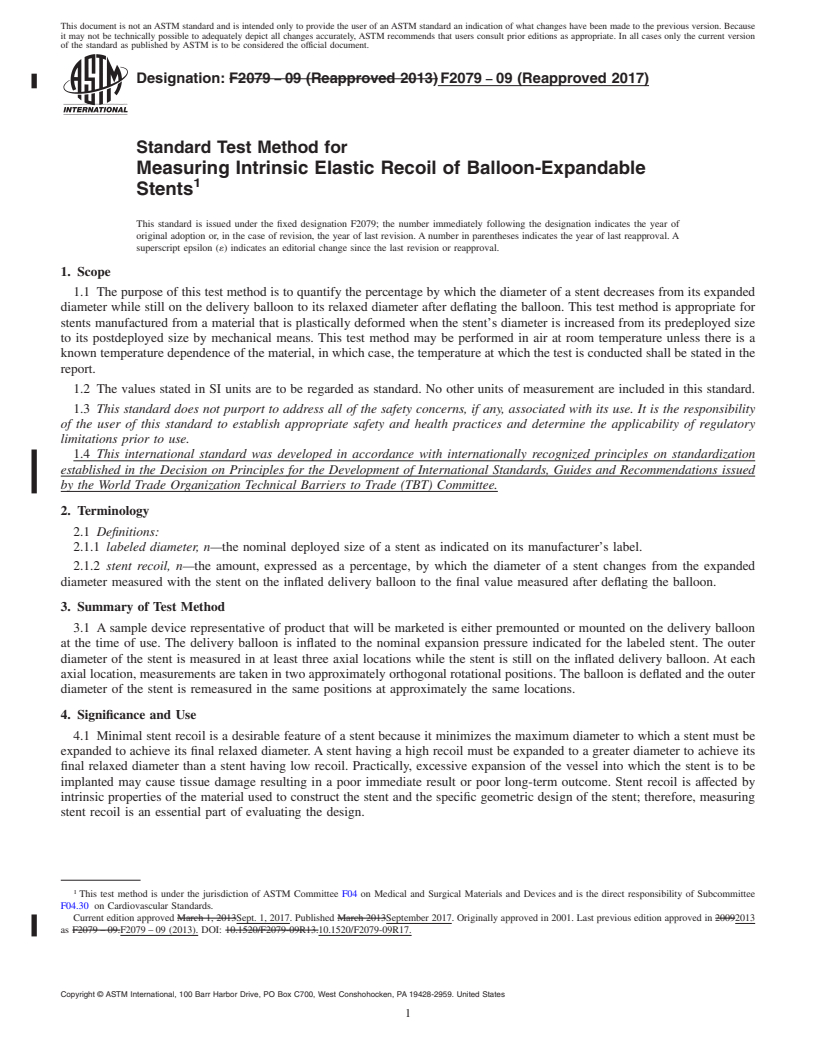
Designation: F2079 − 09 (Reapproved 2013) F2079 − 09 (Reapproved 2017)
Standard Test Method for
Measuring Intrinsic Elastic Recoil of Balloon-Expandable
Stents
This standard is issued under the fixed designation F2079; the number immediately following the designation indicates the year of
original adoption or, in the case of revision, the year of last revision. A number in parentheses indicates the year of last reapproval. A
superscript epsilon (´) indicates an editorial change since the last revision or reapproval.
1. Scope
1.1 The purpose of this test method is to quantify the percentage by which the diameter of a stent decreases from its expanded
diameter while still on the delivery balloon to its relaxed diameter after deflating the balloon. This test method is appropriate for
stents manufactured from a material that is plastically deformed when the stent’s diameter is increased from its predeployed size
to its postdeployed size by mechanical means. This test method may be performed in air at room temperature unless there is a
known temperature dependence of the material, in which case, the temperature at which the test is conducted shall be stated in the
report.
1.2 The values stated in SI units are to be regarded as standard. No other units of measurement are included in this standard.
1.3 This standard does not purport to address all of the safety concerns, if any, associated with its use. It is the responsibility
of the user of this standard to establish appropriate safety and health practices and determine the applicability of regulatory
limitations prior to use.
1.4 This international standard was developed in accordance with internationally recognized principles on standardization
established in the Decision on Principles for the Development of International Standards, Guides and Recommendations issued
by the World Trade Organization Technical Barriers to Trade (TBT) Committee.
2. Terminology
2.1 Definitions:
2.1.1 labeled diameter, n—the nominal deployed size of a stent as indicated on its manufacturer’s label.
2.1.2 stent recoil, n—the amount, expressed as a percentage, by which the diameter of a stent changes from the expanded
diameter measured with the stent on the inflated delivery balloon to the final value measured after deflating the balloon.
3. Summary of Test Method
3.1 A sample device representative of product that will be marketed is either premounted or mounted on the delivery balloon
at the time of use. The delivery balloon is inflated to the nominal expansion pressure indicated for the labeled stent. The outer
diameter of the stent is measured in at least three axial locations while the stent is still on the inflated delivery balloon. At each
axial location, measurements are taken in two approximately orthogonal rotational positions. The balloon is deflated and the outer
diameter of the stent is remeasured in the same positions at approximately the same locations.
4. Significance and Use
4.1 Minimal stent recoil is a desirable feature of a stent because it minimizes the maximum diameter to which a stent must be
expanded to achieve its final relaxed diameter. A stent having a high recoil must be expanded to a greater diameter to achieve its
final relaxed diameter than a stent having low recoil. Practically, excessive expansion of the vessel into which the stent is to be
implanted may cause tissue damage resulting in a poor immediate result or poor long-term outcome. Stent recoil is affected by
intrinsic properties of the material used to construct the stent and the specific geometric design of the stent; therefore, measuring
stent recoil is an essential part of evaluating the design.
This test method is under the jurisdiction of ASTM Committee F04 on Medical and Surgical Materials and Devices and is the direct responsibility of Subcommittee
F04.30 on Cardiovascular Standards.
Current edition approved March 1, 2013Sept. 1, 2017. Published March 2013September 2017. Originally approved in 2001. Last previous edition approved in 20092013
as F2079 – 09.F2079 – 09 (2013). DOI: 10.1520/F2079-09R13.10.1520/F2079-09R17.
Copyright © ASTM International, 100 Barr Harbor Drive, PO Box C700, West Conshohocken, PA 19428-2959. United States
F2079 − 09 (2017)
5. Apparatus
5.1 A means to inflate with noncompressible fluid, typically water, the delivery balloon on which the stent is mounted. The
means used must be capable of achieving the pressure required to maintain the expanded diameter of the stent until it can be
measured and may include a device to monitor pressure.
5.2 A means to measure the outer diameter of the stent without deforming the stent. Typically, a calibrated optical system, which
does not require contact with the stent, is used. The resolution of the measurement system shall be 0.01 mm or better. The accuracy
of the system shall be 2 % of reading or better.
6. Sampling, Test Specimens, and Test Units
6.1 Unless otherwise justified, all samples selected for testing should be taken from fully processed, clinical quality product.
It is not required that these devices undergo terminal sterilization. Cosmetic rejects or other nonclinical samples may be used if
the cause for rejection has been shown not to affect stent recoil.
6.2 The number of specimens tested for each unique stent geometry should be sufficient to meet sampling requirements for
desired specification limits. In general, a minimum of ten specimens is recommended. If a single stent geometry is intended to be
used for more than one labeled diameter, recoil shall be evaluated for test specimens expanded to the smallest and largest diameters
intended for that geometry.
6.3 Most stents are comprised of a repetitious continuous pattern or of repeating subunits. If stents are made longer by additional
repetiti
...
Questions, Comments and Discussion
Ask us and Technical Secretary will try to provide an answer. You can facilitate discussion about the standard in here.