

ASTM C719-22
(Test Method)Standard Test Method for Adhesion and Cohesion of Elastomeric Joint Sealants Under Cyclic Movement (Hockman Cycle)
General Information
- Abstract
SIGNIFICANCE AND USE
5.1 The failure of a building sealant in an active joint is usually manifested by cohesive failure in the sealant or adhesive failure between the sealant and the substrate, or both. The method described in this test method relates only to the performance of the sealant when properly installed with recommended primers, and does not evaluate sealant failures caused by improper joint design, excessive joint movement, improper application practices, and other factors known to cause sealant failure in buildings and building areas.
SCOPE
1.1 This test method is an accelerated laboratory procedure for evaluating the performance of a building sealant in a test configuration that is subjected to water immersion, cyclic movement, and temperature change.3
1.2 The values stated in inch-pound units are to be regarded as standard. The values given in parentheses are mathematical conversions to SI units that are provided for information only and are not considered standard.
1.3 This standard does not purport to address all of the safety concerns, if any, associated with its use. It is the responsibility of the user of this standard to establish appropriate safety, health, and environmental practices and determine the applicability of regulatory limitations prior to use.
1.4 This international standard was developed in accordance with internationally recognized principles on standardization established in the Decision on Principles for the Development of International Standards, Guides and Recommendations issued by the World Trade Organization Technical Barriers to Trade (TBT) Committee.
- Status
- Published
- Publication Date
- 31-Jan-2022
- Technical Committee
- C24 - Building Seals and Sealants
- Drafting Committee
- C24.30 - Adhesion
Buy Documents
ASTM C719-22 - Standard Test Method for Adhesion and Cohesion of Elastomeric Joint Sealants Under Cyclic Movement (Hockman Cycle)
REDLINE ASTM C719-22 - Standard Test Method for Adhesion and Cohesion of Elastomeric Joint Sealants Under Cyclic Movement (Hockman Cycle)
Overview
ASTM C719-22 is the internationally recognized standard test method for evaluating the adhesion and cohesion of elastomeric joint sealants under cyclic movement, also known as the Hockman Cycle. Developed by ASTM International, this test provides an accelerated laboratory procedure to assess how building joint sealants perform under simulated conditions involving water immersion, temperature changes, and repeated movement. The results help determine a sealant's durability and reliability when properly installed in dynamic joint applications such as those found in construction and building maintenance.
Key Topics
- Cohesion and Adhesion Testing: Examines the capacity of sealants to maintain internal integrity (cohesion) and bond with substrates (adhesion) under movement and varying environmental conditions.
- Simulated Environmental Exposure: Subject specimens to cycles of water immersion, compression, and extension at both high and low temperatures.
- Joint Movement Classes: Evaluates various classes based on percentage of cyclic movement, as is common with elastomeric sealants.
- Use of Standard Substrates: Testing is performed using portland cement mortar, float glass, and aluminum alloy; other substrates can also be specified depending on application needs.
- Visual Inspection Criteria: Specimens are closely inspected for evidence of adhesive or cohesive failure, sealant deformation, and bubble formation.
Applications
- Building and Construction: This standard is essential for manufacturers, specifiers, and contractors seeking assurance that sealants will maintain performance in building joints subject to movement from thermal expansion, contraction, or structural load.
- Sealant Product Development and Quality Control: Producers use this method to benchmark and improve the performance of their products, ensuring compliance and consistency.
- Project Specifications: Architects and engineers specify ASTM C719 compliance to guarantee robust sealant selection for projects with demanding movement or environmental conditions.
- Regulatory and Purchasing Decisions: Facilities managers and procurement specialists rely on C719 test data when choosing sealant products for renovation, repair, or new construction requiring reliable long-term performance.
- Insurance and Risk Management: Demonstrates due diligence in the selection and installation of building sealants where failure could result in water ingress, energy loss, or structural damage.
Related Standards
- ASTM C717 - Terminology of Building Seals and Sealants
- ASTM C33/C33M - Specification for Concrete Aggregates
- ASTM C109/C109M - Test Method for Compressive Strength of Hydraulic Cement Mortars
- ASTM C150/C150M - Specification for Portland Cement
Additional guidance and procedural alignment may be provided by other standards focused on building sealant performance, substrate preparation, and installation practices.
Practical Value
Complying with ASTM C719-22 ensures that joint sealant products offer proven performance under cyclic movement, which is vital for the longevity and efficiency of building envelopes. Proper application of this test method helps:
- Reduce the likelihood of premature sealant failure.
- Minimize maintenance costs due to water leaks or energy inefficiency.
- Provide assurance to stakeholders that products meet rigorous industry benchmarks.
Keywords: ASTM C719, elastomeric joint sealant, adhesion test, cohesion, cyclic movement, Hockman Cycle, construction sealants, building standards, sealant performance.
Relations
- Effective Date
- 15-Dec-2023
- Effective Date
- 01-Apr-2019
- Effective Date
- 01-Mar-2019
- Effective Date
- 01-Mar-2018
- Effective Date
- 01-Nov-2017
- Effective Date
- 01-Jan-2017
- Effective Date
- 15-Nov-2016
- Effective Date
- 01-Sep-2016
- Effective Date
- 15-Mar-2016
- Effective Date
- 01-Feb-2016
- Effective Date
- 01-Jul-2015
- Effective Date
- 01-May-2014
- Effective Date
- 01-Feb-2014
- Effective Date
- 01-Nov-2013
- Effective Date
- 01-Jan-2013
Buy Documents
ASTM C719-22 - Standard Test Method for Adhesion and Cohesion of Elastomeric Joint Sealants Under Cyclic Movement (Hockman Cycle)
REDLINE ASTM C719-22 - Standard Test Method for Adhesion and Cohesion of Elastomeric Joint Sealants Under Cyclic Movement (Hockman Cycle)
Get Certified
Connect with accredited certification bodies for this standard

DIBt (Deutsches Institut für Bautechnik)
German Institute for Building Technology.
DIN CERTCO
DIN Group product certification.

Aboma Certification B.V.
Specialized in construction, metal, and transport sectors.
Sponsored listings
Frequently Asked Questions
ASTM C719-22 is a standard published by ASTM International. Its full title is "Standard Test Method for Adhesion and Cohesion of Elastomeric Joint Sealants Under Cyclic Movement (Hockman Cycle)". This standard covers: SIGNIFICANCE AND USE 5.1 The failure of a building sealant in an active joint is usually manifested by cohesive failure in the sealant or adhesive failure between the sealant and the substrate, or both. The method described in this test method relates only to the performance of the sealant when properly installed with recommended primers, and does not evaluate sealant failures caused by improper joint design, excessive joint movement, improper application practices, and other factors known to cause sealant failure in buildings and building areas. SCOPE 1.1 This test method is an accelerated laboratory procedure for evaluating the performance of a building sealant in a test configuration that is subjected to water immersion, cyclic movement, and temperature change.3 1.2 The values stated in inch-pound units are to be regarded as standard. The values given in parentheses are mathematical conversions to SI units that are provided for information only and are not considered standard. 1.3 This standard does not purport to address all of the safety concerns, if any, associated with its use. It is the responsibility of the user of this standard to establish appropriate safety, health, and environmental practices and determine the applicability of regulatory limitations prior to use. 1.4 This international standard was developed in accordance with internationally recognized principles on standardization established in the Decision on Principles for the Development of International Standards, Guides and Recommendations issued by the World Trade Organization Technical Barriers to Trade (TBT) Committee.
SIGNIFICANCE AND USE 5.1 The failure of a building sealant in an active joint is usually manifested by cohesive failure in the sealant or adhesive failure between the sealant and the substrate, or both. The method described in this test method relates only to the performance of the sealant when properly installed with recommended primers, and does not evaluate sealant failures caused by improper joint design, excessive joint movement, improper application practices, and other factors known to cause sealant failure in buildings and building areas. SCOPE 1.1 This test method is an accelerated laboratory procedure for evaluating the performance of a building sealant in a test configuration that is subjected to water immersion, cyclic movement, and temperature change.3 1.2 The values stated in inch-pound units are to be regarded as standard. The values given in parentheses are mathematical conversions to SI units that are provided for information only and are not considered standard. 1.3 This standard does not purport to address all of the safety concerns, if any, associated with its use. It is the responsibility of the user of this standard to establish appropriate safety, health, and environmental practices and determine the applicability of regulatory limitations prior to use. 1.4 This international standard was developed in accordance with internationally recognized principles on standardization established in the Decision on Principles for the Development of International Standards, Guides and Recommendations issued by the World Trade Organization Technical Barriers to Trade (TBT) Committee.
ASTM C719-22 is classified under the following ICS (International Classification for Standards) categories: 91.100.50 - Binders. Sealing materials. The ICS classification helps identify the subject area and facilitates finding related standards.
ASTM C719-22 has the following relationships with other standards: It is inter standard links to ASTM C109/C109M-23, ASTM C150/C150M-19, ASTM C717-19, ASTM C717-18, ASTM C717-17a, ASTM C717-17, ASTM C717-16a, ASTM C717-16, ASTM C150/C150M-16, ASTM C33/C33M-16e1, ASTM C150/C150M-15, ASTM C717-14a, ASTM C717-14, ASTM C717-13, ASTM C33/C33M-13. Understanding these relationships helps ensure you are using the most current and applicable version of the standard.
ASTM C719-22 is available in PDF format for immediate download after purchase. The document can be added to your cart and obtained through the secure checkout process. Digital delivery ensures instant access to the complete standard document.
Standards Content (Sample)
This international standard was developed in accordance with internationally recognized principles on standardization established in the Decision on Principles for the
Development of International Standards, Guides and Recommendations issued by the World Trade Organization Technical Barriers to Trade (TBT) Committee.
Designation: C719 − 22
Standard Test Method for
Adhesion and Cohesion of Elastomeric Joint Sealants
1,2
Under Cyclic Movement (Hockman Cycle)
This standard is issued under the fixed designation C719; the number immediately following the designation indicates the year of
original adoption or, in the case of revision, the year of last revision.Anumber in parentheses indicates the year of last reapproval.A
superscript epsilon (´) indicates an editorial change since the last revision or reapproval.
This standard has been approved for use by agencies of the U.S. Department of Defense.
1. Scope C109/C109MTest Method for Compressive Strength of
Hydraulic Cement Mortars (Using 2-in. or [50 mm] Cube
1.1 This test method is an accelerated laboratory procedure
Specimens)
for evaluating the performance of a building sealant in a test
C150/C150MSpecification for Portland Cement
configuration that is subjected to water immersion, cyclic
3 C717Terminology of Building Seals and Sealants
movement, and temperature change.
1.2 The values stated in inch-pound units are to be regarded
3. Terminology
as standard. The values given in parentheses are mathematical
3.1 Definitions—For definitions of terms used in this test
conversions to SI units that are provided for information only
method, refer to Terminology C717.
and are not considered standard.
1.3 This standard does not purport to address all of the 4. Summary of Test Method
safety concerns, if any, associated with its use. It is the
4.1 This test method consists of subjecting standard joint
responsibility of the user of this standard to establish appro-
specimens to a series of treatments as follows: (a) immersion
priate safety, health, and environmental practices and deter-
inwaterforsevendays;(b)exposureinanovenforsevendays
mine the applicability of regulatory limitations prior to use.
while under compression; (c) automated compression and
1.4 This international standard was developed in accor-
extension cycling at room temperature at a specified rate and
dance with internationally recognized principles on standard-
amount of joint movement; and (d) alternate compression and
ization established in the Decision on Principles for the
extension of the joint at high and low temperatures,
Development of International Standards, Guides and Recom-
respectively, under specified conditions described herein.
mendations issued by the World Trade Organization Technical
4.2 The effects of the test shall be evaluated by visual
Barriers to Trade (TBT) Committee.
inspection for cohesive and adhesive failures, sealant
2. Referenced Documents
deformation, and bubble formation within the sealant.
2.1 ASTM Standards:
4.3 This test method is applicable to any joint movement.
C33/C33MSpecification for Concrete Aggregates
Current cyclic movement classes are shown in Table 1 with
their associated extension and compression dimensions.
ThistestmethodisunderthejurisdictionofASTMCommitteeC24onBuilding
Seals and Sealants and is the direct responsibility of Subcommittee C24.30 on
5. Significance and Use
Adhesion.
5.1 The failure of a building sealant in an active joint is
Current edition approved Feb. 1, 2022. Published March 2022. Originally
approved in 1972. Last previous edition approved in 2019 as C719–14 (2019).
usually manifested by cohesive failure in the sealant or
DOI: 10.1520/C0719-22.
adhesive failure between the sealant and the substrate, or both.
This test method is also known as the Hockman Cycle in recognition ofArthur
The method described in this test method relates only to the
Hockman who originated the method at the National Bureau of Standards.
performance of the sealant when properly installed with
Supporting data are available fromASTM International Headquarters. Request
RR:C24-1013.
recommended primers, and does not evaluate sealant failures
For referenced ASTM standards, visit the ASTM website, www.astm.org, or
caused by improper joint design, excessive joint movement,
contact ASTM Customer Service at service@astm.org. For Annual Book of ASTM
improper application practices, and other factors known to
Standards volume information, refer to the standard’s Document Summary page on
the ASTM website. cause sealant failure in buildings and building areas.
Copyright © ASTM International, 100 Barr Harbor Drive, PO Box C700, West Conshohocken, PA 19428-2959. United States
C719 − 22
6. Apparatus the surface of one face, 1in. by 3in. (25.4mm by 76.2mm),
5 of each block by wet grinding either with a belt sander using
6.1 Compression-Extension Machine, designedtoautomati-
No.60aluminumcarbidesandingbeltorusinganironlapwith
cally compress the joint width of the test specimen from 0.500
No. 60 silicon carbide (or aluminum oxide) grain until the
in. (12.7 mm) to the minimum dimension desired (Table 1,
aggregate is uniformly exposed. Return blocks to saturated
Column C) and extend the specimen from 0.500 in. to the
lime water storage until needed.
maximum extension desired (Table 1, Column E) at a constant
7.1.1.1 Blocks may be prepared and shipped to other loca-
rateof ⁄8in./h(3.2mm/h).Themachineshallbeequippedwith
tions for use. The blocks may be shipped dry and shall be
grips of sufficient strength to withstand, without bending, the
returned to lime water storage on arrival until needed.
resistance of high tensile strength sealants (see Fig. 1 and Fig.
7.1.1.2 Prior to use, wet grind the previously ground face to
2).
remove any laitance, rinse thoroughly under running tap water
6.2 Cold Box or Chamber, maintained at−15°F 6 3°F
and dry the blocks overnight at 220°F to 230°F (105°C to
(−26.1°C 6 1.7°C).
110°C). Clean the blocks of film or powder by vigorous
6.3 Forced-Draft Oven, controlled at 158°F 6 3.6°F brushing with a stiff-bristled fiber brush. Condition the blocks
(70°C 6 2°C). at standard conditions for not less than one day and not more
than seven days.
6.4 C-clamps, or other device for maintaining the specimen
7.1.2 Float Glass—Glass plates shall be 3in. by 1in. by ⁄4
under compression.
in.(76.2mmby25.4mmby6.4mm)clearfloatglass.Priorto
6.5 Casting Spacers.
use, the glass shall be cleaned by wiping the surface with
methyl ethyl ketone or similar solvent. Then dip the surface in
6.6 Room or Chamber, maintained at standard conditions as
a detergent solution. This should be a 0.04% solution of an
noted in Terminology C717.
alcohol ethoxy sulfate. An alternative would be a 0.1%
7. Test Specimens
solution of a clear hand dishwashing detergent. These solu-
tions should be made up in distilled or deionized water. Rinse
7.1 The standard substrate used in the test shall be portland
the surface (without touching it) in distilled or deionized water
cement mortar, float glass, and aluminum alloy.
andallowittoairdry.Thefloatglassrequiresreinforcementto
NOTE 1—When requested, only one or two of the standard materials
survive the rigors of the subsequent testing procedures. This
may be tested with the sample. Likewise, other substrates such as brick,
must be done prior to the compression-extension cycling
marble, wood, etc., may be specified by the interested party in place of or
performed in 9.4. Reinforcement is provided by adhering 3in.
in addition to the standard substrate for test with the sealant sample.
by1in.by ⁄4 in.(76.2mmby25.4mmby6.4mm)aluminum
7.1.1 Mortar Block—Prepare cement mortar blocks, each
plates to the two outside surfaces of the formed test specimen.
3in. by 1in. by 1in. (76.2mm by 25.4mm by 25.4 mm) in
Any adhesive may be used. Commercially available two-part
size, using one part of high early strength portland cement
epoxies have been found suitable. Although the time of
conforming to Type III of Specification C150/C150M to two
reinforcement is not critical, application of the aluminum
parts by weight of clean uniformly graded, concrete fine
platestotheglassbeforepreparingthetestspecimenshasbeen
aggregate (sand) conforming to Specification C33/C33M. Use
found convenient.
sufficientwatertoproduceaflowof100% 65%whentested
7.1.3 Aluminum—The aluminum plates shall be 3in. by
in accordance with the procedure for the determination of
1in. by ⁄4in. (76.2mm by 25.4mm by 6.4 mm) aluminum
consistency of cement mortar described in Test Method C109/
alloy, 6063-T5, or 6061-T6 with anodizing process AA-
C109M. After curing one day in moist air and six days in
M10C22A31. Prior to use, the aluminum (and other metallic
saturated lime water at 73°F 6 3°F (23°C 6 2°C), prepare
substrates, when specified) shall be cleaned as specified for
float glass (7.1.2)(Notes 2 and 3).
Series 510, 530 (previously 520), and 540 Sealing Compound Testers, NOTE 2—Methyl ethyl ketone and similar solvents are both toxic and
manufactured by Applied Test Systems, https://www.atspa.com/, have been found
flammable and should be handled with caution in a well-ventilated hood.
suitable for this purpose. Series 530 is shown in Figs 1 and 2.
NOTE 3—At the request of the sealant producer, the detergent cleaning
The sole source of supply of the apparatus known to the committee at this time
step shall be omitted.
isAppliedTestSystemsInc.Ifyouareawareofalternativesuppliers,pleaseprovide
7.2 Primers—Where use of primer is recommended by the
this information toASTM International Headquarters. Your comments will receive
careful consideration at a meeting of the responsible technical committee , which
sealant manufacturer, substrate materials shall be primed with
you may attend.
the recommended primer or primers.
7.3 Preparation of Test Specimens:
TABLE 1 Examples of Dimensions in Compression and
7.3.1 Standard conditions of temperature and relative hu-
Extension
midity used throughout this test method are defined in Termi-
Dimension
nology C717.
Class C—Width of Joint in E—Width of Joint in
Compression, in. (mm) Extension, in. (mm)
12.5 0.438 (11.1) 0.563 (14.3)
Neodol 25-35, a registered trademark of Royal Dutch Shell PLC,
25 0.375 (9.5) 0.625 (15.9)
www.shell.com, has been found suitable for this purpose.
35 0.325 (8.3) 0.675 (17.1)
Dawn, a registered trademark of Proctor & Gam
...
This document is not an ASTM standard and is intended only to provide the user of an ASTM standard an indication of what changes have been made to the previous version. Because
it may not be technically possible to adequately depict all changes accurately, ASTM recommends that users consult prior editions as appropriate. In all cases only the current version
of the standard as published by ASTM is to be considered the official document.
Designation: C719 − 14 (Reapproved 2019) C719 − 22
Standard Test Method for
Adhesion and Cohesion of Elastomeric Joint Sealants
1,2
Under Cyclic Movement (Hockman Cycle)
This standard is issued under the fixed designation C719; the number immediately following the designation indicates the year of
original adoption or, in the case of revision, the year of last revision. A number in parentheses indicates the year of last reapproval. A
superscript epsilon (´) indicates an editorial change since the last revision or reapproval.
This standard has been approved for use by agencies of the U.S. Department of Defense.
1. Scope
1.1 This test method is an accelerated laboratory procedure for evaluating the performance of a building sealant in a test
configuration that is subjected to water immersion, cyclic movement, and temperature change.
1.2 The values stated in inch-pound units are to be regarded as standard. The values given in parentheses are mathematical
conversions to SI units that are provided for information only and are not considered standard.
1.3 This standard does not purport to address all of the safety concerns, if any, associated with its use. It is the responsibility
of the user of this standard to establish appropriate safety, health, and environmental practices and determine the applicability of
regulatory limitations prior to use.
1.4 This international standard was developed in accordance with internationally recognized principles on standardization
established in the Decision on Principles for the Development of International Standards, Guides and Recommendations issued
by the World Trade Organization Technical Barriers to Trade (TBT) Committee.
2. Referenced Documents
2.1 ASTM Standards:
C33C33/C33M Specification for Concrete Aggregates
C109/C109M Test Method for Compressive Strength of Hydraulic Cement Mortars (Using 2-in. or [50 mm] Cube Specimens)
C150C150/C150M Specification for Portland Cement
C717 Terminology of Building Seals and Sealants
3. Terminology
3.1 Definitions—For definitions of terms used in this test method, refer to Terminology C717.
4. Summary of Test Method
4.1 This test method consists of subjecting standard joint specimens to a series of treatments as follows: (a) immersion in water
for seven days; (b) exposure in an oven for seven days while under compression; (c) automaticautomated compression and
This test method is under the jurisdiction of ASTM Committee C24 on Building Seals and Sealants and is the direct responsibility of Subcommittee C24.30 on Adhesion.
Current edition approved Jan. 1, 2019Feb. 1, 2022. Published January 2019March 2022. Originally approved in 1972. Last previous edition approved in 20142019 as
C719 – 14.C719 – 14 (2019). DOI: 10.1520/C0719-14R19.10.1520/C0719-22.
This test method is also known as the Hockman Cycle in recognition of Arthur Hockman who originated the method at the National Bureau of Standards.
Supporting data are available from ASTM International Headquarters. Request RR:C24-1013.
For referenced ASTM standards, visit the ASTM website, www.astm.org, or contact ASTM Customer Service at service@astm.org. For Annual Book of ASTM Standards
volume information, refer to the standard’s Document Summary page on the ASTM website.
Copyright © ASTM International, 100 Barr Harbor Drive, PO Box C700, West Conshohocken, PA 19428-2959. United States
C719 − 22
extension cycling at room temperature at a specified rate and amount of joint movement; and (d) alternate compression and
extension of the joint at high and low temperatures, respectively, under specified conditions described herein.
4.2 The effects of the test shall be evaluated by visual inspection for cohesive and adhesive failures, sealant deformation, and
bubble formation within the sealant.
4.3 This test method is applicable to any joint movement. The most common test movements are 612.5 and 625 % as used in
the examples.Current cyclic movement classes are shown in Table 1 with their associated extension and compression dimensions.
5. Significance and Use
5.1 The failure of a building sealant in an active joint is usually manifested by cohesive failure in the sealant or adhesive failure
between the sealant and the substrate, or both. The method described in this test method relates only to the performance of the
sealant when properly installed with recommended primers, and does not evaluate sealant failures caused by improper joint design,
excessive joint movement, improper application practices, and other factors known to cause sealant failure in buildings and
building areas.
6. Apparatus
6.1 Compression-Extension Machine, designed to automatically compress the joint width of the test specimen from 0.500 in. (12.7
mm) to the minimum dimension desired (Table 1, Column C) and extend the specimen from 0.500 in. to the maximum extension
desired (Table 1, Column E) at a constant rate of ⁄8 in./h (3.2 mm/h). The machine shall be equipped with grips of sufficient
strength to withstand, without bending, the resistance of high tensile strength sealants (see Figs. 1-3Fig. 1). and Fig. 2).
6.2 Cold Box or Chamber, maintained at −15at −15 °F 6 3°F (−26.13 °F (−26.1 °C 6 1.7°C).1.7 °C).
6.3 Forced-Draft Oven, controlled at 158158 °F 6 3.6°F (703.6 °F (70 °C 6 2°C).2 °C).
6.4 C-clamps, or other device for maintaining the specimen under compression.
6.5 Spacer Blocks.Casting Spacers.
6.6 Room or Chamber, maintained at standard conditions as noted in Terminology C717.
7. Test Specimens
7.1 The standard substrate used in the test shall be portland cement mortar, float glass, and aluminum alloy.
NOTE 1—When requested, only one or two of the standard materials may be tested with the sample. Likewise, other substrates such as brick, marble, wood,
TABLE 1 Examples of Dimensions in Compression and
Extension
Dimension
Class C—Width of Joint in E—Width of Joint in
Compression, in. (mm) Extension, in. (mm)
12.5 0.438 (11.1) 0.563 (14.3)
25 0.375 (9.5) 0.625 (15.9)
35 0.325 (8.3) 0.675 (17.1)
50 0.250 (6.4) 0.750 (19.1)
50/100 0.250 (6.4) 1.000 (25.4)
Series 520 510, 530 (previously 520), and 540 Sealing Compound Tester,Testers, manufactured by Applied Test Systems Inc., 348 New Castle Rd., Butler, PA 16001,
and a durability tester manufactured by Ambard, Inc., 269-11 81st Ave., New Hyde Park, NY 11040, Systems, https://www.atspa.com/, have been found suitable for this
purpose (Fig. 1(purpose. Series 530a)). For extension of the joint at cold temperature, the machine may be designed for extension only (Fig. 3). is shown in Figs 1 and 2.
The sole source of supply of the apparatus known to the committee at this time is Applied Test Systems Inc. and Ambard Inc. If you are aware of alternative suppliers,
please provide this information to ASTM International Headquarters. Your comments will receive careful consideration at a meeting of the responsible technical committee ,
which you may attend.
C719 − 22
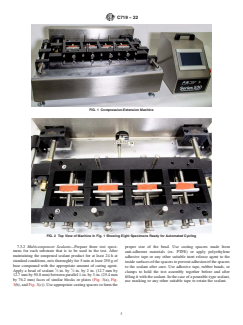
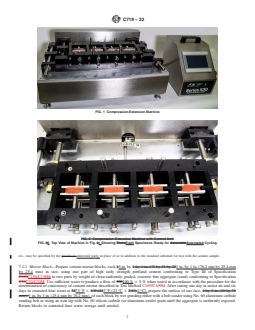
FIG. 1 Compression-Extension Machine
FIG. 2 Compression-Extension Machine with Control Unit
FIG. 32 Top View of Machine in Fig. 21 Showing ThreeEight Specimens Ready for AutomaticAutomated Cycling
etc., may be specified by the purchaser interested party in place of or in addition to the standard substrate for test with the sealant sample.
7.1.1 Mortar Block—Prepare cement mortar blocks, each 33 in. by 1 by 1 in. (75 by 25 by 251 in. by 1 in. (76.2 mm by 25.4 mm
by 25.4 mm) in size, using one part of high early strength portland cement conforming to Type III of Specification
C150C150/C150M to two parts by weight of clean uniformly graded, concrete fine aggregate (sand) conforming to Specification
C33C33/C33M. Use sufficient water to produce a flow of 100100 % 6 5 % when tested in accordance with the procedure for the
determination of consistency of cement mortar described in Test Method C109/C109M. After curing one day in moist air and six
days in saturated lime water at 7373 °F 6 3°F (233 °F (23 °C 6 2°C),2 °C), prepare the surface of one face, 1 by 3 in. (25 by 75
mm), 1 in. by 3 in. (25.4 mm by 76.2 mm), of each block by wet grinding either with a belt sander using No. 60 aluminum carbide
sanding belt or using an iron lap with No. 60 silicon carbide (or aluminum oxide) grain until the aggregate is uniformly exposed.
Return blocks to saturated lime water storage until needed.
C719 − 22
7.1.1.1 Blocks may be prepared and shipped to other locations for use. The blocks may be shipped dry and shall be returned to
lime water storage on arrival until needed.
7.1.1.2 Prior to use, wet grind the previously ground face to remove any laitance, rinse thoroughly under running tap water and
dry the blocks overnight at 220220 °F to 230°F (105230 °F (105 °C to 110°C).110 °C). Clean the blocks of film or powder by
vigorous brushing with a stiff-bristled fiber brush. Condition the blocks at standard conditions for not less than one day and not
more than seven days.
7.1.2 Float Glass—Glass plates shall be 33 in. by 11 in. by ⁄4 in. (76.2(76.2 mm by 25.425.4 mm by 6.4 mm) clear float glass.
Prior to use, the glass shall be cleaned by wiping the surface with methyl ethyl ketone or similar solvent. Then dip the surface in
a detergent solution. This should be a 0.04 % solution of an alcohol ethoxy sulfate. An alternative would be a 0.1 % solution of
a clear hand dishwashing detergent. These solutions should be made up in distilled or deionized water. Rinse the surface (without
touching it) in distilled or deionized water and allow it to air dry. The float glass requires reinforcement to survive the rigors of
the subsequent testing procedures. This must be done prior to the compression-extension cycling performed in 9.4. Reinforcement
is provided by adhering 33 in. by 11 in. by ⁄4 in. (76.2(76.2 mm by 25.425.4 mm by 6.4 mm) aluminum plates to the two outside
surfaces of the formed test specimen. Any adhesive may be used. Commercially available two part two-part epoxies have been
found suitable. Although the time of reinforcement is not critical, application of the aluminum plates to the glass before preparing
the test specimens has been found convenient.
7.1.3 Aluminum—The aluminum plates shall be 33 in. by 11 in. by ⁄4 in. (76.2(76.2 mm by 25.425.4 mm by 6.4 mm) aluminum
alloy, 6063-T5, or 6061-T6 with anodizing process AA-M10C22A31. Prior to use, the aluminum (and other metallic substrates,
when specified) shall be cleaned as specified for float glass (7.1.2) (Notes 2 and 3).
NOTE 2—Methyl ethyl ketone and similar solvents are both toxic and flammable and should be handled with caution in a well ventilated well-ventilated
hood.
NOTE 3—At the request of the sealant producer, the detergent cleaning step shall be omitted.
7.2 Primers—Where use of primer is recommended by the sealant manufacturer, substrate materials shall be primed with the
recommended primer or
...