

ASTM D6416/D6416M-16(2024)
(Test Method)Standard Test Method for Two-Dimensional Flexural Properties of Simply Supported Sandwich Composite Plates Subjected to a Distributed Load
General Information
- Abstract
SIGNIFICANCE AND USE
5.1 This test method simulates the hydrostatic loading conditions which are often present in actual sandwich structures, such as marine hulls. This test method can be used to compare the two-dimensional flexural stiffness of a sandwich composite made with different combinations of materials or with different fabrication processes. Since it is based on distributed loading rather than concentrated loading, it may also provide more realistic information on the failure mechanisms of sandwich structures loaded in a similar manner. Test data should be useful for design and engineering, material specification, quality assurance, and process development. In addition, data from this test method would be useful in refining predictive mathematical models or computer code for use as structural design tools. Properties that may be obtained from this test method include:
5.1.1 Panel surface deflection at load,
5.1.2 Panel face-sheet strain at load,
5.1.3 Panel bending stiffness,
5.1.4 Panel shear stiffness,
5.1.5 Panel strength, and
5.1.6 Panel failure modes.
SCOPE
1.1 This test method determines the two-dimensional flexural properties of sandwich composite plates subjected to a distributed load. The test fixture uses a relatively large square panel sample which is simply supported all around and has the distributed load provided by a water-filled bladder. This type of loading differs from the procedure of Test Method C393, where concentrated loads induce one-dimensional, simple bending in beam specimens.
1.2 This test method is applicable to composite structures of the sandwich type which involve a relatively thick layer of core material bonded on both faces with an adhesive to thin-face sheets composed of a denser, higher-modulus material, typically, a polymer matrix reinforced with high-modulus fibers.
1.3 The values stated in either SI units or inch-pound units are to be regarded separately as standard. Within the text the inch-pound units are shown in brackets. The values stated in each system are not exact equivalents; therefore, each system must be used independently of the other. Combining values from the two systems may result in nonconformance with the standard.
1.4 This standard does not purport to address all of the safety concerns, if any, associated with its use. It is the responsibility of the user of this standard to establish appropriate safety, health, and environmental practices and determine the applicability of regulatory limitations prior to use.
1.5 This international standard was developed in accordance with internationally recognized principles on standardization established in the Decision on Principles for the Development of International Standards, Guides and Recommendations issued by the World Trade Organization Technical Barriers to Trade (TBT) Committee.
- Status
- Published
- Publication Date
- 30-Apr-2024
- Technical Committee
- D30 - Composite Materials
- Drafting Committee
- D30.09 - Sandwich Construction
Overview
ASTM D6416/D6416M-16(2024) - Standard Test Method for Two-Dimensional Flexural Properties of Simply Supported Sandwich Composite Plates Subjected to a Distributed Load establishes a method for determining the two-dimensional flexural properties of sandwich composite plates under distributed loads. This standard is particularly relevant for assessing sandwich structures that encounter hydrostatic or similar distributed loading conditions, commonly found in marine hulls and other engineered sandwich panels. By employing a large square panel specimen supported on all edges and loaded via a water-filled pressure bladder, this method closely simulates real-world load scenarios, providing valuable data for material comparison, quality assurance, and design optimization.
Key Topics
- Test Scope: Focuses on sandwich composite plates featuring a thick core bonded to thin, high-modulus face sheets, tested under distributed (not concentrated) loads.
- Test Fixture: Utilizes a simply-supported setup with a square panel and a distributed load applied through a pressure bladder, simulating hydrostatic conditions.
- Measured Properties: Enables the determination of:
- Panel surface deflection at load
- Panel face-sheet strain at load
- Panel bending stiffness
- Panel shear stiffness
- Panel strength and failure modes
- Data Utility: Results support refinement of predictive models, structural design tools, and validation of fabrication processes or materials.
- Testing Conditions: Provides guidelines for specimen preparation, fixture calibration, measurement instrumentation, and environmental controls to ensure data reliability.
Applications
This ASTM standard test method is vital for:
- Marine Engineering: Evaluating flexural stiffness and strength in hulls and panels subject to hydrostatic pressures.
- Aerospace & Transportation: Validating structural sandwich components exposed to distributed atmospheric or aerodynamic loading.
- Material Selection: Comparing different core and face-sheet materials or fabrication processes to optimize structural efficiency.
- Design & Engineering: Data informs decision-making during structural analysis, computational modeling, and materials development.
- Quality Assurance: Reliable test data ensures conformity of produced panels and identifies processing inconsistencies.
- Research & Development: Supports the development of new composite formulations and sandwich construction techniques.
The method is especially beneficial for scenarios where distributed loading more closely approximates service conditions than traditional beam tests, yielding insight into realistic failure mechanisms and enhancing the predictive accuracy of engineering designs.
Related Standards
For a comprehensive evaluation of sandwich composite properties or to reference complementary methods, the following ASTM standards are relevant:
- ASTM C365/C365M: Flatwise compressive properties of sandwich cores
- ASTM C393: Core shear properties of sandwich constructions by beam flexure
- ASTM D792: Density and specific gravity of plastics by displacement
- ASTM D2584: Ignition loss of cured reinforced resins
- ASTM D2734: Void content of reinforced plastics
- ASTM D3171: Constituent content of composite materials
- ASTM D3878: Terminology for composite materials
- ASTM E251: Performance characteristics of metallic bonded resistance strain gages
- ASTM E4 and E6: Mechanical testing and force calibration standards
Using ASTM D6416/D6416M-16(2024) in conjunction with these related standards provides a thorough evaluation of sandwich composite performance, meeting the needs of engineers, designers, and quality assurance professionals worldwide.
Keywords: ASTM D6416, two-dimensional flexural properties, sandwich composite panels, distributed load, hydrostatic loading, composite testing, structural design, panel stiffness, shear stiffness, quality assurance, marine hulls, material comparison, pressure bladder test.
Get Certified
Connect with accredited certification bodies for this standard

DIN CERTCO
DIN Group product certification.

Smithers Quality Assessments
US management systems and product certification.
Sponsored listings
Frequently Asked Questions
ASTM D6416/D6416M-16(2024) is a standard published by ASTM International. Its full title is "Standard Test Method for Two-Dimensional Flexural Properties of Simply Supported Sandwich Composite Plates Subjected to a Distributed Load". This standard covers: SIGNIFICANCE AND USE 5.1 This test method simulates the hydrostatic loading conditions which are often present in actual sandwich structures, such as marine hulls. This test method can be used to compare the two-dimensional flexural stiffness of a sandwich composite made with different combinations of materials or with different fabrication processes. Since it is based on distributed loading rather than concentrated loading, it may also provide more realistic information on the failure mechanisms of sandwich structures loaded in a similar manner. Test data should be useful for design and engineering, material specification, quality assurance, and process development. In addition, data from this test method would be useful in refining predictive mathematical models or computer code for use as structural design tools. Properties that may be obtained from this test method include: 5.1.1 Panel surface deflection at load, 5.1.2 Panel face-sheet strain at load, 5.1.3 Panel bending stiffness, 5.1.4 Panel shear stiffness, 5.1.5 Panel strength, and 5.1.6 Panel failure modes. SCOPE 1.1 This test method determines the two-dimensional flexural properties of sandwich composite plates subjected to a distributed load. The test fixture uses a relatively large square panel sample which is simply supported all around and has the distributed load provided by a water-filled bladder. This type of loading differs from the procedure of Test Method C393, where concentrated loads induce one-dimensional, simple bending in beam specimens. 1.2 This test method is applicable to composite structures of the sandwich type which involve a relatively thick layer of core material bonded on both faces with an adhesive to thin-face sheets composed of a denser, higher-modulus material, typically, a polymer matrix reinforced with high-modulus fibers. 1.3 The values stated in either SI units or inch-pound units are to be regarded separately as standard. Within the text the inch-pound units are shown in brackets. The values stated in each system are not exact equivalents; therefore, each system must be used independently of the other. Combining values from the two systems may result in nonconformance with the standard. 1.4 This standard does not purport to address all of the safety concerns, if any, associated with its use. It is the responsibility of the user of this standard to establish appropriate safety, health, and environmental practices and determine the applicability of regulatory limitations prior to use. 1.5 This international standard was developed in accordance with internationally recognized principles on standardization established in the Decision on Principles for the Development of International Standards, Guides and Recommendations issued by the World Trade Organization Technical Barriers to Trade (TBT) Committee.
SIGNIFICANCE AND USE 5.1 This test method simulates the hydrostatic loading conditions which are often present in actual sandwich structures, such as marine hulls. This test method can be used to compare the two-dimensional flexural stiffness of a sandwich composite made with different combinations of materials or with different fabrication processes. Since it is based on distributed loading rather than concentrated loading, it may also provide more realistic information on the failure mechanisms of sandwich structures loaded in a similar manner. Test data should be useful for design and engineering, material specification, quality assurance, and process development. In addition, data from this test method would be useful in refining predictive mathematical models or computer code for use as structural design tools. Properties that may be obtained from this test method include: 5.1.1 Panel surface deflection at load, 5.1.2 Panel face-sheet strain at load, 5.1.3 Panel bending stiffness, 5.1.4 Panel shear stiffness, 5.1.5 Panel strength, and 5.1.6 Panel failure modes. SCOPE 1.1 This test method determines the two-dimensional flexural properties of sandwich composite plates subjected to a distributed load. The test fixture uses a relatively large square panel sample which is simply supported all around and has the distributed load provided by a water-filled bladder. This type of loading differs from the procedure of Test Method C393, where concentrated loads induce one-dimensional, simple bending in beam specimens. 1.2 This test method is applicable to composite structures of the sandwich type which involve a relatively thick layer of core material bonded on both faces with an adhesive to thin-face sheets composed of a denser, higher-modulus material, typically, a polymer matrix reinforced with high-modulus fibers. 1.3 The values stated in either SI units or inch-pound units are to be regarded separately as standard. Within the text the inch-pound units are shown in brackets. The values stated in each system are not exact equivalents; therefore, each system must be used independently of the other. Combining values from the two systems may result in nonconformance with the standard. 1.4 This standard does not purport to address all of the safety concerns, if any, associated with its use. It is the responsibility of the user of this standard to establish appropriate safety, health, and environmental practices and determine the applicability of regulatory limitations prior to use. 1.5 This international standard was developed in accordance with internationally recognized principles on standardization established in the Decision on Principles for the Development of International Standards, Guides and Recommendations issued by the World Trade Organization Technical Barriers to Trade (TBT) Committee.
ASTM D6416/D6416M-16(2024) is classified under the following ICS (International Classification for Standards) categories: 83.120 - Reinforced plastics. The ICS classification helps identify the subject area and facilitates finding related standards.
ASTM D6416/D6416M-16(2024) is available in PDF format for immediate download after purchase. The document can be added to your cart and obtained through the secure checkout process. Digital delivery ensures instant access to the complete standard document.
Standards Content (Sample)
This international standard was developed in accordance with internationally recognized principles on standardization established in the Decision on Principles for the
Development of International Standards, Guides and Recommendations issued by the World Trade Organization Technical Barriers to Trade (TBT) Committee.
Designation: D6416/D6416M − 16 (Reapproved 2024)
Standard Test Method for
Two-Dimensional Flexural Properties of Simply Supported
Sandwich Composite Plates Subjected to a Distributed
Load
This standard is issued under the fixed designation D6416/D6416M; the number immediately following the designation indicates the
year of original adoption or, in the case of revision, the year of last revision. A number in parentheses indicates the year of last
reapproval. A superscript epsilon (´) indicates an editorial change since the last revision or reapproval.
1. Scope 2. Referenced Documents
1.1 This test method determines the two-dimensional flex- 2.1 ASTM Standards:
ural properties of sandwich composite plates subjected to a C365/C365M Test Method for Flatwise Compressive Prop-
distributed load. The test fixture uses a relatively large square erties of Sandwich Cores
panel sample which is simply supported all around and has the C393 Test Method for Core Shear Properties of Sandwich
distributed load provided by a water-filled bladder. This type of Constructions by Beam Flexure
loading differs from the procedure of Test Method C393, where D792 Test Methods for Density and Specific Gravity (Rela-
concentrated loads induce one-dimensional, simple bending in tive Density) of Plastics by Displacement
beam specimens. D2584 Test Method for Ignition Loss of Cured Reinforced
Resins
1.2 This test method is applicable to composite structures of
D2734 Test Methods for Void Content of Reinforced Plastics
the sandwich type which involve a relatively thick layer of core
D3171 Test Methods for Constituent Content of Composite
material bonded on both faces with an adhesive to thin-face
Materials
sheets composed of a denser, higher-modulus material,
D3878 Terminology for Composite Materials
typically, a polymer matrix reinforced with high-modulus
E4 Practices for Force Calibration and Verification of Test-
fibers.
ing Machines
1.3 The values stated in either SI units or inch-pound units
E6 Terminology Relating to Methods of Mechanical Testing
are to be regarded separately as standard. Within the text the
E251 Test Methods for Performance Characteristics of Me-
inch-pound units are shown in brackets. The values stated in
tallic Bonded Resistance Strain Gages
each system are not exact equivalents; therefore, each system
E1237 Guide for Installing Bonded Resistance Strain Gages
must be used independently of the other. Combining values
2.2 ASTM Adjunct:
from the two systems may result in nonconformance with the
Sandwich Plate Test Fixture and Hydromat Pressure Blad-
standard.
der, ASTM D6416/D6416M
1.4 This standard does not purport to address all of the
3. Terminology
safety concerns, if any, associated with its use. It is the
responsibility of the user of this standard to establish appro- 3.1 Terminology D3878 defines terms relating to high-
priate safety, health, and environmental practices and deter- modulus fibers and their composites, as well as terms relating
mine the applicability of regulatory limitations prior to use. to sandwich constructions. Terminology E6 defines terms
1.5 This international standard was developed in accor- relating to mechanical testing. In the event of a conflict
dance with internationally recognized principles on standard- between terms, Terminology D3878 shall have precedence
ization established in the Decision on Principles for the over the other terminology standards.
Development of International Standards, Guides and Recom-
3.2 Definitions of Terms Specific to This Standard:
mendations issued by the World Trade Organization Technical
3.2.1 bending stiffness, n—the sandwich property which
Barriers to Trade (TBT) Committee.
resists bending deflections.
For referenced ASTM standards, visit the ASTM website, www.astm.org, or
This test method is under the jurisdiction of ASTM Committee D30 on contact ASTM Customer Service at service@astm.org. For Annual Book of ASTM
Composite Materials and is the direct responsibility of Subcommittee D30.09 on Standards volume information, refer to the standard’s Document Summary page on
Sandwich Construction. the ASTM website.
Current edition approved May 1, 2024. Published May 2024. Originally Detailed drawings for the fabrication of the 500–mm test fixture and pressure
approved in 1999. Last previous edition approved in 2016 as D6416/ bladder shown in Fig. 3 and Fig. 4 are available from ASTM Headquarters,
ɛ1
D6416M – 16 . DOI: 10.1520/D6416_D6416M-16R24. www.astm.org. Order Adjunct No. ADJD6416-E-PDF.
Copyright © ASTM International, 100 Barr Harbor Drive, PO Box C700, West Conshohocken, PA 19428-2959. United States
D6416/D6416M − 16 (2024)
3.2.2 core, n—a centrally located layer of a sandwich water-filled bladder. Pressure on the panel is increased by
construction, usually low density, which separates and stabi- moving the platens of the test frame. The test measures the
lizes the facings and transmits shear between the facings and two-dimensional flexural response of a sandwich composite
provides most of the shear rigidity of the construction. plate in terms of deflections and strains when subjected to a
well-defined distributed load.
3.2.3 face sheet, n—the outermost layer or composite com-
ponent of a sandwich construction, generally thin and of high
4.2 Panel deflection at load is monitored by a centrally
density, which resists most of the edgewise loads and flatwise
positioned LVDT which contacts the tension-side surface.
bending moments: synonymous with face, skin, and facing.
4.3 Load is monitored by both a crosshead-mounted load
3.2.4 footprint, n—the enclosed area of the face sheet
cell, in series with the test fixture, and a pressure transducer in
surface of a sandwich panel in contact with the pressure
the pressure bladder itself. Since the pressure bladder is also at
bladder during loading.
all times in series with the load cell and test fixture, the
3.2.5 hydromat, n—a pressure bladder with a square perim-
effective contact area of the pressure field is continuously
eter fabricated from two square pieces of industrial belting
monitored as the load/pressure quotient.
which are superposed and clamped at the edges with through-
4.4 Strain can be monitored with strategically placed strain
bolted, mild steel bar stock.
gage rosettes bonded to the tension-side face-sheet surface. A
3.2.6 isotropic material, n—a material having essentially the
typical arrangement has four rosettes equally spaced along one
same properties in any direction.
of the axes of symmetry of the plate.
3.2.7 orthotropic material, n—a material in which a prop-
erty of interest, at a given point, possesses three mutually 5. Significance and Use
perpendicular planes of symmetry, which taken together define
5.1 This test method simulates the hydrostatic loading
the principal material coordinate system.
conditions which are often present in actual sandwich
3.2.8 pressure bladder, n—a durable, yet pliable closed
structures, such as marine hulls. This test method can be used
container filled with water, or other incompressible fluid,
to compare the two-dimensional flexural stiffness of a sand-
capable of conforming to the contour of a normally loaded test
wich composite made with different combinations of materials
panel when compressed against its face sheet surface by a test
or with different fabrication processes. Since it is based on
machine.
distributed loading rather than concentrated loading, it may
also provide more realistic information on the failure mecha-
3.2.9 shear stiffness, n—the sandwich property which resists
shear distortions: synonymous with shear rigidity. nisms of sandwich structures loaded in a similar manner. Test
data should be useful for design and engineering, material
3.2.10 test panel, n—a square coupon of sandwich construc-
specification, quality assurance, and process development. In
tion fabricated for two-dimensional flexural testing: synony-
addition, data from this test method would be useful in refining
mous with sandwich panel, sandwich composite plate, sand-
predictive mathematical models or computer code for use as
wich composite panel, and panel test specimen.
structural design tools. Properties that may be obtained from
3.3 Symbols:
this test method include:
3.3.1 a = support span of the test fixture or the length and
5.1.1 Panel surface deflection at load,
width of the test panel structure between supports.
5.1.2 Panel face-sheet strain at load,
3.3.2 A = effective contact area of the pressure bladder
eff
5.1.3 Panel bending stiffness,
when compressed against the test panel.
5.1.4 Panel shear stiffness,
3.3.3 B = test panel bending stiffness.
5.1.5 Panel strength, and
3.3.4 c = core thickness.
5.1.6 Panel failure modes.
3.3.5 ε = normal face sheet strain, x component.
x
3.3.6 ε = normal face sheet strain, y component.
y
6. Interferences
3.3.7 f = face sheet thickness.
3.3.8 F = total normal force applied to a test panel as
m
6.1 Material and Specimen Preparation—Poor material fab-
measured by the test machine load cell.
rication practices, lack of control of fiber alignment, and
3.3.9 h = average overall thickness of the test panel.
damage induced by improper coupon machining are known
3.3.10 N = the number of included terms of the series.
causes of high material data scatter in composites in general.
3.3.11 P = experimentally measured bladder pressure.
m
Specific material factors that affect sandwich composites in-
3.3.12 φ = width of the unloaded border area of a test panel
clude variability in core density and degree of cure of resin in
between the edge supports and the effective footprint boundary.
both face sheet matrix material and core bonding adhesive.
3.3.13 S = test panel shear stiffness.
Important aspects of sandwich panel specimen preparation that
3.3.14 ω = experimentally determined deflection at center
e
contribute to data scatter are incomplete wetout of face sheet
of test panel.
fabric, incomplete or nonuniform core bonding of face sheets,
the non-squareness of adjacent panel edges, the misalignment
4. Summary of Test Method
of core and face sheet elements, the existence of joints or other
4.1 A square test panel is simply supported on all four edges core and face sheet discontinuities, out-of-plane curvature, and
and uniformly loaded over a portion of its surface by a surface roughness.
D6416/D6416M − 16 (2024)
6.2 Test Fixture Characteristics—Configuration of the panel To minimize the error, the edges of soft-core panels should be
edge-constraint structure can have a significant effect on test reinforced in accordance with 8.3.2.
results. Correct interpretation of test data depends on the
7. Apparatus
fixture supporting the test panel in such a manner that the
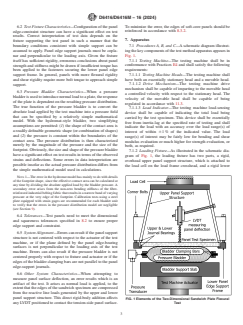
boundary conditions consistent with simple support can be 7.1 Procedures A, B, and C—A schematic diagram illustrat-
assumed to apply. Panel edge support journals must be copla- ing the key components of the test method apparatus appears in
nar and perpendicular to the loading axis. Given the fixture Fig. 1.
itself has sufficient rigidity, erroneous conclusions about panel 7.1.1 Testing Machine—The testing machine shall be in
conformance with Practices E4 and shall satisfy the following
strength and stiffness might be drawn if insufficient torque has
been applied to the fasteners securing the lower panel edge requirements:
7.1.1.1 Testing Machine Heads—The testing machine shall
support frame. In general, panels with more flexural rigidity
have both an essentially stationary head and a movable head.
and shear rigidity require more bolt torque to approach simple
7.1.1.2 Drive Mechanism—The testing machine drive
support.
mechanism shall be capable of imparting to the movable head
6.3 Pressure Bladder Characteristics—When a pressure
a controlled velocity with respect to the stationary head. The
bladder is used to introduce normal load to a plate, the response
velocity of the movable head shall be capable of being
of the plate is dependent on the resulting pressure distribution.
regulated in accordance with 11.3.
The true function of the pressure bladder is to convert the
7.1.1.3 Load Indicator—The testing machine load-sensing
absolute load applied by the test machine into a pressure field
device shall be capable of indicating the total load being
that can be specified by a relatively simple mathematical
carried by the test specimen. This device shall be essentially
model. With the hydromat-style bladder, two simplifying
free from inertia-lag at the specified rate of testing and shall
assumptions are permitted: (1) the shape of the contact area is
indicate the load with an accuracy over the load range(s) of
a readily definable geometric shape (or combination of shapes)
interest of within 61 % of the indicated value. The load
and (2) the pressure is constant within the boundaries of the
range(s) of interest may be fairly low for bending and shear
contact area. The pressure distribution is then characterized
modulus evaluation or much higher for strength evaluation, or
merely by the magnitude of the pressure and the size of the
both, as required.
footprint. Obviously, the size and shape of the pressure bladder
7.1.2 Loading Fixture—As illustrated in the schematic dia-
have a significant effect on test results in terms of the observed
gram of Fig. 1, the loading fixture has two parts, a rigid,
strains and deflections. Some errors in data interpretation are
overhead upper panel support structure, which is attached to
possible insofar as the actual pressure distribution differs from
the load cell on the load frame crosshead, and a rigid lower
the simple mathematical model used in calculations.
NOTE 1—The error in the hydromat model has mainly to do with details
of the footprint shape, since the effective contact area can be calculated at
any time by dividing the absolute applied load by the bladder pressure. A
secondary error arises from the non-zero bending stiffness of the fiber-
reinforced industrial belting fabric that results in a narrow band of varying
pressure at the very edge of the footprint. Calibration tests using a steel
plate equipped with strain gages are recommended for each bladder unit
to verify that the errors in the pressure distribution model are negligible
(see Section 9).
6.4 Tolerances—Test panels need to meet the dimensional
and squareness tolerances specified in 8.2 to ensure proper
edge support and constraint.
6.5 System Alignment—Errors can result if the panel support
structure is not centered with respect to the actuator of the test
machine, or if the plane defined by the panel edge-bearing
surfaces is not perpendicular to the loading axis of the test
machine. Errors can also result if the pressure bladder is not
centered properly with respect to fixture and actuator or if the
edges of the bladder clamping bars are not parallel to the panel
edge-support journals.
6.6 Other System Characteristics—When attempting to
measure panel surface deflection, an error results which is an
artifact of the test. It arises as normal load is applied, to the
extent that the edges of the sandwich specimen are compressed
from the reactive line loads generated by the upper and lower
panel support structure. This direct rigid-body addition affects
FIG. 1 Elements of the Two-Dimensional Sandwich Plate Flexural
any LVDT positioned to contact the tension-side panel surface. Test
D6416/D6416M − 16 (2024)
panel edge support frame which bolts to the upper panel
support structure at the corners. A square sandwich composite
panel specimen is constrained at the edges when captured from
above and below by these two fixture elements. All bearing
surfaces are hardened steel rods with a circular cross-section,
12.7 mm [0.5 in.] in diameter. The support span for each
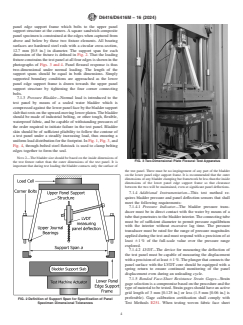
dimension of the fixture is defined in Fig. 2. That the loading
fixture constrains the test panel at all four edges is shown in the
photographs of Figs. 3 and 4. Panel flexural response is thus
two-dimensional under normal loading. The length of the
support spans should be equal in both dimensions. Simply
supported boundary conditions are approached as the lower
panel edge support frame is drawn towards the upper panel
support structure by tightening the four corner connecting
bolts.
7.1.3 Pressure Bladder—Normal load is introduced to the
test panel by means of a sealed water bladder which is
compressed against the lower panel face by the bladder support
slab that rests on the upward-moving lower platen. The bladder
should be made of industrial belting, or other tough, flexible,
waterproof fabric, and be capable of withstanding pressures of
the order required to initiate failure in the test panel. Bladder
skin should be of sufficient pliability to follow the contour of
a test panel under a steadily increasing load, thus ensuring a
uniform load distribution for the footprint. In Fig. 1, Fig. 3, and
Fig. 4, through-bolted steel flatstock is used to clamp belting
edges together to form the seal.
NOTE 2—The bladder size should be based on the inside dimensions of
FIG. 3 Two-Dimensional Plate Flexural Test Apparatus
the test fixture rather than the outer dimensions of the test panel. It is
important that during test loading the bladder contacts only the surface of
the test panel. There must be no impingement of any part of the bladder
on the lower panel edge support frame. It is recommended that the outer
dimensions of any bladder clamping bar framework be less than the inside
dimensions of the lower panel edge support frame so that clearance
between the two will be maintained, even at significant panel deflections.
7.1.4 Additional Instrumentation—This test method re-
quires bladder pressure and panel deflection sensors that shall
meet the following requirements:
7.1.4.1 Pressure Indicator—The bladder pressure trans-
ducer must be in direct contact with the water by means of a
tube that penetrates to the bladder interior. The connecting tube
must be of sufficient diameter to permit pressure equilibrium
with the interior without excessive lag time. The pressure
transducer must be rated for the range of pressure magnitudes
applied during the test and must respond with a precision of at
least 61 % of the full-scale value over the pressure range
explored.
7.1.4.2 LVDT—The device for measuring the deflection of
the test panel must be capable of measuring the displacement
with a precision of at least 61 %. The plunger that connects the
panel surface with the LVDT core should be equipped with a
spring return to ensure continued monitoring of the panel
displacement even during an unloading cycle.
7.1.5 Bonded Face-Sheet Resistance Strain Gages—Strain
gage selection is a compromise based on the procedure and the
type of material to be tested. Strain gages should have an active
grid length of 3 mm [0.125 in.] or less (1.5 mm [0.06 in.] is
preferable). Gage calibration certification shall comply with
FIG. 2 Definition of Support Span for Specification of Panel
Specimen Dimensional Tolerances Test Methods E251. When testing woven fabric face sheet
D6416/D6416M − 16 (2024)
7.1.5.3 Temperature compensation is recommended when
testing at standard laboratory atmosphere. Temperature com-
pensation is required when testing in nonambient temperature
environments. When appropriate, use a traveler coupon
(dummy calibration coupon) with identical lay-up and strain
gage orientations for thermal strain compensation.
7.1.5.4 Consider the transverse sensitivity of the selected
strain gage. Consult the strain gage manufacturer for recom-
mendations on transverse sensitivity corrections. This is par-
ticularly important for a transversely mounted gage.
7.1.6 Torque Wrench—To effect simple support for test
panels of varying shear and bending stiffness, tension in the
four corner bolts that connect the lower panel edge support
frame to the upper panel support structure needs to be
controlled. Since bolt-tension requirements are typically fairly
low, with correspondingly low torque requirements, a reliable
microtorque wrench is recommended for adjusting the fixture.
7.1.7 Line-Load Diffuser Strips—It is recommended that test
panels with wood face sheets, or face sheets of any easily
indentable material, be protected on the upper edges, where
they contact the hard-surface upper panel journal bearings.
Narrow strips of thin spring steel should be placed around the
edges of the upper surface of the panel before securing it in the
loading fixture. Fig. 5 is a diagram that illustrates the proper
placement of such strips, flush with the panel outer edges. The
thickness of the strips should be on the order of 1.6 mm [0.063
in.], while width should be based on the fixture support span.
(See Fig. 2.) Length of the strips should be on the order of one
third the panel length or width, so that they do not inhibit the
free rotation of the panel edges.
7.1.8 Dial Calipers—Dial calipers or conventional microm-
eters shall be sufficient for measuring panel thickness, provided
they are accurate within 60.025 mm [60.001 in.].
FIG. 4 Load Cell and Panel-Loading Fixture with Steel Calibration
Plate
8. Sampling and Test Specimens
8.1 Sampling—Because of the relatively large coupon size,
laminates, gage selection should consider the use of an active
one specimen per condition shall be considered sufficient.
gage length which is at least as great as the characteristic
repeating unit of the weave. Some guidelines on the use of
strain gages on composites are presented as follows, with a
general discussion on the subject in reference.
7.1.5.1 Surface preparation of fiber-reinforced composites
in accordance with Guide E1237 can penetrate the matrix
material and cause damage to the reinforcing fibers resulting in
uncharacteristic local behavior. Reinforcing fibers shall not be
exposed or damaged during the surface preparation process.
Consult the strain gage manufacturer regarding surface prepa-
ration guidelines and recommended bonding agents for com-
posites.
7.1.5.2 Select gages having larger resistances to reduce
heating effects on low-conductivity materials. Resistances of
350 Ω or higher are preferred. Use the minimum possible gage
excitation voltage consistent with the desired accuracy (1 V to
2 V is recommended) to reduce further the power consumed by
the gage. Heating of the substrate by the gage may affect the
performance of the material directly, or it may affect the
indicated strain as a result of a difference between the gage
temperature compensation factor and the coefficient of thermal
expansion of the coupon material. FIG. 5 Placement of Line Load Diffuser Strips
D6416/D6416M − 16 (2024)
NOTE 3—If specimens are to undergo environmental conditioning to
equilibrium, and are of such type or geometry that the weight change of
the material cannot be properly measured by weighing the specimen itself
(such as when face sheets are bonded to a core), then a traveler coupon of
the same nominal face sheet thickness and appropriate size but masked on
one side (to simulate the protective effect of the core) shall be used to
determine when equilibrium has been reached for the specimens being
conditioned.
8.2 Geometry—The test specimen shall be a uniform sand-
wich composite plate structure with a square perimeter and
constant thickness. Dimensional tolerances must be based on
the support span of the available test fixture. (See Fig. 2.)
8.2.1 Specimen Thickness—Specimen thickness h is the
average thickness as measured to the nearest 0.025 mm [0.001
in.] at the center of each edge, h , h , h , and h . There should
1 2 3 4
be no more than a 62 % variation in the thickness of each edge
with respect to the average thickness.
NOTE 4—There are no theoretical restrictions on the acceptable range of
plate specimen thicknesses. However, to be an efficient load-bearing
structure, the proportions of a simply supported sandwich plate should be
such that the core material mainly carries shear load while the two face
sheets mainly carry tension and compression loads, respectively.
Therefore, for this test method to be the most helpful in optimizing
sandwich structure, a thickness specification should be instituted which
will enable a meaningful challenge to the constituent materials, in those
terms, at small deflections. For example, if a panel specimen is too thin,
small loads may induce large deflections where membrane effects become
dominant. On the other hand, if a panel specimen is too thick, flexural
FIG. 6 Test Panel Length, Width, and Squareness Tolerances
response may be dominated by core shear properties. Since test machine
capacities vary, it is advisable to recommend a range for specimen
the core material piece which has been cut for specimen
thickness based on the support span of the available test fixture. Therefore,
for the testing of sandwich panels with the goal of learning how to
construction be carefully weighed and measured for density
optimize structural efficiency, the ratio of the support span to the average
calculation before face sheet bonding in accordance with
specimen thickness (a/h) should be between 10.0 and 30.0.
11.2.2.
8.2.2 Specimen Length and Width—Specimen length and
8.3.2 Edge Reinforcement—If the core material in the speci-
width should be 1.017 times the support span (1.017a) with a
men has a compression modulus less than 300 MPa [43 512
tolerance of 60.0025a. See Fig. 6.
psi] as determined in Test Method C365/C365M, the edges
should be reinforced by installing between the face sheets a
NOTE 5—From a practical standpoint, a panel test specimen needs to be
border of higher-modulus material such as end-grain wood,
slightly longer and wider than its edge supports. But the amount of panel
having a compression modulus of at least 2240 MPa [325 000
structure which extends beyond or “overhangs” the edge supports needs to
be restricted, insofar as it constitutes a violation of simply supported
psi]. The border should be of a width on the order of 0.016a,
boundary conditions. In effect, a specimen with a greater overhang will
where a is the length of the support span. The overall length
appear to be stiffer than an otherwise identical specimen with a lesser
and width of the specimen is to remain as specified in 8.2.2.
overhang.
Preferably, this modification is to be included in the panel
8.2.3 Specimen Squareness—The difference between the
fabrication process and carried out before face sheet bonding,
length of the two opposite diagonals (measured from corner to
rather than done as a retrofit procedure.
corner) should be less than or equal to 0.005a. (See Fig. 6.)
9. Calibration
8.3 Test Specimen Fabrication:
9.1 The accuracy of all measuring equipment shall have
8.3.1 Material and Process Documentation—Although the
certified calibrations that are current at the time of use of the
need for complete and accurate documentation of test specimen
equipment.
composition and fabrication techniques is mentioned in Section
14, it is important to stress that construction details should be 9.2 The bladder loading and panel edge support are critical
immediately recorded in a log after each step of the fabrication components of the two-dimensional test fixture which is
process. Composite construction is necessarily a complex sometimes referred to as the hydromat test system. To ensure
process, and this test method can be effective in validating a that the fixture is properly calibrated, use a steel calibration
particular fabrication method as well as the selection of plate. The steel plate is of constant thickness, typically approxi-
constituent materials, if a detailed record exists. Enough mately 10 mm [0.4 in.], with a thickness tolerance of 60.0125
information needs to be recorded and reported so that the mm [0.0005 in.]. Plate length is 505 mm [19.9 in.] with a
experiment could be duplicated by any composites research tolerance of 60.1 mm [0.004 in.] for the 500-mm [19.7-in.]
facility. If possible, manufacturers’ product numbers with size test fixture. Fix strain rosettes to the plate along the
actual lot numbers should be recorded. It is recommended that centerline of the plate, at the center and quarter points of the
D6416/D6416M − 16 (2024)
plate. Measure deflection at the center of the plate with an procedures of Test Method D3171, or, for certain reinforce-
LVDT. For such a precise plate, the analytical solution is quite ment materials such as glass and ceramics, by the matrix
accurate. Any differences between theoretical and experimental burn-off technique of Test Method D2584. Void content may be
deflections and strains must be in lack of calibration, or misuse evaluated from the equations of Test Method D2734 and are
of the test fixture. Find plate loading for the theoretical solution applicable to both Test Methods D2584 and D3171.
by assuming the measured bladder pressure acts uniformly 11.2.3 Condition the specimens, either before or after strain
over a centrally located square of area A defined in Sections
gaging, as required. Condition traveler coupons if to be used.
eff
3 and 13. The corner bolts, which draw the lower panel support
NOTE 7—Gaging before conditioning may impede moisture absorption
frame up against the upper panel support frame, reduce
locally underneath the strain gage or the conditioning environment may
clearance along the boundary edges, and the experimental
degrade the strain gage adhesive, or both. On the other hand, gaging after
center deflection should asymptotically approach that of the conditioning may not be possible for other reasons, or the gaging activity
itself may cause loss of conditioning equilibrium. The timing on when to
theoretical simply supported solution. Record the torque
gage coupons is left to the individual application and shall be reported.
needed for the experimental deflection to asymptotically ap-
11.2.4 Following final specimen machining and any
proach the theoretical simply supported deflection and use in
conditioning, but be
...