

ASTM C364/C364M-16(2024)
(Test Method)Standard Test Method for Edgewise Compressive Strength of Sandwich Constructions
General Information
- Abstract
SIGNIFICANCE AND USE
5.1 The edgewise compressive strength of short sandwich construction specimens provides a basis for judging the load-carrying capacity of the construction in terms of developed facing stress.
5.2 This test method provides a standard method of obtaining sandwich edgewise compressive strengths for panel design properties, material specifications, research and development applications, and quality assurance.
5.3 The reporting section requires items that tend to influence edgewise compressive strength to be reported; these include materials, fabrication method, facesheet lay-up orientation (if composite), core orientation, results of any nondestructive inspections, specimen preparation, test equipment details, specimen dimensions and associated measurement accuracy, environmental conditions, speed of testing, failure mode, and failure location.
SCOPE
1.1 This test method covers the compressive properties of structural sandwich construction in a direction parallel to the sandwich facing plane. Permissible core material forms include those with continuous bonding surfaces (such as balsa wood and foams) as well as those with discontinuous bonding surfaces (such as honeycomb).
1.2 The values stated in either SI units or inch-pound units are to be regarded separately as standard. Within the text the inch-pound units are shown in brackets. The values stated in each system are not exact equivalents; therefore, each system must be used independently of the other. Combining values from the two systems may result in nonconformance with the standard.
1.3 This standard does not purport to address all of the safety concerns, if any, associated with its use. It is the responsibility of the user of this standard to establish appropriate safety, health, and environmental practices and determine the applicability of regulatory limitations prior to use.
1.4 This international standard was developed in accordance with internationally recognized principles on standardization established in the Decision on Principles for the Development of International Standards, Guides and Recommendations issued by the World Trade Organization Technical Barriers to Trade (TBT) Committee.
- Status
- Published
- Publication Date
- 30-Apr-2024
- Technical Committee
- D30 - Composite Materials
- Drafting Committee
- D30.09 - Sandwich Construction
Overview
ASTM C364/C364M-16(2024), titled "Standard Test Method for Edgewise Compressive Strength of Sandwich Constructions," is an internationally recognized standard developed by ASTM International. This standard outlines a precise and repeatable method for determining the edgewise compressive strength of sandwich construction panels, which are widely used in structural applications for their high strength-to-weight ratio. Measuring edgewise compressive properties is crucial for assessing load-carrying capabilities, quality control, material specification compliance, and product development of sandwich panels using various core and facing materials.
Key Topics
Test Method Scope:
The method covers compressive testing of structural sandwich panels in a direction parallel to the facing plane. It applies to panels with both continuous (e.g., balsa wood, foam) and discontinuous (e.g., honeycomb) core types.Measurable Parameters:
- Edgewise compressive strength (based on facing stress)
- Specimen dimensions and thicknesses
- Failure modes and locations
Specimen Preparation:
- Strict requirements for material traceability and specimen labeling
- Guidelines for specimen geometry and dimensional accuracy for reproducibility
- Conditioning procedures to record environmental exposure and moisture content
Testing Apparatus and Calibration:
- Mandated use of calibrated micrometers and force indicators
- Requirements for specimen installations, alignment, and environmental chambers for non-ambient tests
- Data collection protocols for force, displacement, and optional strain measurements
Reporting Requirements:
Detailed documentation is required, including all materials, fabrication methods, core and facesheet details, test parameters, equipment calibration, environmental conditions, and observed failure modes.
Applications
The ASTM C364/C364M standard is widely used for:
Panel Design and Engineering:
Provides validated mechanical properties for designing lightweight, high-strength structural panels in sectors such as aerospace, automotive, marine, civil infrastructure, and industrial equipment.Material Specification and Quality Assurance:
Forms the basis for material certification and acceptance testing for manufacturers and buyers of sandwich composites, helping ensure consistency and reliability.Research and Development:
Enables comparative testing of new core or facing materials, adhesive systems, and fabrication methods under standardized conditions.Regulatory Compliance:
Supports conformity with international trade and safety standards by following accredited ASTM methodologies and practices.
Related Standards
ASTM C364/C364M references and is closely associated with several other relevant standards:
- ASTM D792: Test Methods for Density and Specific Gravity of Plastics by Displacement
- ASTM D3039/D3039M: Test Method for Tensile Properties of Polymer Matrix Composite Materials
- ASTM D3171: Test Methods for Constituent Content of Composite Materials
- ASTM D3878: Terminology for Composite Materials
- ASTM E4: Practices for Force Calibration and Verification of Testing Machines
- ASTM E122: Practice for Calculating Sample Size
- ASTM E1012: Practice for Verification of Testing Frame and Specimen Alignment
Practical Value
Following ASTM C364/C364M ensures robust and repeatable determination of edgewise compressive strength in sandwich constructions-a critical property for structural integrity and safety. Its standardized approach benefits engineers, manufacturers, and researchers by providing:
- Improved confidence in design data and material selection
- Reliable comparison across different materials and suppliers
- Enhanced traceability and documentation for audit and regulatory needs
By adopting this standard, stakeholders in industry and research align with global best practices for characterizing sandwich composites’ edgewise compressive performance, supporting innovation, safety, and quality through every stage of the product lifecycle.
Get Certified
Connect with accredited certification bodies for this standard

DIN CERTCO
DIN Group product certification.

Smithers Quality Assessments
US management systems and product certification.
Sponsored listings
Frequently Asked Questions
ASTM C364/C364M-16(2024) is a standard published by ASTM International. Its full title is "Standard Test Method for Edgewise Compressive Strength of Sandwich Constructions". This standard covers: SIGNIFICANCE AND USE 5.1 The edgewise compressive strength of short sandwich construction specimens provides a basis for judging the load-carrying capacity of the construction in terms of developed facing stress. 5.2 This test method provides a standard method of obtaining sandwich edgewise compressive strengths for panel design properties, material specifications, research and development applications, and quality assurance. 5.3 The reporting section requires items that tend to influence edgewise compressive strength to be reported; these include materials, fabrication method, facesheet lay-up orientation (if composite), core orientation, results of any nondestructive inspections, specimen preparation, test equipment details, specimen dimensions and associated measurement accuracy, environmental conditions, speed of testing, failure mode, and failure location. SCOPE 1.1 This test method covers the compressive properties of structural sandwich construction in a direction parallel to the sandwich facing plane. Permissible core material forms include those with continuous bonding surfaces (such as balsa wood and foams) as well as those with discontinuous bonding surfaces (such as honeycomb). 1.2 The values stated in either SI units or inch-pound units are to be regarded separately as standard. Within the text the inch-pound units are shown in brackets. The values stated in each system are not exact equivalents; therefore, each system must be used independently of the other. Combining values from the two systems may result in nonconformance with the standard. 1.3 This standard does not purport to address all of the safety concerns, if any, associated with its use. It is the responsibility of the user of this standard to establish appropriate safety, health, and environmental practices and determine the applicability of regulatory limitations prior to use. 1.4 This international standard was developed in accordance with internationally recognized principles on standardization established in the Decision on Principles for the Development of International Standards, Guides and Recommendations issued by the World Trade Organization Technical Barriers to Trade (TBT) Committee.
SIGNIFICANCE AND USE 5.1 The edgewise compressive strength of short sandwich construction specimens provides a basis for judging the load-carrying capacity of the construction in terms of developed facing stress. 5.2 This test method provides a standard method of obtaining sandwich edgewise compressive strengths for panel design properties, material specifications, research and development applications, and quality assurance. 5.3 The reporting section requires items that tend to influence edgewise compressive strength to be reported; these include materials, fabrication method, facesheet lay-up orientation (if composite), core orientation, results of any nondestructive inspections, specimen preparation, test equipment details, specimen dimensions and associated measurement accuracy, environmental conditions, speed of testing, failure mode, and failure location. SCOPE 1.1 This test method covers the compressive properties of structural sandwich construction in a direction parallel to the sandwich facing plane. Permissible core material forms include those with continuous bonding surfaces (such as balsa wood and foams) as well as those with discontinuous bonding surfaces (such as honeycomb). 1.2 The values stated in either SI units or inch-pound units are to be regarded separately as standard. Within the text the inch-pound units are shown in brackets. The values stated in each system are not exact equivalents; therefore, each system must be used independently of the other. Combining values from the two systems may result in nonconformance with the standard. 1.3 This standard does not purport to address all of the safety concerns, if any, associated with its use. It is the responsibility of the user of this standard to establish appropriate safety, health, and environmental practices and determine the applicability of regulatory limitations prior to use. 1.4 This international standard was developed in accordance with internationally recognized principles on standardization established in the Decision on Principles for the Development of International Standards, Guides and Recommendations issued by the World Trade Organization Technical Barriers to Trade (TBT) Committee.
ASTM C364/C364M-16(2024) is classified under the following ICS (International Classification for Standards) categories: 83.120 - Reinforced plastics. The ICS classification helps identify the subject area and facilitates finding related standards.
ASTM C364/C364M-16(2024) is available in PDF format for immediate download after purchase. The document can be added to your cart and obtained through the secure checkout process. Digital delivery ensures instant access to the complete standard document.
Standards Content (Sample)
This international standard was developed in accordance with internationally recognized principles on standardization established in the Decision on Principles for the
Development of International Standards, Guides and Recommendations issued by the World Trade Organization Technical Barriers to Trade (TBT) Committee.
Designation: C364/C364M − 16 (Reapproved 2024)
Standard Test Method for
Edgewise Compressive Strength of Sandwich
Constructions
This standard is issued under the fixed designation C364/C364M; the number immediately following the designation indicates the year
of original adoption or, in the case of revision, the year of last revision. A number in parentheses indicates the year of last reapproval.
A superscript epsilon (´) indicates an editorial change since the last revision or reapproval.
1. Scope mer Matrix Composite Materials
D3171 Test Methods for Constituent Content of Composite
1.1 This test method covers the compressive properties of
Materials
structural sandwich construction in a direction parallel to the
D3878 Terminology for Composite Materials
sandwich facing plane. Permissible core material forms include
D5229/D5229M Test Method for Moisture Absorption Prop-
those with continuous bonding surfaces (such as balsa wood
erties and Equilibrium Conditioning of Polymer Matrix
and foams) as well as those with discontinuous bonding
Composite Materials
surfaces (such as honeycomb).
D5687/D5687M Guide for Preparation of Flat Composite
1.2 The values stated in either SI units or inch-pound units
Panels with Processing Guidelines for Specimen Prepara-
are to be regarded separately as standard. Within the text the
tion
inch-pound units are shown in brackets. The values stated in
E4 Practices for Force Calibration and Verification of Test-
each system are not exact equivalents; therefore, each system
ing Machines
must be used independently of the other. Combining values
E6 Terminology Relating to Methods of Mechanical Testing
from the two systems may result in nonconformance with the
E122 Practice for Calculating Sample Size to Estimate, With
standard.
Specified Precision, the Average for a Characteristic of a
1.3 This standard does not purport to address all of the Lot or Process
safety concerns, if any, associated with its use. It is the
E177 Practice for Use of the Terms Precision and Bias in
responsibility of the user of this standard to establish appro- ASTM Test Methods
priate safety, health, and environmental practices and deter-
E456 Terminology Relating to Quality and Statistics
mine the applicability of regulatory limitations prior to use. E1012 Practice for Verification of Testing Frame and Speci-
1.4 This international standard was developed in accor-
men Alignment Under Tensile and Compressive Axial
dance with internationally recognized principles on standard-
Force Application
ization established in the Decision on Principles for the
Development of International Standards, Guides and Recom-
3. Terminology
mendations issued by the World Trade Organization Technical
3.1 Definitions—Terminology D3878 defines terms relating
Barriers to Trade (TBT) Committee.
to high-modulus fibers and their composites, as well as terms
relating to sandwich constructions. Terminology D883 defines
2. Referenced Documents
terms relating to plastics. Terminology E6 defines terms
2.1 ASTM Standards:
relating to mechanical testing. Terminolgoy E456 and Practice
D792 Test Methods for Density and Specific Gravity (Rela-
E177 define terms relating to statistics. In the event of a
tive Density) of Plastics by Displacement
conflict between terms, Terminology D3878 shall have prece-
D883 Terminology Relating to Plastics
dence over the other terminologies.
D2584 Test Method for Ignition Loss of Cured Reinforced
3.2 Symbols: b = width of specimen
Resins
D2734 Test Methods for Void Content of Reinforced Plastics CV = coefficient of variation statistic of a sample population
D3039/D3039M Test Method for Tensile Properties of Poly- for a given property (in percent)
L = length of specimen
P = force on specimen
This test method is under the jurisdiction of ASTM Committee D30 on
S = standard deviation statistic of a sample population for
Composite Materials and is the direct responsibility of Subcommittee D30.09 on n-1
Sandwich Construction.
a given property
Current edition approved May 1, 2024. Published May 2024. Originally
t = core thickness
c
approved in 1955. Last previous edition approved in 2016 as C364/C364M – 16.
DOI: 10.1520/C0364_C0364M-16R24. t = nominal facesheet thickness
fs
Copyright © ASTM International, 100 Barr Harbor Drive, PO Box C700, West Conshohocken, PA 19428-2959. United States
C364/C364M − 16 (2024)
x = test result for an individual specimen from the sample joints, voids or other core and facing discontinuities, out-of-
i
population for a given property plane curvature, facing thickness variation, and surface rough-
x¯5 mean or average (estimate of mean) of a sample ness.
population for a given property
6.2 System Alignment—Unintended loading eccentricities
σ = facesheet compressive stress will cause premature failure. Every effort should be made to
eliminate undesirable eccentricities from the test system. Such
4. Summary of Test Method eccentricities may occur as a result of misaligned grips, poor
specimen preparation, or poor alignment of the loading fixture.
4.1 This test method consists of subjecting a sandwich panel
If there is any doubt as to the alignment inherent in a given test
to monotonically increasing compressive force parallel to the
machine, then the alignment should be checked as discussed in
plane of its faces. The force is transmitted to the panel through
Test Method D3039/D3039M.
either clamped or bonded end supports. Stress and strength are
reported in terms of the nominal cross-sectional area of the two 6.3 Geometry—Specific geometric factors that affect edge-
wise compressive strength of sandwich panels include
facesheets, rather than total sandwich panel thickness, although
facesheet fiber waviness, core cell geometry (shape, density,
alternate stress calculations may be optionally specified.
orientation), core thickness, specimen shape (L/W ratio), and
4.2 The only acceptable failure modes for edgewise com-
adhesive thickness.
pressive strength of sandwich constructions are those occurring
6.4 Environment—Results are affected by the environmental
away from the supported ends. The sandwich column, no
conditions under which the tests are conducted. Specimens
matter how short, usually is subjected to a buckling type of
tested in various environments can exhibit significant differ-
failure unless the facings are so thick that they themselves are
ences in both static strength and failure mode. Critical envi-
in the short column class. The failure of the facings manifests
ronments must be assessed independently for each sandwich
itself by wrinkling of the facing, in which the core deforms to
construction tested.
the wavy shape of the facings; by dimpling of the facings into
the honeycomb cells; by bending of the sandwich, resulting in
7. Apparatus
crimping near the ends as a result of shear failure of the core;
or by failure in the facing-to-core bond and associated 7.1 Micrometers—The micrometer(s) shall use a 4 mm to
facesheet buckling. 6 mm [0.16 in. to 0.25 in.] nominal diameter ball-interface on
irregular surfaces such as the bag-side of a facing laminate, and
a flat anvil interface on machined edges or very smooth-tooled
5. Significance and Use
surfaces. The accuracy of the instrument(s) shall be suitable for
5.1 The edgewise compressive strength of short sandwich
reading to within 1 % of the sample length, width and
construction specimens provides a basis for judging the load-
thickness. For typical specimen geometries, an instrument with
carrying capacity of the construction in terms of developed
an accuracy of 625 μm [60.001 in.] is desirable for thickness,
facing stress.
length and width measurement. .
5.2 This test method provides a standard method of obtain-
7.2 Test Fixtures:
ing sandwich edgewise compressive strengths for panel design
7.2.1 Spherical Bearing Block, preferably of the suspended,
properties, material specifications, research and development
self-aligning type.
applications, and quality assurance.
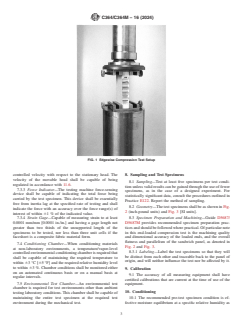
7.2.2 Lateral End Supports—Via (1) clamps made of rect-
5.3 The reporting section requires items that tend to influ-
angular steel bars fastened together so as to clamp the
ence edgewise compressive strength to be reported; these
specimen lightly between them (the cross-sectional dimensions
include materials, fabrication method, facesheet lay-up orien-
of each of these bars shall be not less than 6 mm [0.25 in.],
tation (if composite), core orientation, results of any nonde-
such as that shown in Fig. 1; (2) fitting the specimen snugly
structive inspections, specimen preparation, test equipment
into a lengthwise slot in a round steel bar, where such bars shall
details, specimen dimensions and associated measurement
have a diameter not less than the thickness of the sandwich plus
accuracy, environmental conditions, speed of testing, failure
6 mm [0.25 in.], and are suitably retained on the spherical
mode, and failure location.
bearing block surfaces; or (3) casting the ends of the specimens
in resin or other suitable molding material. The cast ends of the
6. Interferences specimen should be ground flat and parallel, meeting or
exceeding the specimen end tolerances shown in Fig. 2 and
6.1 Material and Specimen Preparation—Poor material fab-
Fig. 3.
rication practices, lack of control of fiber alignment, and
damage induced by improper specimen machining are known 7.3 Testing Machine—The testing machine shall be in ac-
causes of high data scatter in composites in general. Specific cordance with Practices E4 and shall satisfy the following
material factors that affect sandwich composites include vari- requirements:
ability in core density and degree of cure of resin in both facing 7.3.1 Testing Machine Configuration—The testing machine
matrix material and core bonding adhesive. Important aspects shall have both an essentially stationary head and a movable
of sandwich panel specimen preparation that contribute to data head.
scatter are incomplete or nonuniform core bonding to facings, 7.3.2 Drive Mechanism—The testing machine drive mecha-
misalignment of core and facing elements, the existence of nism shall be capable of imparting to the movable head a
C364/C364M − 16 (2024)
FIG. 1 Edgewise Compression Test Setup
controlled velocity with respect to the stationary head. The 8. Sampling and Test Specimens
velocity of the movable head shall be capable of being
8.1 Sampling—Test at least five specimens per test condi-
regulated in accordance with 11.6.
tion unless valid results can be gained through the use of fewer
7.3.3 Force Indicator—The testing machine force-sensing
specimens, as in the case of a designed experiment. For
device shall be capable of indicating the total force being
statistically significant data, consult the procedures outlined in
carried by the test specimen. This device shall be essentially
Practice E122. Report the method of sampling.
free from inertia lag at the specified rate of testing and shall
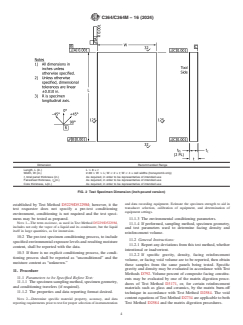
8.2 Geometry—The test specimens shall be as shown in Fig.
indicate the force with an accuracy over the force range(s) of
2 (inch-pound units) and Fig. 3 [SI units].
interest of within 61 % of the indicated value.
7.3.4 Strain Gage—Capable of measuring strain to at least 8.3 Specimen Preparation and Machining—Guide D5687/
0.0001 mm/mm [0.0001 in./in.] and having a gage length not D5687M provides recommended specimen preparation prac-
greater than two thirds of the unsupported length of the tices and should be followed where practical. Of particular note
specimens to be tested, nor less than three unit cells if the in this end-loaded compression test is the machining quality
facesheet is a composite fabric material form. and dimensional accuracy of the loaded ends, and the overall
flatness and parallelism of the sandwich panel, as denoted in
7.4 Conditioning Chamber—When conditioning materials
Fig. 2 and Fig. 3.
at non-laboratory environments, a temperature/vapor-level
8.3.1 Labeling—Label the test specimens so that they will
controlled environmental conditioning chamber is required that
be distinct from each other and traceable back to the panel of
shall be capable of maintaining the required temperature to
origin, and will neither influence the test nor be affected by it.
within 63 °C [65 °F] and the required relative humidity level
to within 63 %. Chamber conditions shall be monitored either
9. Calibration
on an automated continuous basis or on a manual basis at
9.1 The accuracy of all measuring equipment shall have
regular intervals.
certified calibrations that are current at the time of use of the
7.5 Environmental Test Chamber—An environmental test
equipment.
chamber is required for test environments other than ambient
10. Conditioning
testing laboratory conditions. This chamber shall be capable of
maintaining the entire test specimen at the required test 10.1 The recommended pre-test specimen condition is ef-
environment during the mechanical test. fective moisture equilibrium at a specific relative humidity as
C364/C364M − 16 (2024)
Dimension Recommended Range
Length, L (in.) L # 8 × t
Width, W (in.) 2.00 # W # L; W $ 2 × t; W $ 4 × cell widths (honeycomb only)
t, total panel thickness (in.) As required, in order to be representative of intended use
Facesheet thickness, t (in.) As required, in order to be representative of intended use
fs
Core thickness, t (in.) As required, in order to be representative of intended use
c
FIG. 2 Test Specimen Dimension (inch-pound version)
and data recording equipment. Estimate the specimen strength to aid in
established by Test Method D5229/D5229M; however, it the
transducer selection, calibration of equipment, and determination of
test requester does not specify a pre-test conditioning
equipment settings.
environment, conditioning is not required and the test speci-
11.1.3 The environmental conditioning parameters.
mens may be tested as prepared.
NOTE 1—The term moisture, as used in Test Method D5229/D5229M,
11.1.4 If performed, sampling method, specimen geometry,
includes not only the vapor of a liquid and its condensate, but the liquid
and test parameters used to determine facing density and
itself in large quantities, as for immersion.
reinforcement volume.
10.2 The pre-test specimen conditioning process, to include
11.2 General Instructions:
specified environmental exposure levels and resulting moisture
11.2.1 Report any deviations from this test method, whether
content, shall be reported with the data.
intentional or inadvertent.
10.3 If there is no explicit conditioning process, the condi-
11.2.2 If specific gravity, density, facing reinforcement
tioning process shall be reported as “unconditioned” and the
volume, or facing void volume are to be reported, then obtain
moisture content as “unknown.”
these samples from the same panels being tested. Specific
gravity and density may be evaluated in accordance with Test
11. Procedure
Methods D792. Volume percent of composite facing constitu-
11.1 Parameters to be Specified Before Test:
ents may be evaluated by o
...