

ASTM D3373-17
(Test Method)Standard Test Method for Vanadium in Water
General Information
- Abstract
SIGNIFICANCE AND USE
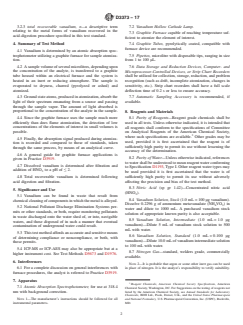
5.1 Vanadium can be found in waste that result from chemical cleaning of components in which the metal is alloyed.
5.2 National Pollutant Discharge Elimination Systems permits or other standards, or both, require monitoring pollutants in waste discharged onto the water shed of, or into, navigable waters, and those disposed of in such a manner that eventual contamination of underground water could result.
5.3 This test method affords an accurate and sensitive means of determining compliance or noncompliance, or both, with those permits.
5.4 ICP-MS or ICP-AES may also be appropriate but at a higher instrument cost. See Test Methods D5673 and D1976.
SCOPE
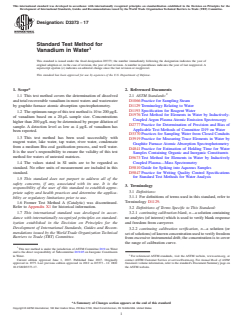
1.1 This test method covers the determination of dissolved and total recoverable vanadium in most waters and wastewater by graphite furnace atomic absorption spectrophotometry.
1.2 The optimum range of this test method is 10 to 200 μg/L of vanadium based on a 20-μL sample size. Concentrations higher than 200 μg/L may be determined by proper dilution of sample. A detection level as low as 4 μg/L of vanadium has been reported.
1.3 This test method has been used successfully with reagent water, lake water, tap water, river water, condensate from a medium Btu coal gasification process, and well water. It is the user's responsibility to ensure the validity of this test method for waters of untested matrices.
1.4 The values stated in SI units are to be regarded as standard. No other units of measurement are included in this standard.
1.5 This standard does not purport to address all of the safety concerns, if any, associated with its use. It is the responsibility of the user of this standard to establish appropriate safety and health practices and determine the applicability or regulatory limitations prior to use.
1.6 Former Test Method A (Catalytic) was discontinued. Refer to Appendix X1 for historical information.
1.7 This international standard was developed in accordance with internationally recognized principles on standardization established in the Decision on Principles for the Development of International Standards, Guides and Recommendations issued by the World Trade Organization Technical Barriers to Trade (TBT) Committee.
- Status
- Published
- Publication Date
- 31-May-2017
- Technical Committee
- D19 - Water
- Drafting Committee
- D19.05 - Inorganic Constituents in Water
Overview
ASTM D3373-17: Standard Test Method for Vanadium in Water is a widely recognized analytical standard developed by ASTM International. This method establishes procedures for determining both dissolved and total recoverable vanadium in a variety of water types, including wastewater, tap water, river water, lake water, and well water, using graphite furnace atomic absorption spectrophotometry (GFAA). Designed to meet environmental monitoring needs, particularly for regulatory compliance, this standard is referenced by environmental agencies and laboratories to ensure accurate quantification of vanadium in water samples.
Key Topics
Scope and Sensitivity
- Covers water and wastewater matrices for dissolved and total recoverable vanadium.
- Optimum concentration range: 10 to 200 μg/L (dilution accommodates higher concentrations).
- Detection level reported as low as 4 μg/L.
Significance and Regulatory Use
- Supports compliance with environmental requirements (e.g., National Pollutant Discharge Elimination System permits).
- Critical in monitoring pollutants resulting from industrial activities such as chemical cleaning of metal alloy components.
- Ensures facilities meet national and local discharge or watershed protection standards.
Analytical Technique
- Utilizes graphite furnace atomic absorption spectrophotometry, which provides high sensitivity for trace metals in small sample volumes.
- Procedure includes acid digestion (for total recoverable vanadium), filtration, and measurement against certified standards.
Quality Control and Precision
- Emphasizes calibration verification, use of blanks, control samples, and matrix spikes.
- Requires demonstration of laboratory capability and ongoing quality control checks.
Alternate Methods
- References alternatives such as ICP-MS (Inductively Coupled Plasma Mass Spectrometry) and ICP-AES, albeit at higher instrument cost (see ASTM D5673, D1976).
Applications
Environmental Water Quality Monitoring
- Routine analysis in municipal, industrial, or environmental laboratories to detect vanadium in water and wastewater.
- Useful for monitoring effluent, surface water, well water, and process condensate, especially from facilities using vanadium alloys.
Industrial Waste Management
- Applied in compliance testing for discharge permits where vanadium is a regulated contaminant.
- Helps prevent contamination of underground and surface waters due to improper waste handling.
Regulatory and Research Settings
- Employed by environmental consultants, regulatory agencies, and researchers studying vanadium cycling and pollution controls.
Laboratory Accreditation and Proficiency
- Adherence to ASTM D3373-17 can support laboratory accreditation in water analysis and proficiency testing.
Related Standards
- ASTM D5673 - Test Method for Elements in Water by Inductively Coupled Plasma Mass Spectrometry (ICP-MS)
- ASTM D1976 - Test Method for Elements in Water by Inductively Coupled Argon Plasma Atomic Emission Spectroscopy (ICP-AES)
- ASTM D3919 - Practice for Measuring Trace Elements in Water by Graphite Furnace Atomic Absorption Spectrophotometry
- ASTM D2777 - Practice for Determination of Precision and Bias of Applicable Test Methods
- ASTM D1193 - Specification for Reagent Water
- ASTM D3370 - Practices for Sampling Water from Closed Conduits
- ASTM D4841 - Practice for Estimation of Holding Time for Water Samples
Practical Value
ASTM D3373-17 is integral to reliable vanadium quantification in water, helping protect public health and the environment by ensuring regulatory standards are met. Its inclusion of sample preparation, analytical procedures, and quality assurance makes it a practical reference for laboratories performing trace metal analysis. By adhering to established protocols, users obtain accurate, reproducible results essential for effective water quality management and compliance.
Keywords: ASTM D3373-17, vanadium in water, test method, graphite furnace atomic absorption spectrophotometry, water quality monitoring, environmental compliance, trace metals analysis.
Relations
- Effective Date
- 01-Jun-2017
- Effective Date
- 01-May-2020
- Effective Date
- 01-May-2020
- Effective Date
- 01-Aug-2018
- Effective Date
- 01-Aug-2018
- Effective Date
- 01-Jul-2018
- Effective Date
- 01-Jul-2015
- Effective Date
- 01-Jan-2013
- Effective Date
- 01-Jan-2013
- Effective Date
- 15-Jun-2012
- Effective Date
- 01-Mar-2012
- Effective Date
- 15-Jun-2011
- Effective Date
- 01-May-2011
- Effective Date
- 01-Dec-2010
- Effective Date
- 01-Aug-2010
Get Certified
Connect with accredited certification bodies for this standard

CIS Institut d.o.o.
Personal Protective Equipment (PPE) certification body. Notified Body NB-2890 for EU Regulation 2016/425 PPE.

Kiwa BDA Testing
Building and construction product certification.
Kmetijski inštitut Slovenije
Agricultural Institute of Slovenia. Soil testing, plant health, agricultural product analysis.
Sponsored listings
Frequently Asked Questions
ASTM D3373-17 is a standard published by ASTM International. Its full title is "Standard Test Method for Vanadium in Water". This standard covers: SIGNIFICANCE AND USE 5.1 Vanadium can be found in waste that result from chemical cleaning of components in which the metal is alloyed. 5.2 National Pollutant Discharge Elimination Systems permits or other standards, or both, require monitoring pollutants in waste discharged onto the water shed of, or into, navigable waters, and those disposed of in such a manner that eventual contamination of underground water could result. 5.3 This test method affords an accurate and sensitive means of determining compliance or noncompliance, or both, with those permits. 5.4 ICP-MS or ICP-AES may also be appropriate but at a higher instrument cost. See Test Methods D5673 and D1976. SCOPE 1.1 This test method covers the determination of dissolved and total recoverable vanadium in most waters and wastewater by graphite furnace atomic absorption spectrophotometry. 1.2 The optimum range of this test method is 10 to 200 μg/L of vanadium based on a 20-μL sample size. Concentrations higher than 200 μg/L may be determined by proper dilution of sample. A detection level as low as 4 μg/L of vanadium has been reported. 1.3 This test method has been used successfully with reagent water, lake water, tap water, river water, condensate from a medium Btu coal gasification process, and well water. It is the user's responsibility to ensure the validity of this test method for waters of untested matrices. 1.4 The values stated in SI units are to be regarded as standard. No other units of measurement are included in this standard. 1.5 This standard does not purport to address all of the safety concerns, if any, associated with its use. It is the responsibility of the user of this standard to establish appropriate safety and health practices and determine the applicability or regulatory limitations prior to use. 1.6 Former Test Method A (Catalytic) was discontinued. Refer to Appendix X1 for historical information. 1.7 This international standard was developed in accordance with internationally recognized principles on standardization established in the Decision on Principles for the Development of International Standards, Guides and Recommendations issued by the World Trade Organization Technical Barriers to Trade (TBT) Committee.
SIGNIFICANCE AND USE 5.1 Vanadium can be found in waste that result from chemical cleaning of components in which the metal is alloyed. 5.2 National Pollutant Discharge Elimination Systems permits or other standards, or both, require monitoring pollutants in waste discharged onto the water shed of, or into, navigable waters, and those disposed of in such a manner that eventual contamination of underground water could result. 5.3 This test method affords an accurate and sensitive means of determining compliance or noncompliance, or both, with those permits. 5.4 ICP-MS or ICP-AES may also be appropriate but at a higher instrument cost. See Test Methods D5673 and D1976. SCOPE 1.1 This test method covers the determination of dissolved and total recoverable vanadium in most waters and wastewater by graphite furnace atomic absorption spectrophotometry. 1.2 The optimum range of this test method is 10 to 200 μg/L of vanadium based on a 20-μL sample size. Concentrations higher than 200 μg/L may be determined by proper dilution of sample. A detection level as low as 4 μg/L of vanadium has been reported. 1.3 This test method has been used successfully with reagent water, lake water, tap water, river water, condensate from a medium Btu coal gasification process, and well water. It is the user's responsibility to ensure the validity of this test method for waters of untested matrices. 1.4 The values stated in SI units are to be regarded as standard. No other units of measurement are included in this standard. 1.5 This standard does not purport to address all of the safety concerns, if any, associated with its use. It is the responsibility of the user of this standard to establish appropriate safety and health practices and determine the applicability or regulatory limitations prior to use. 1.6 Former Test Method A (Catalytic) was discontinued. Refer to Appendix X1 for historical information. 1.7 This international standard was developed in accordance with internationally recognized principles on standardization established in the Decision on Principles for the Development of International Standards, Guides and Recommendations issued by the World Trade Organization Technical Barriers to Trade (TBT) Committee.
ASTM D3373-17 is classified under the following ICS (International Classification for Standards) categories: 13.060.50 - Examination of water for chemical substances. The ICS classification helps identify the subject area and facilitates finding related standards.
ASTM D3373-17 has the following relationships with other standards: It is inter standard links to ASTM D3373-12, ASTM D1129-13(2020)e2, ASTM D1976-20, ASTM D1066-18e1, ASTM D1066-18, ASTM D1976-18, ASTM D5673-15, ASTM D4841-88(2013), ASTM D4841-88(2013)e1, ASTM D2777-12, ASTM D1976-12, ASTM D1066-11, ASTM D5810-96(2011), ASTM D3370-10, ASTM D5673-10. Understanding these relationships helps ensure you are using the most current and applicable version of the standard.
ASTM D3373-17 is available in PDF format for immediate download after purchase. The document can be added to your cart and obtained through the secure checkout process. Digital delivery ensures instant access to the complete standard document.
Standards Content (Sample)
This international standard was developed in accordance with internationally recognized principles on standardization established in the Decision on Principles for the
Development of International Standards, Guides and Recommendations issued by the World Trade Organization Technical Barriers to Trade (TBT) Committee.
Designation: D3373 − 17
Standard Test Method for
Vanadium in Water
This standard is issued under the fixed designation D3373; the number immediately following the designation indicates the year of
original adoption or, in the case of revision, the year of last revision. A number in parentheses indicates the year of last reapproval. A
superscript epsilon (´) indicates an editorial change since the last revision or reapproval.
This standard has been approved for use by agencies of the U.S. Department of Defense.
1. Scope* 2. Referenced Documents
1.1 This test method covers the determination of dissolved 2.1 ASTM Standards:
and total recoverable vanadium in most waters and wastewater D1066 Practice for Sampling Steam
by graphite furnace atomic absorption spectrophotometry. D1129 Terminology Relating to Water
D1193 Specification for Reagent Water
1.2 Theoptimumrangeofthistestmethodis10to200µg/L
D1976 Test Method for Elements in Water by Inductively-
of vanadium based on a 20-µL sample size. Concentrations
Coupled Argon Plasma Atomic Emission Spectroscopy
higher than 200 µg/L may be determined by proper dilution of
D2777 Practice for Determination of Precision and Bias of
sample. A detection level as low as 4 µg/L of vanadium has
Applicable Test Methods of Committee D19 on Water
been reported.
D3370 Practices for Sampling Water from Closed Conduits
1.3 This test method has been used successfully with
D3919 Practice for Measuring Trace Elements in Water by
reagent water, lake water, tap water, river water, condensate
Graphite Furnace Atomic Absorption Spectrophotometry
from a medium Btu coal gasification process, and well water.
D4841 Practice for Estimation of Holding Time for Water
It is the user’s responsibility to ensure the validity of this test
Samples Containing Organic and Inorganic Constituents
method for waters of untested matrices.
D5673 Test Method for Elements in Water by Inductively
Coupled Plasma—Mass Spectrometry
1.4 The values stated in SI units are to be regarded as
standard. No other units of measurement are included in this D5810 Guide for Spiking into Aqueous Samples
D5847 Practice for Writing Quality Control Specifications
standard.
for Standard Test Methods for Water Analysis
1.5 This standard does not purport to address all of the
safety concerns, if any, associated with its use. It is the
3. Terminology
responsibility of the user of this standard to establish appro-
3.1 Definitions:
priate safety and health practices and determine the applica-
3.1.1 For definitions of terms used in this standard, refer to
bility or regulatory limitations prior to use.
Terminology D1129.
1.6 Former Test Method A (Catalytic) was discontinued.
Refer to Appendix X1 for historical information.
3.2 Definitions of Terms Specific to This Standard:
1.7 This international standard was developed in accor- 3.2.1 continuing calibration blank, n—a solution containing
no analytes (of interest) which is used to verify blank response
dance with internationally recognized principles on standard-
ization established in the Decision on Principles for the and freedom from carryover.
Development of International Standards, Guides and Recom-
3.2.2 continuing calibration verification, n—a solution (or
mendations issued by the World Trade Organization Technical
setofsolutions)ofknownconcentrationusedtoverifyfreedom
Barriers to Trade (TBT) Committee.
from excessive instrumental drift; the concentration is to cover
the range of calibration curve.
This test method is under the jurisdiction of ASTM Committee D19 on Water
and is the direct responsibility of Subcommittee D19.05 on Inorganic Constituents
in Water. For referenced ASTM standards, visit the ASTM website, www.astm.org, or
Current edition approved June 1, 2017. Published June 2017. Originally contact ASTM Customer Service at service@astm.org. For Annual Book of ASTM
approved in 1975. Last previous edition approved in 2012 as D3373 – 12. DOI: Standards volume information, refer to the standard’s Document Summary page on
10.1520/D3373-17. the ASTM website.
*A Summary of Changes section appears at the end of this standard
Copyright © ASTM International, 100 Barr Harbor Drive, PO Box C700, West Conshohocken, PA 19428-2959. United States
D3373 − 17
3.2.3 total recoverable vanadium, n—a descriptive term 7.2 Vanadium Hollow Cathode Lamp.
relating to the metal forms of vanadium recovered in the
7.3 Graphite Furnace capable of reaching temperature suf-
acid-digestion procedure specified in this test standard.
ficient to atomize the element of interest.
4. Summary of Test Method 7.4 Graphite Tubes, pyrolytically coated, compatible with
furnace device are recommended.
4.1 Vanadium is determined by an atomic absorption spec-
trophotometer utilizing a graphite furnace for sample atomiza- 7.5 Pipettes, microlitre with disposable tips, ranging in size
tion. from 1 to 100 µL.
4.2 Asamplevolumeofseveralmicrolitres,dependingupon 7.6 Data Storage and Reduction Devices, Computer- and
the concentration of the analyte, is transferred to a graphite Microprocessor-Controlled Devices, or Strip Chart Recorders
tube housed within an electrical furnace and the system is
shall be utilized for collection, storage, reduction, and problem
heated in an inert or reducing atmosphere. The sample is recognition (such as drift, incomplete atomization, changes in
evaporated to dryness, charred (pyrolyzed or ashed) and
sensitivity, etc.). Strip chart recorders shall have a full scale
atomized. deflection time of 0.2 s or less to ensure accuracy.
4.3 Groundstateatoms,producedinatomization,absorbthe 7.7 Automatic Sampling Accessory is recommended, if
light of their spectrum emanating from a source and passing available.
through the sample vapor. The amount of light absorbed is
proportional to the concentration of the analyte in the sample. 8. Reagents and Materials
4.4 Since the graphite furnace uses the sample much more
8.1 Purity of Reagents—Reagent grade chemicals shall be
efficiently than does flame atomization, the detection of low used in all tests. Unless otherwise indicated, it is intended that
concentrations of the elements of interest in small volumes is
all reagents shall conform to the specifications of Committee
possible. on Analytical Reagents of the American Chemical Society,
where such specifications are available. Other grades may be
4.5 Finally, the absorption signal produced during atomiza-
used, provided it is first ascertained that the reagent is of
tion is recorded and compared to those of standards, taken
sufficiently high purity to permit its use without lessening the
through the same process, by means of an analytical curve.
accuracy of the determination.
4.6 A general guide for graphite furnace applications is
8.2 Purity of Water—Unless otherwise indicated, references
given in Practice D3919.
towatershallbeunderstoodtomeanreagentwaterconforming
4.7 Dissolved vanadium is determined after filtration and
to Specification D1193, Type I. Other reagent water types may
addition of HNO toapHof ≤ 2.
be used provided it is first ascertained that the water is of
4.8 Total recoverable vanadium is determined following
sufficiently high purity to permit its use without adversely
acid digestion and filtration. affecting the precision and bias of the test method.
8.3 Nitric Acid (sp gr 1.42)—Concentrated nitric acid
5. Significance and Use
(HNO ).
5.1 Vanadium can be found in waste that result from
8.4 Vanadium Solution, Stock (1.0 mL = 100 µg vanadium).
chemicalcleaningofcomponentsinwhichthemetalisalloyed.
Dissolve 0.2296 g of ammonium metavanadate (NH VO)in
4 3
5.2 National Pollutant Discharge Elimination Systems per-
water and dilute to 1000 mL. A purchased vanadium stock
mits or other standards, or both, require monitoring pollutants
solution of appropriate known purity is also acceptable.
in waste discharged onto the water shed of, or into, navigable
8.5 Vanadium Solution, Intermediate (1.0 mL = 1.0 µg
waters, and those disposed of in such a manner that eventual
vanadium)—Dilute 5 mL of vanadium stock solution to 500
contamination of underground water could result.
mL with water.
5.3 Thistestmethodaffordsanaccurateandsensitivemeans
8.6 Vanadium Solution, Standard (1.0 mL = 0.100 µg
of determining compliance or noncompliance, or both, with
vanadium)—Dilute10.0mLofvanadiumintermediatesolution
those permits.
to 100 mL with water.
5.4 ICP-MS or ICP-AES may also be appropriate but at a
8.7 Nitrogen Gas—standard, welders grade, commercially
higher instrument cost. See Test Methods D5673 and D1976.
available.
6. Interferences
NOTE 2—It is probable that argon or some other inert gas can be used
in place of nitrogen. It is the analyst’s responsibility to verify suitability.
6.1 For a complete discussion on general interferences with
furnace procedures, the analyst is referred to Practice D3919.
7. Apparatus
Reagent Chemicals, American Chemical Society Specifications, American
7.1 Atomic Absorption Spectrophotometer, for use at 318.4
Chemical Society, Washington, DC. For Suggestions on the testing of reagents not
listed by the American Chemical Society, see Annual Standards for Laboratory
nm with background correction.
Chemicals, BDH Ltd., Poole, Dorset, U.K., and the United States Pharmacopeia
NOTE 1—The manufacturer’s instructions should be followed for all and National Formulary, U.S. Pharmacopeial Convention, Inc. (USPC), Rockville,
instrumental parameters. MD.
D3373 − 17
TABLE 1 Determination of Precision and Bias for Vanadium
8.8 Filter Paper—Purchase suitable filter paper. Typically
the filter papers have a pore size of 0.45-µm membrane. Amount Amount
S , Bias, Statistically
T
Added, Found, % Bias
Material such as fine-textured, acid-washed, ashless paper, or
µg/L µg/L Significant
µg V/L µg V/L
glass fiber paper are acceptable. The user must first ascertain
Reagent Water Type II
that the filter paper is of sufficient purity to use without
25 24 2.6 −1.0 4.0 no
70 73.4 4.8 +3.4 4.9 no
adversely affecting the bias and precision of the test method.
240 232.7 25.5 −7.3 3.0 no
Water of Choice
9. Sampling
25 25.9 3.6 +0.9 3.6 no
70 70 7.6 0 0 no
9.1 Collect the sample in accordance with Practices D1066
240 247.3 27.7 +7.3 3.0 no
andD3370,asapplicable.Theholdingtimeforthesamplemay
be calculated in accordance with Practice D4841.
100-mL volumetric flask. Wash the filter paper 2 or 3 times
9.2 Preserve samples with nitric acid (HNO , sp gr 1.42) to
a pH of 2 or less immediately at the time of collection, with water and bring to volume. See Note 6. The acid
normally about 2 mL/L. If only dissolved vanadium is to be concentration at this point should be 5 % HNO .
determined, filter the sample through a 0.45-µm (No. 325)
NOTE 6—If suspended material is not present, this filtration may be
membrane filter before acidification.
omitted, however, digested sample must still be diluted to 100 mL.
NOTE 3—Alternatively, the pH may be adjusted in the laboratory within
11.6 Inject a measured aliquot of sample into the furnace
14 days of collection. However, acid must be added at least 24 hours
device following the directions as provided by the particular
before analysis to dissolve any metals that adsorb to the container walls.
instrument manufacturer. Refer to Practice D3919.
This could reduce hazards of working with acids in the field when
appropriate.
12. Calculation
10. Standardization 12.1 Determine the concentration of vanadium in each
sample in accordance with the Samples Analysis Procedure
10.1 Initially, set the instrument in accordance with the
Section of Practice D3919.
manufacturer’s specifications. Follow the general instructions
as provided in Practice D3919.
13. Precision and Bias
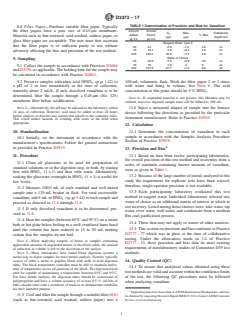
13.1 Based on data from twelve participating laboratories,
11. Procedure
the overall precision of this test method and recoveries from a
11.1 Clean all glassware to be used for preparation of
series of standards containing known amounts of vanadium,
standard solutions or in the digestion step, or both, by rinsing
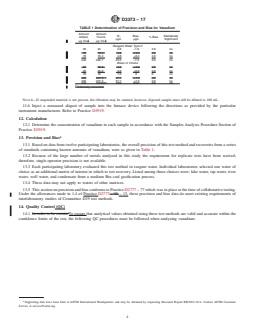
were as given in Table 1.
first with HNO (1 + 1) and then with water. Alternatively,
13.2 Because of the large number of metals analyzed in this
soaking the glassware overnight in HNO (1 + 1) is useful for
study the requirement fo
...
This document is not an ASTM standard and is intended only to provide the user of an ASTM standard an indication of what changes have been made to the previous version. Because
it may not be technically possible to adequately depict all changes accurately, ASTM recommends that users consult prior editions as appropriate. In all cases only the current version
of the standard as published by ASTM is to be considered the official document.
Designation: D3373 − 12 D3373 − 17
Standard Test Method for
Vanadium in Water
This standard is issued under the fixed designation D3373; the number immediately following the designation indicates the year of
original adoption or, in the case of revision, the year of last revision. A number in parentheses indicates the year of last reapproval. A
superscript epsilon (´) indicates an editorial change since the last revision or reapproval.
This standard has been approved for use by agencies of the U.S. Department of Defense.
1. Scope*
1.1 This test method covers the determination of dissolved and total recoverable vanadium in most waters and wastewater by
graphite furnace atomic absorption spectrophotometry.
1.2 The optimum range of this test method is 10 to 200 μg/L of vanadium based on a 20-μL sample size. Concentrations higher
than 200μ g/L200 μg/L may be determined by proper dilution of sample. A detection level as low as 4 μg/L of vanadium has been
reported.
1.3 This test method has been used successfully with reagent water, lake water, tap water, river water, condensate from a
medium Btu coal gasification process, and well water. It is the user’s responsibility to ensure the validity of this test method for
waters of untested matrices.
1.4 The values stated in SI units are to be regarded as standard. No other units of measurement are included in this standard.
1.5 This standard does not purport to address all of the safety concerns, if any, associated with its use. It is the responsibility
of the user of this standard to establish appropriate safety and health practices and determine the applicability or regulatory
limitations prior to use.
1.6 Former Test Method A (Catalytic) was discontinued. Refer to Appendix X1 for historical information.
1.7 This international standard was developed in accordance with internationally recognized principles on standardization
established in the Decision on Principles for the Development of International Standards, Guides and Recommendations issued
by the World Trade Organization Technical Barriers to Trade (TBT) Committee.
2. Referenced Documents
2.1 ASTM Standards:
D1066 Practice for Sampling Steam
D1129 Terminology Relating to Water
D1193 Specification for Reagent Water
D1976 Test Method for Elements in Water by Inductively-Coupled Argon Plasma Atomic Emission Spectroscopy
D2777 Practice for Determination of Precision and Bias of Applicable Test Methods of Committee D19 on Water
D3370 Practices for Sampling Water from Closed Conduits
D3919 Practice for Measuring Trace Elements in Water by Graphite Furnace Atomic Absorption Spectrophotometry
D4841 Practice for Estimation of Holding Time for Water Samples Containing Organic and Inorganic Constituents
D5673 Test Method for Elements in Water by Inductively Coupled Plasma—Mass Spectrometry
D5810 Guide for Spiking into Aqueous Samples
D5847 Practice for Writing Quality Control Specifications for Standard Test Methods for Water Analysis
3. Terminology
3.1 Definitions: For definitions of terms used in this test method refer to Terminology D1129.
3.1.1 For definitions of terms used in this standard, refer to Terminology D1129.
3.2 Definitions of Terms Specific to This Standard:
This test method is under the jurisdiction of ASTM Committee D19 on Water and is the direct responsibility of Subcommittee D19.05 on Inorganic Constituents in Water.
Current edition approved Sept. 1, 2012June 1, 2017. Published September 2012June 2017. Originally approved in 1975. Last previous edition approved in 20072012 as
ε1
D3373 – 03 (2007)D3373 – 12. . DOI: 10.1520/D3373-12.10.1520/D3373-17.
For referenced ASTM standards, visit the ASTM website, www.astm.org, or contact ASTM Customer Service at service@astm.org. For Annual Book of ASTM Standards
volume information, refer to the standard’s Document Summary page on the ASTM website.
*A Summary of Changes section appears at the end of this standard
Copyright © ASTM International, 100 Barr Harbor Drive, PO Box C700, West Conshohocken, PA 19428-2959. United States
D3373 − 17
3.2.1 continuing calibration blank, n—a solution containing no analytes (of interest) which is used to verify blank response and
freedom from carryover.
3.2.2 continuing calibration verification, n—a solution (or set of solutions) of known concentration used to verify freedom from
excessive instrumental drift; the concentration is to cover the range of calibration curve.
3.2.3 total recoverable vanadium, n—dissolved vanadium plus that solubilized by acid digestion of particulates and organics in
the sample.a descriptive term relating to the metal forms of vanadium recovered in the acid-digestion procedure specified in this
test standard.
4. Summary of Test Method
4.1 Vanadium is determined by an atomic absorption spectrophotometer utilizing a graphite furnace for sample atomization.
4.2 A sample volume of several microlitres, depending upon the concentration of the analyte, is transferred to a graphite tube
housed within an electrical furnace and the system is heated in an inert or reducing atmosphere. The sample is evaporated to
dryness, charred (pyrolyzed or ashed) and atomized.
4.3 Ground state atoms, produced in atomization, absorb the light of their spectrum emanating from a source and passing
through the sample vapor. The amount of light absorbed is proportional to the concentration of the analyte in the sample.
4.4 Since the graphite furnace uses the sample much more efficiently than does flame atomization, the detection of low
concentrations of the elements of interest in small volumes is possible.
4.5 Finally, the absorption signal produced during atomization is recorded and compared to those of standards, taken through
the same process, by means of an analytical curve.
4.6 A general guide for graphite furnace applications is given in Practice D3919.
4.7 Dissolved vanadium is determined after filtration and addition of HNO to a pH of ≤ 2.
4.8 Total recoverable vanadium is determined following acid digestion and filtration.
5. Significance and Use
5.1 Vanadium can be found in waste that result from chemical cleaning of components in which the metal is alloyed.
5.2 National Pollutant Discharge Elimination Systems permits or other standards, or both, require monitoring pollutants in waste
discharged onto the water shed of, or into, navigable waters, and those disposed of in such a manner that eventual contamination
of underground water could result.
5.3 This test method affords an accurate and sensitive means of determining compliance or noncompliance, or both, with those
permits.
5.4 ICP-MS or ICP-AES may also be appropriate but at a higher instrument cost. See Test Methods D5673 and D1976.
6. Interferences
6.1 For a complete discussion on general interferences with furnace procedures, the analyst is referred to Practice D3919.
7. Apparatus
7.1 Atomic Absorption Spectrophotometer, for use at 318.4 nm with background correction.
NOTE 1—The manufacturer’s instructions should be followed for all instrumental parameters.
7.2 Vanadium Hollow Cathode Lamp.
7.3 Graphite Furnace capable of reaching temperature sufficient to atomize the element of interest.
7.4 Graphite Tubes, pyrolytically coated, compatible with furnace device are recommended.
7.5 Pipettes, microlitre with disposable tips, ranging in size from 1 to 100 μL.
7.6 Strip Chart Recorder—Data Storage and Reduction Devices, Computer- and Microprocessor-Controlled Devices, or Strip
Chart Recorders A recorder is strongly recommended. The tracings can be used as permanent records and are of diagnostic value
in the identification and analysis of instrument problems shall be utilized for collection, storage, reduction, and problem recognition
(such as drift, incomplete atomization, changechanges in sensitivity, etc.). A fast response recorder (0.2 s or less for full-scale
deflection) is recommended Strip chart recorders shall have a full scale deflection time of 0.2 s or less to ensure accuracy.
Electronic peak-measuring devices have also been found useful.
7.7 Automatic Sampling Accessory is recommended, if available.
8. Reagents and Materials
8.1 Purity of Reagents—Reagent grade chemicals shall be used in all tests. Unless otherwise indicated, it is intended that all
reagents shall conform to the specifications of Committee on Analytical Reagents of the American Chemical Society, where such
D3373 − 17
specifications are available. Other grades may be used, provided it is first ascertained that the reagent is of sufficiently high purity
to permit its use without lessening the accuracy of the determination.
8.2 Purity of Water—Unless otherwise indicated, references to water shall be understood to mean reagent water conforming to
Specification D1193, Type I. Other reagent water types may be used provided it is first ascertained that the water is of sufficiently
high purity to permit its use without adversely affecting the precision and bias of the test method.
8.3 Nitric Acid (sp gr 1.42)—Concentrated nitric acid (HNO ).
8.4 Vanadium Solution, Stock (1.0 mL = 100 μg vanadium). Dissolve 0.2296 g of ammonium metavanadate (NH VO ) in water
4 3
and dilute to 1000 mL. A purchased vanadium stock solution of appropriate known purity is also acceptable.
8.5 Vanadium Solution, Intermediate (1.0 mL = 1.0 μg vanadium)—Dilute 5 mL of vanadium stock solution to 500 mL with
water.
8.6 Vanadium Solution, Standard (1.0 mL = 0.100 μg vanadium)—Dilute 10.0 mL of vanadium intermediate solution to 100 mL
with water.
8.7 Nitrogen Gas—standard, welders grade, commercially available.
NOTE 2—It is probable that argon or some other inert gas can be used in place of nitrogen. It is the analyst’s responsibility to verify suitability.
8.8 Filter Paper—Purchase suitable filter paper. Typically the filter papers have a pore size of 0.45-μm membrane. Material such
as fine-textured, acid-washed, ashless paper, or glass fiber paper are acceptable. The user must first ascertain that the filter paper
is of sufficient purity to use without adversely affecting the bias and precision of the test method.
9. Sampling
9.1 Collect the sample in accordance with Practices D1066 and D3370, as applicable. The holding time for the sample may be
calculated in accordance with Practice D4841.
9.2 Preserve samples with nitric acid (HNO , sp gr 1.42) to a pH of 2 or less immediately at the time of collection, normally
about 2 mL/L. If only dissolved vanadium is to be determined, filter the sample through a 0.45-μm (No. 325) membrane filter
before acidification.
NOTE 3—Alternatively, the pH may be adjusted in the laboratory if the sample is returned within 14 days. within 14 days of collection. However, acid
must be added at least 24 hours before analysis to dissolve any metals that adsorb to the container walls. This could reduce hazards of working with acids
in the field when appropriate.
10. Standardization
10.1 Initially, set the instrument in accordance with the manufacturer’s specifications. Follow the general instructions as
provided in Practice D3919.
11. Procedure
11.1 Clean all glassware to be used for preparation of standard solutions or in the digestion step, or both, by rinsing first with
HNO (1 + 1) and then with water. Alternatively, soaking the glassware overnight in HNO (1 + 1) is useful for low levels.
3 3
11.2 Measure 100.0 mL of each standard and well-mixed sample into a 125-mL beaker or flask. For total recoverable vanadium,
add 5 mL of HNO (sp gr 1.42) to each sample and proceed as directed in 11.4 through 11.6.
11.3 If only dissolved vanadium is to be determined, proceed to 11.6.
11.4 Heat the samples at 95°C (between 65°C and 95°C) on a steam bath or hotplate hot plate below boiling in a well-ventilated
fume hood until the volume has been reduced to 15 to 20 mL making certain that the samples do not boil.
NOTE 4—When analyzing samples of brines or samples containing appreciable amounts of suspended matter or dissolved solids, the amount of
reduction in volume is left to the discretion of the analyst.
NOTE 5—Many laboratories have found block digestion systems a useful way to digest samples for trace metals analysis. Systems typically consist of
either a metal or graphite block with wells to hold digestion tubes. The block temperature controller must be able to maintain uniformity of temperature
across all positions of the block. The digestion block must be capable of maintaining a temperature between 65°C and 95°C. For trace metals analysis,
the digestion tubes should be constructed of polypropylene and have a volume accuracy of at least 0.5%. 0.5 %. All lots of tubes should come with a
certificate of analysis to demonstrate suitability for their intended purpose.
11.5 Cool and filter the sample through a suitable filter (8.8) (such as fine-textured, acid washed, ashless paper) into a 100-mL
volumetric flask. Wash the filter paper 2 or 3 times with water and bring to volume. See Note 6. The acid concentration at this point
should be 5 % HNO .
Reagent Chemicals, American Chemical Society Specifications, American Chemical Society, Washington, DC. For Suggestions on the testing of reagents not listed by
the American Chemical Society, see Annual Standards for Laboratory Chemicals, BDH Ltd., Poole, Dorset, U.K., and the United States Pharmacopeia and National
Formulary, U.S. Pharmacopeial Convention, Inc. (USPC), Rockville, MD.
D3373 − 1
...