

ASTM A767/A767M-19
(Specification)Standard Specification for Zinc-Coated (Galvanized) Steel Bars for Concrete Reinforcement
General Information
- Abstract
ABSTRACT
This specification covers steel reinforcing bars with protective zinc coatings applied by dipping the properly prepared reinforcing bars into a molten bath of zinc. Galvanization shall be used to prepare reinforcing bars. The galvanizer shall be permitted to subject the newly coated steel reinforcing bars to air or steam wiping to remove excess zinc from the bars. The mass of zinc coating shall conform to specified requirements. The mass of the coating shall be determined by magnetic thickness gage measurements. Stripping method, weighing before and after galvanizing, and microscopy method shall be used to referee the results obtained by magnetic thickness measurements. A retest shall be provided if the average zinc coating mass fails to meet the requirements. The galvanized coating shall be chromate treated.
SCOPE
1.1 This specification covers steel reinforcing bars with protective zinc coatings applied by immersing the properly prepared reinforcing bars into a molten bath of zinc.
Note 1: The galvanizer is identified throughout this specification as the manufacturer.
1.2 Guidelines for construction practices at the job-site are presented in Appendix X1.
1.3 Guidelines for use of zinc-coated (galvanized) reinforcing bars with non-galvanized steel forms are presented in Appendix X2.
1.4 The text of this specification references notes and footnotes which provide explanatory material. These notes and footnotes (excluding those in tables) shall not be considered as requirements of the specification.
1.5 This specification is applicable for orders in either inch-pound units (as Specification A767) or SI units (as Specification A767M).
1.6 The values stated in either inch-pound units or SI units are to be regarded separately as standard. Within the text, the SI units are shown in brackets. The values stated in each system may not be exact equivalents. Therefore, each system shall be used independently of the other. Combining values from the two systems may result in non-conformance with this specification.
1.7 This international standard was developed in accordance with internationally recognized principles on standardization established in the Decision on Principles for the Development of International Standards, Guides and Recommendations issued by the World Trade Organization Technical Barriers to Trade (TBT) Committee.
- Status
- Published
- Publication Date
- 30-Apr-2019
- Technical Committee
- A01 - Steel, Stainless Steel and Related Alloys
- Drafting Committee
- A01.05 - Steel Reinforcement
Buy Documents
ASTM A767/A767M-19 - Standard Specification for Zinc-Coated (Galvanized) Steel Bars for Concrete Reinforcement
REDLINE ASTM A767/A767M-19 - Standard Specification for Zinc-Coated (Galvanized) Steel Bars for Concrete Reinforcement
Overview
ASTM A767/A767M-19 specifies requirements for zinc-coated (galvanized) steel bars used as reinforcement in concrete. Developed by ASTM International, this standard details the process of applying a protective zinc coating to steel reinforcing bars by hot-dip galvanizing-immersing pre-cleaned bars into molten zinc. The goal of the standard is to improve the corrosion resistance of rebar, thereby enhancing the long-term durability and service life of reinforced concrete structures. ASTM A767/A767M-19 is applicable for both inch-pound (A767) and SI (A767M) units and aligns with internationally recognized principles for standardization.
Key Topics
Scope and Purpose
Defines the requirements for the zinc-coating of steel rebar to protect against corrosion, particularly in environments susceptible to concrete deterioration.Coating Process and Classes
- Hot-dip Galvanizing: Rebars are cleaned and immersed in molten zinc, forming a metallurgically bonded coating.
- Classes of Coating: Class 1 and Class 2 specify different minimum thickness requirements, with Class 1 providing a thicker coating for greater durability.
- Chromate Treatment: Zinc coatings receive chromate treatment unless waived by the purchaser, reducing the risk of reaction with concrete.
Testing and Quality Control
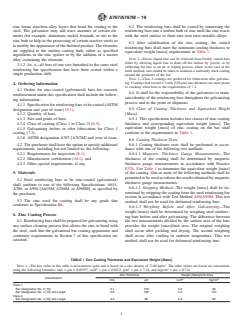
- Coating Thickness Measurement: Primarily measured by magnetic thickness gauge, with referee methods including microscopy and weight difference.
- Inspection and Certification: The standard recommends purchasing contracts specify inspection criteria and certifications for compliance.
- Repair of Damaged Coating: Guidelines for repairing coatings damaged during handling or fabrication are provided, using zinc-rich formulations as per ASTM A780/A780M.
Construction and Handling Guidelines
Appendices offer nonmandatory but valuable best practices for storage, transportation, cutting, welding, and field repair to ensure coating integrity from fabrication to jobsite installation.
Applications
ASTM A767/A767M-19 is widely used in civil engineering, transportation infrastructure, and building construction where reinforced concrete is exposed to aggressive environments. Key applications include:
- Bridges and Highway Structures: Protection against de-icing salt exposure and marine environments.
- Building Foundations and Parking Structures: Enhanced durability for critical reinforcements.
- Marine and Coastal Projects: Superior corrosion resistance in saline conditions.
- Water Treatment and Retaining Structures: Protection from chlorides and aggressive chemicals.
Using zinc-coated (galvanized) rebar extends the service life of concrete structures by minimizing rebar corrosion, reducing maintenance costs, and offering improved performance in environments susceptible to chemical exposure.
Related Standards
ASTM A767/A767M-19 references and complements several standards relevant to galvanized steel rebar and reinforced concrete construction:
- ASTM B6: Specification for Zinc used in galvanizing.
- ASTM A615/A615M: Standard for deformed and plain carbon-steel bars for concrete reinforcement.
- ASTM A706/A706M: Specification for low-alloy steel bars for concrete reinforcement.
- ASTM A996/A996M: Rail-steel and axle-steel deformed bars for concrete reinforcement.
- ASTM A780/A780M: Practice for repair of damaged and uncoated areas of hot-dip galvanized coatings.
- ASTM E376: Practice for measuring coating thickness by electromagnetic methods.
- ASTM B487: Test method for measurement of metal and oxide coating thickness by microscopy.
- ACI 301: Concrete construction specifications providing guidance on the use of galvanized rebar.
- AWS D1.4/D1.4M: Structural Welding Code for reinforcing steel.
Practical Value
Adopting ASTM A767/A767M-19 ensures high-quality, reliable galvanized steel reinforcement in concrete structures, supporting longevity and reducing lifecycle costs associated with corrosion. This standard is essential for engineers, specifiers, contractors, and manufacturers dedicated to delivering resilient, low-maintenance concrete infrastructure.
Keywords: galvanized rebar, zinc-coated steel bars, corrosion-resistant reinforcement, ASTM A767, concrete durability, hot-dip galvanizing, rebar standards, galvanized concrete reinforcement.
Relations
- Effective Date
- 01-May-2019
- Effective Date
- 01-Nov-2017
- Effective Date
- 01-Jul-2015
- Effective Date
- 01-Apr-2015
- Effective Date
- 01-Oct-2014
- Effective Date
- 01-Apr-2014
- Effective Date
- 01-Mar-2014
- Effective Date
- 01-Oct-2013
- Effective Date
- 01-Feb-2013
- Effective Date
- 01-May-2012
- Effective Date
- 01-Mar-2012
- Effective Date
- 01-Jul-2011
- Effective Date
- 15-Nov-2009
- Effective Date
- 15-Nov-2009
- Effective Date
- 01-Oct-2009
Buy Documents
ASTM A767/A767M-19 - Standard Specification for Zinc-Coated (Galvanized) Steel Bars for Concrete Reinforcement
REDLINE ASTM A767/A767M-19 - Standard Specification for Zinc-Coated (Galvanized) Steel Bars for Concrete Reinforcement
Get Certified
Connect with accredited certification bodies for this standard

Element Materials Technology
Materials testing and product certification.

Inštitut za kovinske materiale in tehnologije
Institute of Metals and Technology. Materials testing, metallurgical analysis, NDT.
Sponsored listings
Frequently Asked Questions
ASTM A767/A767M-19 is a technical specification published by ASTM International. Its full title is "Standard Specification for Zinc-Coated (Galvanized) Steel Bars for Concrete Reinforcement". This standard covers: ABSTRACT This specification covers steel reinforcing bars with protective zinc coatings applied by dipping the properly prepared reinforcing bars into a molten bath of zinc. Galvanization shall be used to prepare reinforcing bars. The galvanizer shall be permitted to subject the newly coated steel reinforcing bars to air or steam wiping to remove excess zinc from the bars. The mass of zinc coating shall conform to specified requirements. The mass of the coating shall be determined by magnetic thickness gage measurements. Stripping method, weighing before and after galvanizing, and microscopy method shall be used to referee the results obtained by magnetic thickness measurements. A retest shall be provided if the average zinc coating mass fails to meet the requirements. The galvanized coating shall be chromate treated. SCOPE 1.1 This specification covers steel reinforcing bars with protective zinc coatings applied by immersing the properly prepared reinforcing bars into a molten bath of zinc. Note 1: The galvanizer is identified throughout this specification as the manufacturer. 1.2 Guidelines for construction practices at the job-site are presented in Appendix X1. 1.3 Guidelines for use of zinc-coated (galvanized) reinforcing bars with non-galvanized steel forms are presented in Appendix X2. 1.4 The text of this specification references notes and footnotes which provide explanatory material. These notes and footnotes (excluding those in tables) shall not be considered as requirements of the specification. 1.5 This specification is applicable for orders in either inch-pound units (as Specification A767) or SI units (as Specification A767M). 1.6 The values stated in either inch-pound units or SI units are to be regarded separately as standard. Within the text, the SI units are shown in brackets. The values stated in each system may not be exact equivalents. Therefore, each system shall be used independently of the other. Combining values from the two systems may result in non-conformance with this specification. 1.7 This international standard was developed in accordance with internationally recognized principles on standardization established in the Decision on Principles for the Development of International Standards, Guides and Recommendations issued by the World Trade Organization Technical Barriers to Trade (TBT) Committee.
ABSTRACT This specification covers steel reinforcing bars with protective zinc coatings applied by dipping the properly prepared reinforcing bars into a molten bath of zinc. Galvanization shall be used to prepare reinforcing bars. The galvanizer shall be permitted to subject the newly coated steel reinforcing bars to air or steam wiping to remove excess zinc from the bars. The mass of zinc coating shall conform to specified requirements. The mass of the coating shall be determined by magnetic thickness gage measurements. Stripping method, weighing before and after galvanizing, and microscopy method shall be used to referee the results obtained by magnetic thickness measurements. A retest shall be provided if the average zinc coating mass fails to meet the requirements. The galvanized coating shall be chromate treated. SCOPE 1.1 This specification covers steel reinforcing bars with protective zinc coatings applied by immersing the properly prepared reinforcing bars into a molten bath of zinc. Note 1: The galvanizer is identified throughout this specification as the manufacturer. 1.2 Guidelines for construction practices at the job-site are presented in Appendix X1. 1.3 Guidelines for use of zinc-coated (galvanized) reinforcing bars with non-galvanized steel forms are presented in Appendix X2. 1.4 The text of this specification references notes and footnotes which provide explanatory material. These notes and footnotes (excluding those in tables) shall not be considered as requirements of the specification. 1.5 This specification is applicable for orders in either inch-pound units (as Specification A767) or SI units (as Specification A767M). 1.6 The values stated in either inch-pound units or SI units are to be regarded separately as standard. Within the text, the SI units are shown in brackets. The values stated in each system may not be exact equivalents. Therefore, each system shall be used independently of the other. Combining values from the two systems may result in non-conformance with this specification. 1.7 This international standard was developed in accordance with internationally recognized principles on standardization established in the Decision on Principles for the Development of International Standards, Guides and Recommendations issued by the World Trade Organization Technical Barriers to Trade (TBT) Committee.
ASTM A767/A767M-19 is classified under the following ICS (International Classification for Standards) categories: 77.140.15 - Steels for reinforcement of concrete. The ICS classification helps identify the subject area and facilitates finding related standards.
ASTM A767/A767M-19 has the following relationships with other standards: It is inter standard links to ASTM E376-19, ASTM E376-17, ASTM A996/A996M-15, ASTM A615/A615M-15, ASTM A996/A996M-14a, ASTM A615/A615M-14, ASTM A996/A996M-14, ASTM A615/A615M-13, ASTM B6-13, ASTM B6-12, ASTM A615/A615M-12, ASTM E376-11, ASTM A615/A615M-09b, ASTM A996/A996M-09b, ASTM A706/A706M-09a. Understanding these relationships helps ensure you are using the most current and applicable version of the standard.
ASTM A767/A767M-19 is available in PDF format for immediate download after purchase. The document can be added to your cart and obtained through the secure checkout process. Digital delivery ensures instant access to the complete standard document.
Standards Content (Sample)
This international standard was developed in accordance with internationally recognized principles on standardization established in the Decision on Principles for the
Development of International Standards, Guides and Recommendations issued by the World Trade Organization Technical Barriers to Trade (TBT) Committee.
Designation: A767/A767M −19
Standard Specification for
Zinc-Coated (Galvanized) Steel Bars for Concrete
Reinforcement
This standard is issued under the fixed designationA767/A767M; the number immediately following the designation indicates the year
of original adoption or, in the case of revision, the year of last revision.Anumber in parentheses indicates the year of last reapproval.
A superscript epsilon (´) indicates an editorial change since the last revision or reapproval.
This standard has been approved for use by agencies of the U.S. Department of Defense.
1. Scope* 2. Referenced Documents
2.1 ASTM Standards:
1.1 This specification covers steel reinforcing bars with
A90/A90MTest Method for Weight [Mass] of Coating on
protective zinc coatings applied by immersing the properly
Iron and Steel Articles with Zinc or Zinc-Alloy Coatings
prepared reinforcing bars into a molten bath of zinc.
A615/A615MSpecificationforDeformedandPlainCarbon-
NOTE 1—The galvanizer is identified throughout this specification as
Steel Bars for Concrete Reinforcement
the manufacturer.
A706/A706MSpecification for Deformed and Plain Low-
1.2 Guidelines for construction practices at the job-site are
Alloy Steel Bars for Concrete Reinforcement
presented in Appendix X1.
A780/A780MPracticeforRepairofDamagedandUncoated
Areas of Hot-Dip Galvanized Coatings
1.3 Guidelines for use of zinc-coated (galvanized) reinforc-
A996/A996MSpecification for Rail-Steel and Axle-Steel
ing bars with non-galvanized steel forms are presented in
Deformed Bars for Concrete Reinforcement
Appendix X2.
B6Specification for Zinc
1.4 The text of this specification references notes and
B487Test Method for Measurement of Metal and Oxide
footnotes which provide explanatory material.These notes and
Coating Thickness by Microscopical Examination of
footnotes (excluding those in tables) shall not be considered as
Cross Section
requirements of the specification.
E376 Practice for Measuring Coating Thickness by
Magnetic-Field or Eddy Current (Electromagnetic) Test-
1.5 This specification is applicable for orders in either
ing Methods
inch-pound units (as Specification A767) or SI units (as
Specification A767M). 2.2 ACI Standard:
ACI301Specifications for Structural Concrete
1.6 The values stated in either inch-pound units or SI units
2.3 AWS Standard:
are to be regarded separately as standard. Within the text, the
AWSD1.4⁄D1.4MStructural Welding Code—Reinforcing
SI units are shown in brackets. The values stated in each
Steel
system may not be exact equivalents. Therefore, each system
shall be used independently of the other. Combining values
3. Terminology
from the two systems may result in non-conformance with this
3.1 Definition of Term Specific to This Specification:
specification.
3.1.1 galvanizing, n—the process of immersing (hot-
1.7 This international standard was developed in accor-
dipping) steel in molten zinc for a sufficient time to allow a
dance with internationally recognized principles on standard-
metallurgical reaction between iron from the steel surface and
ization established in the Decision on Principles for the
the molten zinc.
Development of International Standards, Guides and Recom-
mendations issued by the World Trade Organization Technical 3.1.1.1 Discussion—The reaction between steel and molten
Barriers to Trade (TBT) Committee.
For referenced ASTM standards, visit the ASTM website, www.astm.org, or
contact ASTM Customer Service at service@astm.org. For Annual Book of ASTM
This specification is under the jurisdiction ofASTM Committee A01 on Steel, Standards volume information, refer to the standard’s Document Summary page on
Stainless Steel and RelatedAlloys and is the direct responsibility of Subcommittee the ASTM website.
A01.05 on Steel Reinforcement. Available from American Concrete Institute (ACI), 38800 Country Club Dr.,
Current edition approved May 1, 2019. Published May 2019. Originally Farmington Hills, MI 48331-3439, http://www.concrete.org.
approved in 1979. Last previous edition approved in 2016 as A767/A767M–16. Available from American Welding Society (AWS), 8669 NW 36 St., #130,
DOI: 10.1520/A0767_A0767M-19. Miami, FL 33166-6672, http://www.aws.org.
*A Summary of Changes section appears at the end of this standard
Copyright © ASTM International, 100 Barr Harbor Drive, PO Box C700, West Conshohocken, PA 19428-2959. United States
A767/A767M − 19
zinc forms zinc/iron alloy layers that bond the coating to the 6.2 The reinforcing bars shall be coated by immersing the
steel. The galvanizer may add trace amounts of certain ele- reinforcing bars into a molten bath of zinc until the zinc reacts
ments (for example, aluminum, nickel, bismuth, or tin) to the with the steel surface to form zinc-iron inter-metallic alloys.
zinc bath to help in the processing of certain reactive steels or
6.3 After solidification of the zinc coating, the coated
tomodifytheappearanceofthefinishedproduct.Theelements
reinforcing bars shall meet the minimum coating thickness or
are supplied to the molten coating bath, either as specified
equivalent weight [mass] requirements in Table 1.
ingredients in the zinc spelter or by the addition of a master
NOTE 2—Excess liquid zinc can be removed from freshly coated bars
alloy containing the elements.
either by allowing liquid zinc to drain off the surface by gravity, or by
3.1.2 lot, n—all bars of one size furnished to the same steel
subjecting the bars to an air or wiping process, where in the case of the
reinforcing bar specification that have been coated within a
latter method, care should be taken to maintain a uniformly thick coating
single production shift.
around the perimeter of the bar.
NOTE 3—Class 2 coatings are preferred for fabrication after galvaniz-
ing.Coatingsthatexceed4.3mils[110µm]zincthicknessaremoreprone
4. Ordering Information
to cracking when bent to the requirements of 7.4.
4.1 Orders for zinc-coated (galvanized) bars for concrete
6.4 It shall be the responsibility of the galvanizer to main-
reinforcement under this specification shall include the follow-
tain identity of the reinforcing bars throughout the galvanizing
ing information:
process and to the point of shipment.
4.1.1 Specification for reinforcing bars to be coated (ASTM
6.5 Class of Coating Thickness and Equivalent Weight
designation and year of issue) (5.1),
[Mass]:
4.1.2 Quantity of bars,
6.5.1 This specification includes two classes of zinc coating
4.1.3 Size and grade of bars,
thickness and corresponding equivalent weight [mass]. The
4.1.4 Class of coating (Class 1 or Class 2) (6.5),
4.1.5 Galvanizing before or after fabrication for Class 1 equivalent weight [mass] of zinc coating on the bar shall
conform to the requirements in Table 1.
coating (7.3),
4.1.6 ASTM designationA767 [A767M] and year of issue.
6.6 Coating Thickness Tests:
4.2 Thepurchasershallhavetheoptiontospecifyadditional 6.6.1 Coating thickness tests shall be performed in accor-
requirements, including but not limited to, the following: dance with one of the following test methods:
4.2.1 Requirements for inspection (8.1), 6.6.1.1 Magnetic Thickness Gauge Measurements—The
4.2.2 Manufacturer certification (10.1), and
thickness of the coating shall be determined by magnetic
4.2.3 Other special requirements, if any. thickness gauge measurements in accordance with Practice
E376. Use Table 1 to determine the equivalent weight [mass]
5. Materials of the coating. One or more of the following methods shall be
permittedtobeusedtorefereetheresultsobtainedbymagnetic
5.1 Steel reinforcing bars to be zinc-coated (galvanized)
thickness gauge measurements.
shall conform to one of the following Specifications: A615,
6.6.1.2 Stripping Method—The weight [mass] shall be de-
A706, or A996 [A615M, A706M, or A996M], as specified by
terminedbystrippingthecoatingfromthesteelreinforcingbar
the purchaser.
section in accordance with Test Method A90/A90M. This test
5.2 The zinc used for coating shall be any grade that
method shall not be used for deformed reinforcing bars.
conforms to Specification B6.
6.6.1.3 Weighing Before and After Galvanizing—The
weight [mass] shall be determined by weighing steel reinforc-
6. Zinc Coating Process
ing bars before and after galvanizing. The difference between
6.1 Reinforcingbarsshallbepreparedforgalvanizingusing the two measurements divided by the surface area of the bars
any surface cleaning process that allows the zinc to bond with provides the weight [mass]/unit area. The original weighing
the steel, such that the galvanized bar coating appearance and shall occur after pickling and drying. The second weighing
continuity requirements in Section 7 of this specification are shall occur after cooling to ambient temperature. This test
satisfied. method shall not be used for deformed reinforcing bars.
TABLE 1 Zinc Coating Thickness and Equivalent Weight [Mass]
NOTE 1—The key value in this table is micrometres (µm) and is based on a zinc density of 7140 kg/m . The other values are based on conventions
2 2 2
using the following formulae: mils = µm × 0.03937; oz/ft = µm × 0.0232; g/m = µm × 7.14; and mg/cm = µm × 0.714.
Zinc Thickness Weight [Mass]/Unit Area
Classification
2 2
mils µm oz/ft mg/cm
Class 1
Bar Designation No. 3 [10] 5.1 129 3.0 92
Bar Designation No. 4 [13] and Larger 5.9 150 3.5 107
Class 2
Bar Designation No. 3 [10] and Larger 3.4 86 2.0 62
A767/A767M − 19
NOTE 4—Due to variations in the surface areas of deformed bars as a
6.8.3 If the zinc or zinc-alloy coated reinforcing bars are at
function of deformation pattern and bar size, the methods in 6.6.1.2 and
ambient temperature, the chromate treatment shall be the same
6.6.1.3 to measure coating thickness are not appropriate for deformed
as specified in 6.8.1 except that 0.5 to 1.0 % concentration of
bars. These are destructive tests appropriate for small samples of a
2 2
sulfuric acid shall be added as an activator of the chromate
minimum of 3 in. [2000 mm ] of surface area.These tests do not include
solution. In this case, there is no temperature requirement for
the weight [mass] of iron reacted with the zinc coating and may
overestimate coating weight [mass] by up to 10 %.
the activated chromate solution.
6.6.1.4 Microscopy—The equivalent weight [mass] shall be
7. Finish and Adherence of Coating
determined by cross-sectional and optical measurement in
accordance with Test Method B487.Across-section sample of
7.1 The zinc-coated bars shall have no uncoated areas. The
the steel shall be polished and examined with an optical
coating shall be free of blisters, flux spots or inclusions, dross,
microscope to determine the coating thickness. Measurements
andacidspots.Barsthatadheretogetheraftergalvanizingshall
ofthicknessshallnotbetakenonpointslocatedonlongitudinal
be rejected. In addition, the presence of tears or sharp spikes
ribs or transverse deformations. Use Table 1 to determine the
which make the bar hazardous to handle shall be cause for
equivalent weight [mass] of the coating.
rejection. A matte gray finish appearance shall not be itself a
6.6.2 Number of Tests—The following number of coated
cause for rejection.
steel samples and measurements shall be made to determine
NOTE 6—Specific concentrations of elements such as silicon, carbon,
coating thickness:
andphosphorusinsteeltendtoacceleratethegrowthofthezinc-ironalloy
6.6.2.1 For determination of the coating weight [mass]
layer so that the galvanized coating may have a matte finish with little or
using magnetic thickness gauge measurements, three random
no free zinc outer layer. The mass, shape, and amount of cold working of
samples shall be tested from each lot. For each magnetic
the bar being galvanized may also affect this condition.
thickness gauge measurement sample, five or more measure-
7.2 The coating shall be adherent so it cannot be removed
mentsshallbemadeatvariouspointsthroughoutthesampleso
by any reasonable process of handling.
as to represent the entire surface of the sample. A total of at
7.3 Class 1 Coatings—Fabrication:
least fifteen measurements shall be averaged to obtain the
coating thickness. 7.3.1 Fabrication Before Galvanizing:
6.6.2.2 For determination of the coating thickness or 7.3.1.1 Minimum finished bend diameters for reinforcing
equivalent weight [mass] using the stripping method and the
bars that are fabricated before galvanizing shall be equal to or
weighing method, three random coated steel samples shall be greater than those specified in Table 2.
tested from each
...
This document is not an ASTM standard and is intended only to provide the user of an ASTM standard an indication of what changes have been made to the previous version. Because
it may not be technically possible to adequately depict all changes accurately, ASTM recommends that users consult prior editions as appropriate. In all cases only the current version
of the standard as published by ASTM is to be considered the official document.
Designation: A767/A767M − 16 A767/A767M − 19
Standard Specification for
Zinc-Coated (Galvanized) Steel Bars for Concrete
Reinforcement
This standard is issued under the fixed designation A767/A767M; the number immediately following the designation indicates the year
of original adoption or, in the case of revision, the year of last revision. A number in parentheses indicates the year of last reapproval.
A superscript epsilon (´) indicates an editorial change since the last revision or reapproval.
This standard has been approved for use by agencies of the U.S. Department of Defense.
1. Scope*
1.1 This specification covers steel reinforcing bars with protective zinc coatings applied by immersing the properly prepared
reinforcing bars into a molten bath of zinc.
NOTE 1—The galvanizer is identified throughout this specification as the manufacturer.
1.2 Guidelines for construction practices at the job-site are presented in Appendix X1.
1.3 Guidelines for use of zinc-coated (galvanized) reinforcing bars with non-galvanized steel forms are presented in Appendix
X2.
1.4 The text of this specification references notes and footnotes which provide explanatory material. These notes and footnotes
(excluding those in tables) shall not be considered as requirements of the specification.
1.5 This specification is applicable for orders in either inch-pound units (as Specification A767) or SI units (as Specification
A767M).
1.6 The values stated in either inch-pound units or SI units are to be regarded separately as standard. Within the text, the SI units
are shown in brackets. The values stated in each system may not be exact equivalents. Therefore, each system shall be used
independently of the other. Combining values from the two systems may result in non-conformance with this specification.
1.7 This international standard was developed in accordance with internationally recognized principles on standardization
established in the Decision on Principles for the Development of International Standards, Guides and Recommendations issued
by the World Trade Organization Technical Barriers to Trade (TBT) Committee.
2. Referenced Documents
2.1 ASTM Standards:
A90/A90M Test Method for Weight [Mass] of Coating on Iron and Steel Articles with Zinc or Zinc-Alloy Coatings
A615/A615M Specification for Deformed and Plain Carbon-Steel Bars for Concrete Reinforcement
A706/A706M Specification for Deformed and Plain Low-Alloy Steel Bars for Concrete Reinforcement
A780/A780M Practice for Repair of Damaged and Uncoated Areas of Hot-Dip Galvanized Coatings
A996/A996M Specification for Rail-Steel and Axle-Steel Deformed Bars for Concrete Reinforcement
B6 Specification for Zinc
B487 Test Method for Measurement of Metal and Oxide Coating Thickness by Microscopical Examination of Cross Section
E376 Practice for Measuring Coating Thickness by Magnetic-Field or Eddy Current (Electromagnetic) Testing Methods
2.2 ACI Standard:
ACI 301 Specifications for Structural Concrete
2.3 AWS Standard:
AWS D1.4 ⁄D1.4M Structural Welding Code—Reinforcing Steel
This specification is under the jurisdiction of ASTM Committee A01 on Steel, Stainless Steel and Related Alloys and is the direct responsibility of Subcommittee A01.05
on Steel Reinforcement.
Current edition approved Sept. 1, 2016May 1, 2019. Published September 2016May 2019. Originally approved in 1979. Last previous edition approved in 20152016 as
A767/A767M – 09 (2015).A767/A767M – 16. DOI: 10.1520/A0767_A0767M-16.10.1520/A0767_A0767M-19.
For referenced ASTM standards, visit the ASTM website, www.astm.org, or contact ASTM Customer Service at service@astm.org. For Annual Book of ASTM Standards
volume information, refer to the standard’s Document Summary page on the ASTM website.
Available from American Concrete Institute (ACI), P.O. Box 9094, Farmington Hills, MI 48333-9094, http://www.concrete.org.
Available from American Welding Society (AWS), 8669 NW 36 St., #130, Miami, FL 33166-6672, http://www.aws.org.
*A Summary of Changes section appears at the end of this standard
Copyright © ASTM International, 100 Barr Harbor Drive, PO Box C700, West Conshohocken, PA 19428-2959. United States
A767/A767M − 19
3. Terminology
3.1 Definition of Term Specific to This Specification:
3.1.1 galvanizing, n—the process of immersing (hot-dipping) steel in molten zinc for a sufficient time to allow a metallurgical
reaction between iron from the steel surface and the molten zinc.
3.1.1.1 Discussion—
The reaction between steel and molten zinc forms zinc/iron alloy layers that bond the coating to the steel. The galvanizer may add
trace amounts of certain elements (for example, aluminum, nickel, bismuth, or tin) to the zinc bath to help in the processing of
certain reactive steels or to modify the appearance of the finished product. The elements are supplied to the molten coating bath,
either as specified ingredients in the zinc spelter or by the addition of a master alloy containing the elements.
3.1.2 lot, n—all bars of one size furnished to the same steel reinforcing bar specification that have been coated within a single
production shift.
4. Ordering Information
4.1 Orders for zinc-coated (galvanized) bars for concrete reinforcement under this specification shall include the following
information:
4.1.1 Specification for reinforcing bars to be coated (ASTM designation and year of issue) (5.1),
4.1.2 Quantity of bars,
4.1.3 Size and grade of bars,
4.1.4 Class of coating (Class 1 or Class 2) (6.5),
4.1.5 Galvanizing before or after fabrication for Class 1 coating (7.3),
4.1.6 ASTM designation A767 [A767M] and year of issue.
4.2 The purchaser shall have the option to specify additional requirements, including but not limited to, the following:
4.2.1 Requirements for inspection (8.1),
4.2.2 Manufacturer certification (10.1), and
4.2.3 Other special requirements, if any.
5. Materials
5.1 Steel reinforcing bars to be zinc-coated (galvanized) shall conform to one of the following Specifications: A615, A706, or
A996 [A615M, A706M, or A996M], as specified by the purchaser.
5.2 The zinc used for coating shall be any grade that conforms to Specification B6.
6. Zinc Coating Process
6.1 Reinforcing bars shall be prepared for galvanizing using any surface cleaning process that allows the zinc to bond with the
steel, such that the galvanized bar coating appearance and continuity requirements in Section 7 of this specification are satisfied.
6.2 The reinforcing bars shall be coated by immersing the reinforcing bars into a molten bath of zinc until the zinc reacts with
the steel surface to form zinc-iron inter-metallic alloys.
6.3 After solidification of the zinc coating, the coated reinforcing bars shall meet the minimum coating thickness or equivalent
weight [mass] requirements in Table 1.
NOTE 2—Excess liquid zinc can be removed from freshly coated bars either by allowing liquid zinc to drain off the surface by gravity, or by subjecting
the bars to an air or wiping process, where in the case of the latter method, care should be taken to maintain a uniformly thick coating around the perimeter
of the bar.
NOTE 3—Class 2 coatings are preferred for fabrication after galvanizing. Coatings that exceed 4.3 mils [110 μm] zinc thickness are more prone to
cracking when bent to the requirements of 7.4.
TABLE 1 Zinc Coating Thickness and Equivalent Weight [Mass]
NOTE 1—The key value in this table is micrometres (μm) and is based on a zinc density of 7140 kg/m . The other values are based on conventions
2 2 2
using the following formulae: mils = μm × 0.03937; oz/ft = μm × 0.0232; g/m = μm × 7.14; and mg/cm = μm × 0.714.
Zinc Thickness Weight [Mass]/Unit Area
Classification
2 2
mils μm oz/ft mg/cm
Class 1
Bar Designation No. 3 [10] 5.1 129 3.0 92
Bar Designation No. 4 [13] and Larger 5.9 150 3.5 107
Class 2
Bar Designation No. 3 [10] and Larger 3.4 86 2.0 62
A767/A767M − 19
6.4 It shall be the responsibility of the galvanizer to maintain identity of the reinforcing bars throughout the galvanizing process
and to the point of shipment.
6.5 Class of Coating Thickness and Equivalent Weight [Mass]:
6.5.1 This specification includes two classes of zinc coating thickness and corresponding equivalent weight [mass]. The
equivalent weight [mass] of zinc coating on the bar shall conform to the requirements in Table 1.
6.6 Coating Thickness Tests:
6.6.1 Coating thickness tests shall be performed in accordance with one of the following test methods:
6.6.1.1 Magnetic Thickness Gauge Measurements—The thickness of the coating shall be determined by magnetic thickness
gauge measurements in accordance with Practice E376. Use Table 1 to determine the equivalent weight [mass] of the coating. One
or more of the following methods shall be permitted to be used to referee the results obtained by magnetic thickness gauge
measurements.
6.6.1.2 Stripping Method—The weight [mass] shall be determined by stripping the coating from the steel reinforcing bar section
in accordance with Test Method A90/A90M. This test method shall not be used for deformed reinforcing bars.
6.6.1.3 Weighing Before and After Galvanizing—The weight [mass] shall be determined by weighing steel reinforcing bars
before and after galvanizing. The difference between the two measurements divided by the surface area of the bars provides the
weight [mass]/unit area. The original weighing shall occur after pickling and drying. The second weighing shall occur after cooling
to ambient temperature. This test method shall not be used for deformed reinforcing bars.
NOTE 4—Due to variations in the surface areas of deformed bars as a function of deformation pattern and bar size, the methods in 6.6.1.2 and 6.6.1.3
to measure coating thickness are not appropriate for deformed bars. These are destructive tests appropriate for small samples of a minimum of 3 in. [2000
mm ] of surface area. These tests do not include the weight [mass] of iron reacted with the zinc coating and may overestimate coating weight [mass]
by up to 10 %.
6.6.1.4 Microscopy—The equivalent weight [mass] shall be determined by cross-sectional and optical measurement in
accordance with Test Method B487. A cross-section sample of the steel shall be polished and examined with an optical microscope
to determine the coating thickness. Measurements of thickness shall not be taken on points located on longitudinal ribs or
transverse deformations. Use Table 1 to determine the equivalent weight [mass] of the coating.
6.6.2 Number of Tests—The following number of coated steel samples and measurements shall be made to determine coating
thickness:
6.6.2.1 For determination of the coating weight [mass] using magnetic thickness gauge measurements, three random samples
shall be tested from each lot. For each magnetic thickness gauge measurement sample, five or more measurements shall be made
at various points throughout the sample so as to represent the entire surface of the sample. A total of at least fifteen measurements
shall be averaged to obtain the coating thickness.
6.6.2.2 For determination of the coating thickness or equivalent weight [mass] using the stripping method and the weighing
method, three random coated steel samples shall be tested from each lot.
6.6.2.3 For determination of the coating thickness or equivalent weight [mass] using the microscopy method, five random
coated steel samples shall be tested per lot. Each sample shall be measured on four sides and the total of twenty measurements
shall be averaged to obtain the coating thickness.
6.7 Retests—If the average zinc coating thickness or equivalent weight [mass] fails to meet the requirements of Table 1, six
additional random samples from the lot shall be permitted to be tested. If the average zinc coating thickness or equivalent weight
[mass] of the six samples conforms to the requirements of Table 1, the lot shall be accepted.
6.8 Chromating—The zinc coating shall be chromate treated unless waived by the purchaser.
NOTE 5—The purpose of chromate treatment is to preclude a reaction between the bars and fresh portland cement paste.
6.8.1 If the chromate treatment is performed immediately after zinc or zinc-alloy coating, it shall be accomplished either by
quenching the coated steel reinforcing bars in a solution containing at least 0.2 weight [mass] % of pure sodium dichromate in
water (such as 3 oz of each 10 gal [2 kg/m ] of quench water) or by quench chromating in a minimum of 0.2 % chromic acid
solution. The solution shall be at least 90°F [32°C]. The galvanized zinc or zinc-alloy coated reinforcing bars shall be immersed
in the solution for at least 20 s.
6.8.2 Proprietary chromating solutions of equivalent strength shall be permitted in place of the generic chemical treatment
specified in
...