


ASTM E2865-12(2022)
(Guide)Standard Guide for Measurement of Electrophoretic Mobility and Zeta Potential of Nanosized Biological Materials
Standard Guide for Measurement of Electrophoretic Mobility and Zeta Potential of Nanosized Biological Materials
SCOPE
1.1 This guide deals with the measurement of mobility and zeta potential in systems containing biological material such as proteins, DNA, liposomes and other similar organic materials that possess particle sizes in the nanometer scale (
1.2 The values stated in SI units are to be regarded as standard. No other units of measurement are included in this standard.
1.3 This standard does not purport to address all of the safety concerns, if any, associated with its use. It is the responsibility of the user of this standard to establish appropriate safety, health, and environmental practices and determine the applicability of regulatory limitations prior to use.
1.4 This international standard was developed in accordance with internationally recognized principles on standardization established in the Decision on Principles for the Development of International Standards, Guides and Recommendations issued by the World Trade Organization Technical Barriers to Trade (TBT) Committee.
General Information
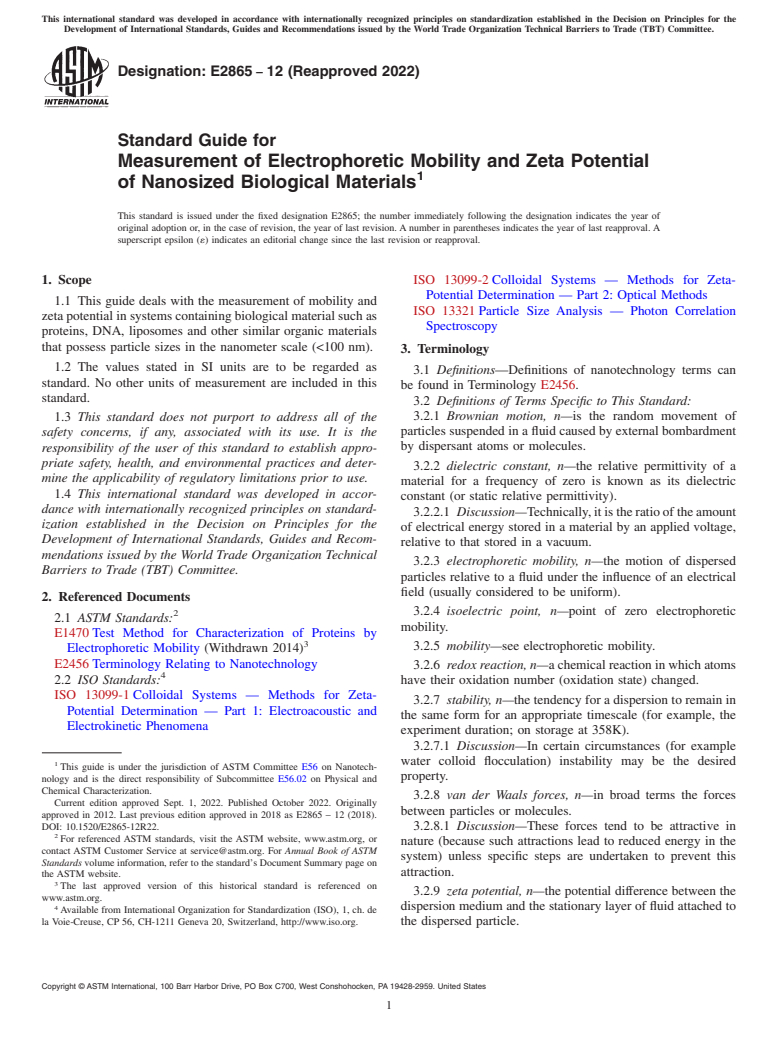

Standards Content (Sample)
This international standard was developed in accordance with internationally recognized principles on standardization established in the Decision on Principles for the
Development of International Standards, Guides and Recommendations issued by the World Trade Organization Technical Barriers to Trade (TBT) Committee.
Designation: E2865 − 12 (Reapproved 2022)
Standard Guide for
Measurement of Electrophoretic Mobility and Zeta Potential
1
of Nanosized Biological Materials
This standard is issued under the fixed designation E2865; the number immediately following the designation indicates the year of
original adoption or, in the case of revision, the year of last revision.Anumber in parentheses indicates the year of last reapproval.A
superscript epsilon (´) indicates an editorial change since the last revision or reapproval.
1. Scope ISO 13099-2 Colloidal Systems — Methods for Zeta-
Potential Determination — Part 2: Optical Methods
1.1 This guide deals with the measurement of mobility and
ISO 13321Particle Size Analysis — Photon Correlation
zetapotentialinsystemscontainingbiologicalmaterialsuchas
Spectroscopy
proteins, DNA, liposomes and other similar organic materials
that possess particle sizes in the nanometer scale (<100 nm).
3. Terminology
1.2 The values stated in SI units are to be regarded as
3.1 Definitions—Definitions of nanotechnology terms can
standard. No other units of measurement are included in this
be found in Terminology E2456.
standard.
3.2 Definitions of Terms Specific to This Standard:
3.2.1 Brownian motion, n—is the random movement of
1.3 This standard does not purport to address all of the
particles suspended in a fluid caused by external bombardment
safety concerns, if any, associated with its use. It is the
by dispersant atoms or molecules.
responsibility of the user of this standard to establish appro-
priate safety, health, and environmental practices and deter-
3.2.2 dielectric constant, n—the relative permittivity of a
mine the applicability of regulatory limitations prior to use.
material for a frequency of zero is known as its dielectric
1.4 This international standard was developed in accor-
constant (or static relative permittivity).
dance with internationally recognized principles on standard-
3.2.2.1 Discussion—Technically,itistheratiooftheamount
ization established in the Decision on Principles for the
of electrical energy stored in a material by an applied voltage,
Development of International Standards, Guides and Recom-
relative to that stored in a vacuum.
mendations issued by the World Trade Organization Technical
3.2.3 electrophoretic mobility, n—the motion of dispersed
Barriers to Trade (TBT) Committee.
particles relative to a fluid under the influence of an electrical
field (usually considered to be uniform).
2. Referenced Documents
3.2.4 isoelectric point, n—point of zero electrophoretic
2
2.1 ASTM Standards:
mobility.
E1470Test Method for Characterization of Proteins by
3
3.2.5 mobility—see electrophoretic mobility.
Electrophoretic Mobility (Withdrawn 2014)
E2456Terminology Relating to Nanotechnology
3.2.6 redox reaction, n—achemicalreactioninwhichatoms
4
2.2 ISO Standards: have their oxidation number (oxidation state) changed.
ISO 13099-1 Colloidal Systems — Methods for Zeta-
3.2.7 stability, n—the tendency for a dispersion to remain in
Potential Determination — Part 1: Electroacoustic and
the same form for an appropriate timescale (for example, the
Electrokinetic Phenomena
experiment duration; on storage at 358K).
3.2.7.1 Discussion—In certain circumstances (for example
water colloid flocculation) instability may be the desired
1
This guide is under the jurisdiction of ASTM Committee E56 on Nanotech-
property.
nology and is the direct responsibility of Subcommittee E56.02 on Physical and
Chemical Characterization.
3.2.8 van der Waals forces, n—in broad terms the forces
Current edition approved Sept. 1, 2022. Published October 2022. Originally
between particles or molecules.
approved in 2012. Last previous edition approved in 2018 as E2865 – 12 (2018).
DOI: 10.1520/E2865-12R22.
3.2.8.1 Discussion—These forces tend to be attractive in
2
For referenced ASTM standards, visit the ASTM website, www.astm.org, or
nature (because such attractions lead to reduced energy in the
contact ASTM Customer Service at service@astm.org. For Annual Book of ASTM
system) unless specific steps are undertaken to prevent this
Standards volume information, refer to the standard’s Document Summary page on
attraction.
the ASTM website.
3
The last approved version of this historical standard is referenced on
3.2.9 zeta potential, n—the potential difference between the
www.astm.org.
4
dispersion medium and the stationary layer of fluid attached to
Available from International Organization for Standardization (ISO), 1, ch. de
la Voie-Creuse, CP 56, CH-1211 Geneva 20, Switzerland, http://www.iso.org. the dispersed particle.
Copyright © ASTM International, 100 Barr Harbor Drive, PO Box C700, West Conshohocken
...
Questions, Comments and Discussion
Ask us and Technical Secretary will try to provide an answer. You can facilitate discussion about the standard in here.