

ASTM B633-23
(Specification)Standard Specification for Electrodeposited Coatings of Zinc on Iron and Steel
General Information
- Abstract
ABSTRACT
This specification establishes the requirements for electrodeposited zinc coatings applied to iron or steel articles for corrosion protection purposes. Electrodeposited zinc-coated steel wires or sheets are not covered here. The coatings shall be provided in four standard thickness classes in the as-plated condition or with one of three types of supplementary finishes. The surfaces of the articles shall under go pre-plating basis metal cleaning, pre- and post-coating treatment for reducing the risk of hydrogen embrittlement, and reactivation and supplementary treatments. Coatings should be sampled, prepared, tested and conform accordingly to specified requirements as to appearance (luster and workmanship), thickness, adhesion, corrosion resistance, and hydrogen embrittlement.
SCOPE
1.1 This specification covers material and process requirements for electrodeposited zinc coatings applied to iron or steel articles to protect them from corrosion.
1.2 This specification is not intended to provide the design activity with all the background needed to properly specify their zinc coating requirements. The users of Specification B633 are encouraged to review this specification in its entirety including the appendices, and access the supplementary papers, other standards, and published literature referenced herein and within other related references.
1.3 The coatings are provided in four standard thickness classes (4.1), in the as-plated condition or with one of five types of supplementary finishes (4.2).
1.4 High strength metals, including high strength steels having a tensile strength greater than 1700 MPa (247 ksi, 46 HRC) should not be zinc electroplated in accordance with this specification.
1.5 It does not cover continuous processes for electrodeposited zinc coated steel wire or sheets (see Specification A591/A591M for sheets).
1.6 For zinc electroplating of mechanical fasteners, the purchaser is encouraged to consider Specification F1941/F1941M.
1.7 The values stated in SI units are to be regarded as standard. No other units of measurement are included in this standard.
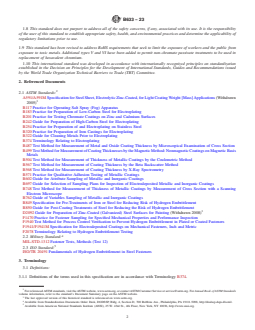
1.8 This standard does not purport to address all of the safety concerns, if any, associated with its use. It is the responsibility of the user of this standard to establish appropriate safety, health, and environmental practices and determine the applicability of regulatory limitations prior to use.
1.9 This standard has been revised to address RoHS requirements that seek to limit the exposure of workers and the public from exposure to toxic metals. Additional types V and VI have been added to permit non-chromate passivate treatments to be used in replacement of hexavalent chromium.
1.10 This international standard was developed in accordance with internationally recognized principles on standardization established in the Decision on Principles for the Development of International Standards, Guides and Recommendations issued by the World Trade Organization Technical Barriers to Trade (TBT) Committee.
- Status
- Published
- Publication Date
- 31-Dec-2022
- Technical Committee
- B08 - Metallic and Inorganic Coatings
- Drafting Committee
- B08.06 - Soft Metals
Buy Documents
ASTM B633-23 - Standard Specification for Electrodeposited Coatings of Zinc on Iron and Steel
REDLINE ASTM B633-23 - Standard Specification for Electrodeposited Coatings of Zinc on Iron and Steel
Overview
ASTM B633-23: Standard Specification for Electrodeposited Coatings of Zinc on Iron and Steel defines the requirements for applying zinc coatings by electrodeposition to iron or steel products. The standard's primary goal is to enhance corrosion protection and extend the service life of iron and steel components while providing guidance on thickness classes, supplementary finishes, and process control. This specification is widely used in industries where zinc-plated steel parts require reliable resistance to environmental and operational corrosion.
The standard excludes continuous processes for zinc-coated steel wires or sheets, directing users to related standards for those products. It also addresses critical process elements such as pretreatment, plating, post-coating treatments to prevent hydrogen embrittlement, appearance, thickness, adhesion, and corrosion resistance. Importantly, ASTM B633-23 has been updated for compliance with RoHS (Restriction of Hazardous Substances) by permitting non-chromate passivate treatments, supporting workplace and public safety.
Key Topics
- Coating Thickness Classes: Four standard thickness classes (Fe/Zn 25, 12, 8, 5 μm) provide varying levels of corrosion protection depending on service conditions (from very severe to mild exposure).
- Supplementary Finishes: Five finish types are available, including chromate, passivate, and phosphate options, each with specific corrosion resistance requirements.
- Process Treatments:
- Pre-plating Cleaning: Essential for optimal adhesion and coating performance.
- Hydrogen Embrittlement Risk Reduction: Both pre- and post-coating treatments (like stress relief heat treating and baking) are required, especially for high-strength steels.
- Reactivation and Supplementary Treatments: Ensure consistent surface quality and corrosion resistance.
- Testing and Quality Control: The standard specifies requirements for sampling, specimen preparation, and tests for appearance, thickness (using accepted ASTM test methods), adhesion, and corrosion resistance (e.g., salt spray testing).
- Restrictions for High-Strength Steels: Steels above 1700 MPa tensile strength should not be processed per this standard due to susceptibility to hydrogen embrittlement.
- Environmental and Safety Compliance: Updated for RoHS to minimize toxic metal exposure, allowing the use of non-chromate passivates as alternatives to hexavalent chromium.
Applications
ASTM B633-23 is critical in manufacturing, automotive, construction, electronics, military hardware, and consumer goods that utilize zinc-coated iron and steel components. Common applications include:
- Fasteners such as bolts, nuts, and screws
- Machine parts, tools, and hardware
- Electrical enclosures, connectors, and contacts
- Architectural hardware, fittings, and furniture components
- Automotive underbody parts, brackets, and supports
- Plumbing fixtures and pole line hardware
The standard enables consistent and reliable corrosion protection, supporting component longevity and reducing maintenance costs. By adhering to prescribed thickness and finish types, manufacturers ensure their products are suitably protected for the intended service environment. With enhanced focus on environmental safety, the specification also aligns with industry initiatives to eliminate hazardous substances.
Related Standards
For comprehensive coverage of zinc electroplating and related processes, consider the following standards:
- ASTM A591/A591M - Electrolytic Zinc-Coated Steel Sheets
- ASTM F1941/F1941M - Electrodeposited Coatings on Mechanical Fasteners
- ASTM B849 - Pre-Treatment to Reduce Hydrogen Embrittlement
- ASTM B850 - Post-Coating Treatments to Reduce Hydrogen Embrittlement
- ASTM B117 - Salt Spray (Fog) Testing for Corrosion Resistance
- ISO/TR 20491 - Fundamentals of Hydrogen Embrittlement in Steel Fasteners
These documents provide supplementary guidance for specific products, additional testing protocols, and in-depth explanations of critical risk factors such as hydrogen embrittlement. Adoption of ASTM B633-23, in conjunction with these standards, ensures the best practices and regulatory compliance for zinc electroplating operations.
Relations
- Effective Date
- 01-Jan-2024
- Effective Date
- 01-Nov-2023
- Effective Date
- 01-Nov-2023
- Effective Date
- 01-Aug-2019
- Refers
ASTM B201-80(2019) - Standard Practice for Testing Chromate Coatings on Zinc and Cadmium Surfaces - Effective Date
- 01-Apr-2019
- Effective Date
- 01-Apr-2019
- Effective Date
- 01-Apr-2019
- Effective Date
- 01-Aug-2018
- Effective Date
- 01-Feb-2018
- Effective Date
- 01-Dec-2016
- Effective Date
- 01-Sep-2015
- Effective Date
- 01-Nov-2014
- Refers
ASTM B201-80(2014) - Standard Practice for Testing Chromate Coatings on Zinc and Cadmium Surfaces - Effective Date
- 01-Nov-2014
- Effective Date
- 01-Nov-2014
- Effective Date
- 01-Aug-2014
Buy Documents
ASTM B633-23 - Standard Specification for Electrodeposited Coatings of Zinc on Iron and Steel
REDLINE ASTM B633-23 - Standard Specification for Electrodeposited Coatings of Zinc on Iron and Steel
Get Certified
Connect with accredited certification bodies for this standard

DVS-ZERT GmbH
German welding certification society.
CARES (UK Certification Authority for Reinforcing Steels)
UK certification for reinforcing steels and construction.
EWF/IIW (European/International Welding Federation)
International welding personnel certification.
Sponsored listings
Frequently Asked Questions
ASTM B633-23 is a technical specification published by ASTM International. Its full title is "Standard Specification for Electrodeposited Coatings of Zinc on Iron and Steel". This standard covers: ABSTRACT This specification establishes the requirements for electrodeposited zinc coatings applied to iron or steel articles for corrosion protection purposes. Electrodeposited zinc-coated steel wires or sheets are not covered here. The coatings shall be provided in four standard thickness classes in the as-plated condition or with one of three types of supplementary finishes. The surfaces of the articles shall under go pre-plating basis metal cleaning, pre- and post-coating treatment for reducing the risk of hydrogen embrittlement, and reactivation and supplementary treatments. Coatings should be sampled, prepared, tested and conform accordingly to specified requirements as to appearance (luster and workmanship), thickness, adhesion, corrosion resistance, and hydrogen embrittlement. SCOPE 1.1 This specification covers material and process requirements for electrodeposited zinc coatings applied to iron or steel articles to protect them from corrosion. 1.2 This specification is not intended to provide the design activity with all the background needed to properly specify their zinc coating requirements. The users of Specification B633 are encouraged to review this specification in its entirety including the appendices, and access the supplementary papers, other standards, and published literature referenced herein and within other related references. 1.3 The coatings are provided in four standard thickness classes (4.1), in the as-plated condition or with one of five types of supplementary finishes (4.2). 1.4 High strength metals, including high strength steels having a tensile strength greater than 1700 MPa (247 ksi, 46 HRC) should not be zinc electroplated in accordance with this specification. 1.5 It does not cover continuous processes for electrodeposited zinc coated steel wire or sheets (see Specification A591/A591M for sheets). 1.6 For zinc electroplating of mechanical fasteners, the purchaser is encouraged to consider Specification F1941/F1941M. 1.7 The values stated in SI units are to be regarded as standard. No other units of measurement are included in this standard. 1.8 This standard does not purport to address all of the safety concerns, if any, associated with its use. It is the responsibility of the user of this standard to establish appropriate safety, health, and environmental practices and determine the applicability of regulatory limitations prior to use. 1.9 This standard has been revised to address RoHS requirements that seek to limit the exposure of workers and the public from exposure to toxic metals. Additional types V and VI have been added to permit non-chromate passivate treatments to be used in replacement of hexavalent chromium. 1.10 This international standard was developed in accordance with internationally recognized principles on standardization established in the Decision on Principles for the Development of International Standards, Guides and Recommendations issued by the World Trade Organization Technical Barriers to Trade (TBT) Committee.
ABSTRACT This specification establishes the requirements for electrodeposited zinc coatings applied to iron or steel articles for corrosion protection purposes. Electrodeposited zinc-coated steel wires or sheets are not covered here. The coatings shall be provided in four standard thickness classes in the as-plated condition or with one of three types of supplementary finishes. The surfaces of the articles shall under go pre-plating basis metal cleaning, pre- and post-coating treatment for reducing the risk of hydrogen embrittlement, and reactivation and supplementary treatments. Coatings should be sampled, prepared, tested and conform accordingly to specified requirements as to appearance (luster and workmanship), thickness, adhesion, corrosion resistance, and hydrogen embrittlement. SCOPE 1.1 This specification covers material and process requirements for electrodeposited zinc coatings applied to iron or steel articles to protect them from corrosion. 1.2 This specification is not intended to provide the design activity with all the background needed to properly specify their zinc coating requirements. The users of Specification B633 are encouraged to review this specification in its entirety including the appendices, and access the supplementary papers, other standards, and published literature referenced herein and within other related references. 1.3 The coatings are provided in four standard thickness classes (4.1), in the as-plated condition or with one of five types of supplementary finishes (4.2). 1.4 High strength metals, including high strength steels having a tensile strength greater than 1700 MPa (247 ksi, 46 HRC) should not be zinc electroplated in accordance with this specification. 1.5 It does not cover continuous processes for electrodeposited zinc coated steel wire or sheets (see Specification A591/A591M for sheets). 1.6 For zinc electroplating of mechanical fasteners, the purchaser is encouraged to consider Specification F1941/F1941M. 1.7 The values stated in SI units are to be regarded as standard. No other units of measurement are included in this standard. 1.8 This standard does not purport to address all of the safety concerns, if any, associated with its use. It is the responsibility of the user of this standard to establish appropriate safety, health, and environmental practices and determine the applicability of regulatory limitations prior to use. 1.9 This standard has been revised to address RoHS requirements that seek to limit the exposure of workers and the public from exposure to toxic metals. Additional types V and VI have been added to permit non-chromate passivate treatments to be used in replacement of hexavalent chromium. 1.10 This international standard was developed in accordance with internationally recognized principles on standardization established in the Decision on Principles for the Development of International Standards, Guides and Recommendations issued by the World Trade Organization Technical Barriers to Trade (TBT) Committee.
ASTM B633-23 is classified under the following ICS (International Classification for Standards) categories: 25.220.40 - Metallic coatings. The ICS classification helps identify the subject area and facilitates finding related standards.
ASTM B633-23 has the following relationships with other standards: It is inter standard links to ASTM F1470-24, ASTM B571-23, ASTM B849-02(2023), ASTM F1940-07a(2019), ASTM B201-80(2019), ASTM B320-60(2019), ASTM B849-02(2019), ASTM B571-18, ASTM F1470-18, ASTM F1941/F1941M-16, ASTM F1941/F1941M-15, ASTM B183-79(2014), ASTM B201-80(2014), ASTM B242-99(2014), ASTM F1940-07a(2014). Understanding these relationships helps ensure you are using the most current and applicable version of the standard.
ASTM B633-23 is available in PDF format for immediate download after purchase. The document can be added to your cart and obtained through the secure checkout process. Digital delivery ensures instant access to the complete standard document.
Standards Content (Sample)
This international standard was developed in accordance with internationally recognized principles on standardization established in the Decision on Principles for the
Development of International Standards, Guides and Recommendations issued by the World Trade Organization Technical Barriers to Trade (TBT) Committee.
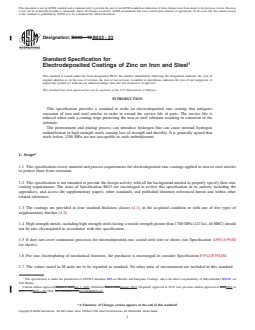
Designation:B633 −23
Standard Specification for
Electrodeposited Coatings of Zinc on Iron and Steel
This standard is issued under the fixed designation B633; the number immediately following the designation indicates the year of
original adoption or, in the case of revision, the year of last revision. A number in parentheses indicates the year of last reapproval. A
superscript epsilon (´) indicates an editorial change since the last revision or reapproval.
This standard has been approved for use by agencies of the U.S. Department of Defense.
INTRODUCTION
This specification provides a standard to order an electrodeposited zinc coating that mitigates
corrosion of iron and steel articles in order to extend the service life of parts. The service life is
reduced when such a coating stops protecting the iron or steel substrate resulting in corrosion of the
substrate.
The pretreatment and plating process can introduce hydrogen that can cause internal hydrogen
embrittlement in high strength steels causing loss of strength and ductility. It is generally agreed that
steels below 1200 MPa are not susceptible to such embrittlement.
1. Scope* 1.7 The values stated in SI units are to be regarded as
standard. No other units of measurement are included in this
1.1 This specification covers material and process require-
standard.
mentsforelectrodepositedzinccoatingsappliedtoironorsteel
1.8 This standard does not purport to address all of the
articles to protect them from corrosion.
safety concerns, if any, associated with its use. It is the
1.2 This specification is not intended to provide the design
responsibility of the user of this standard to establish appro-
activity with all the background needed to properly specify
priate safety, health, and environmental practices and deter-
their zinc coating requirements. The users of Specification
mine the applicability of regulatory limitations prior to use.
B633 are encouraged to review this specification in its entirety
1.9 This standard has been revised to address RoHS re-
includingtheappendices,andaccessthesupplementarypapers,
quirements that seek to limit the exposure of workers and the
other standards, and published literature referenced herein and
public from exposure to toxic metals.Additional types Vand VI
within other related references.
have been added to permit non-chromate passivate treatments
1.3 The coatings are provided in four standard thickness
to be used in replacement of hexavalent chromium.
classes (4.1), in the as-plated condition or with one of five
1.10 This international standard was developed in accor-
types of supplementary finishes (4.2).
dance with internationally recognized principles on standard-
1.4 High strength metals, including high strength steels
ization established in the Decision on Principles for the
having a tensile strength greater than 1700 MPa (247 ksi,
Development of International Standards, Guides and Recom-
46 HRC) should not be zinc electroplated in accordance with
mendations issued by the World Trade Organization Technical
this specification.
Barriers to Trade (TBT) Committee.
1.5 It does not cover continuous processes for electrodepos-
2. Referenced Documents
ited zinc coated steel wire or sheets (see Specification A591/
2.1 ASTM Standards:
A591M for sheets).
A591/A591M Specification for Steel Sheet, Electrolytic
1.6 For zinc electroplating of mechanical fasteners, the
Zinc-Coated, for Light Coating Weight [Mass] Applica-
purchaser is encouraged to consider Specification F1941/
tions (Withdrawn 2005)
F1941M.
B117 Practice for Operating Salt Spray (Fog) Apparatus
1 2
This specification is under the jurisdiction of ASTM Committee B08 on For referenced ASTM standards, visit the ASTM website, www.astm.org, or
Metallic and Inorganic Coatings and is the direct responsibility of Subcommittee contact ASTM Customer Service at service@astm.org. For Annual Book of ASTM
B08.06 on Soft Metals. Standards volume information, refer to the standard’s Document Summary page on
Current edition approved Jan. 1, 2023. Published January 2023. Originally the ASTM website.
approved in 1978. Last previous edition approved in 2019 as B633 – 19. DOI: The last approved version of this historical standard is referenced on
10.1520/B0633-23. www.astm.org.
*A Summary of Changes section appears at the end of this standard
Copyright © ASTM International, 100 Barr Harbor Drive, PO Box C700, West Conshohocken, PA 19428-2959. United States
B633−23
B183 Practice for Preparation of Low-Carbon Steel for 2.3 ISO Standard:
Electroplating ISO/TR 20491 Fundamentals of Hydrogen Embrittlement in
Steel Fasteners
B201 Practice for Testing Chromate Coatings on Zinc and
Cadmium Surfaces
3. Terminology
B242 Guide for Preparation of High-Carbon Steel for Elec-
3.1 Definitions:
troplating
3.1.1 Definitions of the terms used in this specification are
B254 Practice for Preparation of and Electroplating on
in accordance with Terminology B374.
Stainless Steel
3.1.2 passivate—for the purpose of this specification, a
B320 Practice for Preparation of Iron Castings for Electro-
conversion coating on zinc shall not contain hexavalent chro-
plating
mium.
B322 Guide for Cleaning Metals Prior to Electroplating
B374 Terminology Relating to Electroplating
4. Classification
B487 Test Method for Measurement of Metal and Oxide
4.1 Thickness—The coating shall be provided in one of the
Coating Thickness by Microscopical Examination of
four thickness classes defined in Table 1.
Cross Section
B499 Test Method for Measurement of Coating Thicknesses
TABLE 1 Thickness Classes for Coatings
by the Magnetic Method: Nonmagnetic Coatings on
Classification Number
Magnetic Basis Metals
Thickness, min
and Conversion Service Condition
µm
B504 Test Method for Measurement of Thickness of Metal-
Coating Suffix
lic Coatings by the Coulometric Method
Fe/Zn 25 SC 4 (very severe) 25
Fe/Zn 12 SC 3 (severe) 12
B567 Test Method for Measurement of Coating Thickness
Fe/Zn 8 SC 2 (moderate) 8
by the Beta Backscatter Method
Fe/Zn 5 SC 1 (mild) 5
B568 Test Method for Measurement of Coating Thickness
by X-Ray Spectrometry
B571 Practice for Qualitative Adhesion Testing of Metallic
4.2 Finish—The coating shall have one of the finish types
Coatings
defined in Table 2.
B602 Guide for Attribute Sampling of Metallic and Inor-
ganic Coatings
TABLE 2 Finish Type and Corrosion Resistance Requirements
B697 Guide for Selection of Sampling Plans for Inspection
Type Description Minimum Salt Spray
of Electrodeposited Metallic and Inorganic Coatings
h
I As-plated without supplementary
B748 Test Method for Measurement of Thickness of Metal-
treatments
lic Coatings by Measurement of Cross Section with a
II With colored chromate coatings 96
Scanning Electron Microscope
III With colorless chromate 12
conversion coatings
B762 GuideofVariablesSamplingofMetallicandInorganic
IV With phosphate conversion
Coatings
coatings
B849 Specification for Pre-Treatments of Iron or Steel for V With colorless passivate 72
VI With colored passivate 120
Reducing Risk of Hydrogen Embrittlement
B850 Guide for Post-CoatingTreatments of Steel for Reduc-
ing the Risk of Hydrogen Embrittlement
5. Ordering Information
D2092 Guide for Preparation of Zinc-Coated (Galvanized)
Steel Surfaces for Painting (Withdrawn 2008) 5.1 When ordering the electroplating of articles, the pur-
F1470 Practice for Fastener Sampling for Specified Me- chaser shall state ASTM B633, the date of issue, service
chanical Properties and Performance Inspection condition number, and the Type (see 4.1, 4.2, and 7.1).
F1940 Test Method for Process Control Verification to
5.2 If necessary, the purchaser shall include on the part
Prevent Hydrogen Embrittlement in Plated or Coated
drawings or purchase order the following:
Fasteners
5.2.1 Basis metal alloy designation and ultimate tensile
F1941/F1941M Specification for Electrodeposited Coatings
strength of the steel,
on Mechanical Fasteners, Inch and Metric
5.2.2 Whether the part underwent cold forming or cold
F2078 Terminology Relating to Hydrogen Embrittlement
straightening subsequent to heat treatment (see Note 1).
Testing
5.2.3 Thickness, if other than specified (4.1, 7.1),
5.2.4 Location of significant surface (7.1.1, 7.1.2),
2.2 Military Standard:
5.2.5 Luster (7.3),
MIL-STD-1312 Fastener Tests, Methods (Test 12)
5.2.6 Exceptions to stress relief heat treatment prior to
plating (6.4),
Available from Standardization Documents Order Desk, DODSSP, Bldg. 4,
Section D, 700 Robbins Ave., Philadelphia, PA 19111-5098, http:// Available fromAmerican National Standards Institute (ANSI), 25 W. 43rd St.,
dodssp.daps.dla.mil. 4th Floor, New York, NY 10036, http://www.ansi.org.
B633−23
5.2.7 Baking requirements after plating, if any (6.5). ment. Baking of electroplated steel parts with tensile strength
1200 MPa (39 HRC) or less is not mandatory.
5.2.8 Corrosion resistance test, if required (9.3, 10.3),
6.5.1 Steel parts having a tensile strength greater than
5.2.9 Hydrogen embrittlement test, if required (9.4, 10.4),
1200 MPa(39 HRC)aswellassurfacehardenedparts,shallbe
including the tensile strength of the items,
baked to reduce the risk of hydrogen embrittlement. For such
5.2.10 Sample size for inspection, if other than specified,
parts, purchasers shall specify the baking requirements in the
and
ordering information (5.2.7). Purchasers are directed to the
5.2.11 Supplementary requirements, if applicable (see
appropriate ER Class in Guide B850 Table 1.
Supplementary Requirement).
6.5.2 A purchaser wishing to specify baking requirements,
NOTE 1—Information in 5.2.1 and 5.2.2 is necessary for proper
irrespective of tensile strength, shall specify such requirements
pretreatment (6.4) and post coating treatment (6.5) if applicable.
in the ordering information (5.2.7). Purchasers are directed to
Guide B850 Table 1.
6. Materials and Manufacture
6.5.3 Any baking treatment done under this section (6.5)
shall begin within 4 h of removal from the electroplating
6.1 The coatings shall be non-alloyed zinc produced by
process. When applicable, baking treatment shall be done
electrodeposition.
before application of the supplementary treatments if the
6.2 Defects in the surface of the basis metal, such as
baking temperature would damage the supplementary film (see
scratches, porosity, pits, inclusions, cracks, roll marks, and die
Note 4). Application of any supplementary treatment shall be
marks may adversely affect the appearance and performance of
in accordance with the chemical supplier’s recommended
coatings applied thereto despite the observance of the best
practice in regards to the treatment’s exposure to baking
electroplating practices. Accordingly, the electroplater’s re-
temperature (see Note 4).
sponsibility for defects in the coating resulting from such
6.5.4 Electroplated springs and other parts subject to flexure
conditions shall be waived, except when they are the prime
shall not be flexed before the hydrogen embrittlement relief
contractor supplying electroplated parts. In this event, the basis
treatment.
metal shall be subjected to such polishing or buffing operations
NOTE 3—Guide B850 is a guide for post-coating treatments of steel for
as are necessary to yield deposits with the desired final luster
reducing the risk of hydrogen embrittlement.
and appearance. To minimize problems of this sort, the
NOTE 4—Historically, hexavalent-chromium temperature limitations
specifications covering the basis material on the item to be
have restricted their ability to be applied prior to baking. Hexavalent-
electroplated shall contain appropriate limitations to such basis
chromium-free passivates are known to withstand higher temperatures.
metal conditions. After consultation with chemical supplier or experimentation, electroplat-
ers may adopt other suitable baking sequences.
6.3 Cleaning of Basis Metal—Proper preparatory proce-
6.6 Reactivation Treatment—Electroplated surfaces passi-
dures and thorough cleaning of the basis metal are essential to
vated as a result of the baking operation shall be reactivated
ensure satisfactory adhesion and corrosion resistance perfor-
before receiving a supplementary treatment.
mance of the coating. It is recommended that the following
appropriate recommended practices and guides be used: B183, NOTE 5—Surfaces should be activated as soon as possible following
baking and handled carefully to avoid contamination and maintain an
B242, B254, B320, and B322.
active surface for post processing. Proprietary methods are available to
6.4 Pretreatment of Iron or Steel for the Purpose of Reduc-
preparethesurfaceora2 %v/vsulfuricacidindeionizedwaterora7 g⁄L
to 10 g⁄L solution of sulfamic acid in deionized water can be used.
ing the Risk of Hydrogen Embrittlement—Steel parts having an
ultimate tensile strength greater than 1000 MPa (31 HRC) that
6.7 Supplementary Treatments—The supplementary film
containtensilestressescausedbycoldformingorcoldstraight-
treatment for Types II, III, V, and VI shall be in accordance
ening which have not been heat treated after the cold forming
with Practice B201 (see Notes 6 and 7).The treatment required
process, shall be heat treated for stress relief to reduce the risk
for conversion to Type IV shall be in accordance with Guide
of hydrogen embrittlement in the part before clean and
D2092.
electroplateprocesses.Iftheseheattreatmentsarenotrequired,
NOTE 6—The zinc surface is attacked by supplementary treatments,
the purchaser shall specify in the ordering information their
thereby diminishing the amount of metallic zinc present. With Classes
exception (5.2.6). If the purchaser does not specify an excep-
Fe/Zn25 and Fe/Zn12, this reduction is insignificant; but it is significant
tion to heat treatment, then the plater shall use Table 1 in
with Fe/Zn8 and Fe/Zn5. Therefore, it is recommended that supplemen-
tary treatments not be applied to zinc coatings having a nominal thickness
Specification B849 to determine the appropriate heat treatment
less than 5 µm.
for the steel based on its tensile strength.
NOTE7—AlthoughTypesVandVIaretechnicallynot“chromate”films
and they do not contain leachable hexavalent chromium ions, they are
NOTE 2—Secondary machining operations such as grinding, turning,
supplemental coatings that render the active zinc surface passive and
tapping, thread rolling, and milling are not normally problematic. Stress
provide added protection to the steel part.
relief treatment is not necessary when compressive residual stresses are
intentionally added.
7. Coating Requirements
6.5 Post Coating Treatments of Iron and Steel for the
Purpose of Reducing the Risk of Hydrogen Embrittlement 7.1 Thickness—The thickness shall be specified in accor-
(Baking)—Electroplated steel parts having a tensile strength dance with 4.1 and 5.1 (see Note 6).
greater than 1200 MPa (39 HRC) as well as surface hardened 7.1.1 Significant Surfaces—Significant surfaces are areas
parts, shall be baked to reduce the risk of hydrogen embrittle- where minimum thicknesses to be met shall be designated on
B633−23
theapplicabledrawingorbytheprovisionofasuitablymarked placed on the articles, a relatively small number of the articles
sample. Significant surfaces may be defined as those normally (sample) is selected at random and is inspected.The inspection
visible, directly or by reflection, which are essential to the lot is then classified as complying with the requirements based
appearance or serviceability of the article when assembled in on the results of the inspection of the sample. The size of the
normal position or which are the source of corrosion products sample and the criteria for compliance are determined by the
that deface visible surfaces on the assembled article. application of statistics. The procedure is known as sampling
7.1.2 Surfaces on which the specified thickness of deposit inspection. Test Method B602, Guide B697, and Test Method
cannot readily be controlled, such as threads, holes, deep B762 contain sampling plans that are designed for sampling
recesses, bases of angles, and similar areas, are normally inspection of coatings.
exempt from minimum thickness requirements, unless they are 8.1.2 Test Method B602 contains four sampling plans, three
specially designated as not exempt. When such areas are forusewithteststhatarenondestructiveandonewhentheyare
designated, and thus made subject to minimum thickness destructive.Test Method B602 provides a default plan if one is
requirements, the purchaser and the manufacturer shall recog- not specified.
nize the necessity for either thicker deposits on other areas or 8.1.3 Guide B697 provides a large number of plans and also
for special racking. gives guidance in the selection of a plan. Guide B697 provides
a default plan if one is not specified.
NOTE 8—The dimensional tolerance of most threaded articles, such as
8.1.4 Test Method B762 can be used only for coating
nuts, bolts, screws, and similar fasteners with complementary threads,
normally does not permit the application of a coating thickness much requirements that have a numerical limit, such as coating
greater than 8.0 µm. If heavier coatings are required, allowance for the
thickness. The test must yield a numeric value and certain
deposit buildup must be made during the manufacture of the threaded
statistical requirements must be met. Test Method B762
articles.
contains several plans and also gives instructions for calculat-
7.2 Adhesion—The adhesion of the coating shall be such
ing plans to meet special needs. Test Method B762 provides a
that when examined in accordance with 10.2, the coating shall
default plan if one is not specified.
not show separation from the basis metal at the interface.
8.1.5 Practice F1470 may be used for fasteners such as
internally threaded, externally threaded, and nonthreaded fas-
7.3 Luster—Unless ot
...
This document is not an ASTM standard and is intended only to provide the user of an ASTM standard an indication of what changes have been made to the previous version. Because
it may not be technically possible to adequately depict all changes accurately, ASTM recommends that users consult prior editions as appropriate. In all cases only the current version
of the standard as published by ASTM is to be considered the official document.
Designation: B633 − 19 B633 − 23
Standard Specification for
Electrodeposited Coatings of Zinc on Iron and Steel
This standard is issued under the fixed designation B633; the number immediately following the designation indicates the year of
original adoption or, in the case of revision, the year of last revision. A number in parentheses indicates the year of last reapproval. A
superscript epsilon (´) indicates an editorial change since the last revision or reapproval.
This standard has been approved for use by agencies of the U.S. Department of Defense.
INTRODUCTION
This specification provides a standard to order an electrodeposited zinc coating that mitigates
corrosion of iron and steel articles in order to extend the service life of parts. The service life is
reduced when such a coating stops protecting the iron or steel substrate resulting in corrosion of the
substrate.
The pretreatment and plating process can introduce hydrogen that can cause internal hydrogen
embrittlement in high strength steels causing loss of strength and ductility. It is generally agreed that
steels below 1200 MPa are not susceptible to such embrittlement.
1. Scope*
1.1 This specification covers material and process requirements for electrodeposited zinc coatings applied to iron or steel articles
to protect them from corrosion.
1.2 This specification is not intended to provide the design activity with all the background needed to properly specify their zinc
coating requirements. The users of Specification B633 are encouraged to review this specification in its entirety including the
appendices, and access the supplementary papers, other standards, and published literature referenced herein and within other
related references.
1.3 The coatings are provided in four standard thickness classes (4.1), in the as-plated condition or with one of five types of
supplementary finishes (4.2).
1.4 High strength metals, including high strength steels having a tensile strength greater than 1700 MPa (247 ksi, 46 HRC) should
not be zinc electroplated in accordance with this specification.
1.5 It does not cover continuous processes for electrodeposited zinc coated steel wire or sheets (see Specification A591/A591M
for sheets).
1.6 For zinc electroplating of mechanical fasteners, the purchaser is encouraged to consider Specification F1941/F1941M.
1.7 The values stated in SI units are to be regarded as standard. No other units of measurement are included in this standard.
This specification is under the jurisdiction of ASTM Committee B08 on Metallic and Inorganic Coatings and is the direct responsibility of Subcommittee B08.06 on
Soft Metals.
Current edition approved March 1, 2019Jan. 1, 2023. Published March 2019January 2023. Originally approved in 1978. Last previous edition approved in 20152019 as
B633 – 15.B633 – 19. DOI: 10.1520/B0633-19.10.1520/B0633-23.
*A Summary of Changes section appears at the end of this standard
Copyright © ASTM International, 100 Barr Harbor Drive, PO Box C700, West Conshohocken, PA 19428-2959. United States
B633 − 23
1.8 This standard does not purport to address all of the safety concerns, if any, associated with its use. It is the responsibility
of the user of this standard to establish appropriate safety, health, and environmental practices and determine the applicability of
regulatory limitations prior to use.
1.9 This standard has been revised to address RoHS requirements that seek to limit the exposure of workers and the public from
exposure to toxic metals. Additional types V and VI have been added to permit non-chromate passivate treatments to be used in
replacement of hexavalent chromium.
1.10 This international standard was developed in accordance with internationally recognized principles on standardization
established in the Decision on Principles for the Development of International Standards, Guides and Recommendations issued
by the World Trade Organization Technical Barriers to Trade (TBT) Committee.
2. Referenced Documents
2.1 ASTM Standards:
A591/A591M Specification for Steel Sheet, Electrolytic Zinc-Coated, for Light Coating Weight [Mass] Applications (Withdrawn
2005)
B117 Practice for Operating Salt Spray (Fog) Apparatus
B183 Practice for Preparation of Low-Carbon Steel for Electroplating
B201 Practice for Testing Chromate Coatings on Zinc and Cadmium Surfaces
B242 Guide for Preparation of High-Carbon Steel for Electroplating
B254 Practice for Preparation of and Electroplating on Stainless Steel
B320 Practice for Preparation of Iron Castings for Electroplating
B322 Guide for Cleaning Metals Prior to Electroplating
B374 Terminology Relating to Electroplating
B487 Test Method for Measurement of Metal and Oxide Coating Thickness by Microscopical Examination of Cross Section
B499 Test Method for Measurement of Coating Thicknesses by the Magnetic Method: Nonmagnetic Coatings on Magnetic Basis
Metals
B504 Test Method for Measurement of Thickness of Metallic Coatings by the Coulometric Method
B567 Test Method for Measurement of Coating Thickness by the Beta Backscatter Method
B568 Test Method for Measurement of Coating Thickness by X-Ray Spectrometry
B571 Practice for Qualitative Adhesion Testing of Metallic Coatings
B602 Guide for Attribute Sampling of Metallic and Inorganic Coatings
B697 Guide for Selection of Sampling Plans for Inspection of Electrodeposited Metallic and Inorganic Coatings
B748 Test Method for Measurement of Thickness of Metallic Coatings by Measurement of Cross Section with a Scanning
Electron Microscope
B762 Guide of Variables Sampling of Metallic and Inorganic Coatings
B849 Specification for Pre-Treatments of Iron or Steel for Reducing Risk of Hydrogen Embrittlement
B850 Guide for Post-Coating Treatments of Steel for Reducing the Risk of Hydrogen Embrittlement
D2092 Guide for Preparation of Zinc-Coated (Galvanized) Steel Surfaces for Painting (Withdrawn 2008)
F1470 Practice for Fastener Sampling for Specified Mechanical Properties and Performance Inspection
F1940 Test Method for Process Control Verification to Prevent Hydrogen Embrittlement in Plated or Coated Fasteners
F1941/F1941M Specification for Electrodeposited Coatings on Mechanical Fasteners, Inch and Metric
F2078 Terminology Relating to Hydrogen Embrittlement Testing
2.2 Military Standard:
MIL-STD-1312 Fastener Tests, Methods (Test 12)
2.3 ISO Standard:
ISO/TR 20491 Fundamentals of Hydrogen Embrittlement in Steel Fasteners
3. Terminology
3.1 Definitions:
3.1.1 Definitions of the terms used in this specification are in accordance with Terminology B374.
For referenced ASTM standards, visit the ASTM website, www.astm.org, or contact ASTM Customer Service at service@astm.org. For Annual Book of ASTM Standards
volume information, refer to the standard’s Document Summary page on the ASTM website.
The last approved version of this historical standard is referenced on www.astm.org.
Available from Standardization Documents Order Desk, DODSSP, Bldg. 4, Section D, 700 Robbins Ave., Philadelphia, PA 19111-5098, http://dodssp.daps.dla.mil.
Available from American National Standards Institute (ANSI), 25 W. 43rd St., 4th Floor, New York, NY 10036, http://www.ansi.org.
B633 − 23
3.1.2 passivate—for the purpose of this specification, a conversion coating on zinc shall not contain hexavalent chromium.
4. Classification
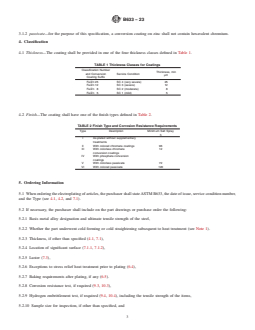
4.1 Thickness—The coating shall be provided in one of the four thickness classes defined in Table 1.
TABLE 1 Thickness Classes for Coatings
Classification Number
Thickness, min
and Conversion Service Condition
μm
Coating Suffix
Fe/Zn 25 SC 4 (very severe) 25
Fe/Zn 12 SC 3 (severe) 12
Fe/Zn 8 SC 2 (moderate) 8
Fe/Zn 5 SC 1 (mild) 5
4.2 Finish—The coating shall have one of the finish types defined in Table 2.
TABLE 2 Finish Type and Corrosion Resistance Requirements
Type Description Minimum Salt Spray
h
I As-plated without supplementary
treatments
II With colored chromate coatings 96
III With colorless chromate 12
conversion coatings
IV With phosphate conversion
coatings
V With colorless passivate 72
VI With colored passivate 120
5. Ordering Information
5.1 When ordering the electroplating of articles, the purchaser shall state ASTM B633, the date of issue, service condition number,
and the Type (see 4.1, 4.2, and 7.1).
5.2 If necessary, the purchaser shall include on the part drawings or purchase order the following:
5.2.1 Basis metal alloy designation and ultimate tensile strength of the steel,
5.2.2 Whether the part underwent cold forming or cold straightening subsequent to heat treatment (see Note 1).
5.2.3 Thickness, if other than specified (4.1, 7.1),
5.2.4 Location of significant surface (7.1.1, 7.1.2),
5.2.5 Luster (7.3),
5.2.6 Exceptions to stress relief heat treatment prior to plating (6.4),
5.2.7 Baking requirements after plating, if any (6.5).
5.2.8 Corrosion resistance test, if required (9.3, 10.3),
5.2.9 Hydrogen embrittlement test, if required (9.4, 10.4), including the tensile strength of the items,
5.2.10 Sample size for inspection, if other than specified, and
B633 − 23
5.2.11 Supplementary requirements, if applicable (see Supplementary Requirement).
NOTE 1—Information in 5.2.1 and 5.2.2 is necessary for proper pretreatment (6.4) and post coating treatment (6.5) if applicable.
6. Materials and Manufacture
6.1 The coatings shall be non-alloyed zinc produced by electrodeposition.
6.2 Defects in the surface of the basis metal, such as scratches, porosity, pits, inclusions, cracks, roll marks, and die marks may
adversely affect the appearance and performance of coatings applied thereto despite the observance of the best electroplating
practices. Accordingly, the electroplater’s responsibility for defects in the coating resulting from such conditions shall be waived,
except when they are the prime contractor supplying electroplated parts. In this event, the basis metal shall be subjected to such
polishing or buffing operations as are necessary to yield deposits with the desired final luster and appearance. To minimize
problems of this sort, the specifications covering the basis material on the item to be electroplated shall contain appropriate
limitations to such basis metal conditions.
6.3 Cleaning of Basis Metal—Proper preparatory procedures and thorough cleaning of the basis metal are essential to ensure
satisfactory adhesion and corrosion resistance performance of the coating. It is recommended that the following appropriate
recommended practices and guides be used: B183, B242, B254, B320, and B322.
6.4 Pretreatment of Iron or Steel for the Purpose of Reducing the Risk of Hydrogen Embrittlement—Steel parts having an ultimate
tensile strength greater than 1000 MPa (31 HRC) that contain tensile stresses caused by cold forming or cold straightening which
have not been heat treated after the cold forming process, shall be heat treated for stress relief to reduce the risk of hydrogen
embrittlement in the part before clean and electroplate processes. If these heat treatments are not required, the purchaser shall
specify in the ordering information their exception (5.2.6). If the purchaser does not specify an exception to heat treatment, then
the plater shall use Table 1 in Specification B849 to determine the appropriate heat treatment for the steel based on its tensile
strength.
NOTE 2—Secondary machining operations such as grinding, turning, tapping, thread rolling, and milling are not normally problematic. Stress relief
treatment is not necessary when compressive residual stresses are intentionally added.
6.5 Post Coating Treatments of Iron and Steel for the Purpose of Reducing the Risk of Hydrogen Embrittlement (Baking)—
Electroplated steel parts having a tensile strength greater than 1200 MPa (39 HRC) as well as surface hardened parts, shall be
baked to reduce the risk of hydrogen embrittlement. Baking of electroplated steel parts with tensile strength 1200 MPa (39 HRC)
or less is not mandatory.
6.5.1 Steel parts having a tensile strength greater than 1200 MPa (39 HRC) as well as surface hardened parts, shall be baked to
reduce the risk of hydrogen embrittlement. For such parts, purchasers shall specify the baking requirements in the ordering
information (5.2.7). Purchasers are directed to the appropriate ER Class in Guide B850 Table 1.
6.5.2 A purchaser wishing to specify baking requirements, irrespective of tensile strength, shall specify such requirements in the
ordering information (5.2.7). Purchasers are directed to Guide B850 Table 1.
6.5.3 Any baking treatment done under this section (6.5) shall begin within 4 h of removal from the electroplating process. When
applicable, baking treatment shall be done before application of the supplementary treatments if the baking temperature would
damage the supplementary film (see Note 4). Application of any supplementary treatment shall be in accordance with the chemical
supplier’s recommended practice in regards to the treatment’s exposure to baking temperature (see Note 4).
6.5.4 Electroplated springs and other parts subject to flexure shall not be flexed before the hydrogen embrittlement relief treatment.
NOTE 3—Guide B850 is a guide for post-coating treatments of steel for reducing the risk of hydrogen embrittlement.
NOTE 4—Historically, hexavalent-chromium temperature limitations have restricted their ability to be applied prior to baking. Hexavalent-chromium-free
passivates are known to withstand higher temperatures. After consultation with chemical supplier or experimentation, electroplaters may adopt other
suitable baking sequences.
B633 − 23
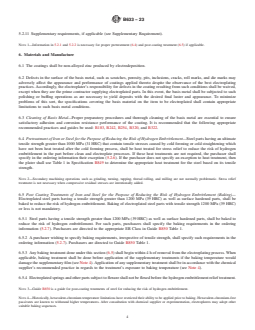
6.6 Reactivation Treatment—Electroplated surfaces passivated as a result of the baking operation shall be reactivated before
receiving a supplementary treatment.
NOTE 5—Surfaces should be activated as soon as possible following baking and handled carefully to avoid contamination and maintain an active surface
for post processing. Proprietary methods are available to prepare the surface or a 2 % v/v sulfuric acid in deionized water or a 77 g ⁄L to 10 g ⁄L solution
of sulfamic acid in deionized water can be used.
6.7 Supplementary Treatments—The supplementary film treatment for Types II, III, V, and VI shall be in accordance with Practice
B201 (see Notes 6 and 7). The treatment required for conversion to Type IV shall be in accordance with Guide D2092.
NOTE 6—The zinc surface is attacked by supplementary treatments, thereby diminishing the amount of metallic zinc present. With Classes Fe/Zn25 and
Fe/Zn12, this reduction is insignificant; but it is significant with Fe/Zn8 and Fe/Zn5. Therefore, it is recommended that supplementary treatments not be
applied to zinc coatings having a nominal thickness less than 5 μm.
NOTE 7—Although Types V and VI are technically not “chromate” films and they do not contain leachable hexavalent chromium ions, they are
supplemental coatings that render the active zinc surface passive and provide added protection to the steel part.
7. Coating Requirements
7.1 Thickness—The thickness shall be specified in accordance with 4.1 and 5.1 (see Note 6).
7.1.1 Significant Surfaces—Significant surfaces are areas where minimum thicknesses to be met shall be designated on the
applicable drawing or by the provision of a suitably marked sample. Significant surfaces may be defined as those normally visible,
directly or by reflection, which are essential to the appearance or serviceability of the article when assembled in normal position
or which are the source of corrosion products that deface visible surfaces on the assembled article.
7.1.2 Surfaces on which the specified thickness of deposit cannot readily be controlled, such as threads, holes, deep recesses, bases
of angles, and similar areas, are normally exempt from minimum thickness requirements, unless they are specially designated as
not exempt. When such areas are designated, and thus made subject to minimum thickness requirements, the purchaser and the
manufacturer shall recognize the necessity for either thicker deposits on other areas or for special racking.
NOTE 8—The dimensional tolerance of most threaded articles, such as nuts, bolts, screws, and similar fasteners with complementary threads, normally
does not permit the application of a coating thickness much greater than 8.0 μm. If heavier coatings are required, allowance for the deposit buildup must
be made during the manufacture of the threaded articles.
7.2 Adhesion—The adhesion of the coating shall be such that when examined in accordance with 10.2, the coating shall not show
separation from the basis metal at the interface.
7.3 Luster—Unless otherwise specified by the purchaser, a bright, semi-bright, or dull finish shall be acceptable.
7.4 Corrosion Resistance—Zinc coatings with Types II, III, V, and VI treatments shall show neither corrosion products of zinc nor
basis metal corrosion products at the end of the test periods described in Table 2 when tested by continuous exposure to salt spray
in accordance with 10.3. The appearance of corrosion products when examined with 20/20 eyesight at normal reading distance
shall be cause for rejection, except that white corrosion products 6 mm or less from the edges of specimens shall not constitute
failure. For corrosion resistance requirements, see Table 2.
7.5 Workmanship—The surface of the electroplated article shall be uniform in appearance, free of visible coating defects, such as
blisters, pits, roughness, nodules, burning, cracks, or unplated areas, and other defects that will affect the function of the coating.
The coating shall not be stained or discolored. However, superficial staining that results from rinsing or slight discoloration
resulting from any drying or baking operation to relieve hydrogen embrittlement, shall not be cause for rejection. On articles in
which a visible contact mark is unavoidable, its position shall be that chosen by the purchaser. The electroplated article shall be
clean and free of damage.
8. Sampling
8.1 The purchaser and producer are urged to employ statistical process control in the
...